
Richard Wilhelm arrived in Qingdao in 1899 with a Bible, a posting from the German Protestant Mission Society, and the reasonable expectation that he would spend his career bringing Christianity to China. He spoke no Chinese. He knew nothing of the classical tradition he was sailing toward. He was twenty-six years old and entirely certain about what he had come to offer.
He left China thirty years later having received something he had not come looking for, carrying a manuscript that would prove more lastingly influential than any missionary work he might otherwise have done. The translation of the I Ching he brought back to Germany — worked on with a traditional master over years of immersive apprenticeship, published in 1923, rendered into English by Cary Baynes in 1950 — became the conduit through which one of the most sophisticated oracular systems in human history entered the Western imagination. It influenced Carl Jung’s theory of synchronicity, shaped the compositional methods of John Cage, accompanied Philip K. Dick through the writing of The Man in the High Castle, and passed through the hands of a generation of thinkers, artists, and ordinary readers who found in it something that Western systems of meaning had not provided them.
None of this was planned. All of it followed from a change of mind that took Wilhelm decades to complete and that he never entirely resolved.
The Missionary Who Stopped Converting
Wilhelm’s initial years in Qingdao were conventional enough by the standards of Protestant missionary work in Wilhelmine Germany’s new colonial territory. He ran a school. He organized community services. He learned Mandarin with a facility that surprised his colleagues and eventually exceeded anything a purely pastoral assignment required.
The facility was the first sign that something was shifting. Wilhelm was not just acquiring a functional vocabulary; he was acquiring an intellectual relationship with the language that drew him deeper into the classical literature than missionary work demanded or, strictly speaking, encouraged. He began reading texts that were not Christian. He began reading texts that were several thousand years old. He began, with a slowness that characterizes real intellectual conversion rather than rhetorical position-changing, to question the premise that he had arrived in China with the more developed civilization.
The question crystallized around one figure: Lao Nai-hsuan, a Confucian scholar of the old school who had served in the imperial bureaucracy before the revolution of 1911 ended that world. Lao was in his seventies when Wilhelm met him, learned in the classical tradition in ways that had become rare even within China as Western influence reshaped the educational system, and — crucially — willing to teach a foreigner who approached with genuine respect rather than the condescension that characterized most European engagement with Chinese intellectual culture at the time.
Their arrangement was unusual enough to be worth describing precisely. Wilhelm did not study the I Ching as a scholar studies a text — from the outside, with philological tools, generating notes toward a critical edition. He studied it as a student studies with a master: sitting with the text, working through the commentaries, learning to consult the hexagrams as a living practice rather than a historical artifact. Lao taught him not just what the text said but how it was used — in private reflection, in difficult decisions, in the kind of ongoing conversation with uncertainty that the tradition had always understood to be the book’s primary purpose.
This distinction mattered enormously for what Wilhelm eventually produced. Previous European translations of the I Ching existed. James Legge’s 1882 rendering was the most scholarly, and it remains useful as a work of philology. But Legge approached the text as an antiquarian approaches a relic — carefully, precisely, from a distance that preserved his own interpretive framework intact. Wilhelm approached it from the inside, with a teacher who knew what the book was for, and this produced a translation that carried the living quality of the tradition rather than merely its verbal surface.
What the I Ching Actually Is
To understand what Wilhelm transmitted, it helps to understand what he was transmitting — which is not primarily a book of predictions, though it has been used that way, but a system for structured engagement with uncertainty.
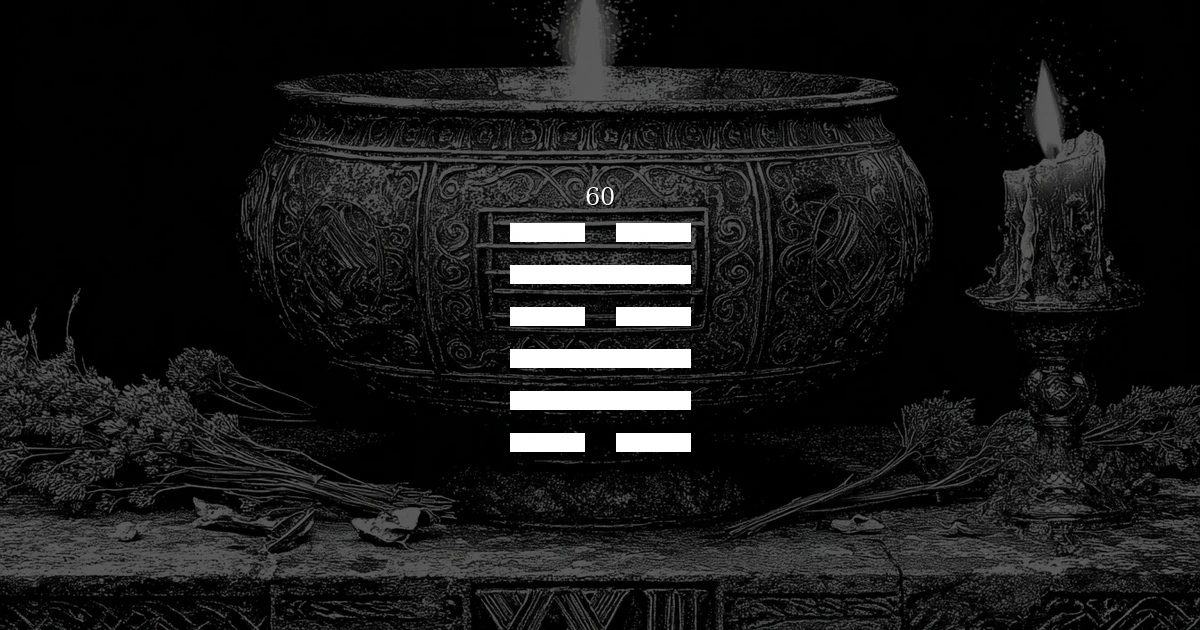
The I Ching’s sixty-four hexagrams are generated by chance — traditionally through the elaborate casting of yarrow stalks, more commonly through coins — and each corresponds to a textual image, a judgment, and a set of line commentaries that have accumulated over roughly three thousand years of continuous use and interpretation. The oldest strata of the text are believed to date to the early Zhou dynasty, around 1000 BCE; the philosophical commentaries known as the Ten Wings were added over subsequent centuries and are traditionally attributed, probably inaccurately, to Confucius.
What makes the system unusual, compared to other oracular traditions, is its explicit acknowledgment that it is not delivering verdicts. The text consistently addresses the reader as an agent facing a situation that has internal structure — tensions, tendencies, qualities of timing — and the hexagrams name those structures rather than dictating outcomes. The image of hexagram 29, the Abysmal, is water flowing through a gorge: the commentary does not say you will drown. It says this is the nature of the moment, this is what it asks of you, this is how to move through it without making it worse. The practice of daily I Ching consultation works within this same logic — not forecast, but situational intelligence.
Lao Nai-hsuan understood this with the precision of a man who had lived inside the tradition his whole life. Wilhelm absorbed it well enough to reproduce it in German in a way that preserved the quality rather than just the content — which is, in translation, the harder achievement.
The Manuscript Crosses the War
Wilhelm finished the translation in 1914. He did not publish it for nine years. The delay was partly circumstance — the First World War disrupted German publishing as it disrupted everything else — and partly the care of a man who understood he was handling something that required getting right. He revised. He consulted Lao again, by correspondence, after the old scholar returned to the relative safety of Beijing. He sought opinions from Western scholars who could assess the philological accuracy and from Chinese scholars who could assess the fidelity to the living tradition.
What he eventually published in 1923 was not merely a translation but an event in intellectual history. Its immediate audience was small — the scholarly community that followed Sinology, the circle around Count Hermann Keyserling’s School of Wisdom where Wilhelm lectured, and, crucially, Carl Jung, who read it that year and felt, by his own account, that he had encountered something that named a phenomenon he had been circling for years without adequate language.
Jung’s response to the Wilhelm translation is documented in detail — in his letters, in his seminars, in the famous foreword he wrote for the Baynes English edition in 1949. What he found in it was a tradition that had arrived, independently of Western psychology, at something structurally similar to what he was calling the unconscious: a dimension of mental and situational reality that is not accessible through direct rational inquiry but can be approached obliquely, through image, symbol, and the kind of structured attention that the I Ching’s consultation process demands. The connection between Wilhelm’s I Ching and Jung’s theory of synchronicity is not incidental; it is constitutive. Jung developed the synchronicity concept partly in response to what the I Ching seemed to demonstrate — that meaningful coincidence, the acausal connection between inner state and outer event, was not a Western discovery but a Chinese one, three thousand years older and considerably better theorized.
What Baynes Added: The English Translation as Second Transmission
The 1923 German translation was significant. The 1950 English translation was transformative. Cary Baynes, an American-born analyst who had trained with Jung, spent years producing the rendering that became the standard English I Ching for the second half of the twentieth century. Jung contributed the foreword. The book arrived in the English-speaking world at a moment of unusual receptivity — postwar, early Cold War, the beginning of the period of cultural experimentation that would accelerate through the 1960s — and found readers who were looking for exactly what it offered.
The list of significant figures who worked with the Wilhelm-Baynes translation during this period is long enough to suggest that something about the book fit a particular cultural need. John Cage used it as a compositional tool from the early 1950s onward, generating musical structures through hexagram casts in a practice that was simultaneously artistic, philosophical, and — Cage would have said — spiritual. Philip K. Dick consulted it through the years he was writing The Man in the High Castle, and made it a central element of the novel’s plot, where characters in an alternate history America use it to navigate a world shaped by Japanese victory in the Pacific War. Gary Snyder, Allen Ginsberg, and other figures associated with the Beat movement worked with it. Later, in the 1960s and 1970s, it became part of the broader countercultural engagement with Eastern traditions that also absorbed Zen Buddhism, Taoism, and Vedantic philosophy.
This was not simply fashion. The I Ching offered something that Western systems of guidance — whether religious, psychological, or philosophical — were not providing in the same form: a method of engaging with the present moment that was structured enough to prevent pure projection, random enough to surface unexpected angles, and ancient enough to carry the weight of accumulated wisdom without the institutional authority that Western readers had, in significant numbers, begun to distrust.
The Translation Debate That Never Ends
Wilhelm’s translation is not without its critics, and the criticism is worth taking seriously rather than dismissing as academic pedantry. His rendering was shaped by the Confucian interpretive tradition that Lao represented — a tradition that had its own investments, its own exclusions, its own ways of reading the older strata of the text through a philosophical lens that was itself a later addition. There are scholars who argue that the Daoist dimensions of the I Ching are underemphasized in Wilhelm, that the original divinatory function of the text is obscured by the philosophical overlay, that a reader of Wilhelm is getting the I Ching as a Song-dynasty Confucian scholar understood it rather than as the Zhou court diviners used it.
These are legitimate concerns. The comparison of major I Ching translations — Wilhelm against Legge, against the more recent Huang, against Rutt’s controversial restoration of the earliest textual layers — is a genuine scholarly debate with real stakes for practitioners who want to understand what they are working with. Different translations genuinely produce different readings, not just different prose styles but different philosophical orientations, different assumptions about what the book is for.
Wilhelm knew this. He wrote about it in his introduction with a honesty that continues to distinguish his work from more confident translators. He was not presenting the definitive I Ching. He was presenting one living tradition’s understanding of the I Ching, learned through the most immersive engagement a Westerner had ever managed with that tradition, rendered as faithfully as he knew how. He was also, implicitly, doing something more: he was demonstrating that the encounter between a Western mind and this tradition could be productive rather than appropriative, provided the Western mind arrived with enough humility to actually learn something rather than simply extract material for its own projects.
What Wilhelm Became
Richard Wilhelm died in 1930, at fifty-six, from an illness he had first contracted in China and never fully recovered from. He had returned to Germany in 1920 and spent his final decade as a professor in Frankfurt, building the China Institute and teaching a generation of students who would carry the engagement with Chinese thought forward through difficult decades. He was not famous in the way that Jung became famous, or Cage, or any of the figures who used his translation as a launching point for their own work. He was the conduit. The book passed through him and became something larger than he was.
What he left behind was not just a translation but a template for a certain kind of cross-cultural encounter: not tourist, not scholar, not convert, but something rarer — a person who spent long enough inside another tradition, with real teachers and real accountability, to bring back something genuine rather than something processed for easy Western consumption. The I Ching he transmitted was not flattened into a self-help manual or dressed up as exotic decoration. It arrived with its difficulty intact, its three thousand years of accumulated commentary present, its demand that the reader sit with uncertainty rather than resolve it prematurely.
That demand — to engage with the present moment as it is rather than as you wish it would be — is as alive in the Wilhelm-Baynes translation today as it was when Lao Nai-hsuan first opened the text for a young German who had come to China to give something and found, instead, that he was there to receive.