
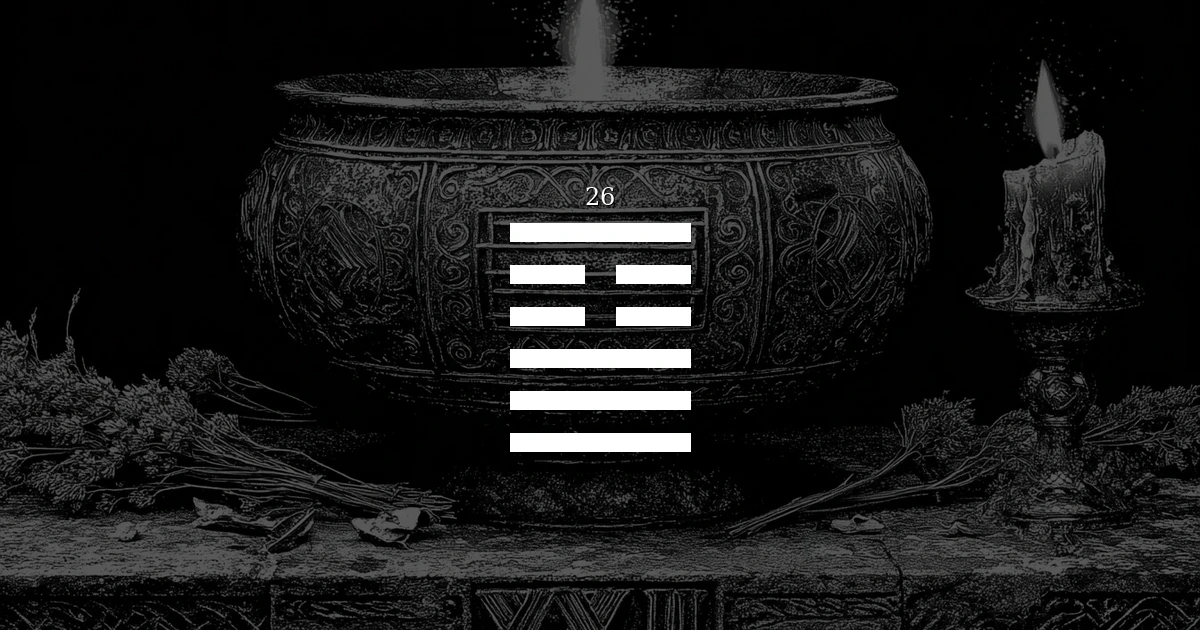
The I Ching has impressed serious Western minds not because it is a party trick, but because it is a disciplined language for the quality of change — a way to name a moment and speak about how to meet it.
That is a different project than most horoscope copy.
What the I Ching is
The I Ching, the Book of Changes (易經, Yì Jīng), is among the oldest sustained symbolic systems still in use. The core idea is that change is not formless: it has repeating patterns, and those patterns can be read.
The system is built on 64 hexagrams — each a stack of six lines, yin (broken) or yang (unbroken) — a binary grammar that can describe 64 different “kinds” of change-situation.
A consultation, at its best, is not a verdict. It is a way of asking: what kind of moment is this, and what kind of conduct fits it?
The 64 hexagrams: a usable mental model
You do not have to memorize all 64 to benefit. You do need a sense of the basic structure.
Trigrams (three lines) represent eight “building blocks” — each an image, a family of qualities, and a direction in the book’s world-model.
| Trigram | Name (common) | Image (classic) | Quality (short) |
|---|---|---|---|
| ☰ | Qian | Heaven | strong, initiating |
| ☷ | Kun | Earth | receptive, carrying |
| ☳ | Zhen | Thunder / arousing | movement, shock, start |
| ☵ | Kan | Water | risk, depth, flow |
| ☶ | Gen | Mountain | stillness, stopping |
| ☴ | Xun | Wind / wood | gentle penetration, gradualness |
| ☲ | Li | Fire | clarity, clinging, illumination |
| ☱ | Dui | Lake / joy | openness, exchange, speech |
A full hexagram stacks lower / inner trigram under upper / outer trigram. The relationship between the two is much of the meaning. Two trumps can be opposite depending on their arrangement, like peace versus standstill, not only because the images differ, but because the direction of exchange between inner and outer differs.
Traditional casting: why the method matters
The classical methods — yarrow stalks and three-coin casting — are slow for a reason. A reading is a ritual of attention, not a dice roll: you return to the question, notice what moves, and build a hexagram line by line with a felt sense of the moment.
Moving lines (changing yin and yang) can produce a second hexagram, which describes where a situation is tending, not a separate universe.
A single throw can have multiple interpretive layers:
- the primary hexagram
- moving line texts, when they appear
- a resulting hexagram, when change is active
- the relationship between those pictures
The I Ching as a daily practice
A daily I Ching practice changes what you ask. Instead of saving the text for a crisis, you return to a lighter question: what is the quality of today?
Over time, you learn the book less as a list of “meanings” and more as a relationship. You start to recognize the difference between a dramatic cast and a subtle one — the difference between an emergency tone and a seasonal tone.
The “seed” approach: fixed input instead of a coin
Traditional casting uses physical randomness. Another approach, used in some modern tools, is to derive a hexagram from a seed (birth data + date) rather than a manual toss. The point is not “randomness” versus “fate” — it is a claim about which relationship is being read: the person and the day, in a specific way, rather than a generic “daily line.”
The Whisper uses a seed-based I Ching layer in its daily engine so the hexagram is tied to your data and the present day in a traceable, repeatable way.
What a hexagram is (and is not) saying
The common mistake is to treat a hexagram as a moral score.
Difficult images are often the most useful in practice, because they name a real quality of the moment: constraint, risk, or confusion — and the classic texts are frequently concerned with the right way of moving inside that weather, not with punishment.
Alignment (moving with a pattern) matters more than “positivity” as comfort.
The Whisper and the I Ching
The I Ching is a core input in The Whisper’s daily synthesis. Your birth data and the current day produce a specific hexagram context, which is read alongside your other active frameworks. When the I Ching and BaZi, or Nine Star Ki, point the same way, the signal is usually clearer. When they point differently, the tension is often the message.
That is a different product goal than a single-sentence daily horoscope.