
In the summer of 1930, Carl Jung stood before an audience at the memorial ceremony for Richard Wilhelm, the sinologist who had spent thirty years translating the I Ching into German. Wilhelm had died in February, and Jung had come to mourn not only a colleague but, as he would say in his address, “one of the great men of our time.” What he told the audience that evening was unusual for a man of scientific reputation. He described consulting the I Ching himself, regularly, and finding in it something he could not explain through any mechanism he knew of — and yet could not dismiss.
It was not the kind of admission that eased a career. Jung was already a controversial figure, having broken from Freud two decades earlier and built a psychology that drew on alchemy, astrology, and mythology in ways that made his colleagues uneasy. The I Ching was another step in that direction. But what the historical record — his published letters, the Red Book, the seminars transcribed by students — reveals is less a mystic surrendering to irrationality and more a rigorous mind wrestling with something that kept producing results he found impossible to ignore.
How Jung First Encountered the Book
Jung’s introduction to the I Ching came through Richard Wilhelm himself, whom he met at the School of Wisdom in Darmstadt in 1922. Wilhelm had lived in China for nearly three decades, first as a missionary who became disenchanted with conversion and fascinated by the culture he had come to change. He had studied the I Ching with a traditional Chinese master, Lao Nai-hsuan, under conditions of immersive apprenticeship that no European scholar had undergone before. When he brought the finished translation to Germany, it arrived with an intimacy with the source text that pure philological translation could not have produced.
Jung recognized something immediately. Here was a system that did not proceed through causality — through the chain of cause and effect that undergirds Western science — but through what he would eventually call synchronicity: meaningful coincidence, the acausal connecting principle. The I Ching did not claim that throwing yarrow stalks causes anything. It claimed that the pattern that emerges from a cast at a particular moment belongs to that moment in the same way that everything else happening at that moment belongs to it. Not cause. Participation.
This was a distinction that mattered enormously to Jung’s developing psychology. He had spent decades listening to patients describe dreams, visions, and coincidences that exceeded what a purely mechanical account of the mind could absorb. The I Ching gave him a traditional framework — thousands of years old, developed by a civilization with no connection to his own — that had apparently arrived at a structurally similar conclusion: that moments have qualities, and that those qualities can be read.
The Practice in His Consulting Room
What is most striking in the clinical record is not that Jung considered the I Ching interesting but that he used it with patients. A number of his seminars from the 1920s and 1930s include transcribed sessions in which he and a patient cast hexagrams together and worked with the resulting text as they might work with a dream image — not as a verdict but as material.
The method was consistent with his broader approach. Jung was not interested in the I Ching as a predictor. He was interested in what the text produced in the space between himself and a patient, or between himself and a question he was sitting with. The hexagram provided an image — sometimes oblique, sometimes uncannily precise — that neither party had generated. Working with that image was, for Jung, a way of circumventing the conscious mind’s tendency to produce only what it already knew.
He described this in a 1950 letter to a correspondent who had asked about his use of the book: the I Ching, he wrote, is not a method of divination in the ordinary sense. It is a method of introspection that uses the random element to produce images the conscious mind has not selected. Whether or not the random element is truly random — or whether what appears random is actually structured by whatever the Chinese meant by Tao — was, he was careful to say, a question he could not answer. He had seen enough to take the results seriously. He had not seen enough to claim he understood the mechanism.
What His Letters Reveal: Doubt as Part of the Practice
The letters are where the most honest account of Jung’s I Ching relationship lives. He wrote about it frequently — to fellow psychologists, to physicists, to theologians, to ordinary correspondents who had read his foreword to Wilhelm’s translation and written to ask what he actually believed.
What emerges across those letters is a practice shaped by sustained uncertainty. Jung did not consult the I Ching the way a believer consults scripture. He consulted it the way an experimentalist runs a trial — with the explicit awareness that individual results prove nothing and that the interpretive act is always entangled with the interpreter. “I have often asked it questions,” he wrote to a correspondent in 1954, “and found the answers illuminating or baffling in roughly equal measure.”
The baffling results mattered as much as the illuminating ones. Jung was not interested in a system that was right every time; he was interested in understanding the conditions under which any system of this kind produces useful information. His conclusion, articulated most fully in his 1949 foreword to Wilhelm’s translation, was that the I Ching does not predict the future — it renders visible certain structural features of the present moment that ordinary attention passes over. This is what he meant by synchronicity: not magic, but a different way of noticing what is already there.
The Foreword That Changed How the West Read the Book
In 1949, the Wilhelm-Baynes English translation was published, and Jung contributed the foreword. It remains one of the most carefully reasoned defenses of oracular practice in print — remarkable not for its mysticism but for its methodological honesty.
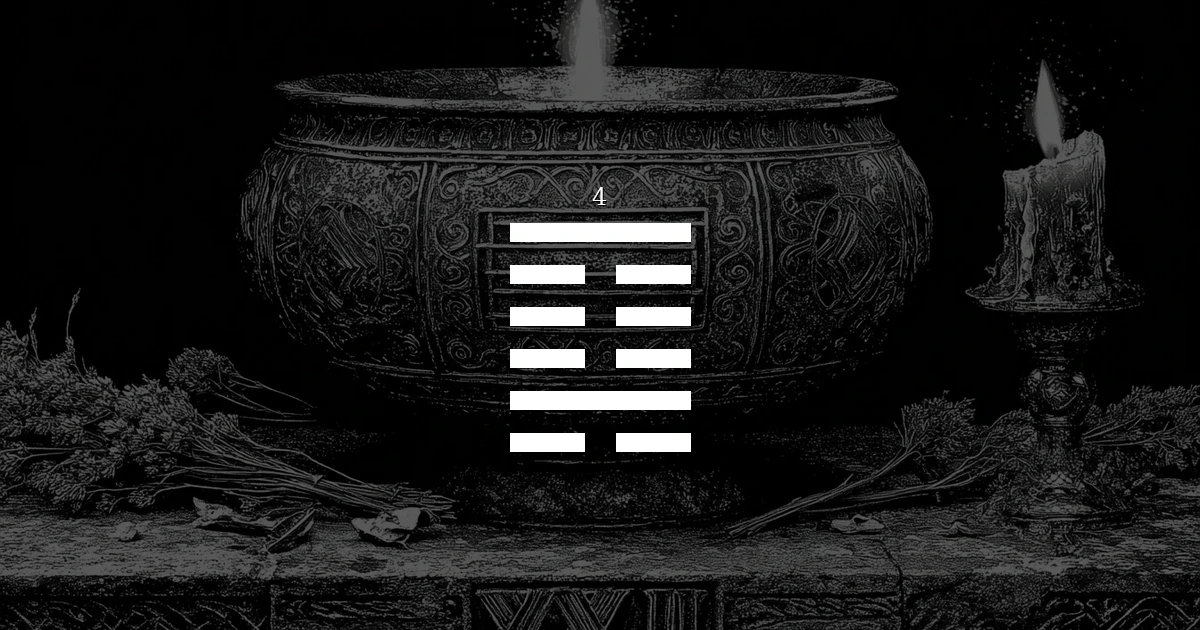
Jung opened by describing how he prepared to write the foreword: he cast the I Ching and asked what it thought of his intention to introduce it to a Western scientific audience. He received hexagram 50, the Cauldron — a hexagram associated with ritual nourishment, with the feeding of culture through sacred vessels. He reported this not to argue that the oracle confirmed his project but to model the practice he was describing. He did not know what to make of the result. He found it interesting. He said so.
He then laid out, carefully, the epistemological problem. The Western mind, he argued, has trained itself to see the world through the lens of causality — what causes what, what follows necessarily from what. The I Ching operates from a different premise: that a moment in time has a quality, a character, that can be read in many ways simultaneously — through the patterns in the sky, through the behavior of coins or stalks, through the structure of a hexagram. This is not a claim about causation. It is a claim about meaning. And meaning, as Jung had spent a career arguing, is not reducible to mechanism.
His concern in the foreword was not to convert skeptics but to explain the tradition honestly to readers who would otherwise dismiss it before engaging with it. “The I Ching does not offer itself with proofs and results,” he wrote. “It does not vaunt itself, nor is it easy to approach. Like a part of nature, it waits until it is discovered.”
This framing — patient, non-coercive, skeptic-aware — shaped how an entire generation of Western readers first encountered the text. The I Ching’s influence on mid-century American intellectual life (John Cage used it to compose music; Philip K. Dick consulted it while writing The Man in the High Castle; countless others worked with it quietly) runs significantly through Jung’s framing.
The Physicist’s Question
One of the most revealing episodes in the I Ching’s Western reception involved not a psychologist or a mystic but a physicist: Wolfgang Pauli, who won the Nobel Prize in 1945 for his exclusion principle. Pauli was in analysis with one of Jung’s students and later with Jung himself. He was also, privately, deeply interested in the relationship between quantum mechanics and what he called “the excluded middle” — the phenomena that physics described statistically but could not account for at the level of individual events.
The correspondence between Jung and Pauli, published as The Interpretation of Nature and the Psyche, circles around exactly this question: what does it mean to say that an individual event is meaningful when the laws governing it are probabilistic? Pauli thought the I Ching was relevant to this question in ways that his physicist colleagues found incomprehensible. Jung found a partner in someone whose scientific credibility was unimpeachable but whose intellectual appetite refused to stop at the boundaries of the discipline.
Their exchange made explicit something that Jung’s clinical practice had been pointing toward for decades: the I Ching is most interesting not as an occult system but as a way of engaging with the parts of reality that causal, deterministic thinking cannot adequately model. The question of whether I Ching operates through randomness or something else is, in Pauli’s framing, the same question quantum mechanics had been asking about electrons since 1926. Neither question has a satisfying mechanistic answer. Both remain genuinely open.
What He Did Alone, at Night
The public record — the letters, the forewords, the seminar transcripts — gives us the official version of Jung’s engagement with the I Ching. The Red Book, his private illustrated manuscript worked on for sixteen years and not published until 2009, gives us something different.
In the Red Book, Jung is not writing for an audience. He is conducting an extended experiment with his own unconscious, using fantasy, active imagination, and — intermittently — the I Ching as a way of navigating the inner landscape he was mapping. The entries do not read like clinical notes. They read like field dispatches from someone genuinely lost in territory he does not fully understand, using every navigational tool available.
The I Ching appears in this context as one instrument among several, not privileged over dream analysis or active imagination but not subordinated to them either. What the Red Book makes clear is that Jung’s relationship with the oracle was not a professional experiment bracketed off from his real life. It was woven into his most serious and private psychological work — the work he considered too unfinished and too strange to publish in his lifetime.
Why It Still Matters
Jung’s practice matters for a reason that goes beyond historical curiosity. He was among the first Westerners with genuine scientific standing to insist that the I Ching deserved serious engagement on its own terms — not because it was true in any simple factual sense, but because it was a sophisticated technology of self-reflection developed by one of history’s most observant civilizations and refined over three millennia.
He was also honest, in a way that many enthusiasts are not, about the limits of his understanding. He did not know why it worked when it worked. He knew that his interpretations were entangled with his own psychology in ways he could not fully separate out. He knew that vivid results were memorable and that banal results were forgotten, and that this created a distortion in his sense of the system’s reliability.
What he came to, and what the synchronicity framework he developed points toward, is not a theory that explains the I Ching. It is a posture toward it: engaged, skeptical, patient, willing to be surprised, unwilling to either believe uncritically or dismiss reflexively. It is, in some ways, the hardest position to maintain — the position of someone who keeps using the tool because it keeps producing something, without claiming to know exactly what that something is.
That is the practice he left behind. Not a system of beliefs. A way of sitting with the book.