
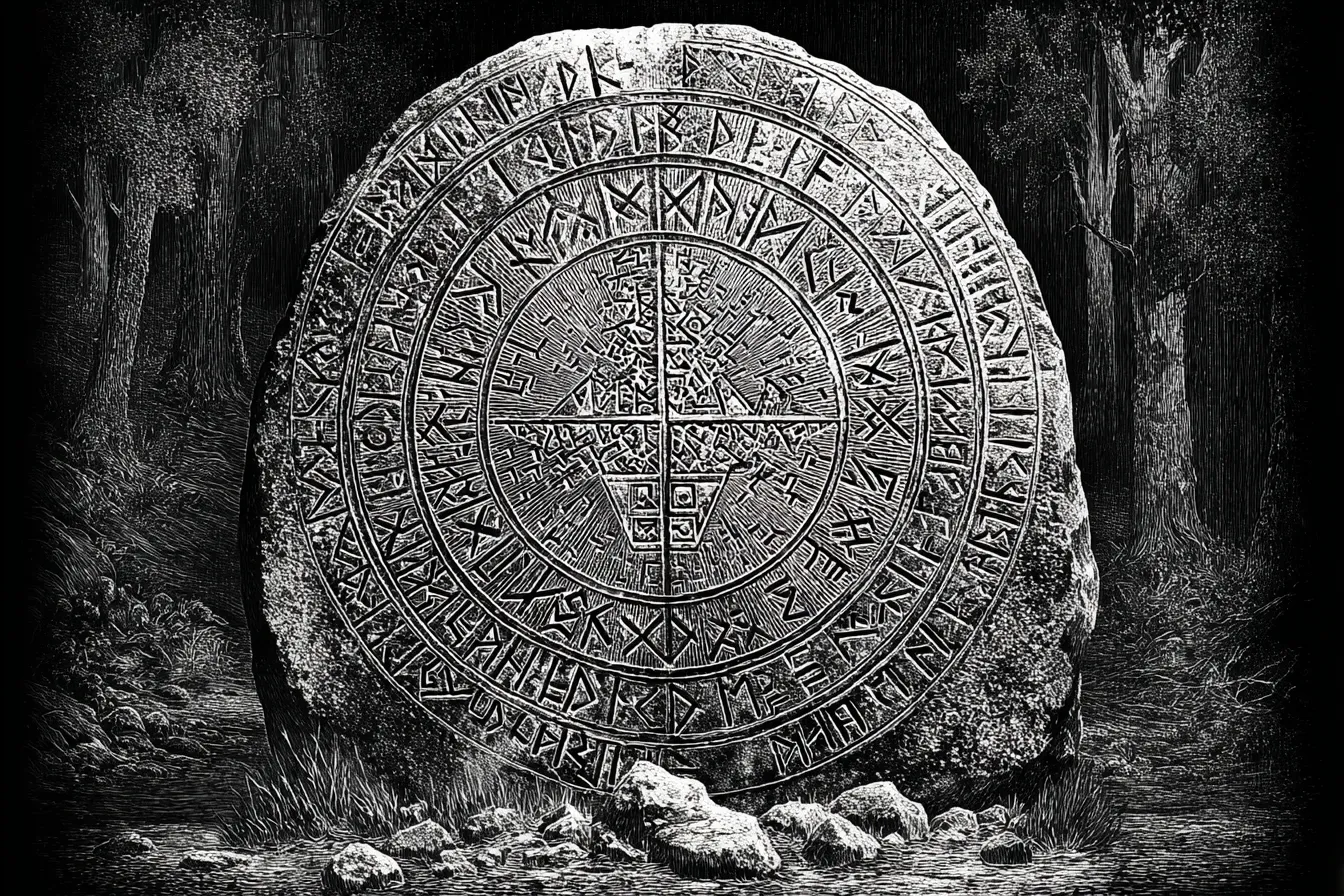
The Vikings didn’t use runes to tell fortunes. That’s the first thing worth getting straight. For daily practice see rune of the day; for the later 16-stave row see Elder vs Younger Futhark.
Runes were, first and foremost, a writing system — the alphabet of the Germanic and Norse peoples for roughly a thousand years, from around the 2nd century CE through the medieval period. They were carved into stones to commemorate the dead, scratched into weapons as markers of ownership, and inscribed on amulets as a form of concentrated meaning — the name of a thing written on the thing, as a kind of invocation.
The use of runes for divination and reflection is more recent, but it draws on something genuine: these symbols were never purely neutral letters. Each rune had a name, and each name was a word in the spoken language — a word with associations, stories, and cosmological weight. The rune Fehu was the letter F, but it was also the word for cattle, for moveable wealth, for the question of what you own and what owns you. That double layer — letter and meaning — is what makes runes useful as a reflective framework today.
What Is the Elder Futhark?
The Elder Futhark is the oldest form of the runic alphabet, named for its first six letters: F-U-Th-A-R-K. It contains 24 symbols, divided into three groups of eight called aettir (singular: aett) — a Norse word meaning “family” or “group of eight.”
The three aettir are traditionally associated with three Norse figures: Freyr (or Freyja), Hagal, and Tyr. This grouping maps the 24 runes onto three thematic domains: the material world and vital forces; the forces of disruption and process; and the realm of justice, communication, and selfhood.
The Elder Futhark was in use from approximately 150 CE to 800 CE, before being gradually replaced by the Younger Futhark (16 runes) and later the Anglo-Saxon Futhorc. For reflective and divinatory use today, the Elder Futhark remains the most widely practiced system.
The 24 Runes: Complete Reference
Freyr’s Aett (Runes 1–8): The Material World
1. Fehu (ᚠ) — Cattle, Wealth Fehu is moveable wealth — livestock, money, resources that circulate. It represents not just having, but sharing: in Norse culture, wealth hoarded was wealth wasted. As a reflective symbol, Fehu asks about your relationship to resources. Are you generating, circulating, or hoarding? What do you truly own, and what simply passes through you?
2. Uruz (ᚢ) — Aurochs, Vital Force The aurochs was a massive wild ox — extinct now, but once the symbol of raw, untamed vitality in Northern Europe. Uruz represents the kind of strength that cannot be fully controlled, only directed. It points toward health, primal energy, and the capacity for change. In a reading, it often marks a moment of raw potential that needs to be worked with rather than simply received.
3. Thurisaz (ᚦ) — Thorn, Giant-Force Thurisaz is one of the more ambivalent runes. It represents the thorn — something that draws blood, but also something that protects. In Norse mythology it’s associated with the Thurses (giants) and with Thor’s power over them. As a reflective symbol, Thurisaz points toward a concentrated, sometimes dangerous force: reactive energy, a crisis that demands response, or the moment before a necessary confrontation.
4. Ansuz (ᚨ) — Divine Breath, Communication Ansuz is associated with Odin — specifically, his role as the god of language, wisdom, and the spoken word. This is the rune of communication, but not just speech: it encompasses inspiration, the moment of understanding, and the message that arrives from somewhere outside the ordinary. In a reflective context, Ansuz asks: what are you receiving? What message have you been too busy to hear?
5. Raidho (ᚱ) — Ride, Journey Raidho is the rune of the journey — not just physical travel, but the right movement at the right time. It carries a sense of rhythm and order: the journey that proceeds as it should. In a reading, Raidho often marks a period of movement or transition, or the need to align your pace with external conditions rather than forcing your own timing.
6. Kenaz (ᚲ) — Torch, Controlled Fire Where Uruz is wild fire, Kenaz is the controlled flame — the torch, the kiln, the forge. It represents skill, craft, and the kind of knowledge that comes from making things with your hands. Kenaz points toward clarity, creativity, and the light that allows you to see what’s actually in front of you. In a reflective reading, it often marks a moment of genuine insight or technical mastery.
7. Gebo (ᚷ) — Gift, Exchange Gebo is the rune of the gift — but in the Norse context, gifts were never simple. A gift created obligation; a gift refused was an insult; a gift freely given changed the relationship between giver and receiver. Gebo marks all exchanges: of goods, of trust, of energy between people. It asks about the nature of your reciprocal relationships — what you’re giving and what you’re receiving.
8. Wunjo (ᚹ) — Joy, Harmony Wunjo is the rune of joy — but not the frantic kind. It represents the deep satisfaction of things being in their right order: fellowship, belonging, the quiet pleasure of alignment between what you want and what you have. As a reflective symbol, Wunjo marks periods of genuine wellbeing, or points toward what would need to shift for that wellbeing to return.
Hagal’s Aett (Runes 9–16): Process and Disruption
9. Hagalaz (ᚺ) — Hail Hail: the force that comes from outside, destroys what’s in its path, and then melts into water that feeds the ground. Hagalaz represents disruption that contains the seeds of renewal. It marks moments when external conditions overturn your plans regardless of your preparation. The reflective question is not “how do I avoid this?” but “what will grow from the damage?”
10. Nauthiz (ᚾ) — Need, Necessity Nauthiz is the rune of need — specifically, the need-fire, the fire made from friction when all other fires have gone out. It represents necessity, constraint, and the kind of creative pressure that comes from having no good options. Nauthiz doesn’t promise rescue. It points toward endurance, and toward the inventiveness that emerges when you have no choice but to find another way.
11. Isa (ᛁ) — Ice Isa is stillness. Ice: everything held in suspension, neither moving forward nor falling apart. As a reflective symbol, Isa marks periods of standstill — times when the right action is no action, when waiting is the most active choice available. It can also mark a kind of ego-rigidity, a frozen position that needs to thaw before anything can move again.
12. Jera (ᛃ) — Year, Harvest Jera is the rune of the agricultural cycle — the year’s full turn, the harvest that only comes after the correct sequence of planting, tending, and waiting. It is one of the most explicitly temporal runes: things take the time they take. Jera marks periods when what you’ve worked toward is coming to fruition, or points toward the work that still needs doing before the harvest is possible.
13. Eihwaz (ᛇ) — Yew Tree The yew tree is one of the oldest living things in Europe — some specimens are thousands of years old — and was associated with death and persistence in equal measure. Eihwaz is the axis between worlds: the tree whose roots reach into the underworld and whose branches reach into the sky. As a reflective symbol, it marks deep endurance, the capacity to hold tension between opposites, and the connection between the living and what has been lost.
14. Perthro (ᛈ) — Lot Cup, Mystery Perthro is one of the most debated runes. The most common interpretation associates it with the lot cup — the container from which fate is cast. It points toward chance, mystery, and what lies hidden: things that will be revealed in time, or things that may never be fully known. In a reflective reading, Perthro marks the unknown variable, the factor you cannot yet account for.
15. Algiz (ᛉ) — Elk, Protection Algiz is the protective rune — sometimes associated with the elk, sometimes with the sedge grass that cuts those who try to uproot it. It represents both the instinct for self-protection and the act of protection extended to others. In a reflective context, Algiz asks about your defenses: are they serving you, or are they keeping out what you actually need?
16. Sowilo (ᛊ) — Sun Sowilo is the sun — not as a deity, but as the force that guides navigation, enables growth, and marks the victory of light over darkness. It is one of the most favorable runes in the system: clarity, success, the energy to achieve. In a reflective reading, Sowilo often marks a period when conditions are genuinely favorable, or points toward the clarity of purpose that would make the path visible.
Tyr’s Aett (Runes 17–24): Self, Society, and the Cosmos
17. Tiwaz (ᛏ) — Tyr, Justice Tiwaz is named for Tyr, the Norse god of justice and law — who placed his hand in the Fenris wolf’s mouth as a pledge, knowing it would be bitten off, because the binding required it. This is the rune of sacrifice in service of a larger order. It points toward justice, courage, and the willingness to accept personal cost for the sake of what is right.
18. Berkano (ᛒ) — Birch, Beginnings Berkano is the birch tree — the first to grow back after a forest fire, a symbol of new beginnings, nurturing, and the cycle of birth. It carries generative energy: care, the beginning of something that will need tending. In a reflective context, Berkano marks moments of genuine new growth, or the conditions that would allow something new to take root.
19. Ehwaz (ᛖ) — Horse, Partnership Ehwaz is the rune of the horse — not just as an animal, but as the partnership between horse and rider. It represents the kind of progress that only comes from a genuine working relationship: trust, coordination, moving in the same direction. In a reflective context, Ehwaz marks the state of your key partnerships. Are you and your collaborators actually in sync?
20. Mannaz (ᛗ) — Human, Self Mannaz is the rune of the human being — the self in relation to others. It points toward self-awareness, the social self, and the question of how you understand your own nature. At its best, Mannaz marks genuine self-knowledge and the ability to see yourself clearly. The shadow is self-absorption, or a too-narrow conception of who you are.
21. Laguz (ᛚ) — Water, Flow Laguz is water — the element that finds every crack, that takes the shape of whatever contains it, that can be a gentle stream or a catastrophic flood. It represents the unconscious, intuition, and the capacity to respond to what the situation requires rather than insisting on a fixed form. In a reflective context, Laguz asks how well you’re reading and responding to emotional undercurrents.
22. Ingwaz (ᛜ) — Ing, Stored Potential Ingwaz represents stored potential — the seed before it germinates, the idea before it becomes action. It is a rune of completion in one sense and beginning in another: something has been gathered and is ready to be released. In a reflective reading, Ingwaz often marks the moment just before a significant new phase.
23. Dagaz (ᛞ) — Day, Breakthrough Dagaz is the rune of daylight — specifically, the transformative moment of dawn when darkness becomes light. It marks breakthrough, clarity, and the sudden shift that changes how everything looks. Unlike the gradual process of Jera or the disruption of Hagalaz, Dagaz is a threshold: one moment you’re in the dark, and the next you can see. In a reflective context, it often marks a turning point that is arriving or has just arrived.
24. Othala (ᛟ) — Ancestral Estate, Inheritance Othala is the final rune of the Elder Futhark, and it points toward what is inherited — land, culture, family patterns, the accumulated wisdom and wounds of those who came before. It represents both home and heritage, and the question of what you will carry forward and what you choose to transform. As a reflective symbol, Othala asks about your relationship to your origins: what are you still receiving from them, and what are you ready to leave behind?
Using Runes for Reflection
The Elder Futhark is not an oracle that tells you what will happen. It’s a vocabulary — a set of 24 precisely named concepts that Germanic peoples found useful for articulating the forces at work in a human life. When you draw a rune, you’re selecting a word from that vocabulary and asking: does this name what’s actually happening?
The reflective practice works because the names are good. Fehu for the question of wealth and circulation. Nauthiz for the creative pressure of necessity. Eihwaz for the endurance that holds opposites in tension. These aren’t mystical forces — they’re categories that help you see what’s in front of you with more precision.
The Whisper integrates runic reflection as one layer of its daily oracle — drawing on your birth data and the current moment to surface the rune that most precisely names what the timing suggests. Combined with your BaZi profile, your Nine Star Ki star, and your I Ching hexagram, it becomes part of a composite reading that’s harder to project onto than any single system alone.
The runes were always a language. The question is what you’re using them to say. Two alphabets, not a mash-up: Ogham vs Elder Futhark. Why most practice sets do better with 24: the blank rune. One month with Freyr’s eight: starting Elder Futhark.