
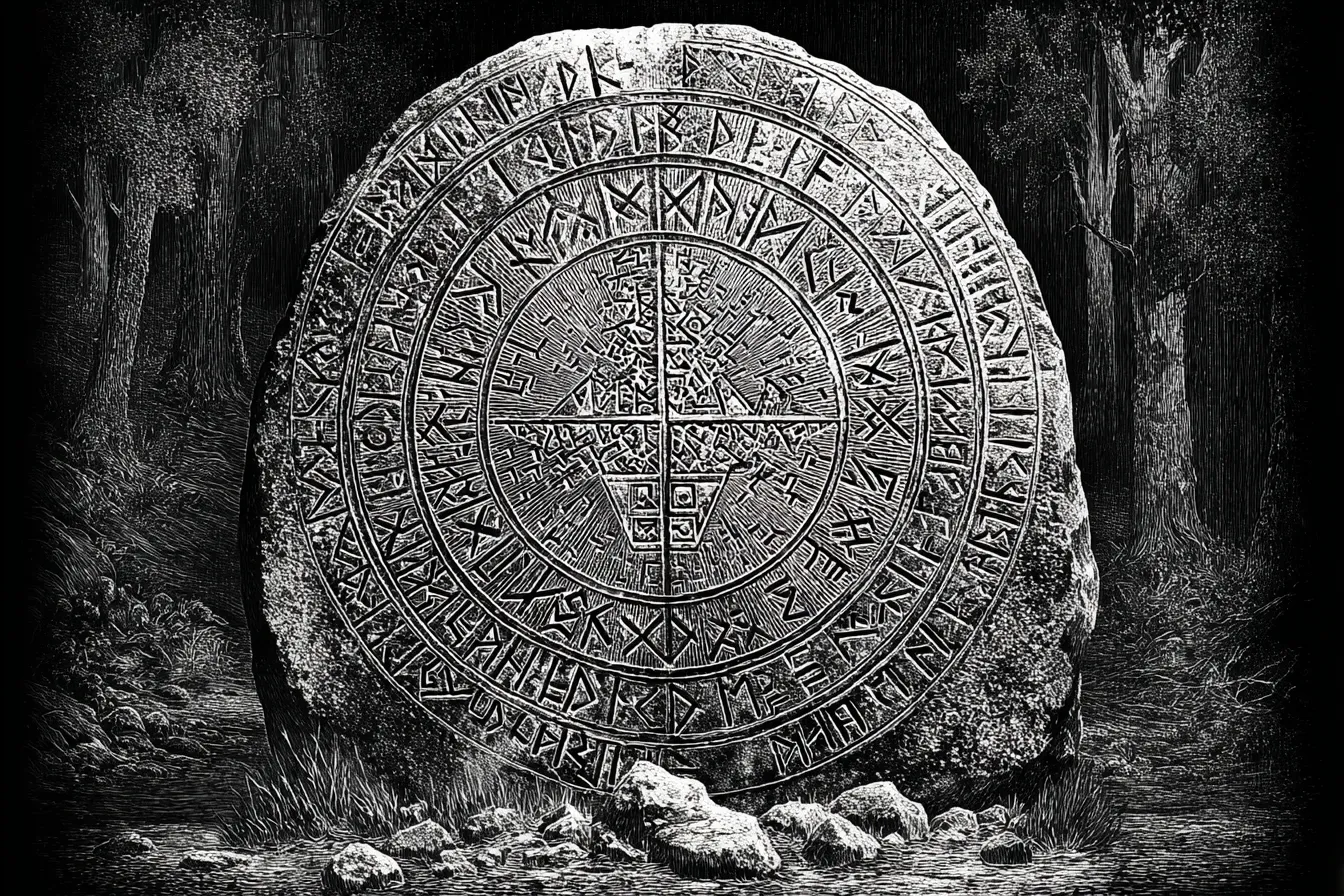
The oldest surviving account of rune casting comes from the Roman historian Tacitus, writing in 98 CE about the divination practices of the Germanic tribes. He describes a method that is strikingly simple: cut a branch from a fruit-bearing tree, slice it into strips, mark each strip with a symbol, and scatter them at random onto a white cloth. Then — facing the sky, in a state of prayer — pick up three strips one at a time and read what they say.
Tacitus is describing, recognizably, what practitioners still do today. The tools are different. The cultural context has shifted entirely. But the essential gesture — selecting a small number of meaningful symbols from a larger set and reading their arrangement as a response to a question — has remained continuous for nearly two thousand years.
What’s changed is the proliferation of methods. The historical record gives us fragments. Modern practice has elaborated those fragments into dozens of spreads, layouts, and approaches, each emphasizing different aspects of what rune casting can do. This guide sorts through that proliferation and tells you what actually matters.
What Rune Casting Is (And What It Isn’t)
Before getting into specific methods, it’s worth being clear about the underlying logic of the practice — because misunderstanding it leads to either overconfidence or dismissal, and neither is useful.
Rune casting is not a mechanism for receiving transmissions from Norse deities, and it is not a method for predicting specific future events. Those framings exist — some practitioners use them, and that’s their prerogative — but they don’t hold up to honest scrutiny and they’re not necessary to make the practice useful.
What rune casting demonstrably does is this: it selects, through a process that contains genuine randomness, one or more symbols from a vocabulary of 24 precisely named concepts. Your task is to ask whether that symbol — that word — names something real about your current situation. Does Nauthiz (necessity, the need-fire, creative constraint) describe what’s actually happening? Does Jera (harvest, the patience of the agricultural cycle) speak to where you actually are?
The vocabulary is good. The 24 runes encode observations about human experience that have been refined over centuries of use. When you draw one and sit with it honestly, you are essentially asking: of all the ways I could name what’s happening right now, does this name fit? That’s a useful question. It interrupts habitual narratives. It offers a frame you didn’t generate yourself. And occasionally — more often than pure chance would predict, though the mechanism remains genuinely unclear — it fits with a precision that stops you.
That’s the practice. Everything else is method.
Historical Methods: What the Evidence Actually Shows
The historical record on runic divination is sparse and largely fragmentary. What we have comes from a handful of sources:
Tacitus (98 CE): The strip-casting method described above — cut, mark, scatter, draw three. This is the earliest direct description and establishes the core gesture.
The Prose Edda and Poetic Edda (13th century): The Norse mythological texts don’t describe casting methods directly, but they describe runes as tools of wisdom, healing, and protection — carved into objects, spoken as charms, used in specific ritual contexts. The Hávamál (the words of the High One, attributed to Odin) describes how Odin discovered the runes through a nine-day ordeal of self-sacrifice on Yggdrasil — establishing runes as earned wisdom rather than arbitrary symbols.
Archaeological evidence: Thousands of runic inscriptions survive from the historical period, on weapons, jewelry, memorial stones, and everyday objects. The majority are commemorative or protective rather than divinatory — but some short inscriptions on small objects (particularly from the Viking Age) appear to be divination-related.
Medieval Icelandic sagas: Scattered references to hlautviðr (casting lots), blót (sacrifice combined with divination), and the use of written staves suggest an active divination tradition, though details are scarce.
What we can say with reasonable confidence: the historical practice involved selecting from marked objects (strips of wood, carved stones, carved sticks), typically in small numbers (three appears most often), often with a question or intention set beforehand, in a ritual context that marked the activity as distinct from ordinary decision-making.
What we cannot say: that specific spreads, layouts, or interpretive frameworks used in modern practice are historically attested. Most modern rune casting methods — including the spreads described below — are reconstructions, elaborations, or modern inventions. That doesn’t make them less useful. It makes them honest about what they are.
The Core Methods
The Single Rune Draw
The most fundamental method and, for daily practice, the most sustainable. Draw one rune — from a bag, from a scattered set face-down, from whatever container you use — and sit with it as the orientation for the day or the response to a specific question.
The single draw is not a lesser version of more complex spreads. It is a complete practice in itself. The discipline is in the question: being specific enough that the rune can respond to something real, without being so specific that you’re looking for a particular answer. “What is the quality of energy available to me today?” is a good question. “Will my meeting go well?” is too specific for this method to answer usefully.
The single rune works best when you allow yourself to sit with it for more than a few seconds. The initial response — “that doesn’t fit” or “yes, exactly” — is worth noting, but what often matters more is what emerges when you stay with the symbol for five minutes. The runes reward slow reading.
The Three-Rune Draw
The classical three-rune method, consistent with the Tacitus description and widely used across different traditions. Three runes are drawn and placed in a row, left to right. The most common interpretive frameworks for the three positions:
Past / Present / Future: The most widely used framework. The left rune describes relevant past context, the center rune describes the current situation, the right rune describes the likely direction if current conditions hold. This framework is intuitive and accessible, but it has a limitation: it can encourage you to treat the “future” rune as a prediction rather than a direction. It’s more useful to read the right rune as “where this trajectory leads” — a conditional, not a certainty.
Situation / Action / Outcome: The left rune describes the situation as it actually is (not as you’d like it to be), the center rune describes the most useful action or orientation, the right rune describes what the situation is moving toward. This framework is more actionable than the past/present/future reading and tends to produce more concrete insight.
Challenge / Action / Outcome: The left rune names the primary obstacle or challenge, the center rune describes the response the situation calls for, the right rune describes what becomes possible if that response is enacted. This is particularly useful for questions about a specific problem.
The choice of framework matters less than using the same framework consistently until you’ve learned what it offers. Switching interpretive frameworks between readings introduces a confusion that makes it hard to develop genuine skill. When three staves earn their jobs: three-rune spread.
The Five-Rune Cross
A more complex draw for questions that have multiple dimensions — situations involving relationship dynamics, major decisions with competing factors, or questions about a longer time horizon.
Five runes are drawn and placed in a cross formation:
        [2]
   [1] [5] [3]
        [4]
- Position 1 (Left): What you bring to the situation — your current resources, orientation, or energy
- Position 2 (Above): The ideal or aspiration — what the situation is calling you toward
- Position 3 (Right): The challenge or opposition — what is working against the aspiration
- Position 4 (Below): The foundation — what the situation is built on, consciously or not
- Position 5 (Center): The heart of the matter — the central dynamic that all other positions are orbiting
The center rune is read last and in light of the others. It names the axis around which the whole situation turns. Sometimes it will directly confirm what the other four runes have suggested. Sometimes it reframes everything.
The Nine-Rune Cast (The World Tree)
The most complex and least structured of the common methods — closest in spirit to the historical Tacitus description. Nine runes are drawn and scattered (or placed randomly) onto a cloth or surface. Their positions relative to the center and to each other are then read.
This method requires more practice than the structured draws because the interpretive framework is spatial rather than positional — you are reading a field rather than a sequence. Some practitioners divide the cloth into zones (center for core issues, edges for peripheral or future concerns, clusters as related themes). Others read purely through adjacency — runes that fall close together are in dialogue; runes that fall apart are in different domains.
The World Tree framework maps the nine positions onto Yggdrasil’s cosmological structure: the center corresponds to Midgard (the human world), the upper positions to Asgard (divine forces and higher principles), the lower positions to Helheim (what lies beneath, the past, what is hidden), the left positions to Jotunheim (challenges and opposing forces), and the right positions to Vanaheim (relationship, creativity, natural forces).
This method is worth learning eventually, but not starting with. The spatial reading requires an internalized relationship with the runes — knowing each symbol well enough that its position and proximity to others can speak without a framework telling you what to look for.
Reversed Runes: The Question of Merkstave
Many modern practitioners use reversed runes — called merkstave (dark stave) — when a rune lands or is drawn upside down, reading the reversal as a modified or shadow meaning. The Nauthiz rune, normally associated with creative constraint and necessity, in reversal might indicate constraint that has become self-imposed blockage; the Wunjo rune in reversal might indicate the absence of the harmony it normally represents.
The historical basis for reversed rune readings is thin — there’s limited evidence that the early Germanic peoples systematically used reversal meanings — but the practice has been in use long enough in modern runic tradition to have developed genuine interpretive depth. Whether you use reversed runes is a personal choice, but the decision should be consistent. Applying reversal meanings sporadically produces readings without a stable interpretive baseline.
If you do use reversals, a few runes are considered “non-reversible” because their symbols look the same upside down: Gebo (the X shape) and Isa (the vertical line) are the clearest examples. These are read identically regardless of orientation.
Building a Daily Rune Practice
The single most important thing you can do to develop genuine skill with the runes is to draw one rune every day for a sustained period — not casually, but with the intention of recording your initial reading and then returning to it at the end of the day to see what the rune actually named.
This retrospective practice is where runic literacy develops. The prospective reading (morning: what does Berkano — new growth, nurturing, the birch tree — say about today?) is your hypothesis. The retrospective check (evening: did the quality of new beginnings or nurturing show up anywhere in the day?) is the test. Over weeks, you build a relationship with each rune that is grounded in your actual experience rather than in abstract definitions.
Some practical notes for a sustainable daily practice:
Consistency of method: Draw at the same time each day if possible, with the same question or intention. Variation is interesting but makes it harder to develop pattern recognition across readings.
Write it down: A brief journal entry — the rune drawn, your initial response, and the end-of-day check — is more valuable than it seems. Memory flattens readings; written records preserve the texture. After three months, you will have a document of unexpected precision about the rhythms of your life.
Don’t over-read: The single rune is one orientation, not a comprehensive analysis of your day. The discipline of the practice is holding the symbol lightly enough that it can surprise you, rather than rigidly enough that you force it to fit.
Allow non-fit: Some days, the rune you draw doesn’t seem to speak to anything that happens. That’s data too — either about the limits of the practice or about the aspects of your day you weren’t paying attention to. Don’t manufacture relevance.
How The Whisper Uses Rune Casting
The Whisper uses your birth data — specifically your birth date’s numerological relationship to the Elder Futhark sequence — to generate a deterministic daily rune rather than a random draw. This is a different approach from the traditional casting methods described above, and it’s worth being clear about what’s different.
Traditional casting introduces genuine randomness: which rune you draw on any given day is not predetermined. The Whisper’s approach removes that randomness and replaces it with a systematic relationship between your birth signature and the runic sequence — the same underlying logic as BaZi’s deterministic calculations, applied to the runic vocabulary.
The advantage is consistency and layering: your daily rune can be read alongside your BaZi day, your Nine Star Ki month, and your active Dasha period as a coherent composite rather than an isolated random draw. The tradeoff is the removal of the element of surprise that many practitioners find most generative in traditional casting.
Both approaches are valid. If you practice traditional casting alongside The Whisper, the most interesting readings often come from the moments when the drawn rune and the calculated rune diverge — when the random and the systematic point in different directions. That divergence is itself worth sitting with.