
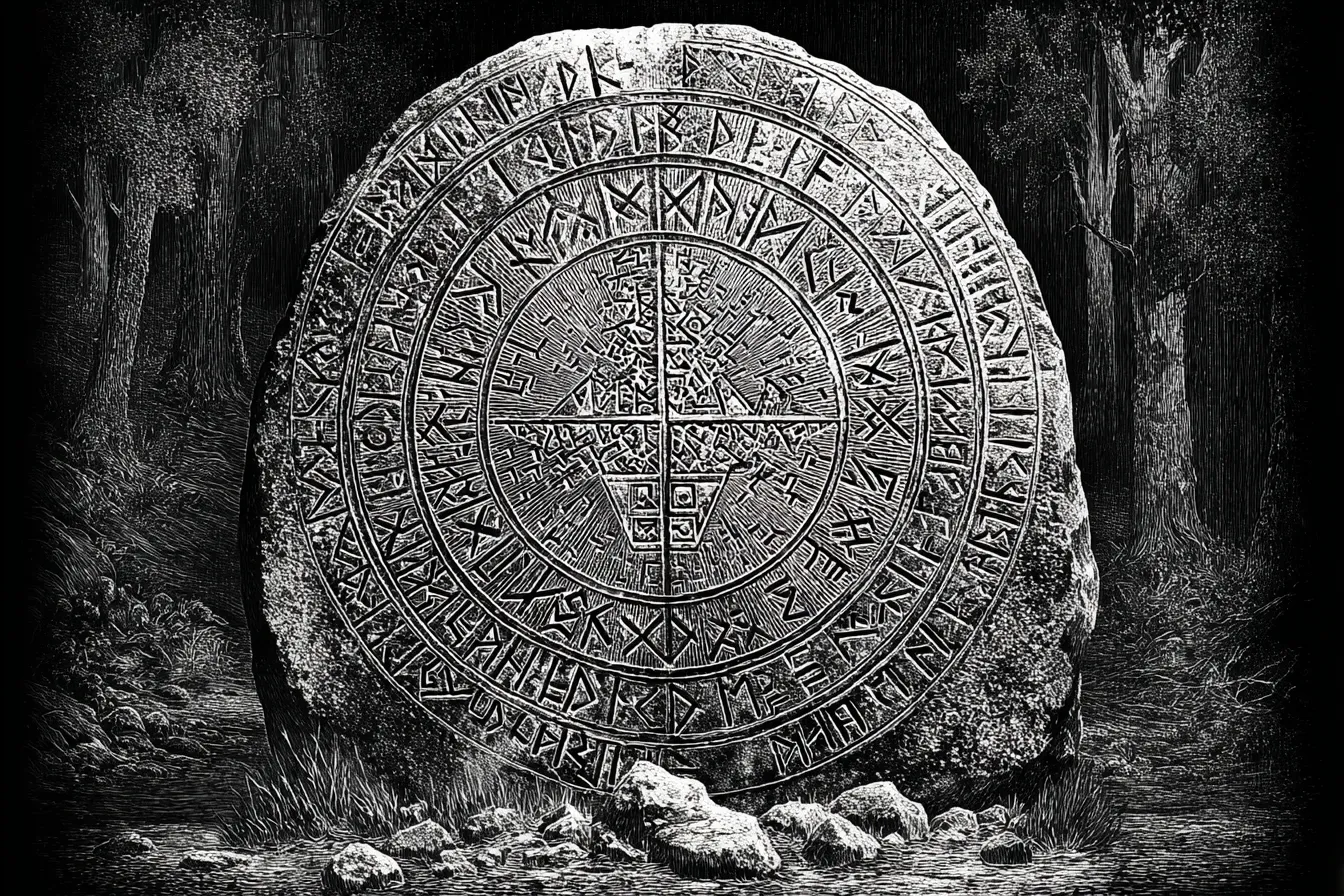
What is Ansuz?
Ansuz is the fourth rune of the Elder Futhark, the oldest runic alphabet used by Germanic and Norse peoples across Northern Europe from roughly the 2nd to 8th centuries CE. After the material and vital forces of Fehu, Uruz, and Thurisaz, Ansuz introduces the force of meaning itself — the quality that transforms raw vitality and directed power into something that can be shared, transmitted, and built upon across generations.
The Elder Futhark is arranged in three groups of eight runes called aettir. Ansuz belongs to Freyr’s Aett, the first group. In The Whisper, this system operates alongside Western Astrology, Nine Star Ki, and BaZi. Your birth rune is determined by a deterministic calculation applied to your birth date; your daily rune is drawn from a deterministic hash of your birth date combined with today’s date, so the same person always receives the same rune on the same calendar date.
A note on historical context: the rune meanings The Whisper uses are informed by the medieval rune poems and scholarly literature, filtered through a self-reflection lens. Much of what circulates today as “traditional” runic interpretation reflects reconstruction shaped partly by 19th-century Romantic revival and 20th-century esoteric practice. The works of R.I. Page and Klaus Düwel offer grounded academic perspectives.
Name, sound, and symbol
The name Ansuz derives from the Proto-Germanic word for god — specifically one of the Æsir, the primary family of Norse deities. The Old English name is os, meaning “god” or “mouth”; the Old Norse is óss. The convergence of “god” and “mouth” in the rune’s naming is not accidental. Odin is pre-eminently the god of inspired speech, poetry, wisdom, and the word in all its forms — the god who sacrificed an eye at Mimir’s well for wisdom, who hung on the World Tree for nine days and nights to receive the runes.
The phonetic value of Ansuz is A, the open vowel — the sound of pure breath, unobstructed. The rune’s shape, a vertical stave with two diagonal branches extending from the upper portion, visually suggests both the open mouth and the tree from which Odin hangs: the axis through which transmission passes, the channel between above and below.
The traditional meaning of Ansuz
At its core, Ansuz is the rune of language as genuine power — not communication in the thin modern sense of information transfer, but the word that shapes reality. The Norse and Germanic tradition understood speech in a fundamentally different register: a spoken oath was binding; a skaldic poem genuinely shaped how a king would be remembered. The curse had force. The blessing had force.
Ansuz carries the Odinic quality of wisdom that arrives through genuine receptivity. Odin does not receive wisdom by forcing it; he receives it through sacrifice, through sustained openness. The rune’s teaching is subtle: inspired communication is not the product of cleverness alone. It requires genuine receptivity — the capacity to be a channel for something larger than one’s own existing knowledge.
This is distinct from simple intelligence or verbal facility. A person can be extremely articulate and produce speech that impresses without genuinely reaching its audience, that displays knowledge without transmitting wisdom. Ansuz points toward the quality that distinguishes these: the word that has been genuinely received before it is transmitted.
Ansuz as a birth rune and daily rune
When Ansuz appears as your birth rune, it suggests that themes of communication, wisdom, and the relationship between genuine receptivity and effective transmission are persistent qualities in how you engage with the world. People with Ansuz as a birth rune often carry a quality of communicative presence. At its most developed, this expresses as the genuine teaching quality — the capacity to transmit something real in a way that genuinely reaches the person receiving it. The shadow worth attending to is the communication that has become performance — the articulate speech more concerned with displaying knowledge than actually transmitting it.
When Ansuz appears as your daily rune, The Whisper is pointing toward a day inflected by themes of communication, receptivity, and the relationship between genuine insight and how it is expressed. It may be useful to attend to the quality of your listening as much as your speaking — Odin’s wisdom comes through sacrifice and sustained receptivity before it is transmitted.
Strengths and growth edges
Ansuz’s strengths centre on the gift of meaningful communication — the capacity to speak and write in ways that genuinely reach their audience. A second strength is wisdom that arrives through genuine receptivity — the channel quality, the capacity to be open enough to receive genuine insight. A third is the capacity to animate and enliven through language — the teaching that opens something in the student, the conversation that leaves both participants changed.
The primary growth edge is the inspired speech that has become performance. The gap between genuine wisdom and the skilled performance of wisdom is not always visible from the outside. A second growth edge is the wisdom claimed rather than genuinely received — the adoption of wisdom’s form without the underlying receptivity that Odin’s sacrifice illustrates.
What Ansuz means in The Whisper
In Western Astrology, Ansuz carries resonances with both Mercury in its highest expression and Jupiter’s quality of wisdom that expands. When The Whisper reads an Ansuz day alongside a Mercury or Jupiter transit, the resonance tends to amplify the quality of communication that genuinely reaches and wisdom that genuinely expands.
In Nine Star Ki, Ansuz resonates with the Four Green Wood Star (四緑木星) — the wind quality of communication that travels far and reaches what it needs to reach. A Ansuz day in a Four Green period tends to have a quality of communication that travels further and permeates more deeply than might be expected.
In BaZi, Ansuz resonates with Jia Wood (甲木) reaching upward — the quality of communication that is genuinely rooted and genuinely reaching; the great tree that draws from deep water and grows toward the light simultaneously.
Frequently asked questions
Q: Is Ansuz exclusively associated with Odin, or does it have a broader meaning? Odin is the deity most closely associated with Ansuz, and the rune’s connection to his qualities is genuine and well-supported. The broader meaning extends to the quality of communication that carries genuine wisdom regardless of its source. In The Whisper’s self-reflection framework, the Odinic connection provides a vivid mythological lens, but the rune’s invitation is toward qualities of genuine receptivity and meaningful transmission that can be developed by anyone.
Q: Does Ansuz appearing as a daily rune mean I should expect important conversations today? Not necessarily in a literal sense. Ansuz as a daily rune points toward attentiveness to the quality of communication broadly — in formal conversations, but also in writing, in internal dialogue, and in whether you are genuinely listening to what the people around you are communicating.
Q: How does the Whisper’s use of Ansuz differ from simply predicting that I will be articulate today? The Whisper’s framework treats rune meanings as lenses for self-reflection rather than predictions. Ansuz appearing in a reading invites you to consider the quality of the communication dimension of your current situation: where genuine wisdom might be available if you are genuinely receptive, and whether the words you are using are serving genuine understanding or performing it.