
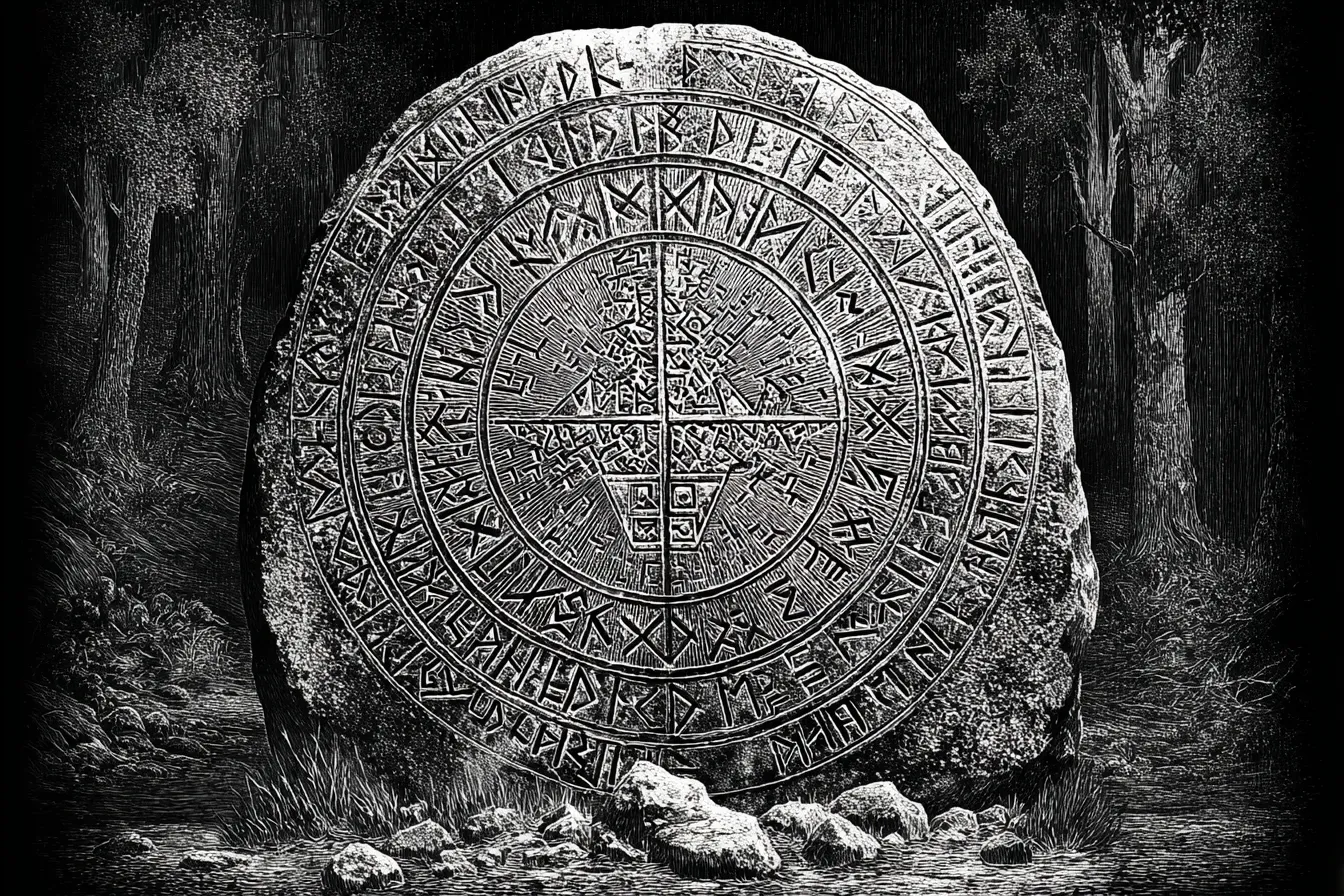
What is Othala?
Othala is the twenty-fourth and final rune of the Elder Futhark — the last rune of Tyr’s Aett and the closing statement of the oldest runic alphabet used by Germanic and Norse peoples across Northern Europe from roughly the 2nd to 8th centuries CE. A system that began with Fehu’s outward-flowing earned abundance ends with Othala’s inward-gathered ancestral home: the land that does not move, cannot be bought and sold in the ordinary sense, and is passed down through generations as the accumulated expression of everything those generations built, understood, and were.
The arc from Fehu to Othala is the arc from the first generative resource a person brings into the world to the deepest ground from which a life and a lineage draw their ultimate sustenance.
In The Whisper, your birth rune is determined by a deterministic calculation applied to your birth date; your daily rune is drawn from a deterministic hash of your birth date combined with today’s date.
A note: Othala’s imagery of ancestral inheritance has been misappropriated by various nationalist and ethnocentric movements in ways entirely contrary to the rune’s genuine historical meaning and to The Whisper’s values. The Whisper explicitly rejects any reading of Othala that conflates ancestral inheritance with ethnic exclusivity or racial ideology, which are modern distortions with no foundation in the rune’s actual historical character.
Name, sound, and symbol
The name Othala derives from the Proto-Germanic ōþalan — the word for ancestral estate or inherited land, the specific form of land ownership in the Norse and Germanic world that was not transferable through ordinary commercial transaction but was held by the family or clan as a collective inheritance across generations. The Old English name is ēðel, meaning homeland or ancestral estate; the Old Norse is óðal.
The phonetic value is O, the rounded back vowel — the sound of genuine depth and genuine resonance, of the voice fully rounded and opened into the most spacious vowel available. The rune’s shape — a diamond or rhombus raised above two diagonal legs that descend outward from its lower corners — simultaneously suggests the dwelling place and the human being who inhabits it: the enclosed space of the home above, the open, grounded stance of the person who belongs to it below.
The traditional meaning of Othala
At its core, Othala is the rune of ancestral inheritance — the accumulated wisdom, character, and ground that is passed down through generations, that cannot be acquired in a single lifetime, and whose depth is precisely a function of the length and quality of the lineage through which it has been carried.
The concept of the home that has been passed down carries several related qualities. There is the physical home — the land, the house, the place. There is the cultural home — the language, the customs, the stories. And there is the deeper home — the patterns of character, the deep orientations toward value, the specific capacities and specific blind spots that recur through a lineage.
What is genuinely one’s own through lineage and belonging is Othala’s second major dimension. The wisdom accumulated through generations is its third — the specific form of knowledge that cannot be acquired in a single lifetime because it requires the testing of approaches against actual conditions across multiple generations.
Othala as a birth rune and daily rune
When Othala appears as your birth rune, it suggests that themes of ancestral inheritance, genuine belonging, and the relationship between where one comes from and who one is are persistent qualities in how you engage with the world. People with Othala as a birth rune often carry a quality of natural orientation toward lineage, continuity, and the depth that genuine rootedness provides. The shadow worth attending to is the inheritance that becomes a prison — the home that prevents genuine engagement with what lies beyond it, the lineage venerated rather than genuinely received and carried forward.
When Othala appears as your daily rune, The Whisper is pointing toward a day inflected by themes of genuine inheritance, genuine belonging, and the relationship between the ground from which one comes and the engagement with the world that this ground enables.
Strengths and growth edges
Othala’s primary strength is the capacity to receive and build on genuine inheritance — the ability to genuinely engage with what has been passed down, to receive it with genuine discernment, and to build on it in ways that carry it genuinely forward. A second is the quality of genuine belonging — the groundedness of the person who can go anywhere because they know where home is. A third is the wisdom that comes through lineage — the multigenerational understanding that is available through genuine engagement with one’s actual inheritance.
The primary growth edge is the inheritance that becomes the prison of tradition. A second is the home that prevents genuine engagement with what is beyond it. A third concerns the lineage venerated rather than genuinely received and carried forward — treating the inherited forms with reverence without genuinely inhabiting them.
What Othala means in The Whisper
In Western Astrology, Othala carries resonances with both Saturn and Cancer — the deep, ancestral quality of genuine belonging in its most characteristic astrological expressions.
In Nine Star Ki, Othala resonates with the Eight White Earth Star (八白土星) — the mountain of accumulated inheritance, the quality of what has been genuinely built and genuinely passed down.
In BaZi, Othala resonates with Wu Earth (戊土) — the mountain as the unchanging ancestral foundation, the quality of what genuinely endures across generations. When The Whisper reads an Othala day with Wu Earth prominent in the BaZi chart, the quality of genuine, enduring, ancestrally deep ground is particularly active.
Frequently asked questions
Q: Othala’s imagery has been misused by political movements. How does The Whisper approach this concern? The historical meaning of Othala concerns the accumulated wisdom, practical knowledge, and grounded belonging that any human lineage can carry and transmit — it is not ethnic, racial, or nationally exclusive in any historically supported sense. Any reading of Othala that uses the rune’s imagery to support claims of ethnic or racial superiority is a modern distortion with no legitimate grounding in the rune’s actual historical character. The Whisper treats Othala as the universal human quality of genuine inherited depth and genuine belonging to a lineage — qualities available to every human being regardless of background.
Q: Does Othala require having a known or stable family history? Othala’s inheritance is not limited to what can be genealogically documented. The rune’s quality of genuine inherited ground is available in various forms to everyone: the cultural and linguistic inheritance carried in the language one speaks and the stories one has absorbed; the patterns of character that run through even fragmentary or difficult family histories; the broader human inheritance of accumulated wisdom that every human being draws on simply by being genuinely human.
Q: As the final rune of the Elder Futhark, does Othala have a special relationship to the system as a whole? The position of Othala as the twenty-fourth and closing rune gives it a structural quality that the other runes do not share. It is simultaneously the conclusion of the entire Elder Futhark and, in the cyclical understanding the tradition supports, the ground from which the next cycle — the next Fehu — begins. Othala is the rune that most fully embodies the continuity of the system itself: the ground that holds all 24 runes in genuine relationship, the home to which every genuine journey eventually returns, and the inheritance that makes the next genuine journey possible.