
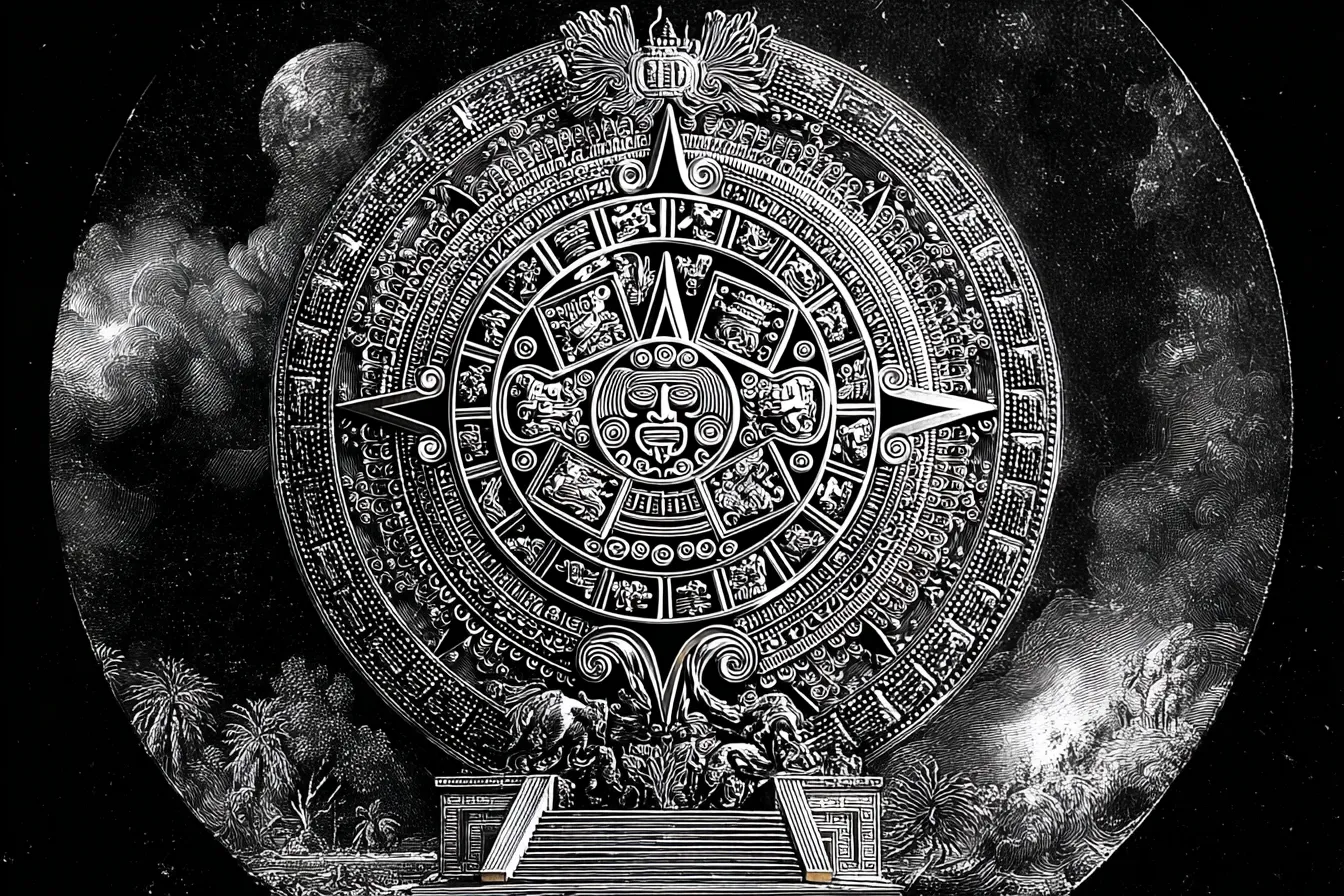
Most people who know anything about Aztec civilization know about the Sun Stone — the massive carved disc often called “the Aztec calendar.” It’s an iconic image, reproduced on textbooks and tattoos alike. But the Sun Stone is not, strictly speaking, a working calendar. It’s a cosmological monument commemorating the Aztec understanding of cosmic cycles and the succession of five suns.
The actual working calendar that the Aztec priests, farmers, and diviners used daily was called the Tonalpohualli — the “count of days” or “count of the sun.” It’s a 260-day cycle still used in some indigenous Mesoamerican communities today. And unlike the Sun Stone, it was designed to be used: to time ceremonies, to read the character of days, and to determine the energetic quality of a person’s birth.
Your birth day sign in the Tonalpohualli is not a horoscope in the Western sense. It doesn’t describe your sun sign or your rising sign. It describes the quality of sacred time you were born into — the energetic signature of the day itself, which the Aztec tradition understood as a living force that shaped character, vocation, and fate.
The Structure of the Tonalpohualli
The Tonalpohualli is built from two interlocking cycles.
The first cycle contains 20 day signs (trecenas), each associated with a specific force, deity, direction, and elemental quality. These signs cycle continuously: Cipactli, Ehecatl, Calli, and so on through all twenty, then back to Cipactli.
The second cycle contains 13 numbers (tones), running from 1 through 13, then back to 1.
These two cycles run simultaneously. Day 1 is 1-Cipactli. Day 2 is 2-Ehecatl. Day 14 is 1-Acatl (because the tone resets to 1 before the signs exhaust themselves). The two cycles complete a full synchronization every 260 days — at which point every combination of sign and tone (20 × 13 = 260) has appeared exactly once.
This 260-day count is not arbitrary. It appears across multiple Mesoamerican civilizations — Aztec, Maya, Zapotec, and others — suggesting deep roots in a shared cosmological tradition. Its relationship to the agricultural cycle (the growing season in highland Mexico), to human gestation (approximately 260 days), and to Venus’s synodic period (583.92 days, with 260 as a significant subdivision) have all been proposed as origins. The truth is probably all of these, operating in concert.
The 20 Day Signs
Each of the twenty day signs carries a distinct quality, associated with a patron deity, a cardinal direction, and an elemental tendency. These associations are not decorative — they’re the interpretive framework that gives each sign its meaning.
| # | Day Sign | English Meaning | Patron Deity | Direction |
|---|---|---|---|---|
| 1 | Cipactli | Earth Monster / Crocodile | Tonacatecuhtli | East |
| 2 | Ehecatl | Wind | Quetzalcoatl | North |
| 3 | Calli | House / Night | Tepeyollotl | West |
| 4 | Cuetzpallin | Lizard | Huehuecoyotl | South |
| 5 | Coatl | Serpent | Chalchiuhtlicue | East |
| 6 | Miquiztli | Death | Tecciztecatl | North |
| 7 | Mazatl | Deer | Tlaloc | West |
| 8 | Tochtli | Rabbit | Mayahuel | South |
| 9 | Atl | Water | Xiuhtecuhtli | East |
| 10 | Itzcuintli | Dog | Mictlantecuhtli | North |
| 11 | Ozomatli | Monkey | Xochipilli | West |
| 12 | Malinalli | Twisted Grass | Patecatl | South |
| 13 | Acatl | Reed / Arrow | Tezcatlipoca | East |
| 14 | Ocelotl | Jaguar | Tlazolteotl | North |
| 15 | Cuauhtli | Eagle | Xipe Totec | West |
| 16 | Cozcacuauhtli | Vulture / Condor | Itzpapalotl | South |
| 17 | Ollin | Movement / Earthquake | Xolotl | East |
| 18 | Tecpatl | Flint Knife | Chalchiuhtotolin | North |
| 19 | Quiauhtl | Rain | Tonatiuh | West |
| 20 | Xochitl | Flower | Xochiquetzal | South |
The patron deities are not simply symbolic. In the Aztec understanding, each deity was an actual force — a living, cosmological power that was genuinely active on days governed by their sign. The tonalpouhque (day-sign readers, the Aztec divination specialists) would consult these associations to determine the character of a day, advise on timing for ceremonies, and read the destiny of newborns.
The 13 Tones
The Tone — the number from 1 to 13 associated with each day — modifies the quality of the Day Sign. A complete birth position in the Tonalpohualli is both a Day Sign and a Tone: 1-Cipactli, 7-Mazatl, 13-Xochitl.
Tone 1 is considered the purest and most concentrated expression of the Day Sign’s energy — undiluted, perhaps most challenging, most essential. As the Tone increases from 1 toward 13, the energy of the Day Sign cycles through different phases of development: emergence, growth, peak, decline, and completion.
Tone 13 represents the fullest integration of the Day Sign’s energy — the most conscious and complete expression of what that sign contains. Some traditions consider high Tones easier to work with; others consider the intensity of Tone 1 more powerful. The relationship between Tone and Sign is the subject of its own rich interpretive tradition.
The Four Directions and Their Meaning
The Tonalpohualli organizes its twenty signs into groups of five, each group associated with one of the four cardinal directions. The directions in Aztec cosmology are not simply spatial — they carry specific qualities of sacred time and energy.
East is the direction of dawn, of birth, of the warrior sun, of new beginning. Signs assigned to the East (Cipactli, Coatl, Atl, Acatl, Ollin) carry an initiating quality — the energy of beginning, of the force that breaks open the new day.
North is the direction of night, of death, of the wind that carries the cold. Signs assigned to the North (Ehecatl, Miquiztli, Itzcuintli, Ocelotl, Tecpatl) carry a quality of transformation, testing, and encounter with what is difficult or hidden.
West is the direction of the setting sun, of the female principle, of completion and rest. Signs assigned to the West (Calli, Mazatl, Ozomatli, Cuauhtli, Quiauhtl) carry a quality of integration, protection, and the deep knowing that comes from having seen the cycle through.
South is the direction of the noon sun, of heat and fertility, of the earth’s productive power. Signs assigned to the South (Cuetzpallin, Tochtli, Malinalli, Cozcacuauhtli, Xochitl) carry a quality of vitality, abundance, and the force that sustains living things.
How to Find Your Birth Day Sign
Converting a Gregorian birth date to a Tonalpohualli position requires a correlation table — a researched connection between the Gregorian calendar and the position in the 260-day cycle. Unlike Western numerology, which uses arithmetic on the birth date, the Tonalpohualli calculation depends on tracking the actual cycle position.
The most widely used correlation for the Aztec calendar places specific known dates in the 20th century as anchor points and counts forward and backward from there. The calculation is precise, and the result gives you both your Day Sign and your Tone.
The Whisper handles this calculation automatically when you enter your birth date.
The Tonalpohualli and the Mayan Tzolkin: What’s Different
The Tonalpohualli and the Mayan Tzolkin share the same structural logic — 20 signs × 13 tones = 260 days — and likely share ancient common roots across Mesoamerican cultures. But they are distinct systems with different sign names, different patron associations, and different mythological frameworks.
The Tzolkin’s signs (Imix, Ik, Akbal, and so on) are Mayan; the Tonalpohualli’s signs (Cipactli, Ehecatl, Calli) are Nahuatl. The deities associated with each position differ. The cosmological narratives that give the signs their meaning are drawn from different — though related — traditions.
The Whisper treats these as separate systems, each contributing its own reading to the daily synthesis. A person who checks both their Tonalpohualli day sign and their Tzolkin day sign on a given day is consulting two distinct traditions that may point in different directions, agree completely, or add complementary layers to the same moment.
How The Whisper Uses the Tonalpohualli
The Tonalpohualli contributes two inputs to The Whisper’s daily synthesis.
The first is your birth Day Sign — fixed at birth, providing a constant background frequency in every daily reading. Your Ollin birth sign, for example, means that every day’s synthesis includes the question of how the current moment interacts with your Ollin quality: amplifying it, creating friction with it, or placing it in dialogue with other energies.
The second is today’s Tonalpohualli Day Sign — which changes every day as the 260-day cycle advances. When today’s sign is the same as your birth sign, the two frequencies converge and amplify. When today’s sign is in a complementary or challenging relationship with your birth sign, the synthesis reads that relationship.
The Tonalpohualli’s contribution is most distinctive when it diverges from the other active systems — when the Western astrological transits are suggesting one quality of energy while the Tonalpohualli is pointing toward something different. That divergence is not noise in the system. It’s information about the multi-layered quality of the day, and it’s exactly the kind of specific, non-obvious reading that no single divination system can produce alone.
Find Your Day Sign
The 20 Day Signs of the Tonalpohualli:
Cipactli — Earth Monster · Ehecatl — Wind · Calli — House · Cuetzpallin — Lizard · Coatl — Serpent · Miquiztli — Death · Mazatl — Deer · Tochtli — Rabbit · Atl — Water · Itzcuintli — Dog · Ozomatli — Monkey · Malinalli — Twisted Grass · Acatl — Reed · Ocelotl — Jaguar · Cuauhtli — Eagle · Cozcacuauhtli — Vulture · Ollin — Movement · Tecpatl — Flint Knife · Quiauhtl — Rain · Xochitl — Flower