
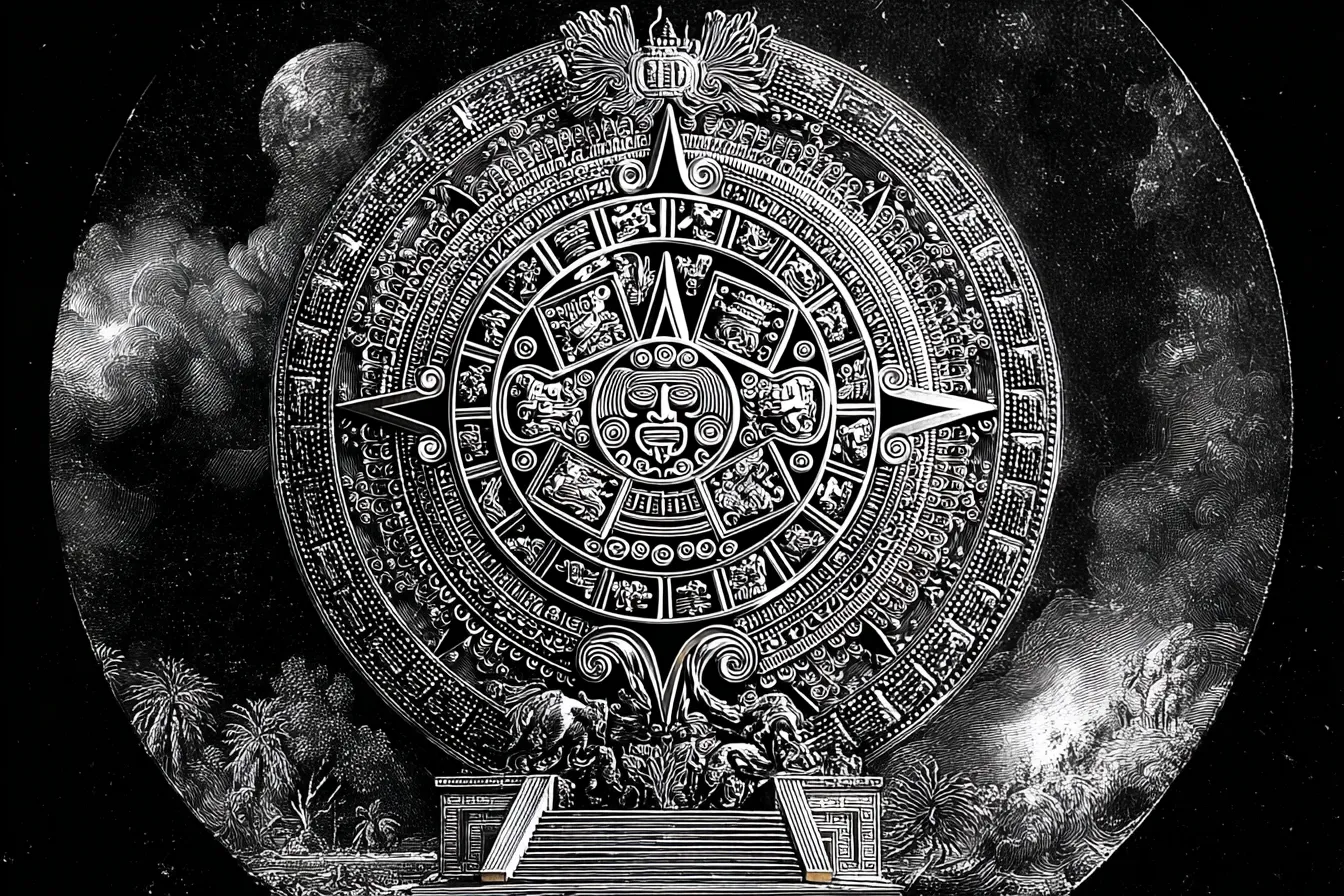
The modern Western relationship to death is, in most cases, one of avoidance. Death is what you hope to postpone, what you don’t discuss at dinner, what arrives as a failure of something that should have continued. The Aztec relationship to death was fundamentally different. Death was the engine of transformation — the force without which nothing new was possible, the necessary dissolution that fed the sun and made the corn grow and allowed the current age to continue.
Miquiztli — Death — is the sixth day sign of the Tonalpohualli, and its patron is Tecciztecatl, the Moon God. The Moon is itself a lesson in death and rebirth: it disappears completely, dwells in darkness, and returns, phase by phase, to fullness. Tecciztecatl was the god who became the moon by refusing to throw himself into the fire when the current sun was being created — he hesitated four times before finally jumping. For his hesitation, he was struck with a rabbit and made the dimmer light. Those born under Miquiztli carry both the transformative depth of death and the Moon’s quality of reflective, cyclic, sometimes hesitant wisdom.
What Is the Tonalpohualli?
The Tonalpohualli is the Aztec sacred calendar — 20 day signs combined with 13 tones in a 260-day cycle. Your birth day sign describes the quality of sacred time you were born into. For the complete framework, the Aztec Calendar overview covers the full system.
How to Find Your Birth Day Sign
Your Tonalpohualli day sign isn’t calculated with birth-date arithmetic; it’s read from a correlation table that maps your Gregorian birth date onto the 260-day cycle, producing your Day Sign and Tone (1–13) together. The Whisper handles this conversion for you automatically when you enter your birth date.
Miquiztli: The Core Energy
Tecciztecatl’s mythology carries a specific lesson: he wanted to become the sun — to be the greatest light — but hesitated at the crucial moment because of fear. His counterpart Nanahuatzin, who had nothing and was covered in disease, jumped without hesitation and became the sun. The Moon, in this story, is the light of the one who almost did it — who had the capacity and was stopped by fear of the final transformation.
This mythology gives Miquiztli a quality that is less about death as ending and more about death as the threshold you resist crossing — and the particular kind of luminous wisdom available to someone who has spent time near that threshold, whether they crossed it or not.
The direction is North — the direction of the night wind, of testing, of the cold intelligence that strips away pretension. North is associated with the difficult gifts: the clarity that comes from having endured something, the knowledge that could only be acquired through loss. Miquiztli’s North is the dark of the moon — the period of complete invisibility before the cycle turns.
The element is Air, which carries the quality of transmission — death, in the Aztec understanding, was not the end of a person’s journey but a transformation of their mode. The dead still existed; they simply existed in a different register. Air carries this: the invisible transmission between what has ended in one form and what continues in another.
Miquiztli people tend to have an unusually developed relationship with impermanence. Not because they’re morbid or death-obsessed — but because they’ve often had early or pronounced encounters with endings, loss, and the necessity of release, and have developed from those encounters a particular kind of wisdom about what actually matters and what doesn’t.
Traits of the Miquiztli Birth Sign
Profound non-attachment. Those who have genuinely encountered death — in any of its forms — tend to develop a relationship to possessions, positions, and identities that is less grasping than those who haven’t. Miquiztli people often carry this non-attachment as a natural quality: a looseness with what they hold, a willingness to let things end.
Wisdom from threshold experience. The Moon sees both the world of the living and the world of the dead as it travels its cycle. Miquiztli people tend to have access to a kind of knowledge that comes from proximity to endings — not just their own, but others’. They understand what is essential because they’ve seen enough endings to know what remains.
Transformative capacity. Death is the greatest transformer. Miquiztli people often have an unusual capacity for genuine self-reinvention — not just updating their circumstances but undergoing the kind of deep change that produces a qualitatively different person. They’ve often done this at least once in ways that were visible.
Presence and quality of attention. The relationship to mortality tends to sharpen presence. Miquiztli people often have a quality of attention that is unusually full — they’re here, now, because they know in some cellular way that now is what exists.
The Moon’s reflective intelligence. Tecciztecatl shines by reflecting the sun’s light. Miquiztli people often have a quality of intelligence that works by reflection — taking in what’s around them, processing it internally, and producing something that illuminates the original source in a new way.
Challenges and Shadow Side
Tecciztecatl’s hesitation. The Moon God hesitated at the threshold. Miquiztli’s shadow is the person who understands death deeply, who knows that transformation is necessary and available, and who nevertheless hesitates at the crucial moment. The wisdom about change without the willingness to enact it becomes a kind of paralysis dressed as depth.
The gravitational pull of the dark. The Moon’s new phase is a period of complete darkness. For Miquiztli people, the gravitational pull toward the dark — toward withdrawal, ending, dissolution — can become a standing habit rather than a seasonal necessity. Learning to come back into the light after necessary periods of darkness, rather than lingering there indefinitely, is often a recurring developmental challenge.
Being associated with what others fear. The death sign carries a weight in social contexts. Miquiztli people are sometimes experienced by others as unsettling — not because of anything they do, but because of what they represent and the depth they carry. This can produce a kind of social isolation that is not chosen but is a consequence of the sign’s nature.
Premature endings. The capacity for non-attachment and the willingness to let things end can become a pattern of ending things before their time — releasing relationships, situations, or commitments at the first significant difficulty, before the transformation that would have come from staying through it has had a chance to arrive.
Miquiztli in Relationships and Vocation
In relationships, Miquiztli brings a quality of presence and genuine depth that others often experience as unusual and valuable. To be truly seen by a Miquiztli person — to have your actual situation perceived rather than the comfortable version of it — is a meaningful thing. They don’t traffic in comfortable falsehoods.
The challenge is that the depth and the non-attachment can coexist in a way that is confusing to partners. Miquiztli people can be simultaneously deeply present and entirely unattached to whether the relationship continues — which is not indifference, but it can be experienced as indifference by someone who needs more conventional forms of investment as evidence of commitment.
In vocation, Miquiztli tends toward work that engages with transformation, endings, and the depths that other vocations avoid: hospice and end-of-life care, depth psychology and therapy, funeral and ceremonial work, research into mortality and what persists, religious and spiritual leadership, work in organizations undergoing major transformation. The Moon’s reflective quality also appears strongly in creative work — Miquiztli people often produce art that reflects the world back at a different frequency.
The Tone (1–13): How Your Birth Number Modifies Miquiztli
Tone 1 Miquiztli is the most concentrated expression of the death-and-moon energy — the deepest, most threshold-adjacent, most transformative potential. Higher Tones tend to bring more integration of the depth with greater capacity for the return arc — the new moon becoming the waxing crescent, the death becoming the acknowledged doorway to what comes next.
How The Whisper Uses Miquiztli
In The Whisper’s synthesis, your Miquiztli birth sign contributes North Air and transformative depth to the daily reading. When multiple systems converge on themes of endings, release, and the necessity of transformation — particularly when the BaZi day pillar carries Metal energy (associated in Five Elements with cutting, separation, and the West-North quality of closure) — The Whisper reads that convergence against your Miquiztli foundation as a specific message about the quality of ending or release that is most available today.