
There is a category of person who doesn’t drift toward change — who moves toward it in lurches, suddenly, completely, and often at moments that seem, to everyone watching, catastrophic. A job abandoned without warning. A city left. A belief system dissolved overnight after years of apparent certainty. And then, some time later, the new configuration is so obviously correct that the old one seems like a different person’s life.
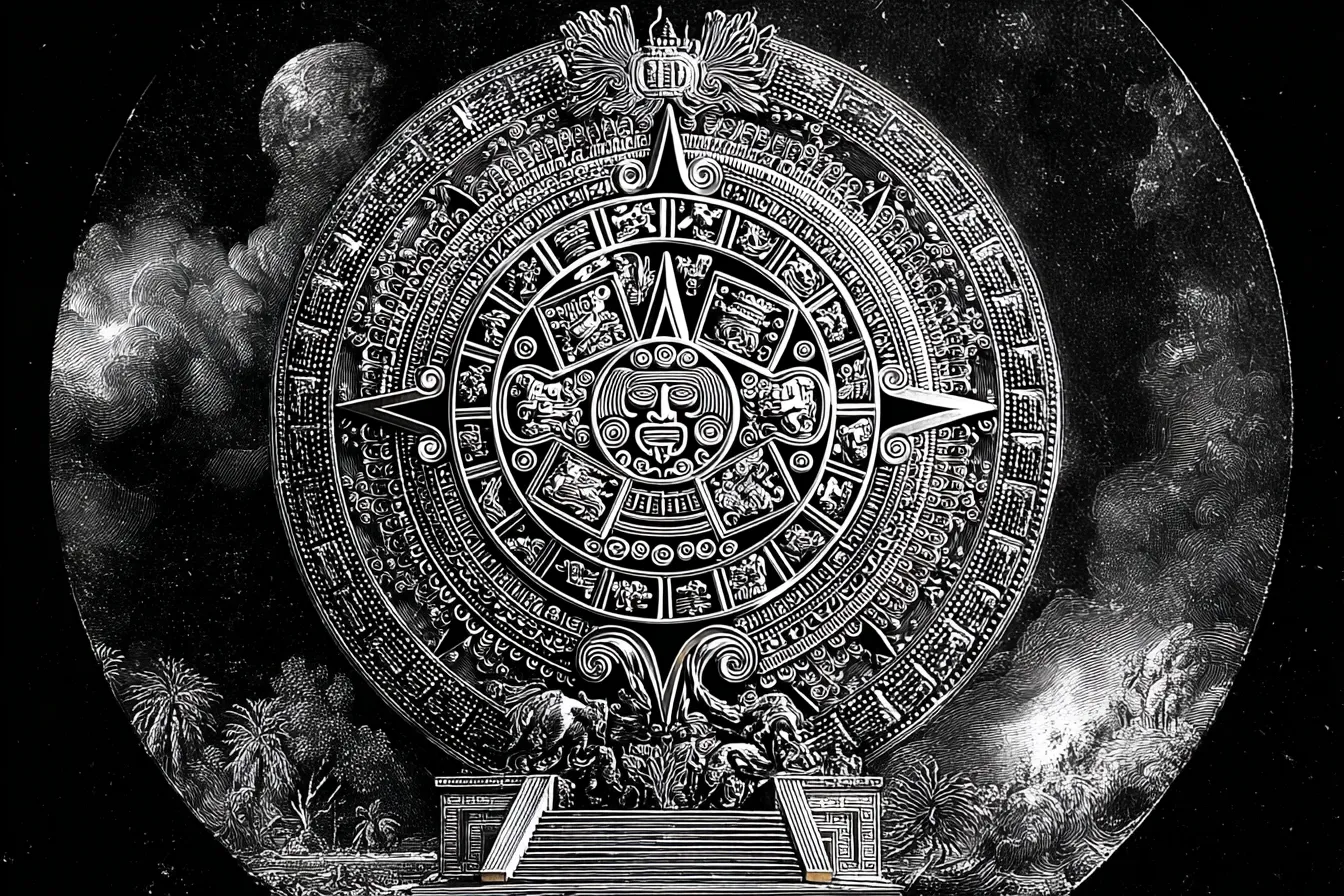
In the Aztec Tonalpohualli — the 260-day sacred calendar — the seventeenth day sign is Ollin: movement, earthquake, the seismic shift. If you were born on an Ollin day, this pattern is not a character flaw or a commitment problem. It’s the shape of your energy. The Tonalpohualli doesn’t apologize for it, and neither should you.
What Is the Tonalpohualli?
The Tonalpohualli is the Aztec sacred calendar — a 260-day cycle created by combining 20 day signs with 13 numerical tones. Every combination of sign and tone appears exactly once in each cycle before the pattern repeats. In the Aztec cosmological tradition, this wasn’t an arbitrary system. The Tonalpohualli was understood as a map of the different qualities of sacred time — each day carrying a distinct energetic signature that influenced events and characters born within it.
Your birth day sign is the Day Sign that was active on the day you were born according to the Tonalpohualli. It doesn’t change across your lifetime. It describes a fundamental quality of the energy you came in with — what the Aztec priestly tradition would have identified as your tonalli, the animating solar force specific to you.
The Tonalpohualli is closely related to but distinct from the Mayan Tzolkin, which uses the same 20 × 13 structure but different sign names and a different mythological framework. Both are real-calendar systems: grounded in actual astronomical cycles and cultural tradition, not derived from birth statistics. For the full context of how the system works, the Aztec Calendar overview covers the complete framework.
How to Find Your Birth Day Sign
Converting a Gregorian birth date to a Tonalpohualli day sign requires a correlation table — a carefully researched conversion between the Gregorian calendar and the Aztec sacred calendar cycle. Unlike Western numerology, which uses simple arithmetic on the birth date, the Tonalpohualli calculation depends on knowing where the current calendar position falls in the 260-day cycle.
The Whisper handles this calculation automatically. When you enter your birth date, the system converts it to the corresponding Tonalpohualli position and identifies your birth Day Sign and Tone.
If you’re calculating manually, the most widely used correlation for the Tonalpohualli places a known anchor date in the 20th century and counts forward or backward from there. The calculation is precise, and small errors in correlation choice can shift the result by one or two signs — which is why a reliable automated calculation is recommended.
Ollin (Movement): The Core Energy
Ollin occupies the seventeenth position in the Tonalpohualli’s cycle of twenty signs. Its patron deity is Xolotl — the dog-headed god of lightning, twins, deformity, and the underworld journey of Venus as evening star. Its direction is East, the direction of dawn and new beginnings. Its element is Fire.
The first thing to understand about Ollin is its cosmological weight. In the Aztec creation mythology, the current era is called the Fifth Sun — Nahui Ollin — Four Movement. The four previous suns were destroyed, each by a different catastrophe. The Fifth Sun, the one we currently inhabit, was created through the self-sacrifice of the gods Nanahuatzin and Tecuciztecatl, who threw themselves into a fire to become the sun and moon. This sun is sustained by the blood of sacrifice and will eventually be destroyed by earthquake — by ollin.
Ollin is therefore not merely movement in the pedestrian sense of physical displacement. It’s the movement that restructures everything: the earthquake that rearranges the landscape, the shift that ends one era and begins another, the transformation that cannot be partially accomplished. You cannot have a small Ollin. The sign carries within it the energy of the complete reorganization.
Xolotl, its patron, is the companion of the dead on their journey through Mictlan — the nine layers of the underworld — and the twin of Quetzalcoatl. Xolotl is associated with lightning, with the hairless xoloitzcuintli dog, with the double and the mirror image, with what is strange and liminal. The Ollin person carries this Xolotl quality: a comfort in threshold spaces, in the between, in the moment of maximum uncertainty that precedes the new configuration.
The direction East gives Ollin a quality of initiation and dawn — but not the gentle dawn of gradual brightening. The Aztec East is the direction from which the sun is born each day in blood, the direction of the dawn star and the warrior. Ollin’s East is the dawn that arrives after a difficult night and demands immediate response.
Traits of the Ollin Birth Sign
Capacity for complete transformation. Ollin people change completely, not incrementally. When the shift is ready, it happens. This is a capacity, not merely a tendency — they can accomplish in a single pivot what others take years to negotiate.
Comfort in crisis. What paralyzes others tends to clarify Ollin. When the earthquake happens and the landscape is rearranged, they find their footing faster than most. The threshold moment — where the old configuration has ended and the new one hasn’t yet formed — is their native environment.
Intensity of presence. Ollin carries Fire and East, and the combination produces a quality of focused, immediate energy. When an Ollin person is fully engaged, it’s perceptible. They are not low-key presences. When they’re moved by something, they’re moved completely.
Seismic emotional range. The energy that produces total external transformation also produces total internal experience. Ollin people tend not to feel things moderately. The emotional register is wide, and the depth at each pole is significant.
Magnetic instability. Others are often drawn to Ollin energy precisely because of its intensity and capacity for transformation — and may also find it destabilizing to be close to. The Ollin person’s shifts can pull the people around them into reorganization as well, which is not always welcome.
Deep connection to the moment. Ollin in the Aztec tradition is connected to the present tense — movement is always happening now, not in the past or future. Ollin people tend to be unusually present, which is both a gift and a source of difficulty with sustained long-term planning.
Challenges and Shadow Side
Destruction without construction. The earthquake reorganizes the landscape. But a landscape of rubble is not yet a new world. Ollin’s shadow is the person who shifts completely and repeatedly but never builds anything that lasts, because the next seismic event arrives before the new structure consolidates.
Unreliability in the ordinary register. Ollin is not a sign of gradual, predictable consistency. In environments that require sustained, undramatic follow-through — daily maintenance, the long unglamorous middle of a project — the Ollin energy can become genuinely difficult to sustain. The sign’s strength is the pivot, not the plateau.
Difficulty with the just-fine. When nothing is in crisis and nothing needs to be transformed, Ollin people sometimes manufacture the instability they’re adapted for. Relationships that have become stable can start to feel constraining; careers that are working fine can suddenly seem insufficient. The Xolotl quality — the comfort in the threshold — can become a search for the threshold where none naturally exists.
Collateral reorganization. The earthquake doesn’t select what it rearranges. Ollin people’s seismic shifts can reorganize not just what needs changing but also what was working. Relationships, situations, and structures that were genuinely valuable can be caught in the movement and damaged.
The Fifth Sun weight. The current era being named Nahui Ollin means the world’s end will come through this energy. Ollin people sometimes carry a quality of cosmic weight — a felt sense that the stakes of what they do are high, that their movements matter, that nothing they touch is merely ordinary. This can be a source of genuine seriousness and purpose; it can also produce a kind of exhaustion from perpetually inhabiting a register where everything feels significant.
Ollin in Relationships and Vocation
In close relationships, Ollin brings an intensity of presence and a quality of transformation that others often describe as the most alive connection they’ve experienced. When an Ollin person is committed to you, they are fully committed — no half-measures, no carefully managed emotional distance. The relationship enters the space of complete engagement.
The complexity is sustainability. Ollin’s complete engagement can shift to complete departure with a suddenness that the other person experiences as abandonment, even when the Ollin person is genuinely moving toward something rather than away. Long-term intimate relationships with Ollin require partners who have enough of their own groundedness to hold the relationship’s center during the seismic episodes — who can distinguish between the Ollin person leaving and the Ollin person transforming.
In vocation, Ollin tends to find the most alive expression in work that requires the capacity to reorganize, to shift direction completely when the situation demands, to enter crisis as a resource rather than a liability: emergency response, entrepreneurship at the turning-point stage, creative work that requires the willingness to scrap and restart, social change work, any role that puts a premium on the pivot. The middle-management maintenance of a stable, well-functioning system is not naturally Ollin’s territory.
The vocational trap for Ollin is a career path built entirely on transformation moments that never allows for the consolidation phase. The Ollin person who can learn to sustain the interval between shifts — building something real in the periods of relative stability — becomes significantly more effective than the one who can only operate in the earthquake.
The Tone (1–13): How Your Birth Number Modifies Ollin
Your birth Day Sign is Ollin, but the full birth position in the Tonalpohualli also includes a number from 1 to 13 — your Tone. The Tone modifies the expression of the Day Sign without fundamentally changing its nature.
Tone 1 is considered the purest expression of the Day Sign’s energy — the Ollin quality undiluted. Tone 13 represents the fullest completion of the energy’s cycle. Middle tones (5–9) tend to carry the most balanced expression, with the Day Sign’s qualities modulated by the Tone’s specific frequency.
In general, lower Tones (1–4) tend to bring a more concentrated and sometimes more challenging expression of the Day Sign. Higher Tones (10–13) tend to bring more integration and capacity to work consciously with the sign’s energy. The full implications of each Tone’s modification of each Day Sign are specific enough to warrant their own treatment.
How The Whisper Uses Ollin
In The Whisper’s synthesis, your Ollin birth Day Sign enters the daily reading as one of fifteen active systems. What makes this synthesis meaningful rather than merely additive is the question of convergence: on any given day, how many of the fifteen systems are pointing toward the same underlying theme?
When the current Tonalpohualli day is itself an Ollin day — which happens every 20 days — your birth sign and the day’s sign converge. The Whisper reads this convergence as an amplification of the core Ollin energy: a day when the seismic quality is particularly available, when shifts that have been building can be initiated, when the threshold energy is at its highest availability.
The cross-system synthesis produces particularly interesting readings for Ollin. In the BaZi framework, certain day pillars carry a quality of sudden change — the Geng (Yang Metal) pillar in particular has an association with decisive cutting and transformation. When your Ollin birth sign meets a Geng day pillar and the Nine Star Ki is in a breaking-out configuration, the convergence across three systems pointing at the same transformative quality carries more weight than any one system’s reading alone.
The I Ching’s contribution to Ollin readings is significant. The I Ching’s attention to timing — the precise question of when a shift is aligned with the larger current versus when it would be premature — speaks directly to Ollin’s central challenge: not whether to transform, but when the seismic shift is ready and when it would merely be self-generated instability. The Whisper reads the I Ching hexagram in context with your Ollin birth sign to produce a reading that is specific to that question on any given day.