
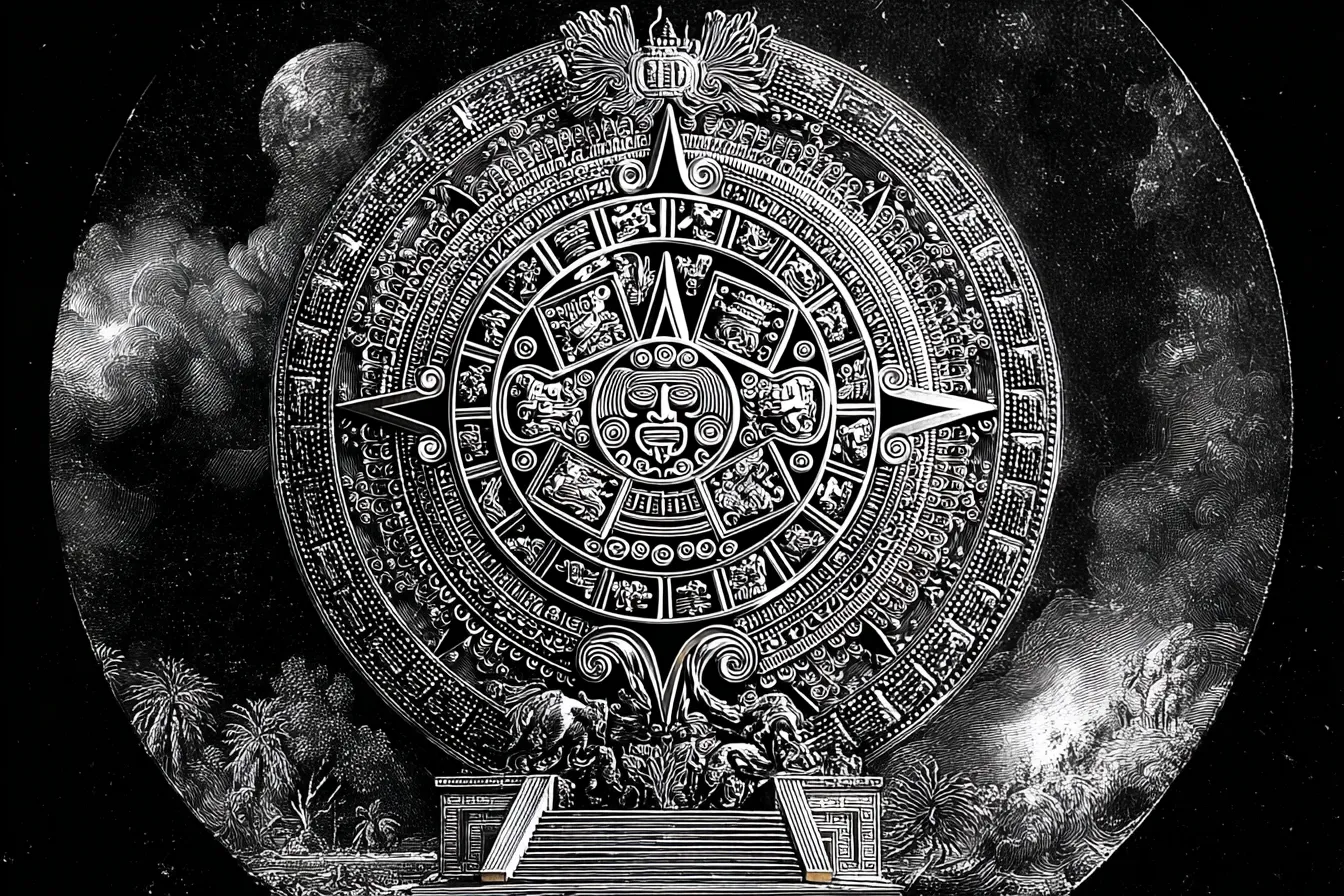
When people say “Aztec calendar,” they usually mean the famous circular stone carving — the Sun Stone — that depicts a complex cosmological diagram at the center of which sits the face of the sun deity Tonatiuh. That stone is real, magnificent, and genuinely important. But it’s not a calendar in the sense of tracking days.
The actual Aztec calendar system was something considerably more personal.
The Mexica (the people we now call the Aztecs) used two interlocking calendars simultaneously. The first was the Xiuhpohualli — a 365-day solar year that tracked seasons, agricultural cycles, and the ceremonial year. The second, and for personal divination far more important, was the Tonalpohualli — the “day count” or “count of days” — a 260-day sacred cycle that assigned every single day in its span a specific combination of number and day-sign.
The 260-day cycle was not arbitrary. It corresponds, within about a day, to the human gestational period — the time from conception to birth. Mesoamerican civilizations may have developed it as a way of mapping the sacred rhythm of human becoming onto the rhythm of the calendar. Whether or not that origin story is precisely correct, the correspondence gave the Tonalpohualli its primary function: every child born into a specific day of the cycle was understood to carry the qualities of that day’s number and sign as a permanent character-mark.
Your position in the Tonalpohualli is your Aztec sign. And unlike most “what’s your sign” systems, the Tonalpohualli gives you not one attribute but two: a number (1 through 13) and a day sign (one of 20 named symbols), whose combination creates your specific tonal energy within the 260-day cycle.
How the Tonalpohualli Works
The Tonalpohualli cycles through 260 days by combining two independent counts:
The 13-day number cycle: 1, 2, 3, 4, 5, 6, 7, 8, 9, 10, 11, 12, 13, then back to 1.
The 20-day sign cycle: Twenty named day signs that repeat in fixed sequence.
These two cycles run simultaneously. Day 1 is “1 Crocodile.” Day 2 is “2 Wind.” Day 3 is “3 House.” Day 14 is “1 Jaguar” — the number resets to 1 while the sign cycle has moved to Jaguar. The two cycles only return to the same combination after 260 days (the least common multiple of 13 and 20), at which point the Tonalpohualli completes one full cycle and begins again.
Each 13-day period — called a trecena — was associated with a patron deity and had a general quality that colored the days within it. But your personal sign is more specific than the trecena: it’s the specific day-number + day-sign combination of your birthday.
The 20 day signs and their primary associations are the core vocabulary of the system. Understanding them is the foundation of reading your Aztec sign.
The 20 Day Signs
1. Cipactli — Crocodile (Alligator)
Element: Earth | Direction: East
Cipactli is the first day sign — the primordial sea monster from whose body the earth was formed in Aztec creation mythology. It represents the earth itself, creative power, and the energy of beginning. People born under Cipactli are often strongly grounded, practically capable, and connected to material reality in a way that others find stabilizing. They tend to be persistent, sometimes stubborn, and unusually effective at building what endures. The shadow is a tendency toward rigidity and a difficulty releasing what is no longer serving them.
2. Ehecatl — Wind
Element: Air | Direction: North
Ehecatl is the wind god, a manifestation of Quetzalcoatl — the Feathered Serpent, one of the most important deities in the Mesoamerican pantheon. Wind people are often gifted communicators, quick thinkers, and natural movers between different social and intellectual worlds. They carry an energy of the breath — animating, connecting, clearing. The shadow is impermanence: wind people can struggle to stay, to root, to commit to a single direction long enough to complete what they begin.
3. Calli — House
Element: Earth | Direction: West
Calli is the house — the home, the container, the dark interior that shelters and holds. House people are often oriented toward family, domesticity, and the creation of safe, comfortable environments. They tend to be introspective, private, and most themselves when in their own space. The shadow is a tendency toward isolation and a difficulty engaging with the outer world’s demands without retreating back into the house.
4. Cuetzpalin — Lizard
Element: Earth | Direction: South
The lizard is associated with fertility, abundance, and the richness of the natural world. Lizard people are often sensually oriented, creative, and gifted at finding and enjoying pleasure. They tend to be sociable, warm, and attractive to others. The shadow is an excess of appetite — a difficulty with the discipline that sustained creative work requires.
5. Coatl — Serpent
Element: Air | Direction: East
The serpent in Mesoamerican symbolism is not the villain of Western mythology. It is associated with life force, renewal, and the vital energy that sheds its skin to become new. Serpent people are often intense, magnetic, and gifted with a kind of penetrating perception that sees past surfaces. They tend to attract others to them with unusual ease. The shadow is the serpent’s darker associations: secrecy, danger, and the potential for toxicity when the vital force isn’t consciously directed.
6. Miquiztli — Death
Element: Air | Direction: North
In the Mesoamerican worldview, death is not the opposite of life but its necessary partner — the skull is a symbol of fertility, the dead feed the living through the cycle of return. Death people are often genuinely comfortable with impermanence, endings, and the aspects of life that others prefer not to think about. They tend to have unusual resilience and a clear-eyed quality that others find either unsettling or deeply reassuring. The shadow is a morbid fixation that loses sight of what the death-cycle is actually feeding.
7. Mazatl — Deer
Element: Earth | Direction: West
The deer is associated with grace, gentleness, and the quality of attention that moves carefully through the world without disturbing it. Deer people tend to be sensitive, aesthetically attuned, and gifted at reading the emotional texture of environments. They often have a particular quality of gentleness that draws others to them. The shadow is an extreme sensitivity that makes ordinary conflict intolerable and leads to chronic avoidance.
8. Tochtli — Rabbit
Element: Earth | Direction: South
The rabbit is associated with pulque — the sacred fermented drink of the Aztecs — and with the 400 rabbit-gods who personify intoxication, excess, and abundance. Rabbit people are often joyful, fertile, and gifted with a creative energy that can produce a great deal. They tend toward abundance in all things — ideas, relationships, material goods. The shadow is that same abundance becoming excess: a difficulty with moderation and a tendency to overcommit.
9. Atl — Water
Element: Water | Direction: East
Water people carry the qualities of the element itself: flow, depth, the capacity to take any shape, the potential for both nourishment and destruction. They tend to be emotionally deep, adaptable, and attuned to the undercurrents in any situation. The shadow is the flooding water — emotion without containment, or an over-adaptation that has no stable self beneath the changes.
10. Itzcuintli — Dog
Element: Earth | Direction: North
The dog in Aztec mythology was the companion of the dead — Xolotl, the dog-god, guided souls through the underworld. Dog people are associated with loyalty, service, and the capacity for unconditional companionship. They tend to be deeply faithful, genuinely helpful, and oriented toward the wellbeing of others. The shadow is an excessive loyalty that becomes servility, or an inability to prioritize their own needs alongside those of others.
11. Ozomatli — Monkey
Element: Air | Direction: West
The monkey is the patron of arts, games, and the joyful disorder of creativity. Monkey people are often gifted artists, performers, and storytellers — energetic, playful, and able to make others laugh. They tend to be socially skilled and to bring a lightness to serious situations. The shadow is the trickster who cannot be serious when seriousness is required, and a tendency to use humor and play as a shield against depth.
12. Malinalli — Grass (Twisted)
Element: Earth | Direction: South
Malinalli is the twisted grass — the plant that bends but doesn’t break, that grows in difficult places, that can be used to bind and to weave. Grass people are often characterized by resilience, tenacity, and the capacity to survive in conditions that defeat others. They tend to be persistent problem-solvers with an unusual comfort in adversity. The shadow is an over-identification with struggle — a difficulty accepting ease, or a tendency to create conflict where none exists.
13. Acatl — Reed
Element: Air | Direction: East
The reed is the material from which arrows are made — the vehicle of directed force, precision, and the capacity to reach a distant target. Reed people are often highly directed, purposeful, and capable of sustained focus on a long-term goal. They tend to be ambitious and effective at channeling their energy toward specific ends. The shadow is rigidity — the straight reed that cannot bend.
14. Ocelotl — Jaguar
Element: Earth | Direction: North
The jaguar was one of the most powerful symbols in the Aztec cosmology — associated with the night sky, with warrior power, and with the Jaguar Warriors, the elite military order. Jaguar people carry this power: they are often physically capable, strategically minded, and effective under pressure. They tend to move with a quality of controlled power that others find compelling. The shadow is aggression and a difficulty channeling the jaguar’s force without causing unnecessary damage.
15. Cuauhtli — Eagle
Element: Air | Direction: West
The eagle was the symbol of the sun warrior — the great vision that sees from above, the capacity to rise above the immediate and perceive the larger pattern. Eagle people tend to be visionary, high-minded, and genuinely gifted at seeing what others miss from ground level. They often have natural leadership qualities and a drive toward significance. The shadow is a quality of remove — the eagle’s altitude becomes a distance from the human and particular.
16. Cozcacuauhtli — Vulture
Element: Air | Direction: South
The vulture is one of the most misunderstood symbols in any tradition — in Mesoamerica, the vulture was associated with wisdom, longevity, and the sacred function of return. Where others see only decay, the vulture sees the nutrients being recycled back into life. Vulture people tend to have an unusual capacity for perspective, patience, and the long view. They are often gifted at finding value where others see only waste. The shadow is a detachment that borders on coldness, or a comfort with decay that loses sight of what might still be saved.
17. Ollin — Movement / Earthquake
Element: Earth | Direction: East
Ollin is the most cosmologically significant of the day signs — it is the glyph of the current age (the Fifth Sun) in Aztec cosmology, the age that will end in earthquake and movement. Ollin people carry this quality of radical presence and existential urgency. They tend to be deeply engaged with life, intensely present, and driven by a sense that what matters must be attended to now. The shadow is a chronic instability — the earthquake that destroys what it inhabits.
18. Tecpatl — Flint Knife
Element: Air | Direction: North
The flint knife is the tool of sacrifice — the instrument that cuts, that separates, that makes the ritual possible. Tecpatl people are often gifted with sharp discernment, a capacity for decisive action, and a quality of clarity that cuts through confusion. They tend to be effective in roles that require difficult decisions and a willingness to separate what should be separated. The shadow is the knife without a hand to direct it — indiscriminate cutting.
19. Quiahuitl — Rain
Element: Water | Direction: West
Rain is the gift and the threat — the water that makes life possible and, in excess, the flood that destroys it. Rain people tend to be generous, emotionally rich, and gifted at nourishing others. They often have a quality of abundance that others find sustaining. The shadow is an emotional excess that overwhelms — the flood that sweeps away the very things it was meant to water.
20. Xochitl — Flower
Element: Earth | Direction: South
Xochitl is the last of the 20 day signs — the flower, the culmination of growth, the beauty that emerges at the end of the cycle. Flower people are associated with art, beauty, love, and the highest expressions of human creativity and feeling. They tend to be gifted aesthetically, naturally attuned to what is beautiful and meaningful, and often drawn to work that involves creating beauty for others. The shadow is a fragility — the flower that cannot withstand the wind — and a tendency toward superficiality that loves the bloom but resists the root-work.
The Number Modifier: 1 Through 13
Your birth sign is not just a day sign — it is a day sign modified by a number from 1 to 13. The number significantly affects how the sign’s energy expresses.
1: The pure, unmodified energy of the sign — most intensely itself, for better or worse. 2: Duality, companionship, the need for a counterpart. The sign expresses best in partnership. 3: Creative expression, self-assertion, a quality of active outward energy. 4: Stability, solidity, the four directions. Grounding energy that can become heaviness. 5: Challenge, conflict, the energy that tests. People born on 5-days often face unusual obstacles that ultimately strengthen. 6: Flow, productivity, and the energy of craft. Often associated with skilled work. 7: Mystery, hidden knowledge, and the deepest expression of the sign’s core nature. 7-days carry unusual intensity. 8: Harmony, balance, and the integration of opposites. Often considered a favorable number. 9: Expansion, teaching, and the sign at its most outward and social. 10: Completion of one cycle and the approach of another. A number of culmination and assessment. 11: Instability and creativity — the number that disrupts in order to generate. 12: Patience, service, and the energy of what must be endured before completion. 13: The sacred number, associated with the highest powers. 13-day births carry the sign’s most spiritually charged quality. Considered both the most powerful and the most difficult.
Your Tonalpohualli Sign and the Broader System
The Tonalpohualli was used by tonalpouhque — day-sign readers, the specialists who interpreted birth signs — for purposes that went beyond personality assessment. They read the day sign to determine auspicious timing for naming ceremonies (held 20 days after birth if the birth day was inauspicious), for career guidance, for marriage timing, and for reading the quality of specific periods in a person’s life.
The Tonalpohualli also interacted with the longer 52-year Calendar Round — the full cycle created by the interlock of the 365-day solar year and the 260-day sacred year. Within the Calendar Round, your birth position in the Tonalpohualli could be tracked against the ongoing cycles of years to identify periods of particular significance, challenge, or opportunity.
The system is, in other words, a timing system as much as a character system — exactly the same logic that underlies BaZi and the Nakshatra-based Dasha system. Different traditions, different symbols, the same fundamental insight: your birth position within a cyclical framework tells you something about your nature, and the cycle’s ongoing movement tells you something about your timing.
How The Whisper Uses Your Tonalpohualli Sign
The Whisper calculates your Tonalpohualli sign from your birth date — identifying both your day sign and your number modifier — and includes it as one layer of your divination profile. In your daily reading, the current day’s Tonalpohualli position (the day sign and number of today’s date within the ongoing 260-day cycle) is read in relationship to your birth sign, tracking how today’s tonal energy resonates with or challenges your natal position.
This is the layer of The Whisper that most distinctly reflects the non-Western, non-Asian traditions in the oracle. Alongside your BaZi, Nakshatra, Nine Star Ki, and I Ching readings, your Tonalpohualli sign adds the voice of the Mesoamerican observation tradition — a tradition that spent centuries watching the relationship between time, character, and the sacred cycles that neither culture created nor controlled.
The 260-day sacred calendar is still in continuous, uninterrupted use in some indigenous Mayan communities in Guatemala, where it has been kept without a single day’s interruption since before the Spanish conquest. That continuity is worth something. It suggests that the people who maintained this calendar found it useful enough — revealing enough about the texture of days and the character of individuals — to carry it across five centuries of pressure to abandon it. That’s a different kind of validation than a peer-reviewed study, but it isn’t nothing.