
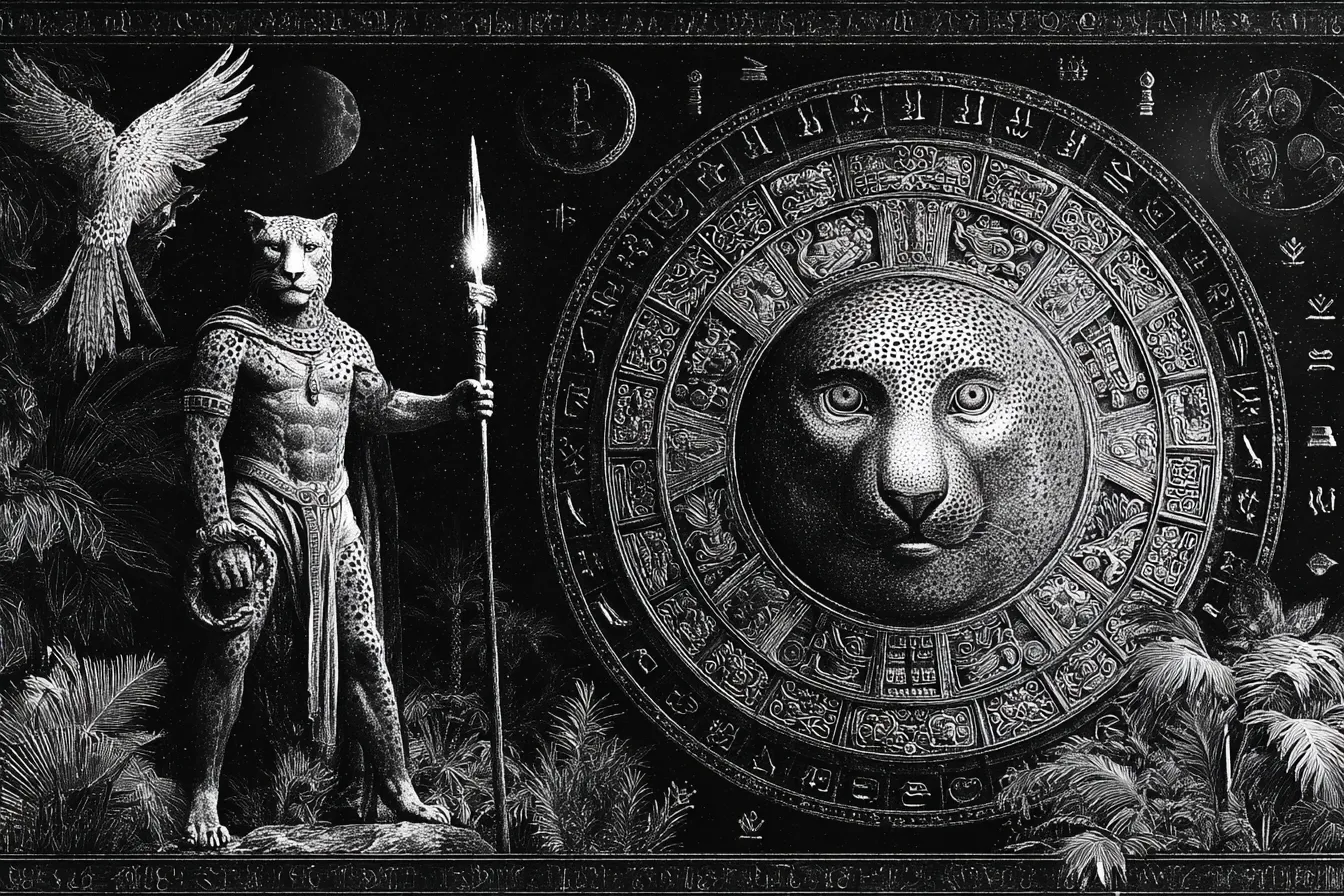
What is Oc?
Oc is the tenth of twenty Solar Seals in the Mayan Tzolkin — the 260-day sacred calendar built from twenty day signs cycling through thirteen numbered tones, producing 260 unique combinations called Kin. The Tzolkin has been in continuous use among Maya peoples for at least 2,500 years and remains a living tradition today. Ajq’ij — Maya day keepers and ceremonial priests — continue to guide communities through the Tzolkin cycle in Guatemala and southern Mexico, where the Chol Q’ij (the K’iche’ Maya name for the calendar) is woven into both ceremonial and everyday life.
The Whisper integrates the Tzolkin alongside Western Astrology, Nine Star Ki, and BaZi into a single daily personal insight. Your birth seal is calculated by locating your birth date within the Tzolkin cycle using the GMT correlation constant (584283) — the most widely accepted scholarly alignment between the Maya Long Count and the Gregorian calendar. This differs from the Dreamspell system developed by José Argüelles in 1987, which applies a different correlation and sometimes different seal names, and which can produce a different result for the same birth date. Many English-language tools for finding a “Mayan day sign” use the Dreamspell framework; The Whisper uses the traditional GMT correlation throughout. In addition to your birth seal, the daily seal marks the current day’s shared position in the Tzolkin cycle and The Whisper synthesizes both with the other active systems to generate each day’s insight.
Oc arrives at position ten — the midpoint of the twenty-seal cycle, the moment when the Tzolkin’s first complete arc of development reaches a natural resting point. The preceding nine seals traced the cycle from the primordial ocean (Imix) through breath (Ik), interior depth (Akbal), encoded potential (Kan), embodied life force (Chicchan), transformative release (Cimi), skilled accomplishment (Manik), radiant harmony (Lamat), and purifying emotional flow (Muluc). Oc at position ten is the seal that receives all of this and returns it as something simple, direct, and complete: unconditional love. The heart’s intelligence that does not calculate.
The symbol and its traditional roots
The glyph associated with Oc in Maya iconography depicts the dog — the animal that, in Mesoamerican cosmology, holds a position of profound and specific significance. The dog in Maya tradition was the guide of the dead through the underworld: Xolotl in Aztec cosmology, the hairless dog who accompanied souls on their passage through Xibalba, the Maya underworld, guiding them through the trials of death toward whatever came after. The dog was not primarily a domestic companion in Mesoamerican symbolism but a sacred guide — the animal that knows the way through the dark, that can be trusted absolutely when the passage is most uncertain, and whose loyalty to the person in its care does not waver regardless of the difficulty of the terrain.
This underworld guide quality adds a dimension to Oc’s love that is worth understanding carefully. The love of the White Dog is not the comfortable, pleasant love of easy circumstances; it is the love that holds through the most difficult passages, that does not abandon when the situation becomes genuinely hard, and that guides through the dark with a quality of absolute reliability. The Maya dog’s loyalty is not the loyalty of the pet who stays because it is comfortable and fed; it is the loyalty of the guide who stays because the person in its care genuinely needs it and because that need is, for the dog, a complete and sufficient reason.
The heart’s direct intelligence that Oc carries is also embedded in the dog archetype in a way that is worth examining. The dog does not analyze its love; it does not construct criteria for who deserves its loyalty and then evaluate candidates against those criteria. The dog’s love is prior to and independent of evaluation — it arises from direct, heart-level recognition that bypasses the mind’s categorizing function entirely. This is what the Tzolkin tradition identifies as the heart’s intelligence: not the emotional reactivity of momentary feeling, but the deep, stable, non-calculating recognition that is the heart’s own form of knowing.
In the Aztec Tonalpohualli, the corresponding day sign is Itzcuintli — the Dog, carrying the same imagery and the same underworld guide associations across both Mesoamerican traditions. In Aztec cosmology, the dog’s role as companion and guide of the dead was embodied specifically in the hairless Xoloitzcuintli, a dog breed considered sacred precisely for its ability to cross between the world of the living and the world of the dead. Both Oc and Itzcuintli carry this threshold-crossing quality: the love that is not limited to the living world but accompanies through whatever passage is required.
The color associated with Oc is White, and the direction is North — the direction the Tzolkin associates with the mind’s clarifying and refining quality. White seals carry qualities of clarity, discernment, and the refinement that separates what is essential from what is not. Oc as a White/North seal brings this clarifying, refining quality to its love nature: the heart’s intelligence that sees clearly, the loyalty that is not distorted by projection or wishful thinking, the guidance that is reliable precisely because it is grounded in genuine, clear recognition rather than in the mind’s more easily distorted constructions.
The energy of Oc
The traditional meaning of Oc centers on unconditional love as a form of intelligence — not the sentimental emotion that the word “love” often evokes in contemporary usage, but the heart’s direct knowing that recognizes what genuinely matters and orients toward it with complete reliability. This is the quality that the dog archetype carries most essentially: the capacity to be present to another being with a quality of wholehearted, non-calculating attention that is, in its own way, as precise and accurate as any other form of intelligence, and that produces a form of knowing that analysis alone cannot access.
The Tzolkin tradition is careful to distinguish between the unconditional love of Oc and other forms of love that might appear similar on the surface. Unconditional in the Oc tradition does not mean undiscriminating or without standards; it means that the love itself is not withheld as a reward for good behavior or withdrawn as punishment for failure. The dog guides the soul through the underworld not because the soul has earned it but because guiding is what the dog does — because the soul’s need and the dog’s nature are in a relationship that does not require negotiation. This quality of non-transactional, genuinely given love is what the tradition identifies as the heart’s most essential characteristic.
Loyalty that holds through difficulty is another central Oc quality that the tradition addresses directly. The guide dog in the underworld does not turn back when the passage becomes treacherous; the loyalty that Oc carries is specifically the kind that is most present and most reliable in the situations where reliability matters most. This is not merely steadiness in comfortable circumstances but the quality of love that deepens under pressure rather than diminishing — the heart’s intelligence that knows the difference between a situation that is difficult and one that is genuinely reason to withdraw, and that chooses, in most cases, to hold.
There is also a quality of genuine, present companionship in Oc that the tradition emphasizes — the dog who is simply, fully, unhesitatingly present to the person in its care, without agenda, without distraction, and without the half-attention of a being whose presence is conditional on circumstances being favorable. This quality of complete, agenda-free presence is one that the Tzolkin tradition identifies as both rare and genuinely nourishing — the experience of being truly accompanied, of having another being whose attention is wholly and actually on you, is one of the deepest forms of support available in human life.
The guidance quality of Oc — the dog as guide rather than simply companion — adds an important dimension to the seal’s love energy. Oc love does not merely accompany; it orients. The guide dog does not simply stay close; it knows the way and leads through the dark with a confidence that the soul in its care cannot yet have, because it has not yet made the passage. Oc carries this quality of love as genuine orientation — the heart’s intelligence that knows where genuine good lies and moves toward it with a reliability that thinking alone cannot provide.
Oc as a birth seal and daily seal
As a birth seal, Oc in the Tzolkin tradition is associated with the person who carries the quality of unconditional, heart-intelligent love as their primary orientation — someone whose most characteristic quality is the depth and reliability of their care for others, whose presence tends to have a genuinely nourishing and orienting effect, and whose natural mode of engagement with the world is through the heart’s direct intelligence rather than through the mind’s categories. The birth tone modifies how this expresses in practice: a person born on Oc with Tone 4 carries the love quality with a more stabilizing, structural dimension; someone born on Oc with Tone 9 may carry it with a more complete, accomplished quality.
People born under Oc are traditionally associated with a particular capacity for genuine, sustained loyalty — the ability to hold their care and commitment to others through difficulty and change in a way that people with more conditionally oriented seal energies may find difficult to sustain. This is not rigidity or unwillingness to change; it is the quality of the guide who knows that the passage through the dark requires a reliable constant, and who provides that constant as a natural expression of their own nature rather than as an effortful discipline.
There is also a traditional association between Oc and the capacity to know what another person genuinely needs through the heart’s direct perception rather than through analysis or inference. The dog who guides does not reason about the best route; it knows. Oc birth-seal people are sometimes described in the Tzolkin tradition as having a quality of heart-level attunement to others — a form of caring intelligence that can sense what is genuinely needed and orient toward it with a directness and reliability that is, in the tradition’s framing, a form of genuine gift.
As a daily seal, when Oc appears as the current day’s position in the Tzolkin cycle, the tradition suggests a quality of heart-level opening and genuine, non-calculating presence — a day when the capacity for unconditional love, genuine companionship, and the heart’s direct intelligence tends to be more available than usual, when acts of genuine care and loyal support tend to carry particular weight. The Whisper synthesizes this with the other active systems to generate the specific texture of that day’s reading.
Strengths and growth edges
The strengths traditionally associated with Oc are rooted in its relationship to the heart’s intelligence and unconditional love. The capacity for genuine, unconditional care is the most fundamental — the ability to love without the calculating quality that conditions love on performance, reciprocity, or worthiness. This is a quality that the Tzolkin tradition treats as genuinely rare and genuinely valuable: the experience of being loved without condition is one of the most nourishing things available in human life, and the capacity to offer that quality is a meaningful gift.
The loyalty that holds through difficulty is the second major strength — the quality of the guide dog who is most present and most reliable precisely when the passage is most uncertain. This expresses in human life as the capacity to remain genuinely present to people and commitments through the full arc of their development, including the difficult phases, and to provide a quality of consistent, reliable care that does not diminish when circumstances become challenging.
The heart’s direct intelligence — the knowing that arises from genuine love rather than from analysis — is the third recognized Oc strength. This form of intelligence is not inferior to rational knowing but differently constituted and differently available: it perceives what cannot be deduced, orients toward what cannot be located through analysis, and provides a form of guidance that is most reliable in exactly the situations where analysis reaches its limits.
The growth edges associated with Oc follow the shadow dimensions of these gifts with characteristic directness. The loyalty that persists beyond wisdom is the primary growth edge — the unconditional quality of Oc love that continues to hold in situations where genuine wisdom would recognize that release is what is needed. Not all relationships, commitments, or passages require the guide dog’s sustained presence; some require the ability to let go and trust the soul to find its own way.
The love that cannot set necessary limits is a closely related growth edge — the Oc quality that has become so oriented toward unconditional care that it cannot provide the clear limits that genuine care sometimes requires. The guide dog who never objects, who accommodates every direction the soul wishes to go including those that lead deeper into danger, is not being loving in the fullest sense but has lost the guidance quality that makes its love genuinely useful.
Finally, the heart’s intelligence mistaken for the mind’s judgment is a recognized Oc growth edge — the assumption that because the heart’s knowing is genuine, it is also complete; that because Oc can sense what another person needs at a deep level, it always knows what is best for them.
What Oc means in The Whisper
In The Whisper’s multi-system synthesis, Oc resonates across several traditions in ways that illuminate its essential qualities from complementary perspectives.
The resonance with Western Astrology is strongest with Venus and the Moon in Cancer — the loving, loyal, heart-centered, and deeply nurturing qualities of the two most relational bodies in the Western astrological tradition. Venus governs the capacity to love, to form genuine bonds of care and affection, and to be oriented toward the good of another as a primary value rather than as a means to other ends. The Moon in Cancer governs the sheltering, unconditionally nurturing quality of the deep maternal — the love that holds without calculating, that is present before it is asked, and that endures through difficulty because enduring is its nature. The combination of Venus’s love-orientation and the Moon’s unconditional, sheltering quality captures the Oc energy closely. When The Whisper synthesizes an Oc influence with a strong Venus or Moon in Cancer quality from the Western layer, the heart-centered, genuinely caring, and loyal dimension of that day’s reading may be particularly amplified.
In Nine Star Ki, the resonance is with the Two Black Earth Star (二黒土星) — the quietly devoted, reliably present quality of deep, patient love. In Nine Star Ki, the Two Black Star is associated with the mother archetype, with the nourishing earth that sustains without announcing itself, with the kind of care that is expressed through consistent, reliable, unhurried presence rather than through dramatic gesture. The Two Black Star’s quality of being genuinely, fully available to others without needing recognition or reciprocity resonates closely with Oc’s unconditional, guide-dog love. When Oc appears alongside a Two Black Earth Star influence in The Whisper’s Nine Star Ki layer, the quietly devoted, sustainingly present quality of the heart’s intelligence may be especially present.
From a BaZi perspective, the resonance is with Bing Fire (丙火) — the warm, generous, unconditional quality of solar warmth that shines on everyone equally. Bing Fire in BaZi is yang fire in its most open, generous expression: the sun’s warmth that does not filter or qualify its giving, that illuminates and warms everything within its reach without calculating whether each recipient deserves it. In its Oc expression, Bing Fire carries the quality of love as light — genuine, freely given, not hoarded or directed only toward those who have earned it, but offered with the completeness and reliability of the sun that rises regardless of what happened yesterday. When Oc appears alongside a Bing Fire influence in The Whisper’s BaZi layer, the unconditional, openly generous, warmly present quality of the heart’s intelligence may be particularly prominent.
The Aztec Tonalpohualli equivalent, Itzcuintli (the Dog), adds the specific dimension of the sacred underworld guide — the love that accompanies through the most difficult and uncertain passages, that is most reliably present when the terrain is most challenging, and that knows the way through the dark not because it has been told but because guiding through the dark is what it is. This frames Oc’s loyalty not as comfortable steadiness but as genuine courage — the heart that stays not because staying is easy but because the one in its care genuinely needs it.
In The Whisper’s daily synthesis, Oc days carry the quality of heart-level opening and genuine, non-calculating care — days when the capacity for unconditional love, loyal presence, and the heart’s direct intelligence tends to be more available.
Frequently asked questions
Q: How is Oc’s unconditional love different from Ahau’s, which also seems to be associated with universal love?
The Tzolkin tradition distinguishes between the two love seals in a way that is worth understanding clearly. Oc’s love is the love of the companion and guide — personal, present, loyal, and specifically oriented toward the particular being in its care. It is unconditional in the sense that it does not calculate or withdraw, but it is also genuinely relational: the dog knows its person. Ahau’s love (Solar Seal 20) is the love of the sun — universal, radiant, and genuinely undifferentiated. The sun does not have a relationship with any particular flower; it shines on all of them with the same quality of unconditional warmth. Oc’s love is the heart that accompanies through the dark; Ahau’s love is the sun that illuminates everything equally and without distinction. Both are expressions of love in the Tzolkin tradition, but they operate at different scales and with different qualities of specificity.
Q: Does having Oc as a birth seal mean I will always prioritize others’ needs over my own?
The Tzolkin tradition associates Oc with the capacity for unconditional love and genuine care — but this is a description of a natural orientation and a potential resource, not a prescription for self-neglect. The growth edges of Oc include specifically the challenges that arise when the love quality has not been balanced with the discernment to know when loyalty is wisdom and when it has become its own form of avoidance. The tradition does not suggest that Oc people are destined to over-give; it suggests that the development Oc is oriented toward involves learning to hold genuine unconditional care alongside the clarity about one’s own needs and limits that makes sustainable giving possible. The guide dog who does not rest eventually cannot guide.
Q: How does The Whisper calculate birth seals, and why might my result differ from other sources?
The Whisper uses the GMT correlation constant (584283), the most widely accepted scholarly alignment between the Maya Long Count and the Gregorian calendar, and the correlation used by traditional Maya practitioners and communities today. Many English-language Mayan astrology tools and apps are based instead on the Dreamspell system developed by José Argüelles in 1987, which applies a different correlation constant and sometimes different seal names. The two systems can produce different results for the same birth date, and they represent genuinely different frameworks rather than different presentations of the same information. If your result in The Whisper differs from a day sign you have received elsewhere, both are internally consistent within their respective systems — but knowing which system you are working with matters for understanding what the result means.