
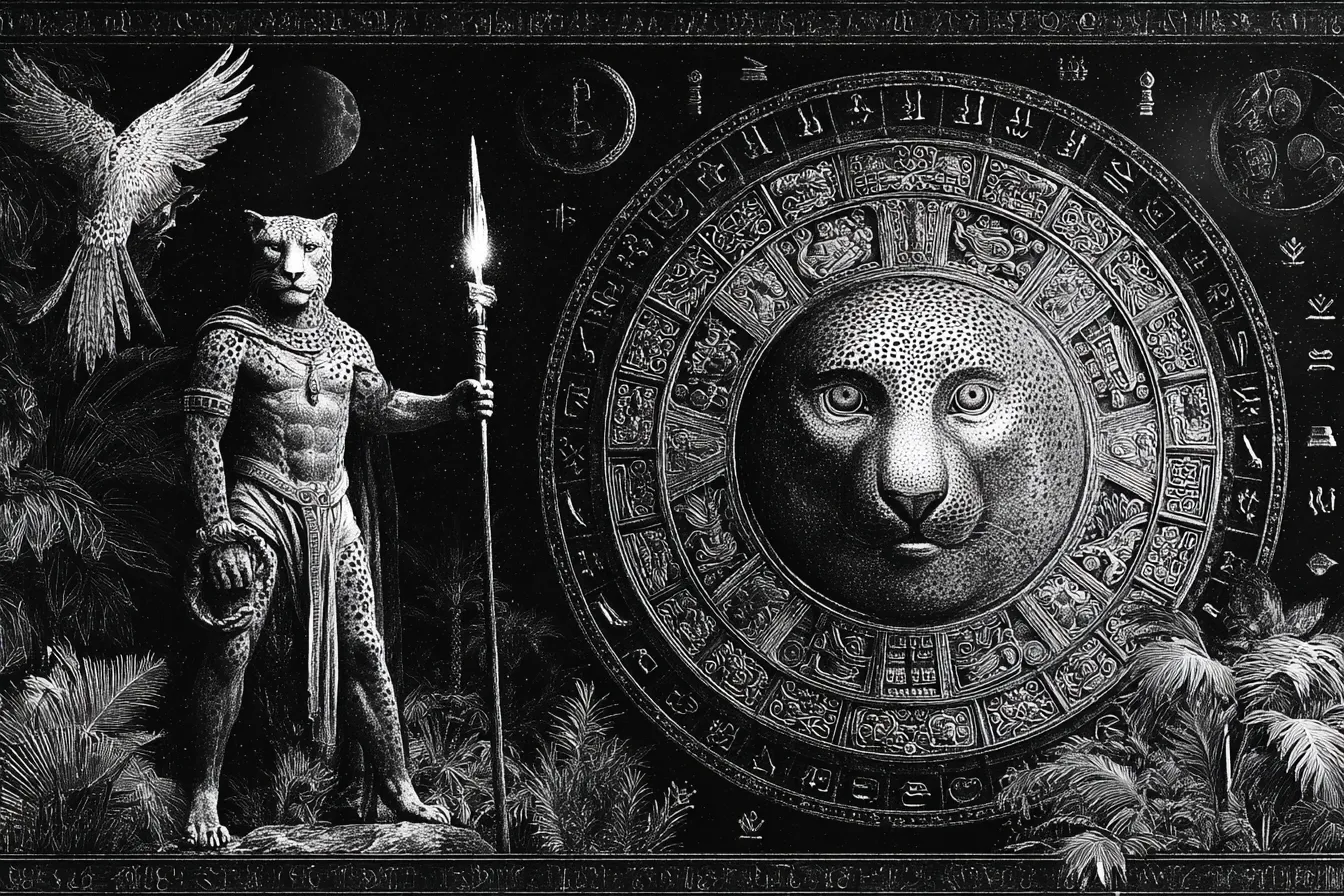
Most people encounter the Mayan calendar through the lens of apocalypse — the 2012 “end of the world” narrative that turned the completion of a major Mayan calendar cycle into a global media event. What that narrative missed, almost entirely, was that the calendar it was misreading is still in active, daily use among Mayan communities in Guatemala and southern Mexico, and has been without a single day’s interruption for at least two thousand years.
The calendar in question is the Tzolkin — the 260-day sacred count — and the people who maintain it, the Ajq’ijab’ (day-keepers) of the K’iche’ Maya, use it not to predict catastrophes but to answer the questions that have always mattered most: what is the quality of today? Who is this child, born on this particular day? What does this moment in the cycle ask of the person living through it?
Your position in the Tzolkin is not exotic trivia. It is your specific coordinate in a system of considerable precision, developed by a civilization that was arguably more sophisticated in its astronomical and mathematical understanding than any contemporary culture, and maintained through conquest, colonization, and cultural suppression by the sheer force of its practical usefulness.
How the Tzolkin Works
The Tzolkin is a 260-day cycle created by the interaction of two independent counts:
The 20 Solar Seals (also called Day Signs or nawales): twenty named symbols that cycle continuously in a fixed sequence — Crocodile, Wind, Night, Seed, Serpent, World-Bridger, Hand, Star, Moon, Dog, Monkey, Road, Reed, Jaguar, Eagle, Warrior, Earth, Mirror, Storm, Sun — and then begin again.
The 13 Galactic Tones: numbers from 1 to 13 that cycle independently alongside the Solar Seals.
These two cycles run simultaneously. Because 13 and 20 share no common factors, the combination of any specific Seal with any specific Tone won’t repeat until 260 days have passed (13 × 20 = 260). Every one of those 260 days has a unique Seal-Tone combination — and the day you were born gives you your Tzolkin birth profile: your Solar Seal and your Galactic Tone.
Your Solar Seal describes your core nature, your gifts, and the primary quality you carry through this lifetime. Your Galactic Tone describes how that nature expresses — the energetic quality, the challenge, and the power of your specific position within the 13-step cycle.
Together, they create a two-dimensional coordinate that is specific to you and to your position in the Tzolkin’s ongoing movement.
The 20 Solar Seals
Each Solar Seal has a name, a primary quality, and a set of associations that have been developed through centuries of Ajq’ijab’ practice. The names below use the most widely accepted contemporary English translations; the K’iche’ Mayan names follow in parentheses.
1. Crocodile — Imox (Imox)
Element: Water | Direction: East | Color: Red
Crocodile is the first seal — primordial, instinctive, connected to the deep waters from which life emerges. Crocodile people carry a quality of ancient knowing, strong intuition, and a fundamental groundedness in the body and in nature. They often have unusual sensitivity to environmental and emotional currents that others don’t consciously register. The shadow is a difficulty functioning in the rational, analytical world when intuitive knowledge and logical reasoning point in different directions.
2. Wind — Iq’ (Iq’)
Element: Air | Direction: North | Color: White
Wind is the breath that animates — the voice, the spirit, the communication that moves between people. Wind people are often gifted communicators, messengers of ideas, and carriers of inspiration. They tend to move quickly through ideas and environments, bringing energy and freshness. The shadow is the wind that doesn’t settle — a tendency to scatter rather than deepen, to carry messages without staying long enough to understand their consequences.
3. Night — Aq’ab’al (Aq’ab’al)
Element: Earth | Direction: West | Color: Blue/Black
Night is the darkness before dawn — the time of dreaming, of interior richness, of the imagination that works while the outer world sleeps. Night people often have powerful inner lives, strong creative imagination, and a quality of depth that takes time to reveal. They are frequently most themselves in quiet, private settings. The shadow is a difficulty bringing the interior richness into exterior form — the dream that stays a dream.
4. Seed — K’at (K’at)
Element: Fire | Direction: South | Color: Yellow
Seed is the gathering and the net — it represents abundance, the accumulation of what is needed, and the capacity to hold many things together. Seed people are often naturally gifted at coordination, at bringing different elements into productive relationship, and at creating the conditions for growth. They tend to be social connectors and resource-gatherers. The shadow is entanglement — the net that captures rather than connects, or the abundance that becomes hoarding.
5. Serpent — Kan (Kan)
Element: Fire | Direction: East | Color: Red
Serpent is life force itself — the primal vital energy that moves through the body, the kundalini that ascends, the power that sheds its skin to become new. Serpent people tend to have strong physical presence, intense vitality, and a magnetic quality that others feel in their body before they understand it rationally. They often have natural authority and sensory intensity. The shadow is the serpent’s toxicity — the same vital force that heals can also poison.
6. World-Bridger — Kame (Kame)
Element: Air | Direction: North | Color: White
World-Bridger is the mediator between worlds — the one who crosses the threshold between the living and the dead, the known and the unknown, the visible and the invisible. World-Bridger people are often gifted at transitions — at helping things complete, at navigating endings with grace, and at moving between very different realms of experience without losing themselves. The shadow is an over-familiarity with death that loses the capacity to fully inhabit life.
7. Hand — Manik’ (Manik’)
Element: Earth | Direction: West | Color: Blue/Green
Hand is the accomplisher — the seal of healing through action, of skill applied, of work done with the hands in the most literal and metaphorical sense. Hand people tend to be gifted with craftsmanship, with healing arts, and with the practical intelligence that knows how to do things. They are often effective, reliable, and deeply connected to the process of making. The shadow is a tendency to grasp — the hand that holds too tightly.
8. Star — Lamat (Lamat)
Element: Water | Direction: South | Color: Yellow
Star is the seed of light — associated with Venus, with harmony, and with the beauty that radiates outward without effort. Star people often have natural beauty, aesthetic gifts, and a quality of creative fertility — they tend to generate abundance in whatever they touch. The shadow is an excess of the star’s own light — vanity, a preoccupation with how one appears, or a scattering of light in too many directions at once.
9. Moon — Muluk (Muluk)
Element: Water | Direction: East | Color: Red
Moon is the purifying water — the rain, the river, the emotional current that cleanses and carries. Moon people are often deeply feeling, highly adaptive, and attuned to the emotional undercurrents of their environment. They tend to have strong empathy and a fluid quality of being that allows them to move through different circumstances without rigidity. The shadow is emotional flooding — an excess of feeling that overwhelms form.
10. Dog — Ok (Ok)
Element: Fire | Direction: North | Color: White
Dog is the loyal guide — the companion on the journey, the one who finds the way and stays faithfully close. Dog people tend to be deeply loyal, community-oriented, and gifted with the quality of unconditional love. They are often natural guides and helpers, and they tend to form bonds of unusual depth and duration. The shadow is loyalty that becomes self-abandonment — the dog who forgets its own needs in service of its companions.
11. Monkey — Chuwen (Chuwen)
Element: Air | Direction: West | Color: Blue/Green
Monkey is the master of arts and play — the trickster-weaver who creates beauty through irreverent intelligence. Monkey people are often gifted artists, storytellers, and creative generators who can find the humor and possibility in any situation. They tend to have a quality of inspired improvisation. The shadow is the endless play that never becomes craft — the trickster who refuses to serve the work with the patience it requires.
12. Road — Eb (Eb)
Element: Earth | Direction: South | Color: Yellow
Road is the path through life — the grass path, the human road, the journey that accumulates experience step by step. Road people tend to be the practical civilizers — gifted at creating the conditions that allow communities and projects to function. They often have a quality of steady, service-oriented patience. The shadow is the road that goes nowhere specific — a tendency to keep moving without a destination.
13. Reed — Ben (Ben)
Element: Fire | Direction: East | Color: Red
Reed is the pillar that holds up the sky — the staff of authority, the backbone of the family and community. Reed people often carry a strong sense of responsibility and a quality of structural integrity. They tend to be pillars for others — reliable, upright, and present when things need holding up. The shadow is rigidity — the reed that cannot bend, the authority that becomes inflexibility.
14. Jaguar — Ix (Ix)
Element: Earth | Direction: North | Color: White
Jaguar is the shaman, the earthkeeper, the one who moves between the visible and invisible worlds with power and grace. Jaguar people tend to have strong earth connection, shamanic sensitivity, and a quality of power that operates quietly and effectively. They often have an unusual relationship to the land and to embodied wisdom. The shadow is the jaguar’s invisibility becoming isolation — the capacity to move unseen that becomes a withdrawal from human connection.
15. Eagle — Men (Men)
Element: Air | Direction: West | Color: Blue/Green
Eagle is the visionary — the one who sees from above, who perceives the large pattern, who carries the vision of what could be. Eagle people tend to be naturally gifted with foresight, global thinking, and the capacity to inspire others with a compelling vision of the future. The shadow is the eagle’s altitude — a distance from the human and particular that makes vision inspirational but not grounded.
16. Warrior — Kib’ (Kib’)
Element: Earth | Direction: South | Color: Yellow
Warrior is the seer who has earned wisdom through experience — not the young fighter, but the seasoned being who has survived enough to see clearly. Warrior people often have a quality of hard-won discernment, an immunity to flattery and illusion, and a directness that comes from having no energy left to waste on pretense. The shadow is a cynicism that has closed off genuine surprise.
17. Earth — Kab’an (Kab’an)
Element: Fire | Direction: East | Color: Red
Earth is the evolutionary force — the intelligence of nature, the synchronicity that reveals itself when attention is present. Earth people tend to have strong intellectual gifts, a natural alignment with synchronous events, and a quality of being that moves in harmony with the larger patterns of the world. They often have unusual experiences of meaningful coincidence. The shadow is an over-reliance on synchronicity that substitutes for practical action.
18. Mirror — Etz’nab’ (Etz’nab’)
Element: Air | Direction: North | Color: White
Mirror is the obsidian blade — the reflecting surface that shows truth without softening it, the cutting clarity that separates what is from what is merely imagined. Mirror people tend to have a gift for truth-telling, a capacity for precision, and an intelligence that cuts to the essential. The shadow is the mirror’s coldness — a clarity that reflects without warmth, that sees without caring what it wounds.
19. Storm — Kawak (Kawak)
Element: Water | Direction: West | Color: Blue/Green
Storm is the catalytic force of generation — the thunder and rain that brings transformation through disruption. Storm people tend to have a catalytic quality, a capacity to generate energy and change in their environments, and a gift for the kind of creative disruption that clears the ground for new growth. The shadow is the storm that doesn’t know when to stop — constant turbulence that exhausts rather than renews.
20. Sun — Ajpu (Ajpu)
Element: Fire | Direction: South | Color: Yellow
Sun is the last and in many ways the central seal — the hero, the one who faces the lords of darkness and returns with the light. Sun people tend to carry a quality of solar radiance, a genuine capacity to illuminate their environment, and a natural orientation toward the heroic. They often attract others to them and inspire without effort. The shadow is a burning that consumes — the sun at its most intense can scorch what it means to nourish.
The 13 Galactic Tones
Your Galactic Tone is the number — from 1 to 13 — that modifies how your Solar Seal expresses. Where the Seal describes your nature, the Tone describes the quality of how that nature moves through the world: its pace, its challenge, its particular kind of power.
Tone 1 — Magnetic
Keyword: Purpose | Challenge: Attraction
The Magnetic tone is the point of pure unified intention — the moment before action, the gathering of purpose. Tone 1 people tend to carry a quality of magnetic clarity — when they are aligned with their purpose, others are drawn toward it. The challenge is the maintenance of unity: the pull to scatter, to diversify, to lose the single thread.
Tone 2 — Lunar
Keyword: Challenge | Power: Stabilization
The Lunar tone is the first challenge — the moment when unity encounters its first opposition. Tone 2 people often have an acute sensitivity to polarities and tensions. They are gifted at identifying what needs to be resolved, what the hidden obstacle is, what the real question underneath the surface question is. The challenge is that this sensitivity to duality can become paralysis.
Tone 3 — Electric
Keyword: Service | Power: Activation
The Electric tone is energy activated into service — the spark that starts the engine. Tone 3 people tend to be energetically intense, quick to act, and gifted at activating others. They often carry a quality of infectious energy. The challenge is that electric energy without grounding can be chaotic — activation without direction.
Tone 4 — Self-Existing
Keyword: Form | Power: Definition
The Self-Existing tone is the stabilization of energy into form — the point where the activated energy finds its structure. Tone 4 people tend to be gifted at definition, at giving form to ideas, at creating the structures that allow things to become real. The challenge is a tendency toward rigidity — the form that cannot adapt.
Tone 5 — Overtone
Keyword: Radiance | Power: Command
The Overtone tone is the gathering of power at the center of the trecena cycle. Tone 5 people often have a quality of commanding presence — natural authority that doesn’t need to announce itself. The challenge is the isolation of the central position: power that isn’t shared eventually becomes lonely.
Tone 6 — Rhythmic
Keyword: Equality | Power: Organizing
The Rhythmic tone is the energy of balance — the moment when the cycle finds its equal distribution. Tone 6 people tend to be naturally gifted at organization, at creating systems that function fairly, at finding the rhythm that allows things to work. The challenge is a tendency to over-organize — to impose structure on what should flow.
Tone 7 — Resonant
Keyword: Attunement | Power: Channeling
The Resonant tone is the center of the 13-tone cycle — the point of deepest vibration and most open channeling. Tone 7 people often have a quality of unusual receptivity and sensitivity. They tend to carry messages or energies from beyond the immediate context. The challenge is the difficulty of maintaining personal boundaries when the primary gift is attunement.
Tone 8 — Galactic
Keyword: Integrity | Power: Modeling
The Galactic tone is the alignment of action with principle — doing what you believe, living what you know. Tone 8 people tend to be gifted at integrity — at the consistency between inner knowing and outer action that others find deeply trustworthy. The challenge is a rigidity of principle that makes adaptation difficult.
Tone 9 — Solar
Keyword: Intention | Power: Pulse
The Solar tone is the pulse of intention at its most expansive — the energy that radiates outward, that moves beyond the individual toward the collective. Tone 9 people often have a quality of far-reaching influence, an intention that affects beyond what they can directly see. The challenge is an over-extension — the pulse that radiates so far it loses its center.
Tone 10 — Planetary
Keyword: Manifestation | Power: Producing
The Planetary tone is the energy of manifestation — the point where intention meets the physical world and produces actual results. Tone 10 people tend to be highly effective at making things real, at completing what they begin, at working at the level of concrete results rather than abstract possibility. The challenge is an over-investment in outcome — a difficulty accepting that not all intentions will manifest exactly as planned.
Tone 11 — Spectral
Keyword: Liberation | Power: Dissolving
The Spectral tone is the energy of release — the dissolving of structures that have completed their purpose. Tone 11 people tend to have a gift for letting go, for clearing away what is finished, for the kind of liberation that comes from releasing attachment. The challenge is that the dissolving quality can be experienced as instability — a difficulty maintaining what should be maintained alongside what should be released.
Tone 12 — Crystal
Keyword: Cooperation | Power: Universalizing
The Crystal tone is the energy of collective synthesis — the gathering of what has been learned into a form that can be shared universally. Tone 12 people tend to be naturally gifted at cooperation, at creating shared understanding, and at the kind of communication that bridges different perspectives. The challenge is a tendency to sacrifice individual clarity in the service of collective harmony.
Tone 13 — Cosmic
Keyword: Presence | Power: Transcending
The Cosmic tone is the completion and transcendence of the cycle — the 13th step that carries what has been learned into the next dimension. Tone 13 people often have a quality of wise completion — they carry the accumulated understanding of the full cycle. The challenge is the difficulty of returning from transcendence to ordinary life — the cosmic tone can feel perpetually between worlds.
Reading Your Tzolkin Profile: Seal + Tone Together
Your Tzolkin profile is the specific combination of your Solar Seal and your Galactic Tone — not two separate readings, but a single integrated character.
A Tone 1 Reed and a Tone 7 Reed are genuinely different people. Both carry the Reed quality of structural integrity, responsibility, and the pillar that holds things up. But Tone 1 Reed is animated by magnetic purpose — the gathering of intention around a clear axis. Tone 7 Reed is animated by resonant channeling — the integrity of the structure opens to receive and transmit what moves through it. Same Seal, different orientation to the world.
Similarly, a Storm Seal with Tone 3 (electric catalysis + disruptive generation = intense activating energy that can be either regenerative or exhausting) is a different profile from Storm Seal with Tone 12 (crystalline cooperation + catalytic disruption = the ability to create shared transformation through collective process).
The most practically useful way to sit with your Tzolkin profile is to ask two questions separately, then together:
The Seal question: What is the core gift and shadow of my Solar Seal? Where do I see this operating in my life — the gift I return to naturally, the shadow I keep encountering?
The Tone question: What is the quality of how I move through the world? Is the tone’s challenge recognizable in my recurring patterns?
The combined question: How does the Tone modify the Seal? Does my Tone amplify the Seal’s gifts, complicate them, or redirect them?
The Tzolkin as a Timing System
Your birth Seal and Tone describe your natal character. But the Tzolkin is also a daily calendar — every day has its own Seal and Tone, cycling continuously through the 260-day count. When today’s Seal matches your birth Seal, you’re in your “birthday” energy — a day of particular resonance with your core nature. When today’s Tone matches your birth Tone, a different kind of resonance occurs — the energy quality of your core is available.
The Ajq’ijab’ use these cycles to identify auspicious timing for ceremonies, planting, healing work, and major decisions. The Tzolkin provides not just a birth profile but an ongoing calendar of what each day is particularly good for — which kinds of actions, relationships, and intentions each day’s Seal-Tone combination supports.
The Whisper tracks the current position in the Tzolkin alongside your birth profile, noting the resonances between today’s day-sign energy and your natal position. Combined with your BaZi day, your Nine Star Ki monthly star, and your active Dasha period, the Tzolkin layer adds the voice of the Mesoamerican tradition to the composite oracle — a tradition that placed its deepest attention on the quality of time itself, on what each moment in the sacred cycle is specifically asking of the person living through it.
The Tzolkin’s 260-day rhythm doesn’t align with any obvious astronomical cycle — not the solar year, not the lunar month, not the synodic period of any planet. The best current explanation is the gestational period — the time from conception to birth. If that origin is correct, the Tzolkin is essentially a map of human becoming, applied both to the individual at birth and to the ongoing rhythm of days. That is a genuinely beautiful idea, and it doesn’t require belief in anything supernatural to take seriously.