
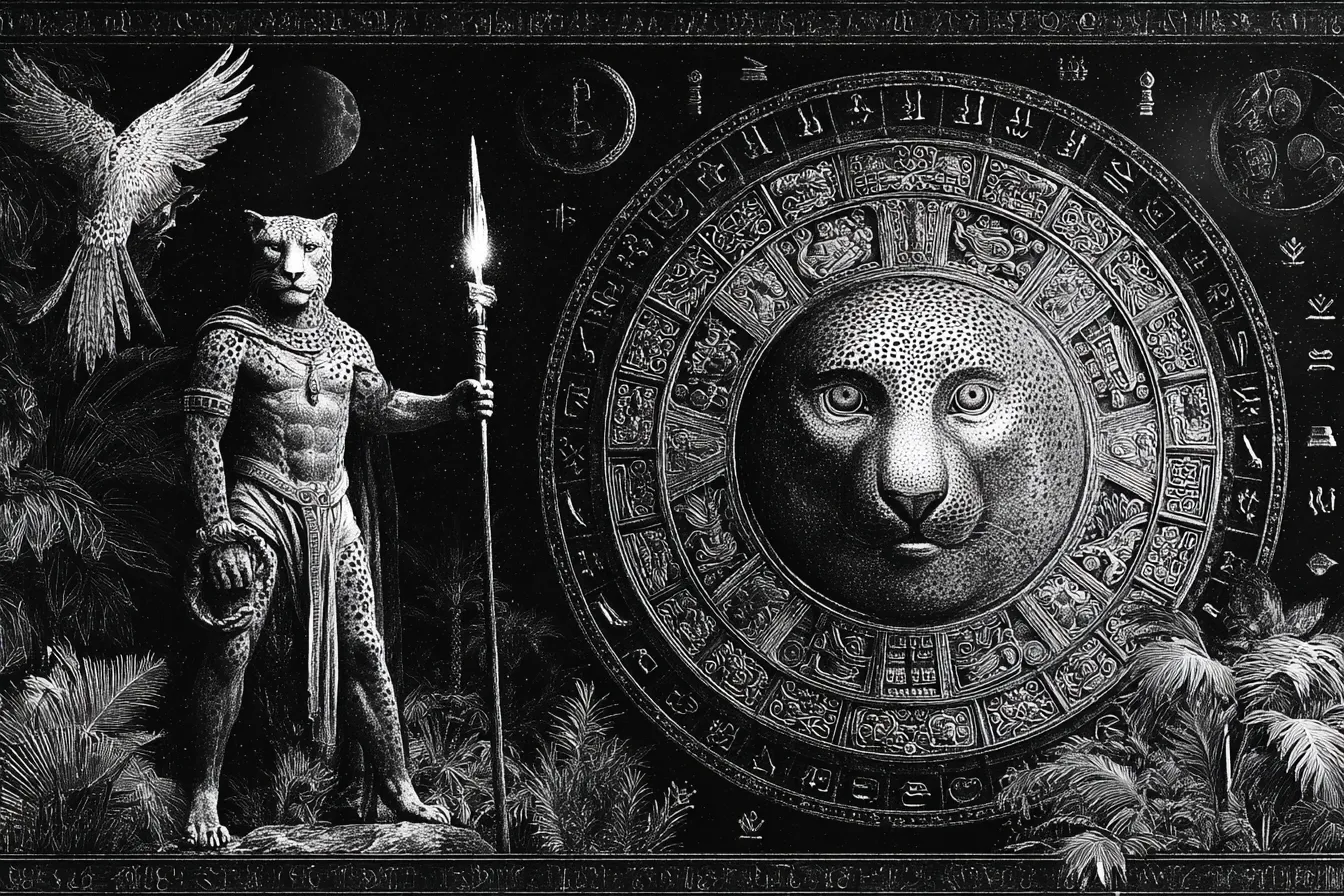
The Tzolkin is a 260-day ceremonial calendar that the Maya used continuously for at least two millennia — and possibly much longer. It survives today not as an archaeological curiosity but as a living system: still used by Daykeepers in the highlands of Guatemala, still consulted for naming children, timing ceremonies, and reading the character of a day. When people encounter it through modern astrology, they’re touching something genuinely ancient and genuinely sophisticated. They’re also often encountering a layer of New Age interpretation that the original system doesn’t contain and doesn’t need.
This article gives you your complete Tzolkin profile and what it actually means: the two coordinates that define your position in the 260-day cycle, how those coordinates interact, what the Maya themselves emphasized in reading them, and what the system can and can’t honestly tell you about yourself. It’s a more interesting picture than most mayan astrology calculators produce — and a more accurate one.
The Tzolkin: What It Is Structurally
The Tzolkin is not an astrology system in the Western sense. It doesn’t track planetary positions. It doesn’t use a zodiac based on the sun’s apparent path through the constellations. What it tracks is a purely mathematical cycle: the meshing of two smaller cycles — a cycle of 20 named days and a cycle of 13 numbered tones — that together produce 260 unique day-signatures before repeating.
The mathematics are elegant: 20 × 13 = 260. Every day in the Tzolkin has exactly one Solar Seal (one of the 20 named day signs) and exactly one Galactic Tone (one of the 13 numbers). The combination of your Solar Seal and Galactic Tone on the day you were born is your Tzolkin signature — sometimes called your Kin. There are 260 possible Kins, and every person born on the same day shares the same Kin.
The 260-day cycle has fascinated researchers because it corresponds to several meaningful astronomical and biological periods: the human gestation period (approximately 260 days from first missed period to birth), the average interval between the sun crossing the zenith at particular latitudes in Mesoamerica, and various agricultural cycles in the Mayan highlands. Whether the Maya chose 260 for one of these reasons, for multiple reasons simultaneously, or for reasons we no longer fully understand remains an open scholarly question.
Your Two Coordinates: Solar Seal and Galactic Tone
Your Tzolkin profile is defined by two pieces of information, both derived from your birth date.
The Solar Seal (Day Sign)
The 20 Solar Seals are the named days of the Tzolkin cycle. Each has a name, a glyph, a direction, a color, and a set of associated qualities developed over centuries of Maya and Aztec usage. The twenty seals cycle continuously — day 1 through day 20, then back to day 1 — throughout the Tzolkin’s 260-day span.
The twenty Solar Seals in order are:
1. Imix (Red Dragon / Crocodile) — primordial water, birth, nourishment, the source. Associated with the East and the color red. Imix energy is foundational, creative, and intensely receptive. The image is of the primordial ocean from which everything emerges.
2. Ik (White Wind) — breath, spirit, communication, inspiration. Associated with the North and white. Ik energy is changeable, communicative, and connected to the invisible. The breath that animates.
3. Akbal (Blue Night) — the abyss, dreams, intuition, the interior space. Associated with the West and blue. Akbal holds what is not yet manifest — the dream before waking, the interior landscape.
4. Kan (Yellow Seed) — seeds, flowering, targets, awareness. Associated with the South and yellow. Kan energy is about potential becoming actual, about planting the right thing in the right ground.
5. Chicchan (Red Serpent) — life force, instinct, survival, the body’s intelligence. Associated with the East and red. Chicchan connects to the physical body’s deepest knowing — desire, sensation, the intelligence that precedes thought.
6. Cimi (White Worldbridger) — death, transition, surrender, the crossing between worlds. Associated with the North and white. Cimi is the energy of necessary endings, of making space through release. Not morbid — transformative.
7. Manik (Blue Hand) — accomplishment, healing, tools, the gateway. Associated with the West and blue. Manik is the energy of skilled action, of the hand that knows its craft.
8. Lamat (Yellow Star) — beauty, harmony, elegance, the octave. Associated with the South and yellow. Lamat holds Venus energy — the morning star, the pattern of beauty that returns.
9. Muluc (Red Moon) — water, feelings, purification, universal memory. Associated with the East and red. Muluc holds the emotional body’s intelligence, the memory that flows like water through the system.
10. Oc (White Dog) — love, loyalty, the heart, guidance. Associated with the North and white. Oc is the energy of unconditional love, of the companion who remains.
11. Chuen (Blue Monkey) — play, magic, illusion, the artist. Associated with the West and blue. Chuen holds the trickster’s energy — the child who creates through play, the magician who knows the trick and performs it anyway.
12. Eb (Yellow Human) — free will, influence, the chalice, wisdom. Associated with the South and yellow. Eb holds the accumulated wisdom of the human lineage — the vessel that carries what has been learned.
13. Ben (Red Skywalker) — space, wakefulness, new dimensions, the pillar. Associated with the East and red. Ben bridges heaven and earth, explores the space between known and unknown.
14. Ix (White Wizard) — timelessness, receptivity, jaguar magic, heart-knowing. Associated with the North and white. Ix holds the stillness that perceives beyond ordinary time.
15. Men (Blue Eagle) — vision, creativity, mind, planetary mind. Associated with the West and blue. Men holds the seeing from above — the eagle’s view that perceives the whole pattern.
16. Cib (Yellow Warrior) — intelligence, questioning, fearlessness, the cosmic warrior. Associated with the South and yellow. Cib holds the intelligence that doesn’t accept easy answers.
17. Caban (Red Earth) — synchronicity, navigation, Earth force, evolution. Associated with the East and red. Caban is the intelligence of Earth itself — the resonance between inner movement and outer events.
18. Etznab (White Mirror) — reflection, truth, endlessness, the sword of clarity. Associated with the North and white. Etznab reflects without distortion — the mirror that shows what is, not what you wish were there.
19. Cauac (Blue Storm) — self-generation, purification, catalysis, transformation. Associated with the West and blue. Cauac is the lightning that precedes the rain — the catalytic disruption that enables new growth.
20. Ahau (Yellow Sun) — enlightenment, ascension, universal fire, the whole. Associated with the South and yellow. Ahau is the solar intelligence — the source of light and warmth that makes the cycle complete before it begins again.
The Galactic Tone
The 13 Galactic Tones are the numbered pulse of the Tzolkin. Where the Solar Seal gives the quality of the energy, the Tone describes how that energy is expressed — what its purpose is, what question it’s asking, what phase of a 13-step cycle it occupies.
The 13 Tones and their core qualities:
Tone 1 (Unity) — magnetic, purpose, the beginning. What is my purpose? Tone 2 (Duality) — lunar, challenge, polarization. What is my challenge? Tone 3 (Rhythm) — electric, activation, service. How can I best serve? Tone 4 (Measure) — self-existing, form, definition. What is the form? Tone 5 (Radiance) — overtone, core, empowerment. How do I empower? Tone 6 (Equality) — rhythmic, balance, organizing. How do I extend? Tone 7 (Resonance) — resonant, attunement, channeling. How do I attune? Tone 8 (Integrity) — galactic, harmonizing, modeling. Do I live what I believe? Tone 9 (Intention) — solar, pulsing, realizing. How do I attain my purpose? Tone 10 (Manifestation) — planetary, perfecting, producing. How do I perfect? Tone 11 (Liberation) — spectral, releasing, dissolving. How do I release? Tone 12 (Cooperation) — crystal, dedicating, universalizing. How do I dedicate? Tone 13 (Presence) — cosmic, enduring, transcending. How do I transcend?
Your Tone is the number assigned to your birth date in the Tzolkin cycle — it tells you which of these thirteen phases of expression your Solar Seal is working through.
Reading Your Complete Profile
Your Tzolkin Kin is the combination of your Solar Seal and your Galactic Tone. The combination is read as a unit — the Seal provides the what (what kind of energy, what domain, what elemental quality), and the Tone provides the how (through what mode of expression, toward what purpose, in what phase of the cycle).
To illustrate: Kin 1 is Tone 1 (Magnetic) with Solar Seal 1 (Imix, Red Dragon). The magnetic pulse of unity expressing through primordial water and nourishment — a purpose-driven, foundational energy. Kin 131 is Tone 1 (Magnetic) again, but now with Solar Seal 11 (Chuen, Blue Monkey). The same magnetic purpose expressed through play, magic, and artistic trickery — a completely different signature despite sharing the same Tone.
Two people with the same Solar Seal but different Tones share the energetic quality of that Seal but express it through entirely different developmental purposes. Two people with the same Tone but different Seals are in the same phase of the cycle but operating in completely different domains. The full Kin is the complete picture.
The Four Additional Profile Elements
A complete Tzolkin profile includes more than just the basic Kin. Classical Maya reading also incorporates:
The Analog Kin: The Solar Seal that supports and harmonizes with your own. Found at a specific position in the Tzolkin grid relative to your Seal. Your Analog is your natural support partner — the energy that complements yours without contradiction.
The Guide: The Solar Seal that guides you in the hour of your birth (determined by birth hour) and the broader thematic guide for your Wavespell. Your Guide is the energy that points you toward your highest expression.
The Antipode: The Solar Seal directly opposite yours — your challenge and your greatest teacher. The Antipode holds qualities you tend to avoid but need to integrate.
The Occult: The hidden power in your Kin — the Seal whose Tone adds with yours to 14 (a specific mathematical relationship in the Tzolkin). Your Occult is the unexpected support, the quality that appears when you’re least looking for it.
Together, these five elements — your Solar Seal, your Galactic Tone, your Analog, your Antipode, and your Occult — form the complete Oracle profile that traditional Maya Daykeepers read.
What the Tzolkin Is and Isn’t
The Tzolkin describes the quality of the cycle you were born into — the energetic signature of your day in the 260-day round. What it doesn’t do is predict specific events, determine personality in the way Western psychology describes it, or tell you what decisions to make. The Maya used it primarily as a ceremonial and agricultural calendar, as a naming system (children were often named after their birth Kin), and as a tool for understanding the quality of specific days for specific purposes.
The New Age interpretation that developed in the late 20th century — particularly José Argüelles’s Dreamspell system — reinterpreted the Tzolkin significantly and added layers of meaning that aren’t present in classical Maya usage. The Dreamspell system is a distinct modern system that draws on the Tzolkin’s mathematical structure but produces different Kin readings than the traditional correlation. The Whisper uses the traditional GMT correlation (Goodman-Martínez-Thompson), which aligns with the calendar as used by contemporary Maya Daykeepers.
This isn’t to say that the Tzolkin’s symbolic vocabulary isn’t meaningful — it is, and has been refined through centuries of observation and use. It’s to say that the system is most useful when encountered with a clear sense of what it was designed to do: to describe the quality of days and the energetic signature of moments in time, including the moment of your birth.
How The Whisper Uses Your Tzolkin Profile
The Whisper incorporates your Tzolkin Kin as one of the fifteen divination systems in its daily synthesis. On any given day, the current day’s Solar Seal and Galactic Tone — and their relationship to your natal Kin — inform part of what you read. Days where the current Kin has a specific resonance with your natal profile (same Seal, same Tone, Analog or Antipode relationship) tend to appear in your reading as days of particular significance or particular challenge.
The synthesis across fifteen systems means that the Tzolkin’s signal is one voice among many. When multiple systems converge on a similar quality for a particular day — the Tzolkin’s Solar Seal, the BaZi’s annual elemental texture, the Nine Star Ki’s palace position all pointing toward the same theme — that convergence is meaningful. When they diverge, the divergence itself carries information about the complexity of what you’re navigating.
Frequently Asked Questions
How do I calculate my Tzolkin Kin? Your Tzolkin Kin is determined by your Gregorian birth date, converted using the GMT correlation constant to a position in the 260-day Tzolkin cycle. The calculation is not intuitive to do by hand — most people use a calculator or app. The Whisper calculates your Kin automatically from your birth date. If you want to verify manually, the GMT correlation assigns a specific Kin to known dates that can then be counted forward or backward to any other date.
Does the Tzolkin use birth time, or just birth date? The traditional Tzolkin uses birth date only — every person born on the same day shares the same Solar Seal and Galactic Tone. Birth time is used in some extended reading frameworks to identify the Guide Kin for the hour of birth, but the core Kin is date-based. This is one of the structural differences between the Tzolkin and systems like BaZi, which require both date and time.
What’s the difference between the Tzolkin and the Mayan zodiac I see in popular astrology? Most popular “Mayan zodiac” systems online are simplified versions of the Solar Seal component only — they give you your day sign without the Galactic Tone, and often without the Analog, Antipode, or Occult components. This is a partial reading. Your complete Tzolkin profile is the full Kin (Seal + Tone) plus the four additional profile elements. The simplified zodiac format is accessible but loses most of what makes the Tzolkin a coherent system rather than just a set of 20 personality types.