
What is Chuen?
Chuen is the eleventh of twenty Solar Seals in the Mayan Tzolkin — the 260-day sacred calendar built from twenty day signs cycling through thirteen numbered tones, producing 260 unique combinations called Kin. The Tzolkin has been in continuous use among Maya peoples for at least 2,500 years and remains a living tradition today. Ajq’ij — Maya day keepers and ceremonial priests — continue to guide communities through the Tzolkin cycle in Guatemala and southern Mexico, where the Chol Q’ij (the K’iche’ Maya name for the calendar) is woven into both ceremonial and everyday life. Any engagement with Chuen is an engagement with a tradition that has never been interrupted, carried across an unbroken line of living practice.
The Whisper integrates the Tzolkin alongside Western Astrology, Nine Star Ki, and BaZi into a single daily personal insight. Your birth seal is calculated by locating your birth date within the Tzolkin cycle using the GMT correlation constant (584283) — the most widely accepted scholarly alignment between the Maya Long Count and the Gregorian calendar. This differs from the Dreamspell system developed by José Argüelles in 1987, which applies a different correlation and sometimes different seal names, and which can produce a different result for the same birth date. Many English-language tools for finding a “Mayan day sign” use the Dreamspell framework; The Whisper uses the traditional GMT correlation throughout. In addition to your birth seal, the daily seal marks the current day’s shared position in the Tzolkin cycle and The Whisper synthesizes both with the other active systems to generate each day’s insight.
Chuen arrives at position eleven — a position the Tzolkin associates with the quality of dynamic spectral energy, the point in any sequence where accumulated structure meets the freedom that reconfigures it. The preceding ten seals traced the cycle from the primordial ocean through breath, depth, potential, life force, transformation, accomplishment, harmony, purifying flow, and the unconditional guidance of the heart. Chuen at position eleven is the seal that takes all of this accumulated richness and begins to play with it — weaving connections that the more serious, sequentially oriented energies could not find, discovering through delight what deliberate search could not reach.
The symbol and its traditional roots
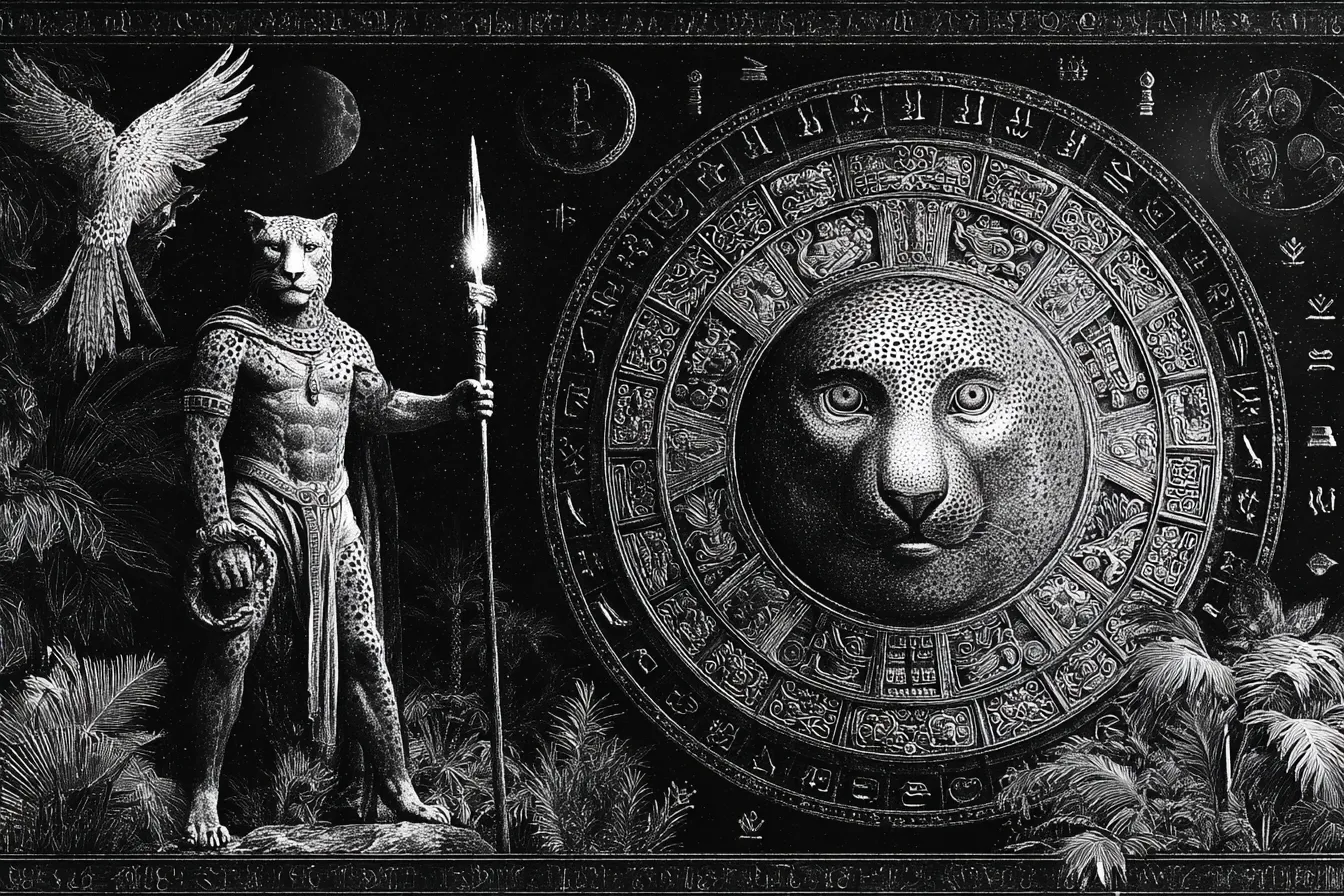
The glyph associated with Chuen in Maya iconography is connected to Hunahpu — one of the Hero Twins of the Popol Vuh, the great Maya creation narrative, who is a figure of extraordinary creative intelligence, transformative play, and the capacity to move between worlds through wit and artistry rather than through force. The monkey artisan deity of the Maya — Hunbatz and Hunchouén in some accounts — is the patron of the arts, of writing, of music, and of the kind of creative intelligence that works through play, improvisation, and the unexpected connection rather than through systematic application of technique.
The weaver quality of Chuen is embedded in its association with Ix Chel, the Maya moon goddess who is also the goddess of weaving, medicine, and the moon’s rhythmic creative power. Ix Chel’s weaving is not merely the production of cloth but the metaphysical activity of connecting disparate threads into a pattern that reveals relationships invisible in the individual strands. This is precisely the Chuen intelligence: the capacity to perceive and create connections between things that do not appear related when examined separately, and to weave those connections into something genuinely new that could not have been predicted from the properties of any individual element.
The trickster quality of Chuen is the third dimension of its traditional symbolism that the Maya tradition carries explicitly. The trickster in Maya narrative — as in most world mythological traditions that include this figure — is not merely a mischief-maker but a revealer: the being who disrupts the settled, serious, self-important order of things precisely in order to reveal what that order has been concealing. The monkey’s tricks are not random; they are specifically targeted at the pretensions and rigidities that prevent genuine vitality and genuine contact with what is real. The trickster reveals truth through laughter because laughter bypasses the defenses that argument cannot penetrate.
In the Aztec Tonalpohualli, the corresponding day sign is Ozomatli — the Monkey, carrying identical imagery and closely related associations across both Mesoamerican traditions. In Aztec cosmology, Ozomatli was associated with the arts, with dance, with music, and with the playful, creative intelligence that produces genuine delight. The Aztec monkey deity was the patron of those who work with the arts and entertainment — the quality of genuine joy in creative expression that Chuen also carries as one of its most distinctive and recognizable qualities.
The color associated with Chuen is Blue, and the direction is West — the direction the Tzolkin associates with transformation, deepening, and the willingness to engage with what lies beneath surfaces. Chuen as a Blue/West seal brings this transformative, depth-oriented quality to its playful nature: the play that is genuinely transformative, the artistry that works through genuine depth rather than surface cleverness, the trickster’s revelation that changes something real rather than merely amusing.
The energy of Chuen
The traditional meaning of Chuen centers on creative intelligence that works through play — the quality of mind that discovers through delight, that makes connections through the freedom of genuine playful engagement that the more serious, goal-directed modes of intelligence systematically miss. This is not frivolity or the avoidance of depth; it is a specific and powerful form of intelligence that requires a particular quality of freedom to operate — the freedom from the self-consciousness, the outcome-orientation, and the fear of being wrong that genuine play requires.
The Tzolkin tradition is careful to distinguish Chuen’s play from mere entertainment or avoidance. Genuine play in the Chuen tradition is a fully engaged, fully present activity that does not know in advance where it is going and does not need to — because the direction reveals itself through the quality of the engagement rather than through prior planning. The child who is genuinely playing is not less present than the adult who is seriously working; they are differently present, with a quality of open, responsive, continuously improvising attention that the adult’s more directed engagement has often lost. Chuen carries this quality of genuine play as its most essential characteristic.
The weaving intelligence that connects disparate threads into unexpected patterns is another central Chuen quality. This is not the systematic, analytical process of establishing relationships between concepts through logical inference; it is the more intuitive, associative, and often surprising process of finding that two things — an idea and a feeling, a color and a rhythm, a personal experience and a historical event, a problem in one domain and a solution from a completely different one — are unexpectedly related in a way that, once perceived, illuminates both. Chuen’s weaving intelligence is the quality that produces genuine creative breakthrough, the insight that could not have been reached by systematic analysis because its raw materials were in domains that systematic analysis keeps separate.
The trickster’s capacity to reveal through humor is the third major dimension of Chuen energy that the tradition addresses. Humor in the Chuen tradition is not mere entertainment but a specific cognitive and social tool: the capacity to say what is true when seriousness would be deflected, to reveal what is present when direct statement would be defended against, and to dissolve the rigidities of self-importance and fixed perspective through the sudden shift of frame that genuine laughter produces. The monkey who makes the solemn priest slip on a banana peel is not being disrespectful to genuine sacredness; it is exposing the performance of solemnity that has displaced genuine engagement with what is actually sacred.
There is also a quality of genuine delight in the act of making that Chuen carries as one of its most recognizable characteristics. The artisan who loves their craft — who finds genuine pleasure in the act of working with their materials, in the problem-solving of the creative process, in the moment when something that did not exist before comes into being through their hands — is expressing the Chuen quality that the tradition identifies as magical artistry. The magic is not supernatural but the very real quality of creative engagement that produces something genuinely new.
Chuen as a birth seal and daily seal
As a birth seal, Chuen in the Tzolkin tradition is associated with the person who carries the weaving artisan’s creative intelligence and the trickster’s revelatory playfulness as their primary orientation — someone whose most characteristic quality is the capacity to find unexpected connections, to create through genuine engagement rather than through systematic application, and whose presence tends to have a lightening, enlivening effect on the situations they inhabit. The birth tone modifies how this expresses in practice: a person born on Chuen with Tone 1 carries the creative-playful quality with a more singular, initiating dimension; someone born on Chuen with Tone 13 may carry it with a more transcendent, completing quality.
People born under Chuen are traditionally associated with a particular capacity for spontaneous creative connection — the ability to find the unexpected link, to perceive the pattern that connects things that appeared unrelated, and to create from that perception something genuinely new. This is the core of the weaver’s intelligence: not the ability to apply known techniques to known materials but the capacity to see what those materials are doing together that no technique could have predicted.
There is also a traditional association between Chuen and the capacity to hold multiple simultaneous threads — to be genuinely engaged with several things at once without losing the quality of engagement with any of them, because the weaver’s intelligence is specifically the intelligence of multiple simultaneous relationships rather than of single-focused sequential attention. This multi-threaded quality is both a genuine creative strength and one of Chuen’s characteristic growth edges.
As a daily seal, when Chuen appears as the current day’s position in the Tzolkin cycle, the tradition suggests a quality of creative playfulness and unexpected connection — a day when the capacity for genuine creative engagement, for finding the surprising link that illuminates both of the things it connects, and for the kind of lightness and humor that reveals truth tends to be more available than usual. The Whisper synthesizes this with the other active systems to generate the specific texture of that day’s reading.
Strengths and growth edges
The strengths traditionally associated with Chuen are rooted in its relationship to creative play, weaving intelligence, and the trickster’s revelatory capacity. The capacity to create through genuine play is the most fundamental — the ability to engage with creative work from a quality of genuine, open, non-outcome-directed presence that allows the work to reveal what it wants to become rather than imposing a predetermined form upon it. This is the quality that distinguishes the work that comes alive from the work that is merely technically competent.
The weaving intelligence that sees connections others miss is the second major strength — the capacity to perceive unexpected relationships between things that systematic analysis keeps separate, and to create from those perceptions something genuinely new that could not have been reached by any more direct route. This is a form of intelligence that is particularly valuable in complex, multi-domain situations where the solution is not in any one field but in the unexpected intersection of several.
The trickster’s gift of revealing truth through humor is the third recognized Chuen strength — the capacity to say what is true in a way that bypasses the usual defenses, to dissolve rigidity and self-importance through the sudden shift of perspective that genuine laughter produces. This is not the same as being entertaining; it is the specific gift of the one who can say the true thing in the unexpected way that allows it to actually land.
The growth edges associated with Chuen follow the shadow dimensions of these gifts with characteristic directness. The play that avoids genuine depth is the primary growth edge — the creative intelligence that moves so fluidly across surfaces that it never stays long enough in any one place to develop the depth that genuine mastery requires. The monkey who leaps from branch to branch never develops the craftsperson’s embodied knowledge that comes from sustained engagement with a single material over time.
The trickster quality used to deflect rather than reveal is a closely related growth edge — the humor and playfulness that has become a way of avoiding genuine engagement with difficulty rather than a way of engaging with it more effectively. The trickster who makes everything a joke has lost the trickster’s genuine function; the laughter that prevents genuine contact is no longer the laughter that reveals.
Finally, the weaving that creates complexity without genuine substance is a recognized Chuen growth edge — the connection-making intelligence that produces intricate, interesting, surprising associations without the underlying depth that would make those associations genuinely illuminating.
What Chuen means in The Whisper
In The Whisper’s multi-system synthesis, Chuen resonates across several traditions in ways that illuminate its essential qualities from complementary perspectives.
The resonance with Western Astrology is strongest with Mercury in Gemini — the playful, connecting, weaving intelligence of the planet of communication and language at its most creatively fluid and associatively free. Mercury in Gemini carries the quality of the mind that moves at the speed of genuine delight, that finds connections faster than it can explain them, that is most alive in the medium between things rather than at any fixed point. The Gemini quality of genuine comfort with multiplicity and apparent contradiction — the sign that holds two things simultaneously without needing to resolve them into one — resonates closely with Chuen’s weaving intelligence. When The Whisper synthesizes a Chuen influence with a strong Mercury or Gemini quality from the Western layer, the playful, connecting, creatively surprising dimension of that day’s reading may be particularly amplified.
In Nine Star Ki, the resonance is with the Three Jade Wood Star (三碧木星) — the communicative, playful, initiating quality of the spring thunder energy that breaks through the ground with sudden, surprising vitality. In Nine Star Ki, the Three Jade Star is associated with the voice, with the kind of communication that initiates and activates, with the sudden breaking-through of what has been building beneath the surface. The Three Jade Star carries a quality of excited, surprising, rapid movement — the lightning-fast connection, the suddenly illuminating remark, the creative spark that appears without warning — that resonates closely with Chuen’s trickster-artisan creative intelligence. When Chuen appears alongside a Three Jade Wood Star influence in The Whisper’s Nine Star Ki layer, the communicative, playfully initiating, suddenly connecting quality of the creative intelligence may be especially present.
From a BaZi perspective, the resonance is with Yi Wood (乙木) — the flexible, creative, weaving quality of yin wood that creates by finding its way through every available opening. Yi Wood in BaZi is the vine, the creeper, the plant that does not grow in a straight line but finds its way through and around every obstacle, creating unexpected connections between distant points through the simple quality of persistent, flexible, improvisational growth. In its Chuen expression, Yi Wood carries the weaving artisan’s quality of creating through flexible, responsive, continuously improvising engagement. When Chuen appears alongside a Yi Wood influence in The Whisper’s BaZi layer, the flexible, creatively finding, unexpectedly connecting quality of the intelligence may be particularly prominent.
The Aztec Tonalpohualli equivalent, Ozomatli (the Monkey), adds the dimension of the arts patron — the being whose domain is specifically the creative, performative, genuinely delightful expression of human creative capacity. This frames Chuen not only as an intelligence but as a quality of genuine cultural and communal vitality: the arts and play and creative expression are not decoration added to the serious business of life but the primary medium through which a community’s genuine aliveness is expressed and sustained.
In The Whisper’s daily synthesis, Chuen days carry the quality of creative playfulness and unexpected connection — days when the weaving intelligence is closer to the surface, when surprising connections and genuine delight in creative engagement tend to be more available.
Frequently asked questions
Q: Is Chuen a “lighter” or less serious seal than others in the Tzolkin cycle?
The Tzolkin tradition does not rank the twenty Solar Seals by seriousness or depth. Chuen’s playful, trickster-artisan quality is not a sign of shallowness but of a specific and powerful form of intelligence that is genuinely distinct from the more solemn or internally oriented seals. The trickster’s function in Maya tradition — and in most world mythological traditions that include this figure — is to reveal what seriousness conceals and to disrupt the rigidities that prevent genuine vitality. This is a deeply important function, and carrying it requires a genuine depth of perception and a genuine courage: the willingness to say the true thing in the unexpected way, to disrupt what has become settled and self-important in service of what is genuinely alive. Chuen’s lightness is not the lightness of the superficial but the lightness of the being who has genuinely understood that genuine engagement with life does not require the performance of gravity.
Q: How does The Whisper determine which Tzolkin seal corresponds to my birth date, and why might this differ from other sources?
The Whisper uses the GMT correlation constant (584283), the most widely accepted scholarly alignment between the Maya Long Count and the Gregorian calendar, which is the correlation used by traditional Maya practitioners and communities today. Many English-language Mayan astrology tools and apps are based on the Dreamspell system developed by José Argüelles in 1987, which applies a different correlation constant and sometimes different seal names. The Dreamspell system was designed as a creative reinterpretation of the Tzolkin rather than as a direct continuation of the traditional calendar, and the two systems are genuinely different frameworks that can produce different results for the same birth date.
Q: If Chuen is my birth seal, does this mean I should be working in the creative arts?
The Tzolkin tradition associates Chuen with the artisan’s creative intelligence and the weaver’s capacity to create through unexpected connection — but this quality expresses across many domains beyond the conventional arts. A Chuen birth-seal person may find their creative-play intelligence expressing in visual art, music, or writing, but equally in the unexpected solution to a technical problem, the surprising business strategy that connects two previously unrelated markets, the therapeutic approach that reaches a client through humor and play when serious engagement has not, or the quality of genuine delight and surprising connection that enlivens any domain of work or life. What the Tzolkin tradition suggests is an orientation toward creative play, unexpected connection, and the artisan’s quality of genuine delight in making as meaningful and intelligent — not a prescription for any particular professional domain.