
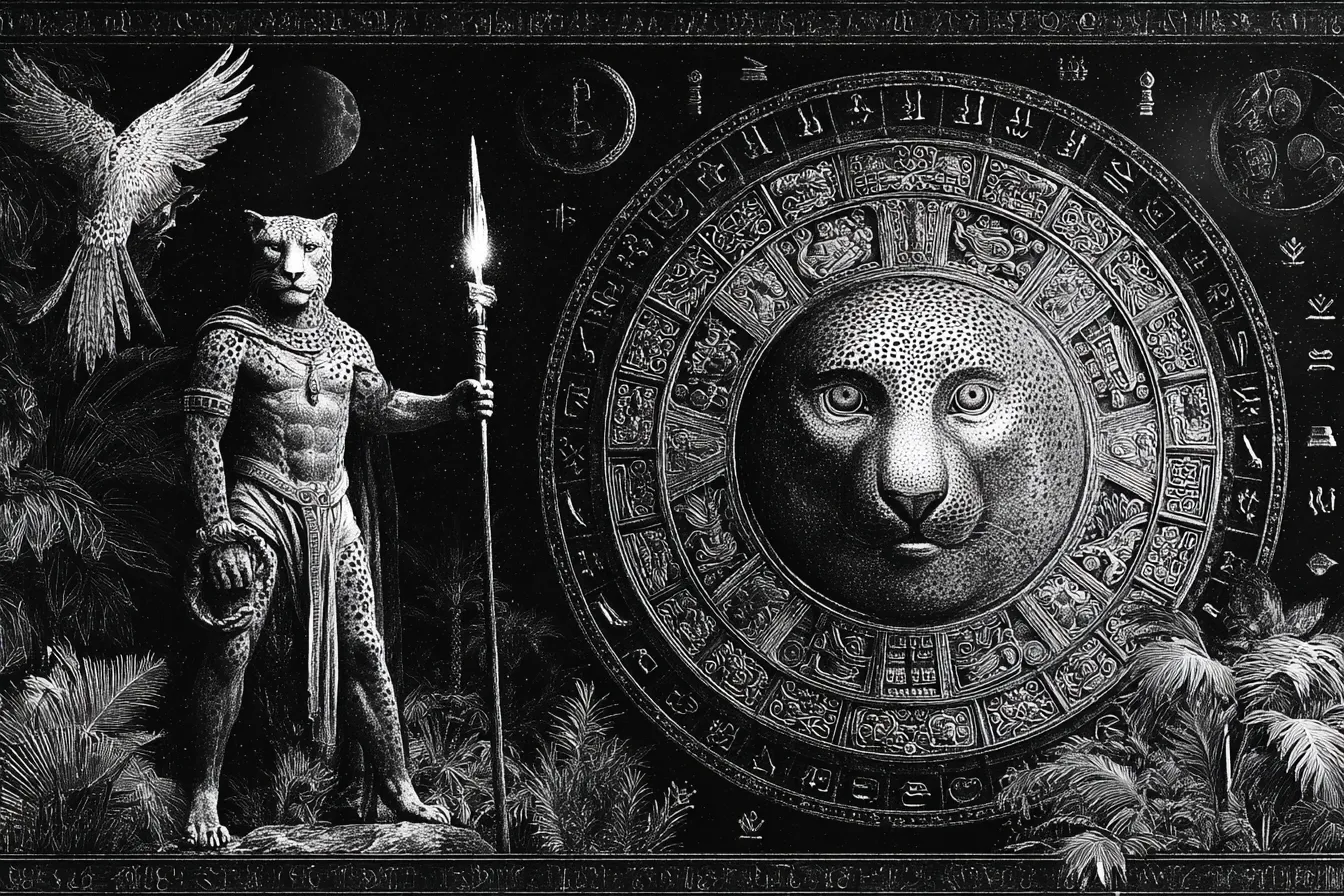
What is Muluc?
Muluc is the ninth of twenty Solar Seals in the Mayan Tzolkin — the 260-day sacred calendar built from twenty day signs cycling through thirteen numbered tones, producing 260 unique combinations called Kin. The Tzolkin has been in continuous use among Maya peoples for at least 2,500 years and is a living tradition today. Ajq’ij — Maya day keepers and ceremonial priests — continue to guide communities through the Tzolkin cycle in Guatemala and southern Mexico, where the Chol Q’ij (the K’iche’ Maya name for the calendar) remains active in both ceremonial and everyday life.
The Whisper draws on the Tzolkin as one of four ancient systems — alongside Western Astrology, Nine Star Ki, and BaZi — synthesizing them into a single daily personal insight. Your birth seal is calculated by locating your birth date within the Tzolkin cycle using the GMT correlation constant (584283) — the most widely accepted scholarly alignment between the Maya Long Count and the Gregorian calendar. Many English-language tools for finding a “Mayan day sign” use instead the Dreamspell system developed by José Argüelles in 1987, which applies a different correlation and sometimes different seal names, and which can produce a different result for the same birth date. The Whisper uses the traditional GMT correlation throughout. In addition to your birth seal, the daily seal marks the current day’s shared position in the Tzolkin cycle and The Whisper synthesizes both with the other active systems to generate each day’s insight.
Muluc arrives ninth in the cycle — a position that carries its own significance in the Tzolkin’s structure. Nine is the tone of the Tzolkin’s completion-within-movement: the number associated with the Lords of the Night in Maya cosmology, the force that sustains the cycle through its interior dimension. Muluc at position nine carries this quality of interior, sustaining movement. The preceding eight seals traced the arc from primal ocean through breath, depth, encoded potential, embodied life force, transformative release, skilled accomplishment, and radiant harmony. Muluc is the tide that moves through all of this — the purifying water that flows through what has been created, clarifying, cleansing, and carrying forward what is genuinely alive.
The symbol and its traditional roots
The glyph associated with Muluc in Maya iconography depicts water — specifically water in its offering and purifying aspects. In Maya ceremonial tradition, water was not simply a physical substance but a living, sacred medium that carried spiritual quality, ancestral memory, and the purifying force of genuine emotional truth. Offerings of water, jade (which was associated with water’s green depth), and blood were made to the rain deities whose favor was essential for the agricultural abundance on which Maya civilization depended. Muluc carries the quality of water as offering — the giving of something precious and genuine to sustain the relationship between the human community and the forces that make life possible.
The lunar quality of Muluc is expressed through its name — the Red Moon — and through the traditional association between the moon and the tidal movement of water in all its forms: the ocean tides, the seasonal rains, the flow of blood, and the rhythmic ebbing and surging of emotional life. In Maya cosmology, the moon goddess Ix Chel was associated with both water and weaving — the tidal flow and the patterned structure through which that flow is shaped into something usable. Muluc carries the tidal quality of Ix Chel’s domain: the rhythmic, cyclical, purifying movement of water as it flows through, cleanses, and renews what it passes through.
The purifying dimension of Muluc’s water quality deserves careful attention. Purification in the Maya tradition is not punishment or correction but clarification — the water that washes does not judge what it cleanses but simply moves through it, carrying away what has accumulated and leaving the surface cleaner than it found it. This is the quality of Muluc’s purification: not the severity of the flint knife but the gentle, pervasive, thorough movement of water that reaches everywhere and leaves nothing entirely untouched.
In the Aztec Tonalpohualli, the corresponding day sign is Atl — Water itself, carrying the same primary association with the sacred, purifying, life-sustaining quality of water across both Mesoamerican traditions. In Aztec cosmology, Atl was governed by Xiuhtecuhtli, the fire-water deity whose paradoxical nature expressed the understanding that genuine purification requires both the clearing quality of water and the transforming quality of fire. This paradox is present in Muluc as well: the purifying flow is not passive but actively transforming, not cold but carrying its own form of warmth.
The color associated with Muluc is Red, and the direction is East — the initiating, active, beginning-oriented quarter of the Tzolkin’s directional system. Muluc as a Red/East seal brings this initiating, active quality to its water nature: the purifying flow that does not wait to be invited but moves through what is present with the directness of the tide that comes regardless of whether the shore is ready for it.
The energy of Muluc
The traditional meaning of Muluc centers on purification through flow — the quality of genuine emotional movement that, like water, clarifies what it passes through by carrying away what has accumulated. This is a meaningfully different quality from the transformation of Cimi, which involves genuine ending and the crossing of irreversible thresholds. Muluc’s purification is more continuous and more gentle: the river that keeps moving does not require dramatic catharsis to stay clean but sustains its clarity through the simple fact of its consistent flow. Stagnation, not intensity, is the condition that Muluc’s water quality most naturally opposes.
The Tzolkin tradition associates Muluc with universal emotional intelligence — the quality of feeling that flows without becoming attached to any particular emotional state, that moves through grief, joy, anger, and tenderness with the same quality of genuine presence and genuine release. This is not emotional flatness or detachment; it is the opposite — the full, genuine engagement with emotional reality that is possible precisely because the water does not hold what it carries but releases it downstream. Muluc emotional intelligence is characterized by depth and range rather than by the suppression or control of what is felt.
The lunar quality of tidal emotional movement is another central Muluc dimension. The moon’s tidal influence on the ocean is not random but cyclical and patterned — the tides know their rhythm and move within it with reliable precision. Muluc carries this quality of emotional rhythm — the understanding that feelings move in cycles rather than in straight lines, that what has ebbed will flow again, that the depth of the low tide is not the measure of the water’s total quantity but one phase in a reliable cycle. This rhythm-awareness is one of Muluc’s distinctive gifts: the capacity to trust the emotional cycle rather than fixing on any particular point within it as permanent.
There is a further quality of universal reach in Muluc’s water imagery that the tradition addresses. Water does not flow only where it is welcomed; it finds every available channel and fills every available space. The purifying quality of Muluc water is similarly pervasive — it reaches into the corners and crevices that more directed energies might miss, and it brings its clarifying quality to what it finds there without needing to be specifically invited to do so. This pervasive quality can be one of Muluc’s most significant gifts and, as the growth edges section addresses, one of its most characteristic challenges.
The offering quality of Muluc — water as something precious given freely — adds a dimension of generosity and genuine giving to the seal’s energy. The rain that falls does not calculate which plants deserve to be watered; it gives what it has to everything it reaches. Muluc carries this quality of non-discriminating, genuinely given emotional presence as a form of offering to the life it moves through.
Muluc as a birth seal and daily seal
As a birth seal, Muluc in the Tzolkin tradition is associated with the person who carries the purifying, flowing, lunar-emotional quality as their primary orientation — someone whose knowing tends to be emotional and intuitive before it is analytical, whose relationships are characterized by a quality of genuine, non-calculating emotional presence, and whose natural mode of processing experience is through feeling it fully rather than analyzing it from a distance. The birth tone modifies how this expresses in practice: a person born on Muluc with Tone 2 carries the water quality with a more polarized, relational dimension; someone born on Muluc with Tone 11 may carry it with a more spectral, boundary-dissolving quality.
People born under Muluc are traditionally associated with a particular capacity for genuine emotional presence — the ability to be fully, actually present to what is being felt without immediately moving to manage, explain, or resolve it. This is a more demanding quality than it appears from the outside; genuine emotional presence requires the willingness to feel what is there rather than what is comfortable, and the capacity to remain present through the full duration of what the emotional cycle requires rather than seeking the shortcut to resolution.
There is also a traditional association between Muluc and the capacity to track emotional cycles — to sense the rhythm of feeling in themselves and in situations, to know when a feeling is cresting and when it is turning, when something needs to be moved through and when it needs to be honored with stillness. This cycle-tracking intelligence is related to the lunar quality of Muluc: the person who can feel the tide knows something about what is coming that someone who only observes the surface of the water cannot access.
As a daily seal, when Muluc appears as the current day’s position in the Tzolkin cycle, the tradition suggests a quality of emotional openness and purifying flow — a day when genuine feelings may be closer to the surface than usual, when the capacity for authentic emotional presence tends to be more accessible, and when allowing what needs to flow to flow tends to be more productive than attempting to manage or suppress it. The Whisper synthesizes this with the other active systems to generate the specific texture of that day’s reading. A Muluc day in the tradition is also associated with water offerings and with the acknowledgment of what has been given and received — a quality of gratitude and recognition that flows naturally from genuine emotional attunement.
Strengths and growth edges
The strengths traditionally associated with Muluc are rooted in its relationship to genuine emotional flow and the purifying intelligence of water. The capacity for genuine, non-calculating emotional presence is the most fundamental — the ability to be fully, actually present to what is being felt in oneself and in others, without the management, performance, or suppression that less emotionally fluid orientations may require. This quality tends to make Muluc people unusually effective in contexts where genuine, undefended emotional honesty is what is needed: in deep personal relationships, in therapeutic or supportive roles, in creative work that requires authentic emotional material, and in the kind of genuine communication that cannot happen without real feeling behind the words.
The lunar intelligence that tracks cycles is the second major strength — the capacity to sense the rhythm of emotional and situational movement and to work with that rhythm rather than against it. This expresses practically as an unusual sensitivity to timing: the Muluc quality of knowing when something is cresting and when it is turning, when to stay with what is present and when to move, is a form of intelligence that more analytically oriented approaches cannot replicate.
The capacity to purify through genuine emotional flow — to release what has accumulated through the simple, sustained movement of genuine feeling rather than through dramatic catharsis or effortful processing — is the third recognized Muluc strength. Water does not have to work hard to stay clean; it stays clean by continuing to flow. Muluc people who have developed this quality tend to process difficulty with a relative efficiency and thoroughness that others may find impressive.
The growth edges associated with Muluc follow the shadow dimensions of these gifts with characteristic directness. The purifying flow that becomes flooding is the primary growth edge — the emotional responsiveness and pervasive reach of Muluc’s water quality that, when not held within a sufficient container, can overwhelm the situations and relationships it moves through rather than clarifying them. The river that floods is carrying more water than its banks can hold; the Muluc person whose emotional flow has exceeded the container available to it can have the opposite of a purifying effect.
The inability to distinguish one person’s emotions from another’s is a closely related growth edge — the universal emotional quality of Muluc that, without clear boundaries, can result in a kind of emotional merging that is disorienting both for the Muluc person and for the people around them.
Finally, the emotional responsiveness without the capacity to contain what is felt is a recognized Muluc growth edge — the full, genuine feeling that has not yet developed the banks that allow it to flow in a direction rather than in all directions simultaneously. The Tzolkin tradition suggests that Muluc’s development involves not the suppression of its emotional depth but the development of a container adequate to hold and direct that depth in ways that are genuinely useful.
What Muluc means in The Whisper
In The Whisper’s multi-system synthesis, Muluc resonates across several traditions in ways that illuminate its essential qualities from complementary perspectives.
The resonance with Western Astrology is strongest with the Moon, Cancer, and Neptune — the purifying, flowing, lunar-emotional dimension of the Western astrological tradition. The Moon in Western astrology governs the tidal, cyclical, deeply feeling quality of emotional life — the quality of attunement to inner states and to the emotional field of the environment that operates below the threshold of rational awareness. Cancer governs the sheltering, deeply nurturing, emotionally present quality of the water sign most associated with genuine care and emotional intelligence. Neptune governs the dissolving of boundaries between the personal and the universal — the quality of emotional permeability that makes both deep empathy and the Muluc growth edge of emotional merging possible. When The Whisper synthesizes a Muluc influence with a strong Moon, Cancer, or Neptune quality from the Western layer, the emotional depth, tidal rhythm, and purifying flow of that day’s reading may be particularly amplified.
In Nine Star Ki, the resonance is with the One White Water Star (一白水星) — the flowing, depth quality of water that adapts to every container it enters, that finds its way through every available channel, and that purifies through the simple sustained fact of its movement. In Nine Star Ki, the One White Water Star is associated with the depth of midwinter and with the quality of the hidden underground stream — the flow that nourishes from below, that is felt before it is seen, that connects distant points through invisible channels. The One White Star’s quality of pervasive, depth-oriented, hidden-current movement resonates closely with Muluc’s purifying, lunar, emotionally intelligent water quality. When Muluc appears alongside a One White Water Star influence in The Whisper’s Nine Star Ki layer, the depth, fluidity, and pervasive emotional reach of the reading may be especially present.
From a BaZi perspective, the resonance is with Ren Water (壬水) — the powerful flowing yang water of the BaZi elemental system; the river that purifies through its movement. Ren Water in BaZi is the ocean current, the great river, the water that moves with genuine force and whose direction, once established, is not easily changed. It carries the quality of emotional power in motion — the depth that does not sit still but flows with genuine intensity through what it encounters. In its Muluc expression, Ren Water carries the purifying quality of sustained, powerful movement — the water that is clean not because it is still but because it keeps moving. When Muluc appears alongside a Ren Water influence in The Whisper’s BaZi layer, the powerful, flowing, actively purifying quality of the emotional intelligence may be particularly present.
The Aztec Tonalpohualli equivalent, Atl (Water), adds the paradoxical fire-water dimension of Xiuhtecuhtli’s domain — the understanding that genuine purification requires both the clarifying quality of water and the transforming quality of fire. This frames Muluc’s purifying flow not as purely gentle or passive but as carrying its own form of transforming intensity: the water that purifies is also the water that wears stone, that cuts canyons, that reshapes what it moves through over time.
In The Whisper’s daily synthesis, Muluc days carry the quality of genuine emotional openness and purifying flow — days when authentic feeling may be more accessible than usual, when the cycle-tracking intelligence of the lunar emotional field tends to be more available.
Frequently asked questions
Q: Is Muluc specifically an emotional or feminine seal, and does that mean it expresses differently in men and women?
The Tzolkin tradition associates Muluc with the lunar, emotional, purifying quality of water — but this is not a gendered quality in the tradition’s own framework. The moon and its tidal rhythms are present in the lives of all people; the capacity for genuine emotional flow, cycle-tracking intelligence, and purifying emotional presence is not the exclusive domain of any gender. The Tzolkin does not assign seals gendered meanings; it describes qualities of awareness and engagement that express differently depending on the individual’s birth tone, personal history, and cultural context. What the tradition suggests is an orientation toward emotional depth and genuine feeling as meaningful and intelligent — not a prescription for how that orientation should look in any particular person.
Q: How does Muluc differ from Akbal, which also seems associated with deep, inner feeling and the interior world?
Both Muluc and Akbal carry interior, depth-oriented qualities, but the Tzolkin tradition distinguishes them in a way that is worth understanding. Akbal is the generative darkness of the interior night — the dreamfield, the womb-space, the depth that is essentially still and gestational. Its quality is receptive, contained, and oriented toward what arises from genuine inner stillness. Muluc, by contrast, is water in motion — the tidal flow, the purifying river, the emotional current that moves through and cleanses rather than resting in depth. Where Akbal’s intelligence is the intelligence of the deep pool, Muluc’s is the intelligence of the river: both are water, but one sustains through stillness and the other through movement.
Q: Can The Whisper’s Tzolkin calculation give me a different result from what I have seen in other Mayan astrology tools?
Yes, this is possible and worth understanding clearly. Many English-language Mayan astrology tools, apps, and websites are based on the Dreamspell system developed by José Argüelles in 1987. Dreamspell applies a different correlation constant between the Maya Long Count and the Gregorian calendar than the traditional Tzolkin, and sometimes uses different seal names. The Whisper uses the GMT correlation constant (584283), the most widely accepted scholarly alignment and the correlation used by traditional Maya practitioners and communities today. The two systems are genuinely different frameworks — not different presentations of the same information — and the same birth date can yield different seals in each.