
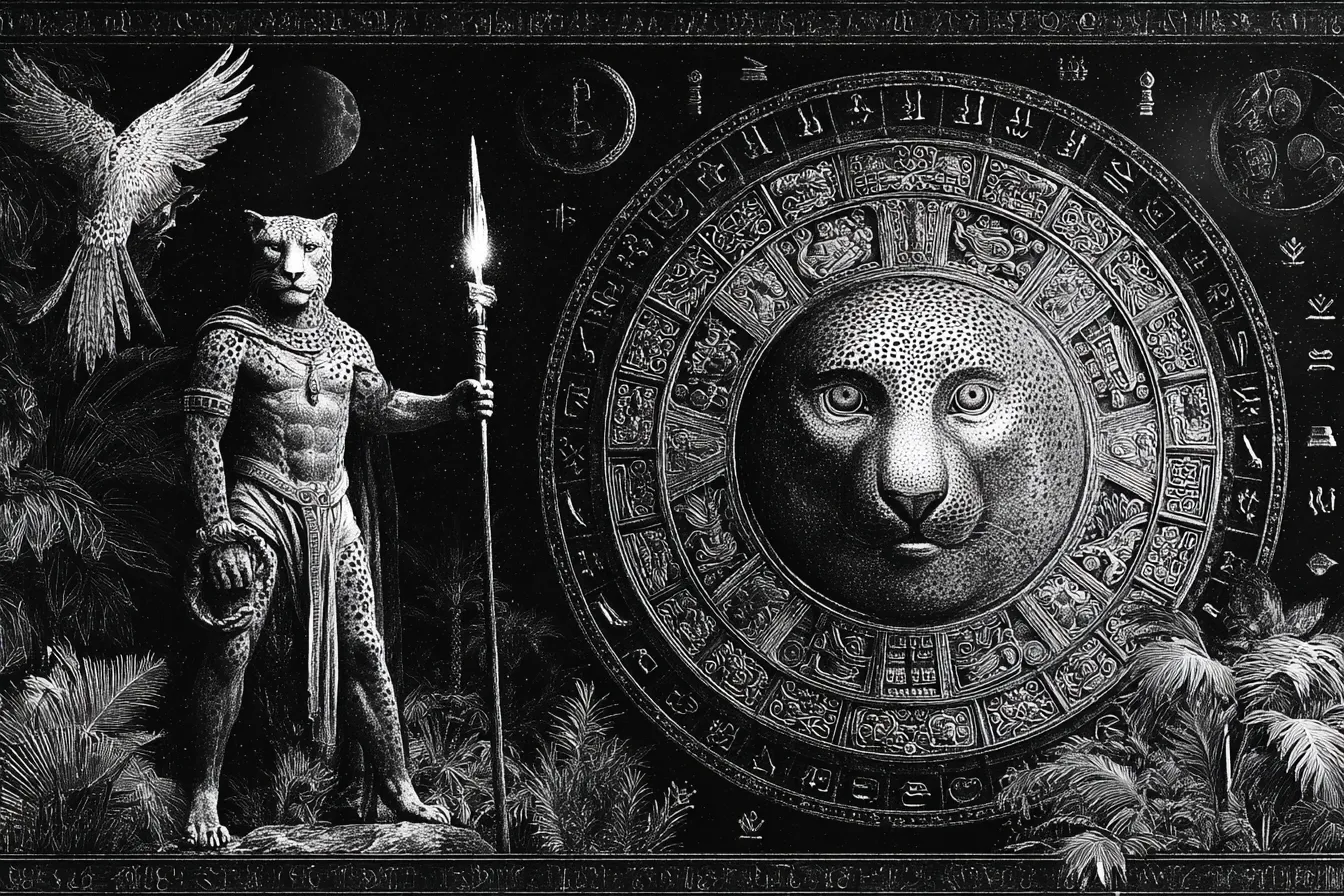
What is Lamat?
Lamat is the eighth of twenty Solar Seals in the Mayan Tzolkin — the 260-day sacred calendar built from twenty day signs cycling through thirteen numbered tones, producing 260 unique combinations called Kin. The Tzolkin has been in continuous use among Maya peoples for at least 2,500 years and remains a living tradition today. Ajq’ij — Maya day keepers and ceremonial priests — continue to guide communities through the Tzolkin cycle in Guatemala and southern Mexico, where the Chol Q’ij (the K’iche’ Maya name for the calendar) is observed in both ceremonial and daily life.
The Whisper draws on the Tzolkin as one of four ancient systems — alongside Western Astrology, Nine Star Ki, and BaZi — synthesizing them into a single daily personal insight. Your birth seal is calculated by locating your birth date within the Tzolkin cycle using the GMT correlation constant (584283) — the most widely accepted scholarly alignment between the Maya Long Count and the Gregorian calendar. Many English-language tools for finding a “Mayan day sign” use instead the Dreamspell system developed by José Argüelles in 1987, which applies a different correlation and sometimes different seal names, and which can produce a different result for the same birth date. The Whisper uses the traditional GMT correlation throughout. In addition to your birth seal, the daily seal marks the current day’s shared position in the Tzolkin cycle — the same for everyone worldwide — and The Whisper synthesizes both with the other active systems to generate each day’s insight.
Lamat arrives eighth in the cycle’s unfolding sequence. The preceding seven seals moved through the primordial ocean (Imix), animating breath (Ik), interior depth (Akbal), encoded potential (Kan), the body’s life force (Chicchan), the transformative passage of release (Cimi), and the skilled, healing accomplishment of the hand (Manik). Lamat is the moment when all of that — the potential, the vitality, the transformation, the skilled making — reaches a natural point of genuine harmony and begins to shine. The star does not strive to produce its light; it shines because its inner organization has reached the state that produces light as its natural expression.
The symbol and its traditional roots
The glyph associated with Lamat in Maya iconography is directly connected to Venus — the planet that held a position of extraordinary importance in Maya astronomical and cosmological thinking. The Maya tracked Venus with remarkable precision, documenting its 584-day synodic cycle across centuries in the Dresden Codex, one of the few surviving Maya manuscripts. The Venus cycle was used to time significant ceremonial and political events, and the planet’s appearance as morning star and evening star was understood as a cosmic rhythm of great consequence. Lamat is the day sign directly linked to this Venus tracking — it carries not merely the aesthetic associations of beauty and harmony but the astronomical precision of a civilization that understood Venus’s movements with a sophistication that continues to impress contemporary researchers.
The star quality of Lamat is therefore not simply decorative. In the Maya cosmological framework, the stars — and Venus in particular — were understood as sources of genuine pattern and order in the cosmos. The light of a star is the signal of genuine structural integrity: the star shines because its internal organization has achieved a state of sustained, self-maintaining balance. Lamat carries this quality — beauty not as surface appearance but as the visible signal of genuine inner harmony, the radiance that arises when things are in genuine right relationship with each other.
In the Aztec Tonalpohualli, the corresponding day sign is Tochtli — the Rabbit. The rabbit in Mesoamerican tradition carries associations with the moon, with fertility, with the abundance of things in right seasonal relationship, and with the quality of multiplying joy. The rabbit’s speed and lightness add a dimension to Lamat’s star quality that the astronomical imagery alone might not convey: Lamat is not solemn beauty but living, quickening, joyful beauty — the kind that multiplies and spreads rather than sitting still to be admired.
The color associated with Lamat is Yellow, and the direction is South — the direction the Tzolkin associates with ripening, completing, and the harvest. Yellow seals carry the warmth and fullness of the south’s quality: the energy that brings things to their fullest expression, that allows what has been developing to arrive at genuine completion and abundance. Lamat as a Yellow/South seal represents beauty and harmony as a form of ripening — the star’s light as the natural expression of a process that has been allowed to reach its full development.
The energy of Lamat
The traditional meaning of Lamat centers on beauty as the expression of genuine harmony — the radiance that arises not from the application of aesthetic judgment but from the natural state of things that are in genuine right relationship with each other. This is a meaningful distinction: Lamat beauty is not the result of arrangement, decoration, or the imposition of form from the outside, but the visible quality of genuine inner coherence. The star shines not because someone has designed it to shine but because its inner organization has reached the state that produces light spontaneously.
The Tzolkin tradition associates Lamat with aesthetic intelligence — the capacity to recognize and produce genuine harmony, to sense when things are in right relationship and when they are not, and to understand that this sensing is a form of knowledge rather than mere preference. Aesthetic intelligence in the Lamat tradition is not about taste or style; it is the capacity to perceive the quality of organization in things, relationships, and situations — to feel the difference between what is genuinely in harmony and what is merely arranged to appear so. This is a form of discernment that, like the Blue Hand’s skillful touch, operates through direct contact rather than through analysis from a distance.
The star’s quality of being genuinely bright — not performing brightness but actually shining — is another central Lamat quality that the tradition emphasizes. This distinction between genuine radiance and performed radiance is fundamental to Lamat’s meaning. The star does not try to be visible; it is visible because of what it genuinely is. Lamat carries this as both a quality and a challenge: the genuine brightness that comes from actual inner harmony is very different from the brightness that is produced by effort, performance, or the attempt to be seen. The tradition suggests that Lamat energy tends to express most powerfully precisely when it is not trying to express — when the person or the moment is simply, genuinely, in the state of harmony that produces natural radiance.
There is a further quality in Lamat associated with Venus’s role as both morning star and evening star — the planet that appears in two apparently different roles, present at both the beginning and the end of the day’s sky. This duality adds a dimension of completeness to Lamat’s beauty: the genuine harmony that Lamat represents is not one-sided or partial but the kind of balance that holds opposites in dynamic relationship. The morning star that announces the coming day and the evening star that accompanies its close are the same planet seen from different positions in the same cycle. Lamat’s beauty is of this kind: comprehensive rather than selective, present in the full range rather than only in the conventionally pleasing parts.
The multiplication quality that the Aztec Tochtli (rabbit) brings to this seal is also worth examining. Genuine beauty and genuine harmony have a quality of increase — they tend to generate more of themselves, to inspire others to their own expressions of genuine quality, to create conditions in which more things come into right relationship. This is different from the competitive quality of performance or display; it is the generative quality of genuine light, which illuminates rather than consumes.
Lamat as a birth seal and daily seal
As a birth seal, Lamat in the Tzolkin tradition is associated with the person who carries genuine aesthetic intelligence and the capacity for natural radiance as their primary orientation — someone whose most characteristic quality is the ability to sense, produce, and embody genuine harmony, and whose presence tends to have a naturally illuminating effect on the situations they inhabit. The birth tone modifies how this quality expresses: a person born on Lamat with Tone 5 carries the star’s radiance with a more commanding, central quality; someone born on Lamat with Tone 12 may carry it with a more complex, cooperative quality.
People born under Lamat are traditionally associated with a particular capacity for recognizing genuine quality — the ability to sense the difference between what is genuinely in harmony and what is arranged to appear so. This is a quality that extends well beyond the conventional arts: a Lamat person’s aesthetic intelligence may express as the capacity to design elegant systems, to facilitate genuinely productive relationships, to recognize which solution to a complex problem is the most genuinely harmonious one, or to sense when a situation has achieved the quality of rightness that signals genuine completion.
There is also a traditional association between Lamat and the capacity to hold genuine joy — not the performed happiness of social convention, but the living, quickening quality that the Aztec rabbit brings to the star’s light. People with Lamat as a birth seal are sometimes described in the Tzolkin tradition as carriers of genuine delight — the quality of being genuinely lit up by what genuinely deserves it, and of communicating that quality to others through the simple fact of their authentic response.
As a daily seal, when Lamat appears as the current day’s position in the Tzolkin cycle, the tradition suggests a quality of natural harmony and genuine aesthetic opening — a day when the capacity to sense and express genuine beauty tends to be more available, when things have a quality of natural rightness that is worth noticing and working with, and when the effort to perform or force a particular outcome tends to be less productive than the simpler practice of allowing what is genuinely in harmony to express itself.
Strengths and growth edges
The strengths traditionally associated with Lamat are rooted in its relationship to genuine harmony and aesthetic intelligence. The capacity to create and recognize genuine beauty is the most fundamental — in the broader sense of perceiving and producing the quality of right relationship that makes things genuinely good rather than merely adequate. This expresses across domains: the elegance of a well-structured argument, the grace of a well-managed relationship, the beauty of a well-designed object, the satisfaction of a problem solved with genuine economy of means.
The quality of genuine, natural radiance is the second major strength — the capacity to be genuinely bright rather than to perform brightness, to illuminate the situations one enters through actual inner quality rather than through effort or display. This is a subtler strength than the more active qualities of other seals, but it is a genuinely powerful one: the person who is genuinely in harmony with themselves and with what they are doing tends to have an effect on their environment that is disproportionate to any deliberate effort they make.
The capacity for genuine joy and delight — the rabbit’s quickening quality within the star’s light — is another recognized Lamat strength. The ability to be genuinely, authentically delighted by what genuinely deserves delight is not trivial; it is a form of attunement to genuine quality that the Tzolkin tradition treats as valuable and meaningful.
The growth edges associated with Lamat follow from the same territory with characteristic directness. The beauty-seeking that avoids genuine depth is the primary growth edge — the aesthetic intelligence oriented so strongly toward harmony and radiance that it avoids, minimizes, or exits early from the situations of genuine difficulty, friction, and complexity that are also part of a full life. The star that shines only in clear skies has not yet developed the quality of genuine radiance that holds through all conditions.
The aesthetic intelligence used in the service of appearance rather than genuine quality is a closely related growth edge — the Lamat quality that has become disconnected from its root in genuine inner harmony and is now operating as a surface phenomenon: the beautiful arrangement that is not actually harmonious, the performed lightness that is not actually joyful, the elegant solution that does not actually solve the problem.
Finally, the star that shines so brightly it prevents genuine contact is a recognized Lamat growth edge — the radiance that is so complete and so self-contained that others cannot find an entry point, cannot contribute their own quality to what is being created, cannot experience the genuine relationship that Lamat’s harmony might otherwise enable.
What Lamat means in The Whisper
In The Whisper’s multi-system synthesis, Lamat resonates across several traditions in ways that clarify its essential quality from complementary angles.
The resonance with Western Astrology is strongest with Venus and Libra — the quality of genuine beauty and harmony and the aesthetic intelligence that recognizes and creates right relationship. Venus in Western astrology governs the capacity to perceive and produce beauty, to sense the quality of relationship and harmony in situations, and to be drawn toward what is genuinely good rather than merely useful or powerful. Libra governs the intelligence of balance and right relationship — the sign most associated with the capacity to hold multiple qualities in genuine dynamic equilibrium rather than forcing resolution into one-sidedness. The combination of Venus’s beauty-sensing and Libra’s balance intelligence captures the Lamat quality precisely. When The Whisper synthesizes a Lamat influence with a strong Venus or Libra quality from the Western layer, the beauty-perceiving, harmony-creating dimension of that day’s reading may be particularly amplified.
In Nine Star Ki, the resonance is with the Seven Red Metal Star (七赤金星) — the aesthetic sensibility, joyous expression, and the quality of genuine beauty that the autumn metal carries in its refined, fully-expressed form. In Nine Star Ki, the Seven Red Star is associated with the harvest season’s quality of completed ripeness — the moment when what has been developing has arrived at its full expression and can be genuinely enjoyed. It carries the quality of the artist, the aesthete, the one who creates not from external necessity but from genuine inner orientation toward the beautiful. The autumn evening star quality of the Seven Red resonates with Lamat’s Venus imagery directly. When Lamat appears alongside a Seven Red Metal Star influence in The Whisper’s Nine Star Ki layer, the refined aesthetic quality and natural radiance of the reading may be especially present.
From a BaZi perspective, the resonance is with Xin Metal (辛金) — the polished, reflective, aesthetically precise quality of yin metal; the jewel that genuinely shines. Xin Metal in BaZi is the metal that has been refined to its highest expression: the gem, the polished blade, the surface that reflects with perfect clarity. It carries the quality of genuine aesthetic discernment — the ability to recognize and produce what is genuinely excellent rather than merely acceptable — alongside the natural radiance of something that has been brought to its full, refined quality. When Lamat appears alongside a Xin Metal influence in The Whisper’s BaZi layer, the refined aesthetic quality and natural radiance of the reading may be especially present.
The Aztec Tonalpohualli equivalent, Tochtli (the Rabbit), adds the quality of quickening, multiplying joy — the living vitality that genuine beauty carries when it is in contact with actual life rather than elevated above it. The rabbit’s fertility and speed frame Lamat’s star quality as something active and generative rather than static and admired: genuine beauty in the Lamat tradition does not stand apart from life but moves through it, quickening what it touches.
In The Whisper’s daily synthesis, Lamat days carry the quality of natural harmony and genuine aesthetic opening — days when the capacity to recognize and express genuine beauty tends to be more available, and when allowing what is genuinely in harmony to express itself tends to be more productive than forcing a particular outcome.
Frequently asked questions
Q: Why is Lamat associated with Venus specifically rather than with beauty in a general sense?
The connection between Lamat and Venus in the Maya tradition is primarily astronomical rather than mythological. The Maya tracked Venus’s 584-day synodic cycle with extraordinary precision across centuries, using it to time ceremonial and political events documented in the Dresden Codex and other sources. Lamat is the Tzolkin day sign directly associated with this Venus tracking — it carries the astronomical reality of Venus as a precisely observed, cosmologically significant cycle, not merely its conventional mythological associations with love and beauty. The beauty and harmony dimension of Lamat derives from this deeper root: Venus’s cycles were understood as a cosmic expression of genuine pattern and order, and Lamat’s aesthetic quality is the human-scale expression of the same capacity for right relationship that Venus’s precise orbital mechanics represents at the cosmic scale.
Q: Does The Whisper use the same Mayan calendar system as apps and sites that offer Mayan astrology readings?
Not necessarily. The majority of English-language Mayan astrology tools are based on the Dreamspell system developed by José Argüelles in 1987, which uses a different calendar correlation and sometimes different seal names than the traditional Tzolkin. The Whisper uses the GMT correlation constant (584283), which is the most widely accepted scholarly alignment and is the correlation used by traditional Maya practitioners and communities today. If you have previously received a Mayan day sign from another source, your result in The Whisper may differ, and it is worth understanding that these are genuinely different frameworks rather than different expressions of the same information.
Q: If Lamat is my birth seal, does that mean I am naturally artistic or drawn to the arts?
The Tzolkin tradition associates Lamat with aesthetic intelligence — the capacity to sense and produce genuine harmony — but this expresses across many domains, not exclusively the conventional arts. A Lamat birth-seal person may find their aesthetic intelligence expressing as visual art, music, or design, but equally in the elegance of their analytical thinking, the quality of their relationships, the way they structure a project or manage a space, or the quality of their attention to what is genuinely good in any situation. The birth tone paired with Lamat also significantly shapes how this quality expresses in practice. What the Tzolkin tradition suggests is an orientation toward genuine quality and genuine harmony as meaningful in themselves — not a predetermination of the domain in which that orientation will express.