
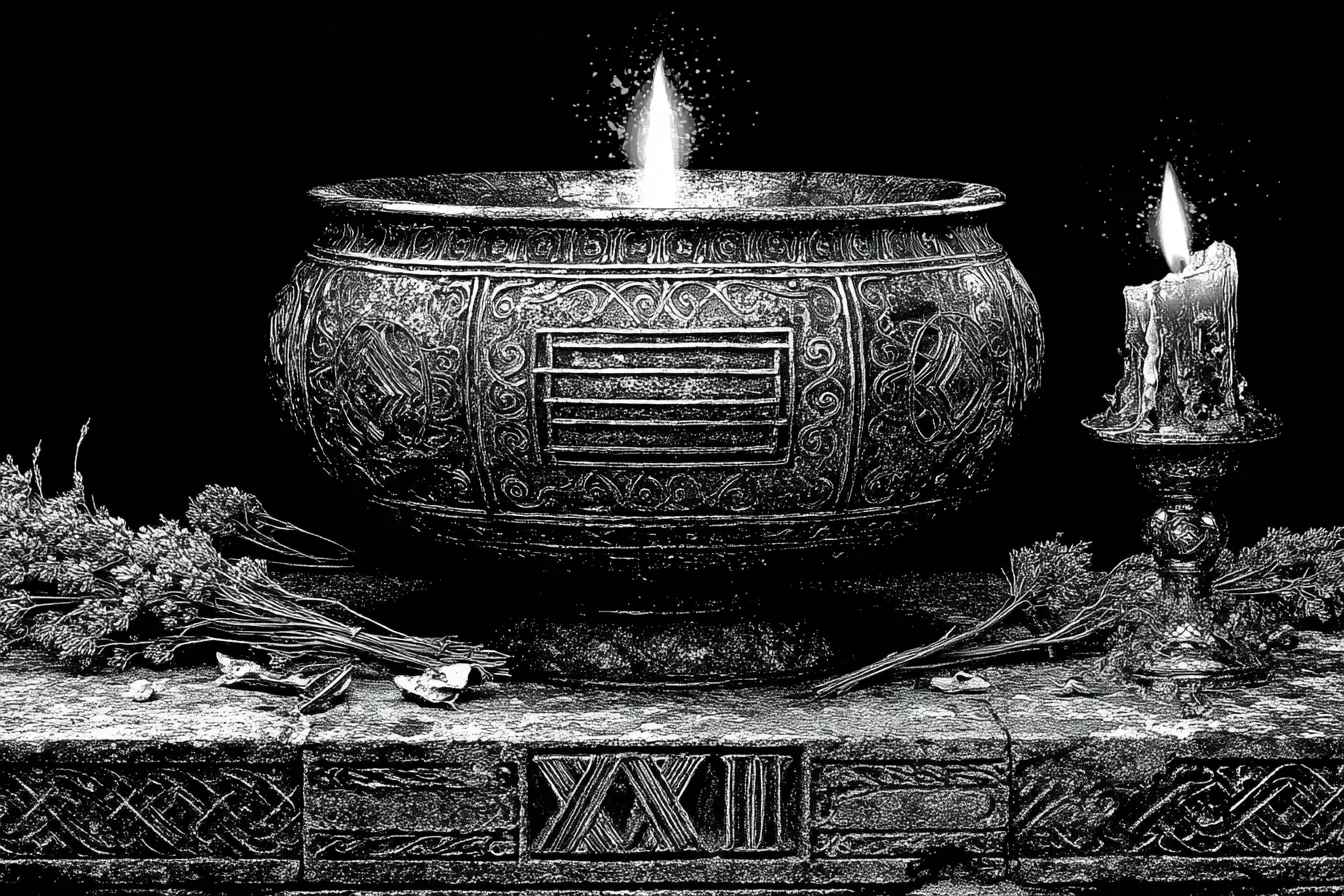
When you receive Hexagram 23, the first thing most people feel is unease.
The name is Po — translated by Richard Wilhelm and Cary Baynes as “Splitting Apart.” Five broken yin lines below, one unbroken yang line at the top, barely holding on. The visual alone feels precarious. And the standard reading confirms it: this is not a time to act, not a time to advance, not a time to go anywhere at all.
But what Hexagram 23 is actually describing — when you sit with it carefully, when you read Wilhelm’s commentary alongside the original structure, when you understand what the trigrams are doing — is considerably more interesting and considerably less catastrophic than the first impression suggests.
Po is not a warning of incoming disaster. It is an honest description of a structural situation: the moment when what cannot hold together is finally, visibly coming apart. The splitting is not new. What is new is that it has become undeniable.
Understanding the difference between these two readings — disaster warning vs. honest structural description — is the difference between using Hexagram 23 well and using it badly.
The Structure: What the Trigrams Show
Hexagram 23 is composed of two trigrams:
- Upper trigram: Gen (☶) — Mountain. Stillness, heaviness, weight that doesn’t move.
- Lower trigram: Kun (☷) — Earth. Receptivity, the ground itself, the capacity to receive and hold.
The mountain sits on the earth — which sounds stable. But the relationship between them here is one of erosion, not foundation. The mountain is being undermined from below. The earth beneath it is giving way slowly, and the mountain, which appears solid and fixed from the outside, is sitting on an increasingly unreliable base.
The five broken yin lines below the single unbroken yang at the top are the visual representation of this erosion. The yang line at position six is what remains — the last solid thing, barely supported. The ancient commentators described the image as a bed that has been chipped away from underneath until only the frame remains, then the mat, then nothing.
Five out of six lines are now yin. The yang force — the active, initiating, structuring principle — has been almost entirely displaced. What was once a structure is now mostly its absence.
What Wilhelm-Baynes Actually Says
Richard Wilhelm’s translation of Hexagram 23, rendered into English by Cary Baynes, is the version most Western readers encounter. It is worth engaging with carefully, because its language is precise in ways that are easy to miss on a first reading.
The Judgment reads: “Splitting apart. It does not further one to go anywhere.”
That phrase — “it does not further one to go anywhere” — is the I Ching’s consistent idiom for a period when forward movement is structurally not supported. It is not saying that action is impossible or that terrible things will happen if you act. It is saying that the conditions do not amplify or support forward movement. What you do will not gain traction. The ground is too soft.
The Image reads: “The mountain rests on the earth: the image of Splitting Apart. Thus those above can ensure their position only by giving generously to those below.”
This is the part most cursory readings skip, and it contains the hexagram’s most practically useful guidance. The commentary is not about retreat or passivity. It is about the specific relational dynamic that the structural erosion has created: those who remain in positions of apparent strength do so only through genuine generosity toward those below — toward the foundation, toward whatever is being eroded. The mountain maintains itself by nourishing the earth it sits on, not by pretending the erosion isn’t happening.
The Lines — the six individual positions — describe specific aspects of the splitting process:
Line 1 (bottom, yin): The splitting has begun at the foundation, at the legs of the bed. The image is of small, incremental erosion that has already started but is not yet obvious.
Line 2 (yin): The splitting has progressed to the edge of the bed. The erosion is continuing and the misfortune is increasing — not because of any single catastrophic event, but because the process that was already underway has continued.
Line 3 (yin): An unexpected split — but in a different direction. Wilhelm’s commentary here describes a situation where the person in the midst of splitting apart finds themselves also splitting from the source of the erosion. This is the changing line that most often marks genuine transition: not just the fall of what was deteriorating, but the beginning of separation from what was causing the deterioration.
Line 4 (yin): The splitting reaches the skin — the surface. What was internal has now become visible. The image is stark: the bed has reached the body itself.
Line 5 (yin): The court ladies are favored like fish in the net. This line is the most enigmatic of the five yin lines and is often interpreted as a reversal — the yin forces, in their ascendancy, become organized, even favored. There is no misfortune here for the people who are part of the new arrangement.
Line 6 (yang): The large fruit uneaten. The single yang line at the top — the last stronghold of the structuring force — is described as fruit not yet consumed, still containing within itself the seed of renewal. The superior person’s wagon wheels roll away; the small person’s hut splits apart. The distinction is significant: who you are in this moment determines what you carry out of it.
The Common Misreading and Why It Happens
The most common mistake when receiving Hexagram 23 is to read it as a prediction of approaching catastrophe — to interpret “it does not further one to go anywhere” as “things are about to get much worse.”
This misreading is understandable. The image is striking. The language is stark. And the five yin lines overwhelming the single yang line looks, visually, like defeat.
But the I Ching’s Judgment speaks about fitting action for the current moment, not about what is coming next. The distinction the hexagram draws is between a time when action is structurally supported and a time when it isn’t. Hexagram 23 describes the latter. It does not say that moving forward will cause disaster. It says that moving forward won’t gain traction — that the conditions don’t amplify effort the way they do in other hexagrams.
More importantly: the splitting described in Hexagram 23 is typically already well underway before the hexagram is received. The relationship that is splitting apart has been showing signs of the split for some time. The project that is disintegrating has been in decline. The situation that is deteriorating started deteriorating before the reading. What Po describes is the moment when this process becomes undeniable — when the erosion that was happening beneath the surface has become visible and structural.
This is not a warning about what might happen. It is an accurate description of what is happening. And accurate description, even of uncomfortable things, is valuable.
The Relating Hexagram and What It Points Toward
In traditional I Ching practice, changing lines produce a second hexagram — the “relating hexagram” or “future hexagram” — that describes where the situation is moving. The most common changing line scenario for Hexagram 23 involves line 6 (the single yang line) transforming, which produces Hexagram 2 — Kun, The Receptive.
Hexagram 2 is pure yin — complete receptivity, the earth itself, the capacity to receive without initiating. It is not a hexagram of passivity so much as one of pure potential: the field that is ready to receive what is planted, the ground cleared after what could not hold has fallen away.
The movement from Po (23) to Kun (2) describes a classical I Ching arc: the splitting apart of what was structurally compromised, followed by the return to pure ground — the condition from which genuine new growth becomes possible. The fallen fruit of Line 6 contains the seed. The empty ground is ready to receive it.
This is the hope encoded in Hexagram 23 that the initial unease often obscures: it describes a transition, not an ending. What splits apart is what could not hold. What comes after is the ground cleared for what comes next.
When You Receive This Hexagram
If you receive Hexagram 23 in a reading, here are the questions worth sitting with:
What is already splitting? The hexagram is almost certainly naming something in your current situation that has been deteriorating for some time and has now become structurally visible. What is it? The honest answer to this question is often more obvious than you want it to be.
Where is the erosion coming from? The trigrams describe erosion from below — from the foundation, from the ground on which what you’ve built is resting. What is the foundational issue? The surface symptoms of what is splitting apart are rarely the actual source.
What is the remaining yang? Line 6 — the single unbroken line — is what remains intact. In your situation, what is the genuine thing of value that has not been compromised, that still contains the seed of what comes next? Protecting that thing — the large fruit not yet eaten — is the specific task of this moment.
Are you being called to nourish or to move on? The Image’s commentary — that those above maintain their position only through giving generously to those below — suggests a possible path forward within the current structure. But sometimes what splits is genuinely done. The question is which situation you’re in.
How The Whisper Uses Hexagram 23
The Whisper generates your daily I Ching hexagram from your birth data — a deterministic rather than random process, which means the hexagram you receive reflects your specific natal position in the I Ching sequence combined with the current moment in the temporal cycle.
When Hexagram 23 appears in your composite reading, The Whisper places it in context alongside your BaZi day, your Nine Star Ki palace position, and your other divination profiles. A day when your Nine Star Ki star is also in a consolidation palace and your BaZi indicates a Metal-dominant period — and Po appears in the I Ching — produces a coherent composite message: the current conditions across multiple systems are consistently pointing toward holding steady, assessing honestly, and refraining from force.
The hexagram’s function is naming — giving a precise label to a situation that is real and that deserves accurate description. What you do with that name is yours to determine.
Po describes the moment the splitting becomes visible. It does not determine what you carry out of it.
Explore the full 64 I Ching hexagrams in The Whisper’s daily oracle — combined with BaZi, Nine Star Ki, and more, at whisper.day.