
The I Ching — the Book of Changes — is one of the oldest continuously used texts in human history. Its core structure, the 64 hexagrams, was probably complete by around 1000 BCE in the Zhou Dynasty, though the interpretive commentary that surrounds it was added over the following centuries. For three thousand years, the hexagrams have been consulted by emperors and philosophers, farmers and generals, scholars and poets — not as a mechanism for telling the future, but as a vocabulary for naming what is actually happening.
Each hexagram is built from six lines, each line either unbroken (yang, ——) or broken (yin, — —). Six lines produce 64 possible combinations — the complete set of configurations the I Ching uses to describe every situation a human being might face. The genius of the system is not the mathematics but the naming: each of the 64 configurations has been given a name, an image, and a judgment that has been refined through centuries of commentary into something remarkably precise.
This is a complete reference to all 64 hexagrams: their names, their trigram composition, and their core meaning as a reflective framework.
How to Read This Reference
Each hexagram is composed of two trigrams — a lower (inner) trigram and an upper (outer) trigram. The eight trigrams are: Qian (Heaven, ☰), Kun (Earth, ☷), Zhen (Thunder, ☳), Xun (Wind/Wood, ☴), Kan (Water, ☵), Li (Fire, ☲), Gen (Mountain, ☶), Dui (Lake, ☱). Understanding the trigrams gives you a structural intuition for the hexagrams — Hexagram 11 (Peace) puts Earth above Heaven, a natural settling of the heavy element downward; Hexagram 12 (Standstill) inverts this, putting Heaven above Earth, which creates a separation between the two.
The core meaning given here is the distillation most useful for reflective reading — the question or insight the hexagram places in front of you. This is not a substitute for the full text of the I Ching, which rewards deep reading, but a working reference that allows you to move from hexagram number to core meaning quickly.
The 64 Hexagrams
1. Qian — The Creative (Heaven over Heaven ☰☰)
Pure yang energy — the initiating, creative force at its most concentrated. The core question: what are you building, and does your effort carry genuine force? Qian is the hexagram of undivided creative potential. It calls for action from a place of clarity rather than desire, and cautions that power without wisdom is dangerous.
2. Kun — The Receptive (Earth over Earth ☷☷)
Pure yin energy — the receptive, responsive force at its most complete. The counterpart to Qian: where Qian initiates, Kun receives and brings to form. The core question: are you able to follow, to serve, to receive what is given? Kun does not mean passivity — it means the active orientation of complete responsiveness.
3. Zhun — Difficulty at the Beginning (Water over Thunder ☵☳)
The moment of difficult emergence — like a plant pushing through hard ground. Things are beginning but not yet formed. The core insight: the difficulty of the beginning is not a sign of wrongness. Stay with it, gather support, don’t force the emergence faster than conditions allow.
4. Meng — Youthful Folly (Mountain over Water ☶☵)
The condition of not yet knowing — youth, inexperience, the need for guidance. The core question: are you willing to learn, or are you insisting on your own understanding prematurely? Meng is not a criticism. It describes a real condition that requires a specific response: seek the teacher, ask the honest question.
5. Xu — Waiting (Water over Heaven ☵☰)
Waiting with genuine patience — not passive delay, but the active attention of one who knows the moment has not yet arrived. The core insight: the person who waits in strength is different from the person who waits in anxiety. What is your quality of waiting right now?
6. Song — Conflict (Heaven over Water ☰☵)
A genuine tension between two parties, each of whom believes themselves in the right. The core counsel: conflict rarely resolves through force of argument alone. If possible, seek mediation. If not possible, accept that not every conflict can be won and choose what you’re willing to accept.
7. Shi — The Army (Earth over Water ☷☵)
Organized force in service of a just purpose. The core question: what is the cause that justifies the mobilization of your resources? Shi cautions that the use of force requires clear leadership, clear purpose, and a return to ordinary life once the purpose is achieved.
8. Bi — Holding Together (Water over Earth ☵☷)
Union, alliance, the bond between people who choose to stand together. The core question: what are the genuine bonds in your life, and are you tending them? Bi calls for sincerity as the foundation of any lasting alliance.
9. Xiao Xu — Small Accumulation (Wind over Heaven ☴☰)
The conditions for advance are not yet fully present — the wind clouds the sky but rain hasn’t fallen. Small progress is possible through patience and gentle persistence. The core insight: the situation calls for small acts, not grand movements. Accumulate what you can in the time available.
10. Lu — Treading (Heaven over Lake ☰☱)
Moving carefully through dangerous territory — treading on the tail of the tiger, as the image says, and not being bitten. The core question: are you moving with the appropriate care and awareness in your current situation? Lu is about the lightness and precision that allows you to proceed where clumsiness would cause harm.
11. Tai — Peace (Earth over Heaven ☷☰)
The great harmonizing of heaven and earth — when the creative and receptive forces are in proper relationship, things flourish. The core insight: this is a period of genuine ease and productive flow. The caution is not to squander it through complacency or to assume it will last indefinitely.
12. Pi — Standstill (Heaven over Earth ☰☷)
The inversion of Peace — heaven and earth separated, communication between them broken, stagnation prevailing. The core question: what has caused the breakdown of communication or flow in your situation? Pi is not permanent, but it requires honest acknowledgment before the blockage can clear.
13. Tong Ren — Fellowship (Heaven over Fire ☰☲)
Union with others based on shared principle and genuine affinity. The core question: who are your genuine companions, and on what basis do you stand together? Tong Ren distinguishes between fellowship rooted in principle (durable) and fellowship based on mutual advantage (fragile).
14. Da You — Great Possession (Fire over Heaven ☲☰)
Abundance and great capacity — a position of genuine strength and resource. The core question: how do you hold what you have? Da You is about the wisdom required to bear great possession without being corrupted by it. The image is the sun in the sky: it illuminates without hoarding its light.
15. Qian — Modesty (Earth over Mountain ☷☶)
Genuine modesty — not false humility, but the quality of not overstating one’s own importance. The core insight: the modest person succeeds because they don’t threaten others and can be trusted. In this context, modesty is a strength, not a diminishment.
16. Yu — Enthusiasm (Thunder over Earth ☳☷)
The energy of inspired forward movement — enthusiasm that moves others because it is genuine. The core question: what actually inspires you, and are you moving from that place? Yu cautions against false enthusiasm and against losing the root of genuine inspiration in the pursuit of stimulation.
17. Sui — Following (Lake over Thunder ☱☳)
The capacity to adapt to circumstances, to follow the moment’s lead rather than imposing a fixed direction. The core question: are you able to respond to what is actually happening, or are you insisting on a plan the situation has already moved past?
18. Gu — Work on What Has Been Spoiled (Mountain over Wind ☶☴)
The correction of accumulated error — attending to what has decayed through neglect or wrong action. The core question: what in your situation has been allowed to deteriorate, and what would genuine repair require? Gu is about the courage and patience to undo inherited damage.
19. Lin — Approach (Earth over Lake ☷☱)
Something is approaching — an opportunity, a period of growth, a relationship that is drawing near. The core question: are you ready to meet what is coming? Lin calls for the genuine preparation that allows an approaching opportunity to be fully received.
20. Guan — Contemplation (Wind over Earth ☴☷)
The pause of genuine observation — looking at the situation clearly before acting. The core question: what do you actually see when you look without the filter of what you want or fear? Guan is the practice of honest perception.
21. Shi He — Biting Through (Fire over Thunder ☲☳)
The forceful removal of an obstacle that is preventing proper connection or completion. The core question: what stands between you and a genuine resolution, and does the situation call for decisive action to remove it?
22. Bi — Grace (Mountain over Fire ☶☲)
Beauty and elegance — the form that makes substance communicable. The core question: is the outer form of your action consistent with its inner intent? Bi cautions that grace is valuable but that it must not be mistaken for substance.
23. Bo — Splitting Apart (Mountain over Earth ☶☷)
The disintegration of what can no longer hold — things falling away, the ground beneath giving way. The core insight: this is a time to conserve rather than advance. What is falling apart cannot and should not be held together by force.
24. Fu — Return (Earth over Thunder ☷☳)
The return of the light after darkness — the winter solstice, the turning point when the cycle begins again. The core question: what is returning in your situation? Fu describes a genuine new beginning, often subtle and fragile, that requires careful attention to take root.
25. Wu Wang — Innocence (Heaven over Thunder ☰☳)
Action free from ulterior motive — doing what is right because it is right, without calculation. The core question: are you acting from genuine integrity, or is there a hidden agenda? Wu Wang calls for the kind of action that has no regrets because it was never about outcome management.
26. Da Xu — Great Accumulation (Mountain over Heaven ☶☰)
The accumulation of substantial inner resource — knowledge, virtue, capacity that has been built over time and now represents genuine power. The core question: what have you been quietly building, and is the time approaching to put it to use?
27. Yi — Nourishment (Mountain over Thunder ☶☳)
Attention to what nourishes — physical, intellectual, spiritual. The core question: what are you taking in, and what are you providing? Yi asks you to notice the relationship between the quality of your nourishment and the quality of what you produce.
28. Da Guo — Preponderance of the Great (Lake over Wind ☱☴)
A situation that exceeds ordinary capacity — the ridgepole bends under excessive weight. The core question: is the load you’re carrying genuinely supportable, or have you taken on more than the structure can hold? Da Guo calls for extraordinary action or structural change.
29. Kan — The Abysmal (Water over Water ☵☵)
Water doubled — the abyss, the danger that must be navigated without being overwhelmed. The core question: how do you maintain yourself when the difficulty is genuine and sustained? Kan offers a counsel of consistency: stay true to yourself in the midst of the abyss, and you will find a way through.
30. Li — The Clinging (Fire over Fire ☲☲)
Fire doubled — the brightness that depends on what it clings to. The core insight: clarity and brilliance require the right attachment. Li asks what you are clinging to, and whether that attachment is sustaining your light or consuming it.
31. Xian — Influence (Lake over Mountain ☱☶)
Mutual attraction, the influence that flows between people who are genuinely drawn to each other. The core question: what is the quality of the attraction in your current situation — genuine and mutual, or one-sided and calculated?
32. Heng — Duration (Thunder over Wind ☳☴)
Perseverance — the sustained movement that comes from being rooted in what endures. The core question: what is the enduring principle in your situation, and are you moving from that ground rather than from circumstance?
33. Dun — Retreat (Heaven over Mountain ☰☶)
Strategic withdrawal — not defeat, but the wise recognition that the moment calls for a tactical step back. The core question: is the retreat you’re considering a genuine strategic move, or a flight from difficulty?
34. Da Zhuang — Great Power (Thunder over Heaven ☳☰)
Great strength in an ascending position. The core question: are you using your current power in accordance with what is right? Da Zhuang cautions that power without restraint becomes force, and force without direction causes damage.
35. Jin — Progress (Fire over Earth ☲☷)
Steady advancement into clarity and light. The core question: what progress is available to you right now, and are you moving toward it with appropriate confidence?
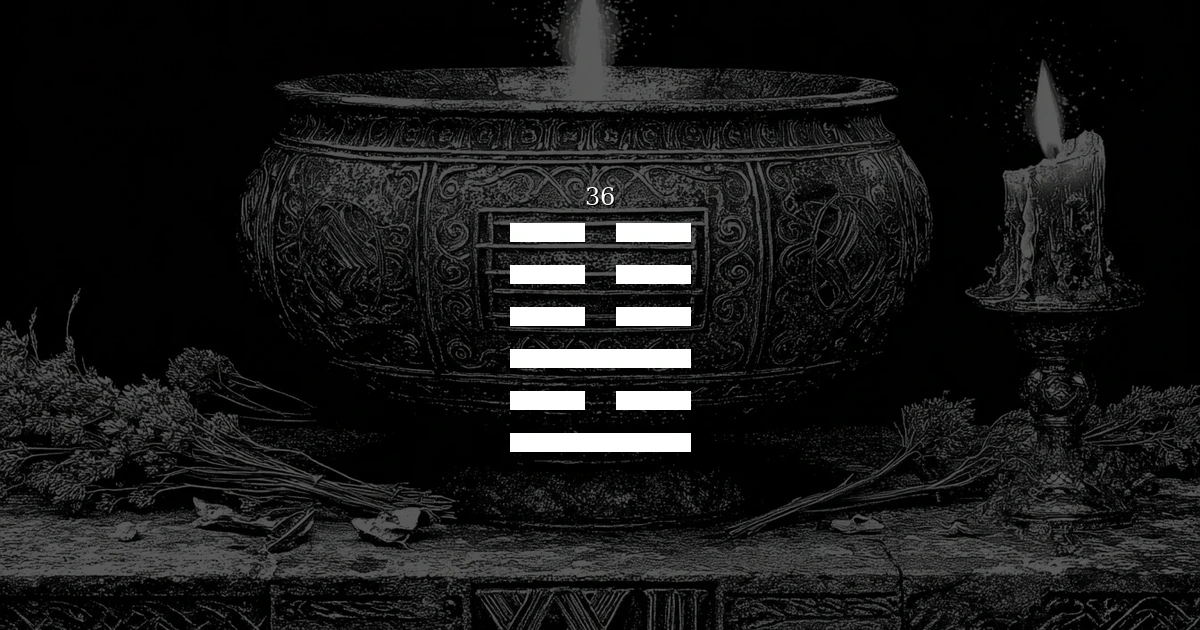
36. Ming Yi — Darkening of the Light (Earth over Fire ☷☲)
The light is wounded, hidden, under threat. The core counsel: preserve the inner light by concealing it from those who would extinguish it. This is not the time for full expression — it is the time for patient inner cultivation while outer conditions are hostile.
37. Jia Ren — The Family (Wind over Fire ☴☲)
The right ordering of relationships within the household or close circle. The core question: what does genuine care and clear roles look like in your closest relationships? Jia Ren describes the household as the foundation of all larger social order.
38. Kui — Opposition (Fire over Lake ☲☱)
A situation of genuine divergence — people or elements pointing in different directions. The core insight: opposition is not always bad. In small things, the tension between opposites can be productive. In large things, it requires resolution.
39. Jian — Obstruction (Water over Mountain ☵☶)
Genuine obstacles on the path forward. The core question: what is the obstacle, and is the path around it visible? Jian counsels seeking allies and reconsidering direction before exhausting yourself against an immovable wall.
40. Xie — Deliverance (Thunder over Water ☳☵)
Release after a period of tension or difficulty. The core question: what needs to be let go in order for genuine release to occur? Xie marks the moment when the pressure lifts — but the release must be intentional, not merely passive.
41. Sun — Decrease (Mountain over Lake ☶☱)
A period of conscious reduction — simplifying, releasing, accepting that less is appropriate for this moment. The core question: what can be genuinely surrendered without loss of what matters? Sun reminds that decrease at the right time is not loss but preparation.
42. Yi — Increase (Wind over Thunder ☴☳)
A period of genuine increase — conditions favor growth, abundance, forward movement. The core question: what is the most important thing to cultivate during this period of increase? The moment of increase is also the moment when the direction of growth is set.
43. Guai — Breakthrough (Lake over Heaven ☱☰)
The decisive breakthrough of the positive force — but accomplished through firm, clear declaration rather than force. The core question: what needs to be said clearly, once, without anger? Guai is about the moment when truth must be spoken in order for the blockage to break.
44. Gou — Coming to Meet (Heaven over Wind ☰☴)
An unexpected encounter — something arrives that was not sought. The core caution: not everything that presents itself without invitation is beneficial. Gou calls for discernment about what you allow to approach.
45. Cui — Gathering Together (Lake over Earth ☱☷)
The assembly of scattered elements — people, resources, intentions — into a unified whole. The core question: what is the organizing principle that allows genuine gathering? Cui requires something worth gathering around.
46. Sheng — Pushing Upward (Earth over Wind ☷☴)
The quiet, persistent upward movement of growth — like a tree growing through the earth toward light. The core question: is your current effort marked by this patient, persistent quality? Sheng cautions against forcing growth faster than conditions support.
47. Kun — Oppression / Exhaustion (Lake over Water ☱☵)
Genuine depletion and constraint — a situation where resources are insufficient and pressure is real. The core counsel: in genuine exhaustion, maintain your inner integrity. The conditions will change. Your character is what you can control.
48. Jing — The Well (Water over Wind ☵☴)
The inexhaustible source — the deep resource that remains constant regardless of how much is drawn from it. The core question: are you drawing from a genuine source, or a finite reserve? Jing is also about the social well — the shared resource that must be maintained for everyone to benefit.
49. Ge — Revolution (Lake over Fire ☱☲)
Fundamental change — not reform but transformation. The core question: is the change you’re considering truly necessary, or is it disruption for its own sake? Ge succeeds only when the time is genuinely right and the cause is genuinely just.
50. Ding — The Cauldron (Fire over Wind ☲☴)
The sacred vessel that transforms raw material into nourishment — cooking, refinement, the alchemical process. The core question: what are you in the process of transforming, and is the fire under the cauldron at the right temperature?
51. Zhen — The Arousing (Thunder over Thunder ☳☳)
Thunder doubled — shock, the sudden awakening that comes from outside. The core insight: the shock is not the end but the awakening. After the initial jolt, there is laughter and a return to consciousness. Fear passes; presence remains.
52. Gen — Keeping Still (Mountain over Mountain ☶☶)
The mountain doubled — stillness, the capacity to stop movement when movement is not called for. The core question: can you be genuinely still in your situation, or is your stillness actually suppressed movement? Genuine stillness is an active state, not an absence.
53. Jian — Development (Wind over Mountain ☴☶)
Gradual, orderly development — the wild goose that moves in proper stages along the migration path. The core question: is your development following its natural sequence, or are you attempting to skip necessary stages?
54. Gui Mei — The Marrying Maiden (Thunder over Lake ☳☱)
Moving into a situation where one’s position is not primary — accepting a secondary role in order to participate at all. The core question: is the role available to you in this situation worth accepting on its own terms, or does it require a compromise of something essential?
55. Feng — Abundance (Thunder over Fire ☳☲)
The zenith — a moment of full abundance, at its height. The core insight: the moment of greatest abundance is also the turning point. Abundance at its peak requires conscious tending to maintain. What are you doing with the fullness of this moment?
56. Lu — The Wanderer (Fire over Mountain ☲☶)
Moving through unfamiliar territory as a stranger — temporarily, without established roots. The core question: what is the appropriate conduct for a person in a foreign or temporary position? The wanderer succeeds through carefulness, genuine engagement, and not overstaying.
57. Xun — The Gentle (Wind over Wind ☴☴)
Wind doubled — the gentle, persistent penetration of the yielding force. The core question: what is the most penetrating approach available to you in your situation? Xun works through repetition and gentleness, not force. Small consistent pressure achieves what dramatic effort cannot.
58. Dui — The Joyous (Lake over Lake ☱☱)
Lake doubled — genuine joy, the pleasure of mutual exchange and shared delight. The core question: what is the quality of the joy in your current situation — genuine and shared, or performed and isolating? Dui reminds that true joy comes through connection, not possession.
59. Huan — Dispersion (Wind over Water ☴☵)
The dissolution of rigidity and separateness — like wind scattering ice on water. The core question: what hardness or isolation in your situation needs to be dissolved? Huan often describes the renewal that comes from genuine openness after a period of closure.
60. Jie — Limitation (Water over Lake ☵☱)
The acceptance of necessary limits — structure that makes things possible rather than restricting them. The core question: what are the genuinely necessary limits in your situation, as distinct from the limits that are merely habitual? Jie distinguishes constructive constraint from unnecessary restriction.
61. Zhong Fu — Inner Truth (Wind over Lake ☴☱)
The truth that emanates from genuine inner certainty — the kind of confidence that moves others because it is real. The core question: what do you actually know, with genuine inner certainty? Zhong Fu is about the rare quality of acting from what is truly known rather than what is desired.
62. Xiao Guo — Small Exceeding (Thunder over Mountain ☳☶)
A situation where the available action is smaller than the aspiration — not the time for great things, but for careful attention to the small things the moment actually offers. The core question: can you value what is genuinely available rather than mourning what isn’t?
63. Ji Ji — After Completion (Water over Fire ☵☲)
The moment after completion — everything is in its right place, the work is done. The core caution: the moment after completion is also the beginning of dissolution. Careful attention is required precisely when things seem most settled.
64. Wei Ji — Before Completion (Fire over Water ☲☵)
The moment before the final crossing — the fire above, the water below, the transition not yet made. The core question: what is the final step that remains, and does the situation call for careful preparation before taking it? Wei Ji is the last hexagram — and its position before completion (rather than after) is itself a statement: the I Ching ends with the acknowledgment that completion is always approaching but never permanently achieved.
Reading the Hexagrams in Practice
The 64 hexagrams are not 64 pieces of advice. They are 64 precise names for situations — the full vocabulary of the I Ching’s observation that life organizes itself into recognizable configurations, each of which has a characteristic quality and a characteristic response.
When you receive a hexagram in a reading, the first question is always: does this name what is actually happening? Not “what does this mean?” but “does this fit?” That fitting — the moment of recognition — is where the reading’s value lives. The interpretive text amplifies and deepens; the recognition comes first.
The I Ching’s structure also includes changing lines — individual lines within a hexagram that are in transition, moving from yin to yang or yang to yin. Changing lines generate a second hexagram (the “relating hexagram”) that describes where the situation is moving. The traditional reading thus involves two hexagrams: the present configuration and its direction of change.
The Whisper uses your birth data as the seed for a deterministic daily hexagram selection — the same seed-based approach described in the I Ching daily oracle guide — placing your hexagram in context alongside your BaZi day, your current Dasha period, and your Nine Star Ki stars. The 64 hexagrams provide the I Ching layer of that composite: a vocabulary that has been refined over three thousand years of human use, and that rewards returning to again and again as the situations it names keep recurring in new forms.