
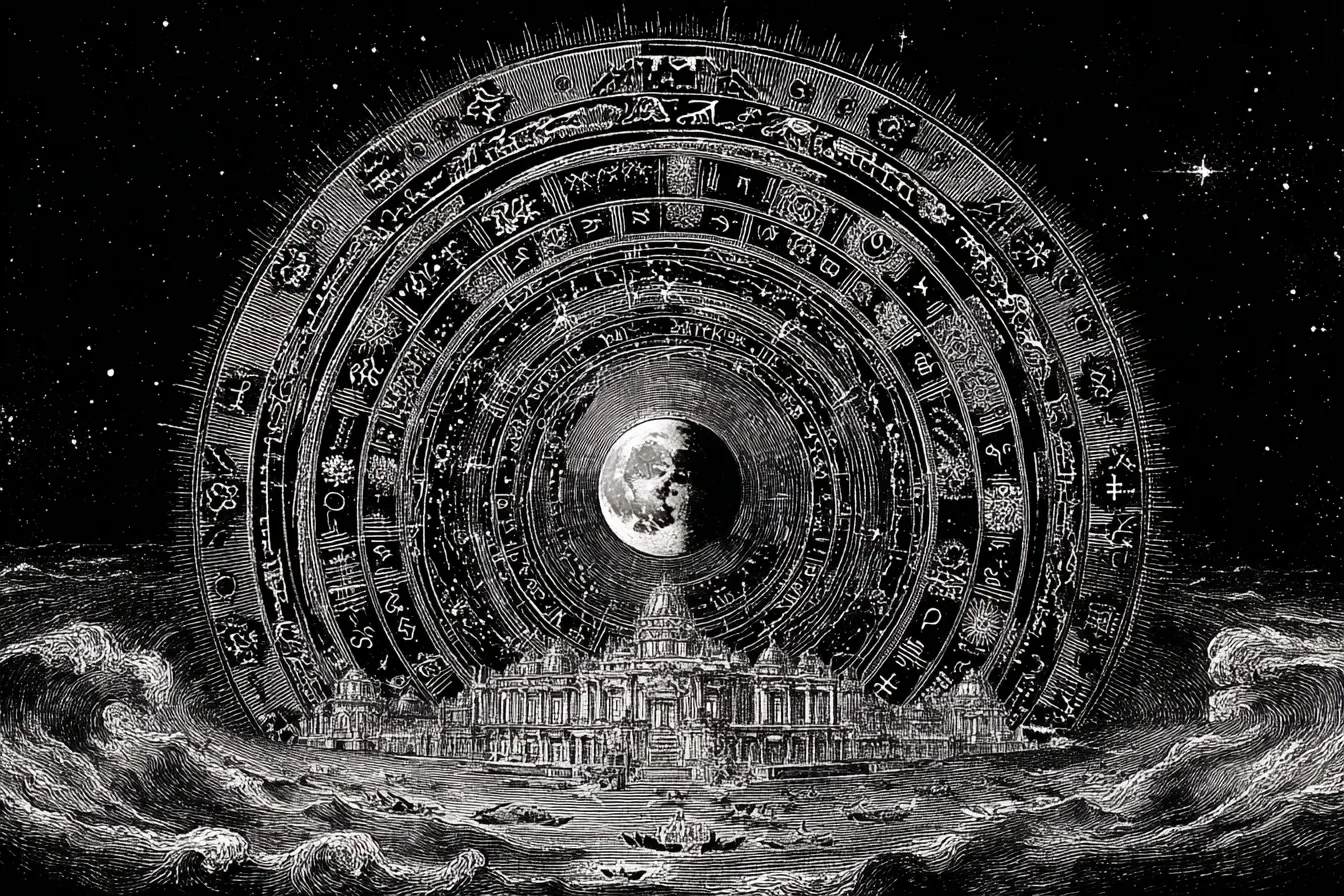
Western astrology gives the sun twelve houses. Vedic astrology gives the moon twenty-seven.
This asymmetry is not an accident. The Vedic tradition considered the moon the most intimate of the celestial bodies — closer to daily human experience than the slow-moving sun, more directly connected to mind, emotion, and the texture of lived moments. The sun moves through one zodiac sign per month. The moon moves through one every two and a half days. To map the moon’s journey with the same twelve-sign framework would be to lose most of the resolution.
The Nakshatras — from Sanskrit naksha (approach) + tra (guard, keeper) — are the 27 lunar mansions that divide the moon’s monthly path into precise segments of 13 degrees and 20 minutes each. Each Nakshatra has a name, a presiding deity, a ruling planet, an animal symbol, a primary quality (guna), and a set of associations built up over thousands of years of observation and interpretation. They are among the oldest components of the Vedic astrological system, predating the twelve-sign zodiac by centuries.
Your birth Nakshatra — the mansion the Moon occupied at the moment of your birth — is, in the Vedic view, one of the most revealing placements in your entire chart. It describes the quality of your mind and emotional nature with a precision that the twelve-sign framework simply cannot achieve.
How the Nakshatras Work
The 27 Nakshatras divide the 360-degree zodiac into 27 equal segments, beginning at 0 degrees Aries (sidereal). Each Nakshatra spans exactly 13°20’, and each is further divided into four padas (quarters) of 3°20’ each — giving a total of 108 padas, a number of deep significance in Vedic cosmology.
Every Nakshatra is ruled by one of nine planets (each planet rules three Nakshatras), and this planetary ruler connects the Nakshatra to the Dasha system — the Vedic timing system of planetary periods. Your birth Nakshatra determines which Dasha you begin life in and the sequence of planetary periods that follows through your lifetime.
Each Nakshatra also has a yoni (animal symbol), a gana (temperamental type: deva/divine, manushya/human, or rakshasa/demonic), and a nadi (energetic channel). These secondary attributes are used primarily in compatibility analysis.
All 27 Nakshatras
1. Ashwini (0°00’ – 13°20’ Aries)
Ruling planet: Ketu | Deity: Ashwini Kumaras (divine physicians)
Ashwini is the first Nakshatra — the point of arrival, the first breath. Its symbol is the horse’s head; its presiding deities are the Ashwini Kumaras, the twin horsemen who are the physicians of the gods. Ashwini carries a quality of swift initiation, healing energy, and a fundamental freshness — people born with the Moon in Ashwini often have a quality of vitality and enthusiasm that others find energizing. They tend to move fast, start new things eagerly, and can struggle with patience and follow-through. At its highest, Ashwini is the energy that heals and initiates. The shadow is a perpetual restlessness that never settles long enough to complete.
2. Bharani (13°20’ – 26°40’ Aries)
Ruling planet: Venus | Deity: Yama (god of death and dharma)
Bharani’s symbol is the yoni — the container, the womb — and its presiding deity is Yama, the lord of death and the upholder of dharma. This pairing of creation and death is central to Bharani’s character: this is the Nakshatra of containing intense experience, of holding what is difficult, of the creative force that requires destruction to work. Bharani people are often highly creative, intensely feeling, and drawn to experiences of intensity — whether in art, in love, or in spiritual practice. The shadow is a tendency to become consumed by what they contain, or to use creative/sexual energy as a means of control.
3. Krittika (26°40’ Aries – 10°00’ Taurus)
Ruling planet: Sun | Deity: Agni (god of fire)
Krittika spans the boundary between Aries and Taurus — the only Nakshatra to do so — and its symbol is the knife or cutting instrument. Its deity is Agni, the sacred fire that purifies, transforms, and illuminates. Krittika carries a quality of sharp discernment, penetrating truth-telling, and a refusal to accept comfortable illusions. People born with the Moon in Krittika are often direct to the point of sharpness, highly critical (of themselves and others), and genuinely committed to quality and truth. The shadow is a cutting quality that wounds without intention to heal.
4. Rohini (10°00’ – 23°20’ Taurus)
Ruling planet: Moon | Deity: Brahma (the creator)
Rohini is often considered the most beautiful of the Nakshatras — it sits at the heart of Taurus, ruled by the Moon (which is exalted in Taurus), and its deity is Brahma, the creator of manifest existence. Its symbol is the ox cart or a growing plant. Rohini carries the quality of fertile abundance, sensory beauty, and the creative pleasure of the material world. People born with the Moon in Rohini often have strong aesthetic sensibilities, magnetic presence, and a gift for creating beauty in whatever domain they inhabit. The shadow is possessiveness and an over-attachment to comfort and beauty that resists necessary change.
5. Mrigashira (23°20’ Taurus – 6°40’ Gemini)
Ruling planet: Mars | Deity: Soma (the moon god)
Mrigashira’s symbol is the deer’s head — the gentle, searching, curious animal that moves through the forest following its nose. Its deity is Soma, associated with the nectar of immortality and with poetic inspiration. Mrigashira carries the quality of perpetual seeking — an insatiable curiosity, a restless search for something that always seems just ahead. People born here are often intellectually gifted, charming, and perpetually interested in new ideas, places, and experiences. The shadow is a chronic dissatisfaction with what has already been found.
6. Ardra (6°40’ – 20°00’ Gemini)
Ruling planet: Rahu | Deity: Rudra (the storm god)
Ardra’s symbol is the teardrop or diamond — intense, pressurized, clarifying. Its deity is Rudra, the fierce form of Shiva associated with storms, destruction, and the kind of catharsis that clears the air. Ardra is one of the most intense Nakshatras: its energy is turbulent, transformative, and driven by a deep emotional hunger for authenticity. People born with the Moon in Ardra often have great intellectual power, emotional depth, and an instinct for cutting through pretense. The shadow is a tendency toward destruction for its own sake, or an identification with suffering.
7. Punarvasu (20°00’ Gemini – 3°20’ Cancer)
Ruling planet: Jupiter | Deity: Aditi (mother of the gods)
Punarvasu means “the return of the light” — puna (again) + vasu (good, wealth). Its symbol is the quiver of arrows; its deity is Aditi, the boundless mother who represents infinite space and the inexhaustible potential of the universe. Punarvasu carries a quality of renewal, resilience, and a fundamentally optimistic orientation toward existence. People born with the Moon here often have a remarkable capacity to recover from difficulty and to find abundance even after loss. The shadow is an over-idealism that refuses to acknowledge permanent damage.
8. Pushya (3°20’ – 16°40’ Cancer)
Ruling planet: Saturn | Deity: Brihaspati (Jupiter, teacher of the gods)
Pushya is often called the most auspicious of the Nakshatras — its name means “to nourish” or “to flourish,” and it is associated with the highest qualities of nurturing, wisdom, and spiritual sustenance. Its symbol is the udder of a cow; its deity is Brihaspati, the teacher of the gods. Pushya carries the quality of genuine care, wisdom that comes from experience, and the capacity to nourish others without depleting oneself. People born here are often gifted teachers, caregivers, or wisdom-holders. The shadow is dogmatism — a certainty that one’s particular form of nourishment is the right one.
9. Ashlesha (16°40’ – 30°00’ Cancer)
Ruling planet: Mercury | Deity: The Nagas (serpent beings)
Ashlesha is one of the most complex Nakshatras — its symbol is the coiled serpent, and its deities are the Nagas, the serpent beings who represent both poison and medicine, kundalini energy and deception. Ashlesha carries a quality of penetrating perception, psychological acuity, and an intimate relationship with power. People born with the Moon here often have great insight, magnetic presence, and a capacity to understand human nature at its most complex. The shadow is manipulation, a tendency to use insight to control rather than to illuminate.
10. Magha (0°00’ – 13°20’ Leo)
Ruling planet: Ketu | Deity: The Pitrs (ancestral spirits)
Magha begins at 0 degrees Leo — the start of a new sign, a new quality. Its symbol is the throne or the royal court; its deity is the Pitrs, the ancestral spirits who are honored with rituals and offerings. Magha carries the quality of noble authority, ancestral connection, and a deep sense of lineage and legacy. People born with the Moon in Magha often have natural leadership, a strong sense of their own significance, and a connection to the past that informs their present. The shadow is pride and an excessive concern with status and recognition.
11. Purva Phalguni (13°20’ – 26°40’ Leo)
Ruling planet: Venus | Deity: Bhaga (god of prosperity and pleasure)
Purva Phalguni’s symbol is the front legs of a bed or a couch — the Nakshatra of rest, pleasure, and the enjoyment of life’s gifts. Its deity is Bhaga, the god who presides over marital happiness, good fortune, and sensory pleasure. This is the Nakshatra of genuine enjoyment: people born here are often warm, charming, creative, and genuinely capable of pleasure in a way that others find infectious. The shadow is hedonism and a tendency to avoid difficulty by retreating into comfort.
12. Uttara Phalguni (26°40’ Leo – 10°00’ Virgo)
Ruling planet: Sun | Deity: Aryaman (god of contracts and social bonds)
Uttara Phalguni follows Purva Phalguni and adds the quality of commitment to pleasure — its symbol is the back legs of a bed, implying the lasting relationship rather than the initial enjoyment. Its deity is Aryaman, who governs contracts, social obligations, and the bonds that hold communities together. People born with the Moon in Uttara Phalguni often have a quality of reliable warmth — they are generous, socially responsible, and genuinely helpful in concrete ways. The shadow is a tendency toward self-righteousness or a difficulty receiving as easily as giving.
13. Hasta (10°00’ – 23°20’ Virgo)
Ruling planet: Moon | Deity: Savitar (the sun before rising, creativity)
Hasta’s symbol is the open hand — dexterous, skilled, giving. Its deity is Savitar, the creative sun before it rises, associated with the capacity to manifest and create. Hasta carries the quality of craftsmanship, practical intelligence, and the ability to make things with precision and care. People born with the Moon here are often gifted with their hands, quick-witted, and highly practical in their approach to problems. The shadow is a tendency toward restlessness and a facility with deception — the dexterous hand can conceal as easily as it creates.
14. Chitra (23°20’ Virgo – 6°40’ Libra)
Ruling planet: Mars | Deity: Tvashtr (the divine architect and craftsman)
Chitra means “brilliant” or “bright” — its symbol is the shining jewel, and its deity is Tvashtr, the divine craftsman who creates forms and worlds. Chitra carries the quality of aesthetic vision, structural creativity, and a fundamental orientation toward beauty as a form of truth. People born with the Moon in Chitra are often visually gifted, architecturally minded, and drawn to work that involves creating something of lasting beauty. The shadow is vanity and a tendency to value appearance over substance.
15. Swati (6°40’ – 20°00’ Libra)
Ruling planet: Rahu | Deity: Vayu (god of wind)
Swati’s symbol is the single blade of grass bending in the wind — flexible, resilient, rooted just enough to survive the storm without resisting it. Its deity is Vayu, the god of wind and breath. Swati carries the quality of independence, adaptability, and a light, mobile quality of being that can move through different environments without losing itself. People born with the Moon here are often socially intelligent, commercially minded, and genuinely good at navigating complex social situations. The shadow is a rootlessness that mistakes flexibility for direction.
16. Vishakha (20°00’ Libra – 3°20’ Scorpio)
Ruling planet: Jupiter | Deity: Indra and Agni (king of gods and fire god)
Vishakha spans the Libra-Scorpio boundary and is presided over by both Indra (the king) and Agni (the fire) — a potent dual rulership. Its symbol is the decorated gateway or the forked branch. Vishakha carries the quality of focused, purposeful ambition — people born here often have a singular goal that they pursue with unusual persistence. The first half (in Libra) is more balanced and diplomatic; the second half (in Scorpio) is more intense and driven. The shadow is an ends-justify-the-means quality that can damage relationships in the pursuit of goals.
17. Anuradha (3°20’ – 16°40’ Scorpio)
Ruling planet: Saturn | Deity: Mitra (god of friendship and contracts)
Anuradha’s symbol is the lotus flower blooming in difficult water, or the staff. Its deity is Mitra, the god of friendship, alliance, and covenant. Anuradha carries the quality of devoted friendship, organizational ability, and the capacity to thrive in foreign or difficult environments — the lotus in the mud. People born with the Moon here are often deeply loyal, skilled at maintaining relationships across distance and difficulty, and drawn to work that involves gathering and organizing people toward a purpose. The shadow is jealousy and a tendency toward possessiveness in relationships.
18. Jyeshtha (16°40’ – 30°00’ Scorpio)
Ruling planet: Mercury | Deity: Indra (king of the gods)
Jyeshtha means “the eldest” or “the most senior” — its symbol is the circular amulet or umbrella, protective and authoritative. Its deity is Indra in his full kingly authority. Jyeshtha carries the quality of earned authority, protective power, and the kind of leadership that comes from experience. People born with the Moon here are often gifted with intelligence and a natural authority that others defer to. The shadow is arrogance and a difficulty accepting that authority must be continually earned rather than permanently possessed.
19. Mula (0°00’ – 13°20’ Sagittarius)
Ruling planet: Ketu | Deity: Nirriti (goddess of dissolution and the undoing)
Mula means “root” — its symbol is the tied bundle of roots, or the lion’s tail. Its deity is Nirriti, the goddess of dissolution, the dark mother who destroys what is no longer needed. Mula is one of the most spiritually intense Nakshatras: it sits at the galactic center, and its quality is one of going to the root, of stripping away what is superficial, of the radical investigation that can be as destructive as it is liberating. People born with the Moon here are often driven toward root causes, fundamental truths, and a life that refuses comfortable surfaces. The shadow is an attraction to crisis and destruction that can undermine what was genuinely good.
20. Purva Ashadha (13°20’ – 26°40’ Sagittarius)
Ruling planet: Venus | Deity: Apas (goddess of water and purification)
Purva Ashadha’s symbol is the winnowing fan or the tusk of an elephant — tools that separate the essential from the inessential. Its deity is Apas, the divine waters that purify and invigorate. This Nakshatra carries the quality of invigoration, philosophical confidence, and the kind of pride that comes from genuine achievement. People born here are often persuasive, energetically optimistic, and capable of inspiring others toward shared goals. The shadow is an overconfidence that refuses to acknowledge setbacks or errors.
21. Uttara Ashadha (26°40’ Sagittarius – 10°00’ Capricorn)
Ruling planet: Sun | Deity: The Vishvadevas (universal gods)
Uttara Ashadha spans the Sagittarius-Capricorn boundary and is presided over by the ten Vishvadevas — the universal deities who represent collective virtues. Its symbol is the elephant’s tusk or a small cot. Uttara Ashadha carries the quality of permanent victory — not the quick win of Purva Ashadha, but the sustained achievement that comes from thorough preparation and ethical conduct. People born with the Moon here are often remarkably capable, morally oriented, and committed to excellence over the long term. The shadow is a rigidity that equates following rules with doing right.
22. Shravana (10°00’ – 23°20’ Capricorn)
Ruling planet: Moon | Deity: Vishnu (the preserver)
Shravana means “hearing” — its symbol is the ear, or three footprints. Its deity is Vishnu, the sustainer and preserver. Shravana carries the quality of attentive listening, the preservation of knowledge, and the capacity to learn from everything that arrives. People born with the Moon here are often gifted listeners, deeply curious about others, and skilled at connecting what they hear to broader patterns. They are often found in roles that involve transmitting or preserving knowledge across time. The shadow is a dependency on external input — a difficulty generating direction from within rather than receiving it from without.
23. Dhanishtha (23°20’ Capricorn – 6°40’ Aquarius)
Ruling planet: Mars | Deity: The Ashta Vasus (eight elemental gods)
Dhanishtha means “most famous” or “most giving” — its symbol is the drum, and its deity is the eight Vasus, the elemental beings associated with the abundance of the natural world. Dhanishtha carries the quality of rhythm, musical intelligence, and the abundance that comes from aligned action. People born with the Moon here are often ambitious, musically sensitive, and effective at wealth creation. The shadow is a tendency toward extreme self-focus — a difficulty with intimacy and a propensity toward marital or partnership challenges in classical Vedic readings.
24. Shatabhisha (6°40’ – 20°00’ Aquarius)
Ruling planet: Rahu | Deity: Varuna (god of cosmic order and the night sky)
Shatabhisha means “a hundred healers” or “a hundred stars” — its symbol is an empty circle, or the thousand-petaled lotus. Its deity is Varuna, the god who maintains cosmic order, who sees all secrets and holds them in cosmic law. Shatabhisha carries the quality of deep inquiry, healing knowledge, and a fundamental orientation toward mystery. People born with the Moon here are often drawn to research, esoteric knowledge, and the healing arts. They tend to be private, self-sufficient, and highly individualistic. The shadow is isolation and a tendency to close themselves off from the very connections that would sustain them.
25. Purva Bhadrapada (20°00’ Aquarius – 3°20’ Pisces)
Ruling planet: Jupiter | Deity: Ajaikapada (the one-footed god, a form of Shiva)
Purva Bhadrapada’s symbol is the front legs of a funeral cot, or a two-faced man — the Nakshatra of passionate idealism, spiritual fervor, and the kind of dedication to a cause that can border on fanaticism. Its deity is a fierce, one-footed form of Shiva. People born with the Moon here are often deeply principled, intensely motivated by their beliefs, and capable of extraordinary effort in service of what they hold sacred. The shadow is an extremism that loses perspective — the fiery idealism that consumes what it claims to serve.
26. Uttara Bhadrapada (3°20’ – 16°40’ Pisces)
Ruling planet: Saturn | Deity: Ahir Budhnya (the serpent of the deep)
Uttara Bhadrapada’s symbol is the back legs of a funeral cot, or the twins. Its deity is Ahir Budhnya, the serpent that dwells in the deepest waters, associated with kundalini energy, depth, and hidden foundations. This Nakshatra carries a quality of profound wisdom, genuine compassion, and a settled depth that is rare among the 27 Nakshatras. People born with the Moon here are often genuinely wise — not in an academic sense, but in the lived-experience sense. They tend to be generous, self-controlled, and effective at supporting others through difficulty. The shadow is a tendency toward withdrawal and an over-reliance on solitude that closes off necessary contact.
27. Revati (16°40’ – 30°00’ Pisces)
Ruling planet: Mercury | Deity: Pushan (god of safe travel and nourishment)
Revati is the final Nakshatra — the completion of the moon’s full journey, the 27th mansion before the cycle begins again with Ashwini. Its symbol is the drum used to mark time, or a fish in the ocean. Its deity is Pushan, the gentle god who guides travelers safely, who nourishes and protects. Revati carries a quality of compassionate completeness — a fullness that comes from having traveled the whole distance. People born with the Moon in Revati are often deeply empathic, artistically gifted, and characterized by a kind of universal kindness that others find healing. The shadow is an over-sensitivity that struggles with the harsher aspects of the world, and a tendency to remain in places, relationships, or situations past the time when departure is necessary.
Your Birth Nakshatra: The Moon’s Position at Your First Breath
Your birth Nakshatra — the Nakshatra the Moon occupied at the moment of your birth — is called your Janma Nakshatra. It is determined by your birth date, time, and location, and it is one of the most important placements in your Vedic chart.
Where your Lagna describes how you meet the world, and your sun describes your vital energy, your Janma Nakshatra describes the quality of your mind and emotional nature — how you feel, how you process, what you instinctively turn toward and away from. The Nakshatra is more fine-grained than the twelve-sign zodiac; two people with the Moon in Cancer may have Moons in Pushya, Ashlesha, or the end of Punarvasu — and these three are genuinely different emotional textures, not just variations on the same theme.
Your Janma Nakshatra also determines your Dasha sequence — the specific order in which the nine planetary periods unfold across your lifetime. The Dasha system is one of the most sophisticated timing tools in any astrological tradition anywhere in the world, and your Nakshatra is its starting point.
How The Whisper Uses Your Nakshatra
The Whisper calculates your Janma Nakshatra from your birth date, time, and location, and uses it as one of the primary Vedic layers in your daily oracle reading. Your Nakshatra’s ruling planet connects directly to your active Dasha period — allowing The Whisper to track not just the quality of your current moment, but which planetary energy is shaping the larger arc of this phase of your life.
Combined with your Vedic Lagna, your BaZi Day Master, and your Nine Star Ki Life Star, your Nakshatra adds one more precise, non-redundant dimension to the composite reading. The goal is not to give you twelve different versions of the same message. It’s to give you twelve different questions — each from a distinct tradition, each looking at a genuinely different aspect of who you are and what the current moment is asking of you.
The 27 Nakshatras were developed precisely because the twelve-sign framework wasn’t precise enough. That original instinct — toward finer resolution, toward the nuance that coarser systems miss — is what The Whisper is built on.