
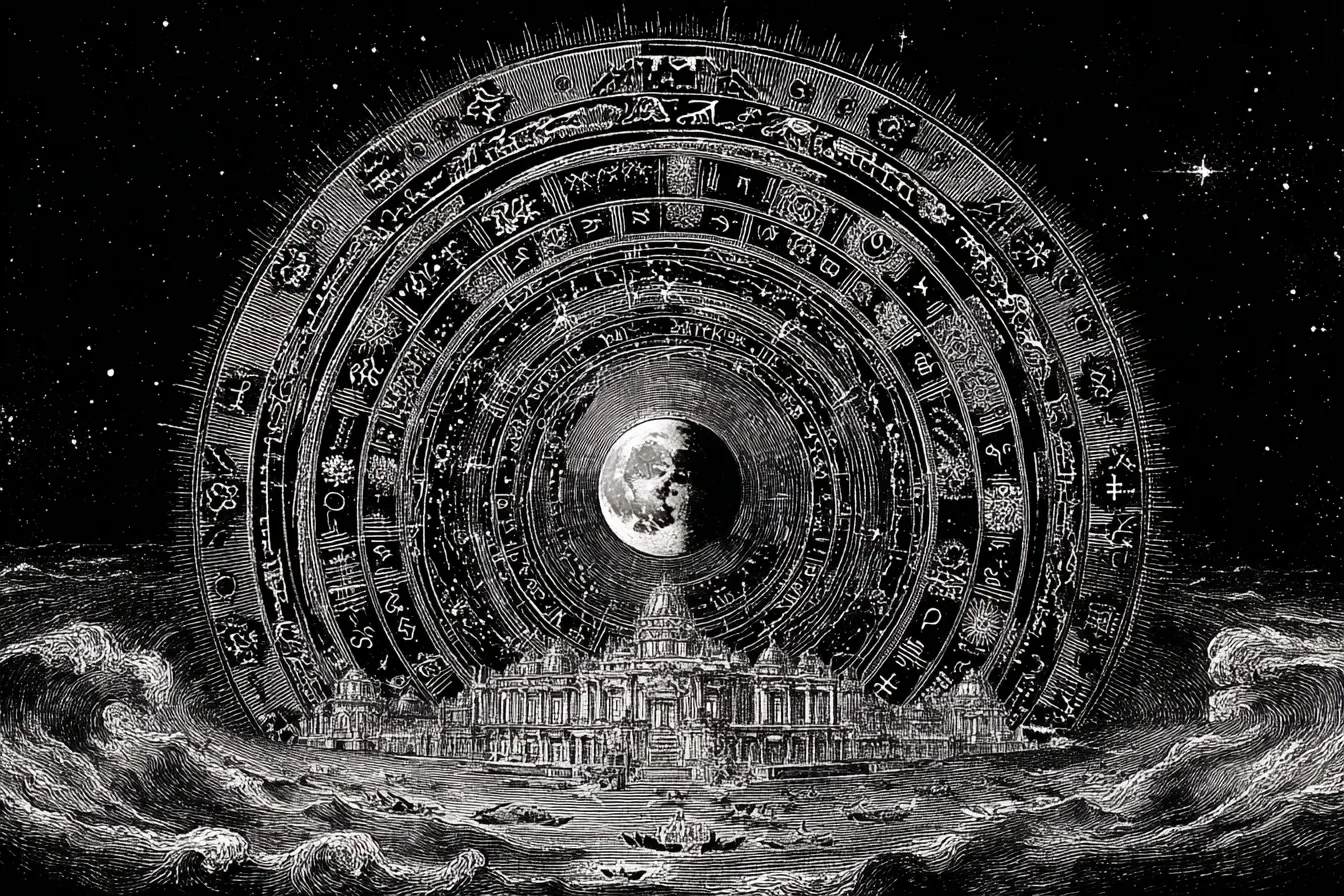
What is Ardra Nakshatra?
Ardra is the sixth of the 27 nakshatras in Jyotish, the Vedic astrological tradition. It occupies the degrees from 6°40’ to 20°00’ of Gemini, sitting entirely within Mercury’s sign but carrying an energy that is far from Gemini’s typically light, airy quality. Ardra is associated with the star Betelgeuse — one of the largest and most intensely red stars in the night sky, a dying giant whose enormous presence in Orion gives some sense of the scale this nakshatra can operate at.
In The Whisper, your birth nakshatra is determined by the position of the Moon at your birth. The Moon moves through one nakshatra approximately every 24 to 27 hours, completing the full cycle of 27 in about a sidereal month. If your Moon was in Ardra, the nakshatra describes a quality of emotional nature and instinctive response that is recognizable: an intensity beneath the Gemini surface, a depth of feeling that sometimes surprises both the person who carries it and those around them.
A practical note: The Whisper approximates birth nakshatra from date alone when birth time is not available. This is accurate for most births, but if you were born near the Mrigashira–Ardra or Ardra–Punarvasu transition, adding your birth time to your profile will improve the calculation.
The daily nakshatra shifts approximately each day and provides a temporal quality that The Whisper considers alongside the other active systems when generating the day’s synthesis.
Symbol and ruling deity
Ardra’s primary symbol is the teardrop — and the tradition holds this image with genuine complexity. The teardrop is grief, yes, but it is also the specific relief of a grief that has finally broken through. There is a related symbol: the jewel or gem, which suggests something that has been formed under pressure and now carries a different quality of light than what surrounds it. Both images describe transformation through intensity.
The associated star is Betelgeuse — a red supergiant in Orion, one of the brightest and most recognizable stars in the night sky in the season it is visible. In the Vedic tradition, Ardra is specifically associated with this star, and its red intensity, its enormous scale, and its eventual fate (a supernova) all carry some of the nakshatra’s quality: the intensity that, at its far extreme, transforms everything.
The ruling deity is Rudra — the fierce, storm-like form of Shiva who brings the tempest that finally breaks what has become oppressively still. Rudra is not Shiva in his meditative aspect; he is Shiva as the wild, necessary force that breaks drought-hardened ground. The storm that people dread is also the storm that waters the fields.
The ruling planet is Rahu — the north lunar node, associated in Jyotish with amplification, desire, boundary-crossing, and the quality of always seeking more. Rahu intensifies whatever it touches, and in Ardra, it amplifies the transformative and penetrating qualities that Rudra describes.
The nature and qualities of Ardra
Jyotish classifies Ardra as Tikshna (sharp, dreadful) in quality — one of the nakshatra qualities associated with intensity, capacity for penetrating perception, and the kind of energy that cuts through surface appearances. Its gana is Manushya (human) — meaning its intensity operates within the full human range rather than being either purely divine in its brightness or simply fierce in the Rakshasa sense.
What the tradition associates with Ardra is a particular combination: penetrating intelligence and depth of feeling, coexisting in a way that can be both powerful and difficult to carry. Ardra is the nakshatra that sees through things. It does not comfortably accept the surface presentation; it perceives what is underneath, and this quality of depth-perception operates through emotional intelligence as much as through abstract reasoning.
The storm metaphor is consistently useful for understanding this nakshatra. The storm does not choose its timing based on social convenience. It breaks through when the conditions have accumulated to the point of breakthrough. Ardra people tend to experience their own transformations in this way: not gradual adjustments, but breaking points followed by genuine shifts. And they often catalyze similar processes in others, not necessarily through intention, but through the quality of their presence — the way genuinely intense honesty, even when gentle, breaks through surfaces that comfortable social interaction maintains.
Ardra is also associated with a particular quality of emotional depth beneath an intellectual or sharp exterior. The Gemini context means this often presents as wit, quickness, or analytical sharpness — and the depth is not always immediately visible. This is the teardrop image: the depth of feeling is inside the jewel that appears primarily to be a gem.
Strengths and growth edges
The qualities the Jyotish tradition associates with Ardra include penetrating intelligence that reaches beneath surfaces, genuine emotional depth, the capacity for real transformation — not only in oneself but in situations and people one encounters — a quality of radical honesty that is not cruelty but genuine seeing, and a certain intensity of purpose that, when it is well-directed, produces work of real depth and significance.
The growth edges are inseparable from these same qualities. Rahu’s amplifying influence means that Ardra’s intensity can overflow its useful channel — the storm that breaks the drought can also break what was not meant to break. The penetrating perception that serves well when it is offered can become an inability to let surfaces be surfaces when surfaces are exactly what a situation requires. The depth of feeling that makes Ardra’s emotional intelligence so acute can produce volatility — the intensity that moves through a room and leaves things changed in ways that were not fully intended.
Traditional Jyotish commentary notes that Ardra benefits from intentionality around impact — not suppressing the intensity, but developing the discernment that Rudra’s storm can lack. The storm does not calibrate; the person carrying Ardra’s energy can learn to. The difference between Ardra at its best and Ardra at its edges is often not the intensity but the direction.
What Ardra means in The Whisper
The Whisper draws on Ardra’s cross-system resonances when synthesizing the daily message.
Western Astrology: Ardra occupies Gemini in the sidereal zodiac, but with Rahu’s amplifying quality giving this Gemini territory unusual intensity. The Western system’s Mercury-ruled Gemini is typically associated with lightness, curiosity, and relational intelligence. Ardra disrupts this expectation — the Gemini characteristics of quick perception and communicative intelligence are present, but deepened into something that has genuine force behind it. On days when Rahu or intense planetary configurations feature in the Western transits, Ardra’s depth quality may be especially active.
Nine Star Ki: The resonance here is with the One White Water Star (一白水星) — the hidden current quality, the depth that sustains what is above from below, the underground water that has accumulated to the point of finding an outlet. One White Water’s quality of depth and the eventual emergence of what has been contained resonates with Ardra’s teardrop: the breakthrough that follows accumulation.
BaZi: The resonance is with Ren Water (壬水) — the powerful yang water of the river or ocean, the water that moves through everything when it has found its opening. Ren Water carries Ardra’s quality of the force that is not aggressive in intention but simply has too much momentum to be turned aside once it has found its direction.
Frequently asked questions
Q: Is Ardra considered a difficult nakshatra?
The tradition describes Ardra as intense rather than simply difficult, and the distinction matters. What makes a nakshatra “difficult” is often a mismatch between the nakshatra’s qualities and the contexts in which those qualities are most commonly expressed. Ardra’s intensity is genuinely valuable in contexts that require depth, penetration, and the capacity to work through transformation. It is genuinely challenging in contexts that require easy, comfortable surface interaction. The Whisper uses this as information rather than as a judgment.
Q: What is the significance of Ardra being associated with Betelgeuse?
Betelgeuse is one of the largest known stars — a red supergiant hundreds of times the size of the Sun — and it is expected to eventually end in a supernova of extraordinary brightness. The Vedic association of Ardra with this particular star is not accidental: the scale of transformation that Betelgeuse’s eventual end implies is part of the nakshatra’s quality. Not every Ardra person experiences supernova-scale events, but the nakshatra does describe a quality of transformation that, at its fullest expression, changes everything in the environment rather than only the immediate situation.
Q: How does Rahu’s influence shape Ardra differently than other Rahu-ruled nakshatras?
Rahu rules three nakshatras: Ardra, Swati, and Shatabhisha. In each, Rahu’s amplifying, boundary-crossing quality expresses differently based on the nakshatra’s deity and sign context. In Ardra, Rahu amplifies Rudra’s storm quality and Gemini’s perceptive intelligence — producing intensity that is particularly sharp and penetrating. In Swati, Rahu amplifies Vayu’s wind quality in Libra — producing adaptable, seeking, sometimes restless diplomacy. In Shatabhisha, Rahu amplifies Varuna’s depth in Aquarius — producing unusual depth of perception. The Whisper treats these as distinct expressions rather than as variations on the same theme.