
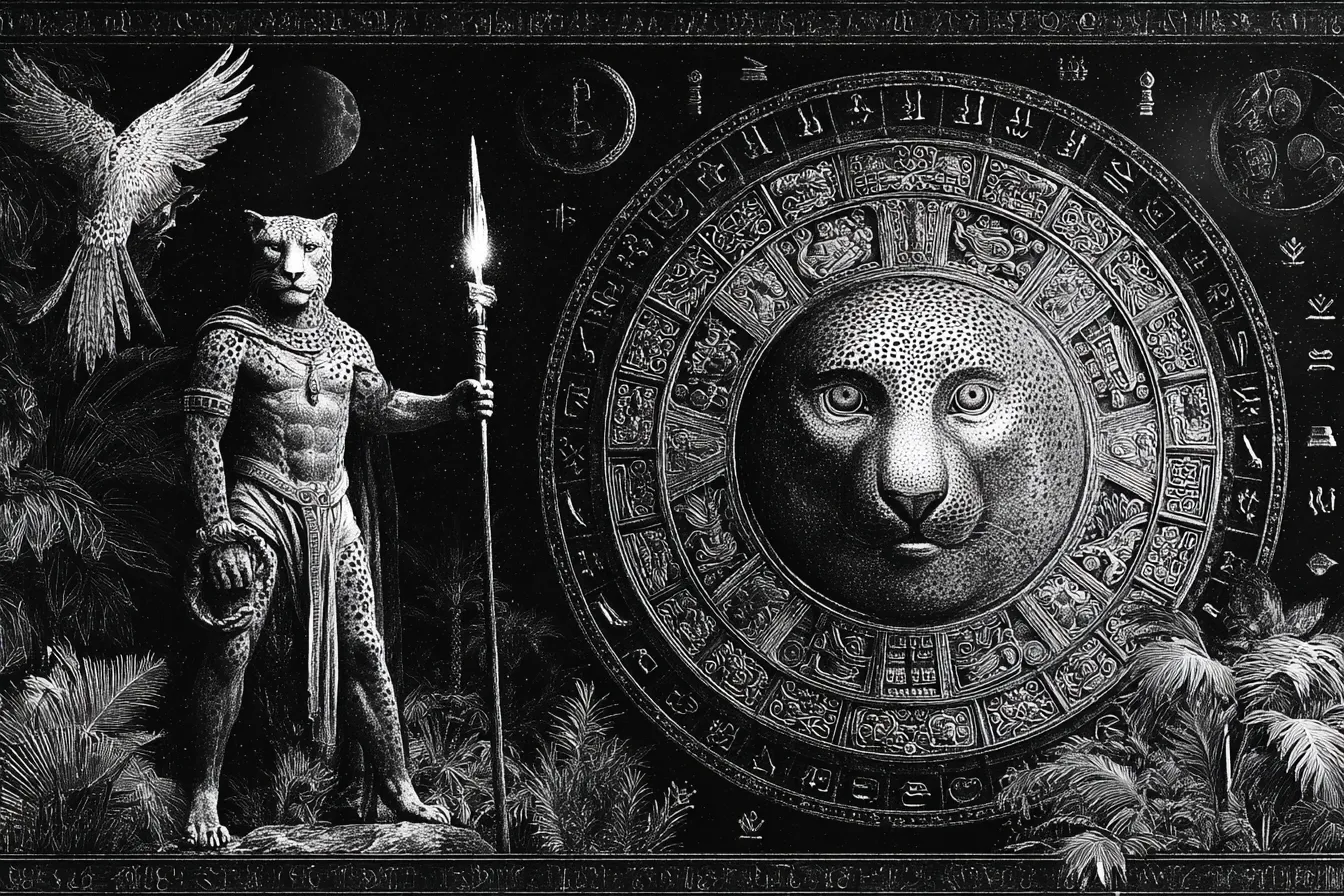
What is Kan?
Kan is the fourth of twenty Solar Seals in the Mayan Tzolkin — the 260-day sacred calendar built from twenty day signs cycling through thirteen numbered tones, producing 260 unique combinations called Kin. The Tzolkin has been in continuous use among Maya peoples for at least 2,500 years and is a living tradition today. Ajq’ij — Maya day keepers and ceremonial priests — guide communities through the Tzolkin cycle in Guatemala and southern Mexico, where the Chol Q’ij (the K’iche’ Maya name for the calendar) remains embedded in ceremonial and everyday life. The antiquity of this tradition, and the fact of its unbroken continuity, distinguishes the Tzolkin from many of the systems with which it is sometimes grouped.
The Whisper integrates the Tzolkin alongside Western Astrology, Nine Star Ki, and BaZi into a single daily personal insight. Your birth seal is calculated by placing your birth date within the Tzolkin cycle using the GMT correlation constant (584283) — the most widely accepted scholarly alignment between the Maya Long Count and the Gregorian calendar. Many English-language tools for finding a “Mayan day sign” are based instead on the Dreamspell system developed by José Argüelles in 1987, which uses a different correlation and partly different seal names, and which can produce a different result for the same birth date. The Whisper uses the traditional GMT correlation throughout. In addition to your birth seal, the daily seal marks the current day’s shared position in the Tzolkin cycle — the same for everyone worldwide — and The Whisper synthesizes both with the other active systems to generate each day’s insight.
Kan is the fourth seal in the cycle’s opening sequence. Imix was the primordial waters, the creative ocean before form. Ik was the breath that animated it. Akbal was the interior night where the animating spirit gathered itself into depth. Kan is what comes next: the moment when all that potential is encoded into a specific, concentrated form — the seed. The journey from ocean to seed is the Tzolkin’s opening movement, and Kan marks the point where undifferentiated potential becomes targeted, purposeful, and ready. The ocean has become something you can hold in your hand and plant in the ground.
The symbol and its traditional roots
The glyph associated with Kan in Maya iconography is connected to the seed and to the concept of ripening — specifically the idea of the maize seed, which held a position of profound cultural and cosmological importance in Maya civilization. In Maya creation accounts, human beings were themselves fashioned from maize; the seed was not merely food but the encoded substance of life itself. Kan carries this weight: the seed is not passive raw material but the concentrated intelligence of what a thing will become, held in a form small enough to be carried, planted, and trusted to the earth.
The concept of targeting is central to Kan’s traditional meaning. A seed is not scattered randomly; it is placed with intention at the point where conditions are right for it to grow. The Maya tradition associates Kan with the directed, purposeful quality of awareness that recognizes where and when to plant — the intelligence that knows which opportunity is genuinely aligned and which is merely available, which moment is genuinely ready and which merely seems ready because waiting has become uncomfortable.
In the Aztec Tonalpohualli, the corresponding day sign is Cuetzpalin — the Lizard. This correspondence is less immediately obvious than some other Aztec-Maya pairings, but the lizard in Mesoamerican symbolism carries associations with fertility, regeneration, and the kind of patient, sun-warmed vitality that enables things to grow. The lizard waits, conserves its warmth, and then moves with precision when the moment is right. This patience and precision echo the Kan seed quality of waiting for right conditions before committing to growth — not passive waiting but the active holding of potential in a state of readiness.
The color associated with Kan is Yellow, and the direction is South — the direction the Tzolkin associates with ripening, completing, and the harvest. Yellow seals carry the qualities of the south’s warmth: the energy that brings things to fruition, that allows the full expression of what has been developing. Kan as a Yellow/South seal represents the seed’s relationship to ripening — not the ripening itself, which comes later in the cycle, but the encoded potential for ripening that is already present within the seed before it has been planted. The harvest is already inside the seed; it requires only the right conditions and sufficient time to become actual.
The energy of Kan
The traditional meaning of Kan centers on the intelligence encoded within potential — the quality of knowing what one will become before the process of becoming has begun. A seed contains the full genetic information of the mature plant; it does not need to figure out how to become a tree. The information is already there, waiting for activation. This is the quality Kan carries into human experience: a form of creative intelligence that is not constructed through analysis but is already present, already complete in its essential structure, waiting to be activated by the right conditions.
The Tzolkin tradition describes this as targeted awareness — the capacity to direct one’s attention and energy toward what will genuinely flourish rather than toward what merely seems appealing or convenient. This is a form of discernment that operates below the level of deliberate reasoning. The seed does not evaluate its options; it knows what it is and what it needs. Kan carries this quality as a kind of instinctive precision — the ability to recognize, without lengthy deliberation, which direction is genuinely aligned with one’s encoded purpose. This recognition tends to feel less like a decision and more like a remembering: the sense that this was already known, and the thinking was just confirmation.
There is also an important quality of patience in Kan that is worth examining carefully. The patience of the seed is not passive waiting or procrastination; it is the active holding of potential until the conditions that will allow it to express are genuinely present. The seed does not sprout in winter not because it is passive but because it is intelligent — it holds its potential intact until spring provides what germination requires. This is a meaningful distinction: Kan patience is not the absence of action but the precision that knows when action will be effective and when it will not. The intelligence of the seed is precisely the intelligence of timing — of knowing when the ground is warm enough, when the moisture is sufficient, when the light will be there to support what emerges.
The ripening intelligence of Kan also carries with it an orientation toward genuine quality rather than mere output. The seed’s purpose is not to germinate as quickly as possible but to become what it is encoded to become, fully and specifically. A maize plant that is rushed into flower before it has developed its full stalk does not produce good corn. Kan energy in the Tzolkin tradition is associated with a preference for genuine development over premature expression — the understanding that what is rushed tends to be less fully realized than what has been allowed its proper time.
Kan as a birth seal and daily seal
As a birth seal, Kan in the Tzolkin tradition is associated with the person who carries encoded creative intelligence as their primary quality — someone whose knowing tends to operate from a deep, pre-articulate level of certainty about what they are here to develop and express. The birth tone (the number 1 through 13 paired with Kan at the specific Kin of one’s birth date) shapes how this quality manifests in practice. A person born on Kan with Tone 4 will carry the seed energy in a more structured, stabilizing way; someone born on Kan with Tone 7 may express it through a more resonant, reflective quality. The seal describes the nature of the creative intelligence; the tone describes its particular mode of expression.
People born under Kan are traditionally associated with a particular capacity for recognizing and cultivating potential — both in themselves and in others. The seed-keeper’s intelligence is attuned to what has not yet grown but is ready to grow, and this attunement tends to express as an ability to see the fully realized version of something that is still in early stages. This can be a significant gift in creative, educational, or developmental contexts, where the ability to perceive what something will become — rather than only what it currently is — is genuinely useful and often decisive.
There is also a traditional association between Kan and the challenge of activation — the movement from encoded potential to actual expression. The seed that holds its intelligence perfectly but never encounters conditions in which it can germinate has not fulfilled its purpose, however complete its encoding. Kan birth-seal people are sometimes described in the Tzolkin tradition as navigating the tension between the fullness of what they carry and the requirements of finding or creating the conditions in which that fullness can express. The intelligence is there; the question is always whether the conditions are there too, and whether the Kan person can distinguish between conditions that are genuinely insufficient and conditions that are merely imperfect.
As a daily seal, when Kan appears as the current day’s position in the Tzolkin cycle, the tradition suggests a quality of directed creative intelligence — a day that tends to favor the careful targeting of attention, the planting of intentions with precision, and the kind of patient, purposeful action that works from genuine inner knowing rather than external pressure. The Whisper synthesizes this quality with the other active systems to produce the specific texture of a Kan day’s reading.
Strengths and growth edges
The strengths traditionally associated with Kan are rooted in its relationship to encoded intelligence and purposeful direction. Creative intelligence that works from genuine inner knowledge is the most fundamental — the capacity to know what is truly aligned before analysis has confirmed it, and to act from that knowing with confidence. This is not arrogance; it is the seed’s relationship to its own encoding. When it is functioning well, Kan intelligence is notably precise and remarkably efficient, because it does not waste energy pursuing directions that are not genuinely aligned.
The capacity to hold potential correctly — to carry what is not yet expressed without either forcing premature growth or allowing the potential to dissipate — is another recognized Kan strength. This expresses practically as the ability to work on long-horizon projects without losing confidence in their eventual realization, and as the quality of patient, sustained attention that developmental work requires. Kan in the Tzolkin tradition is associated with the gardener’s intelligence: not the explosive creative force of Imix or the inspired transmission of Ik, but the sustained, purposeful cultivation that brings things to genuine fruition.
The growth edges associated with Kan follow the shadow of these gifts with particular directness. The seed that waits for conditions that never quite arrive is the primary growth edge — the encoded intelligence that has become so attuned to the conditions required for its ideal expression that it perpetually finds the current conditions insufficient. The Tzolkin tradition describes this as one of Kan’s characteristic challenges: the targeting intelligence that becomes so precise it never actually targets anything, because no real situation matches the internal image of what is required.
The related growth edge is the tendency for Kan’s deliberate, quality-oriented intelligence to shade into overthinking — the movement from purposeful evaluation of conditions to endless analysis that substitutes for the actual planting. The seed does not think its way into germination; at some point, the conditions are good enough and the soil is ready, and thinking more does not help. Kan’s growth edge at this threshold is learning to distinguish between the genuine patience of the seed holding its right moment and the avoidance that masquerades as waiting.
What Kan means in The Whisper
In The Whisper’s multi-system synthesis, Kan resonates across several traditions in ways that clarify its essential quality from complementary angles.
The resonance with Western Astrology is strongest with Virgo and Mercury — the precise, encoded, practically intelligent quality of the sign and planet most associated with the intelligence that works through careful discernment and purposeful application. Virgo in the Western astrological tradition governs the harvest — the discrimination between what is ready and what is not, the intelligence that recognizes quality and applies it precisely. Mercury as the ruler of Virgo adds the communicative dimension: the seed’s encoding is also a form of information, held and transmitted with precision. When The Whisper synthesizes a Kan influence with a strong Virgo or Mercury quality from the Western layer, the precision and purposeful intelligence of the reading may be notably amplified.
In Nine Star Ki, the resonance is with the Eight White Earth Star (八白土星) — the quality of patient accumulation that precedes genuine growth, and the intelligence of the threshold between one state and the next. The Eight White Star in Nine Star Ki governs endings that are also beginnings, the stillness before movement, the mountain that holds what has accumulated until the moment when it can be released as something new. This correspondence with Kan is close: both carry the quality of holding potential correctly, of the intelligence that knows the difference between premature expression and genuine readiness. When Kan appears alongside an Eight White Earth Star influence in The Whisper’s Nine Star Ki layer, the patient, threshold-intelligent quality of encoded potential may be especially prominent.
From a BaZi perspective, the resonance is with Yi Wood (乙木) in its seed form — the encoded potential of yin wood before it has emerged from the soil. Yi Wood in BaZi is the vine, the flexible, persistent growth that works through and around obstacles; in its Kan expression, it is the moment before that growth has begun, when all the information of the mature vine is already present in the seed but has not yet been activated. When Kan appears alongside a Yi Wood influence in The Whisper’s BaZi layer, the quality of encoded creative potential waiting for its right conditions may be especially prominent.
The Aztec Tonalpohualli equivalent, Cuetzpalin (the Lizard), adds the quality of sun-warmed, patient vitality — the intelligence that knows how to conserve energy until the conditions are right, and then to move with precision when they are. The lizard’s relationship to warmth as the activating condition for its own vitality mirrors the seed’s relationship to spring: not passive waiting, but the intelligent conservation of potential until the environmental conditions align with what is encoded within.
In The Whisper’s daily synthesis, Kan days are read as days of purposeful creative intelligence — days when the capacity to target awareness precisely, to plant intentions with care, and to work from genuine inner knowing rather than external urgency tends to be more accessible than usual.
Frequently asked questions
Q: How does the patience associated with Kan differ from simply being slow or indecisive?
The Tzolkin tradition distinguishes carefully between the seed’s intelligent patience and passivity or avoidance. The seed holds its potential in a state of active readiness — not dormant in the sense of being switched off, but conserved, intact, and alert to the conditions that will signal that the moment has arrived. Kan patience is characterized by a clear inner sense of what is being waited for, and a genuine orientation toward eventual expression rather than permanent deferral. Indecision, in contrast, typically involves a lack of inner clarity about direction. If you find yourself with Kan as a birth seal and a tendency to wait indefinitely, the Tzolkin tradition would suggest the question is not whether to be more decisive but whether you have genuinely identified what your seed is encoded to become — and whether the conditions you are waiting for are truly external or partly a reflection of the internal work that still needs to happen.
Q: Can The Whisper’s Tzolkin calculation differ from other Mayan astrology tools I have used?
Yes, and this is worth understanding. Many English-language tools for finding a Mayan day sign use the Dreamspell system developed by José Argüelles in 1987. Dreamspell applies a different correlation constant between the Maya Long Count and the Gregorian calendar, and sometimes uses different seal names. The Whisper uses the GMT correlation constant (584283), the most widely accepted scholarly alignment and the one used by traditional Maya practitioners and communities. The two systems are genuinely different frameworks — not simply two ways of expressing the same information — and the same birth date can yield different seals in each. If you have received a different seal from another tool, both results are internally consistent within their respective systems; what matters is knowing which system you are working with.
Q: If Kan is my birth seal, does that mean I am meant to do something specific with my life?
The Tzolkin tradition associates Kan with encoded creative intelligence and the quality of purposeful potential — but this is a description of a tendency and an orientation, not a predetermined destiny. The birth tone paired with Kan at your specific Kin also shapes how this quality expresses, and the other systems active in The Whisper add further layers of context. What Kan as a birth seal offers is one lens: the suggestion that a quality of directed, patient, precision-oriented creative intelligence may be particularly available to you as a resource. How that resource is developed and expressed is not encoded in the seal but in the choices made over a lifetime — including the choices you make after recognizing what the seal suggests about your natural orientation.