
What is Akbal?
Akbal is the third of twenty Solar Seals in the Mayan Tzolkin — the 260-day sacred calendar that has structured ceremonial and personal time across Maya traditions for at least 2,500 years. The Tzolkin is built from twenty day signs cycling through thirteen numbered tones, yielding 260 unique combinations called Kin. Every 260 days the full cycle completes and begins again. This is not a historical artifact; it is a living tradition. Ajq’ij — Maya day keepers and ceremonial priests — continue to observe and guide communities by the Tzolkin today, particularly in Guatemala and southern Mexico, where the Chol Q’ij (as the calendar is known in K’iche’ Maya) remains woven into the fabric of daily and ceremonial life.
The Whisper draws on the Tzolkin as one of several ancient systems — alongside Western Astrology, Nine Star Ki, and BaZi — synthesizing them into a single daily personal insight. Your birth seal is calculated by locating your birth date within the Tzolkin cycle using the GMT correlation constant (584283), the most widely accepted scholarly alignment between the Maya Long Count and the Gregorian calendar. It is worth noting that the Dreamspell system popularized by José Argüelles in 1987, which is the basis for many English-language “Mayan astrology” tools, applies a different correlation and sometimes different seal names. The two systems can return different seals for the same birth date. The Whisper uses the traditional GMT correlation, and if you have previously encountered your day sign elsewhere, your result here may differ. Alongside your birth seal, the daily seal — shared by everyone worldwide — marks the current day’s position in the Tzolkin cycle, providing the temporal quality that The Whisper layers with your personal indicators each day.
Akbal arrives third in the cycle’s sequence. Imix was the primordial waters — the undifferentiated creative potential before form. Ik was the first breath that animated it. Akbal is what follows: the interior space that the breath now inhabits, the house of night where the animating spirit settles and begins to dream. Each step in the Tzolkin’s opening seals is a deepening, and Akbal represents the descent inward — the movement from the surface of things into the dimension where genuine knowing arises from below consciousness rather than from analysis or observation.
The symbol and its traditional roots
The glyph associated with Akbal in Maya iconography depicts the interior of the night house — the bounded darkness of the enclosed space where day does not reach. The root meaning of akbal in Mayan languages is darkness or night, but this is not the threatening darkness of absence. It is the generative darkness of the interior — the womb-space, the cave, the hour before dawn when the dream is most vivid and the subconscious speaks most clearly. This darkness is full rather than empty; it is the darkness of gestation rather than of extinction.
In Maya cosmology, the night was not simply the absence of the sun but a positive, active dimension of reality — the time when the underworld was most present, when ancestors moved closer, when the seeds of the next day’s events were quietly being formed. The Lord of the Night was not a figure of terror but of a different quality of knowledge — the knowing that comes in the dark, that is not available in daylight, and that is no less real for being invisible. The darkness of Akbal is this kind of darkness: full rather than empty, interior rather than absent, generative rather than inert.
In the Aztec Tonalpohualli, the corresponding day sign is Calli — the House. Calli in Aztec tradition represents the protected interior space: the domestic shelter, but also the interior world of the psyche, the place one returns to after the journey outward. The correspondence between Maya Akbal (the night interior) and Aztec Calli (the house) is illuminating — both traditions recognized the same quality and mapped it to the idea of an interior space that is bounded, protected, and generative. What is held inside the house, in the dark, is not nothing; it is the life that continues when the outer world has gone quiet. The house is not the absence of the world but a different relationship to it.
The color associated with Akbal is Blue, and the direction is West — the direction the Tzolkin associates with transformation, deepening, and the movement toward the unknown. Blue seals carry qualities of transformation and the willingness to engage with what lies beneath surfaces. West is where the sun descends — not ending, but moving into the underworld journey that makes the next morning possible. Akbal as a Blue/West seal is therefore the turning inward that is not retreat but the necessary counterpart to outward action: the descent that enables the next ascent.
The energy of Akbal
The traditional meaning of Akbal centers on the dreamfield — the interior dimension where intuitive knowing arises, where images and insights come without being summoned, where the subconscious moves with a freedom it does not have in waking life. This is not the realm of fantasy or escapism but of genuine interior intelligence: the knowing that cannot be reached by analysis but that becomes available when the analytical mind pauses and the deeper layers of awareness begin to surface.
The Tzolkin tradition associates Akbal with abundance through inner connection — a formulation worth pausing on. The abundance here is not primarily material but the felt sense of fullness that arises from genuine contact with one’s own interior depth. When someone is genuinely connected to their own inner knowing, they tend to act from a place of sufficiency rather than scarcity, to see resources where others see lack, to feel the ground beneath apparent emptiness. This is the abundance that Akbal carries — not as a promise but as a quality of awareness that becomes available when the interior space is honored rather than avoided. The person who has genuine access to their own depth tends to move through the world with a quality of inner steadiness that others can sense and that does not depend on external circumstances for its maintenance.
There is also a quality of mystery in Akbal that is worth naming precisely. The Blue Night is associated in the Tzolkin tradition with the kind of understanding that is deeper than explanation — the knowing that precedes articulation and that does not always translate cleanly into words. This is not inferior to verbal or analytical knowing; it is a different register of intelligence that has access to things the analytical mind cannot reach. One way to consider this: Akbal energy tends to produce insights that feel immediately true without being fully analyzable, and a form of intelligence that operates by pattern-sensing and resonance rather than by linear reasoning. When this quality is trusted and developed, it produces a reliability of inner guidance that is remarkably accurate. When it is not trusted — when the person insists on being able to explain every piece of their knowing before they will act on it — the interior intelligence goes underground and the person loses access to one of their most genuine resources.
The night sky’s quality of infinite depth is another dimension of the Akbal field. The night sky does not display all its contents at once; the longer you look, the more is revealed. Near the horizon there are relatively few visible stars; toward the zenith, and with eyes adjusted to the dark, the sky becomes almost impossibly full. This layered depth — the sense that there is always more below the surface — is characteristic of Akbal’s energy, and it is both a gift and an orientation that requires a particular kind of patience to live with well. The depth is real; the gifts it contains are real; but they are not immediately obvious, and they require the willingness to spend time in the dark before they become visible.
Akbal as a birth seal and daily seal
As a birth seal, Akbal in the Tzolkin tradition is associated with the person who carries the depth of the interior night into their life — someone whose knowing tends to operate from a deeper layer than the immediately visible, and whose creative and intuitive capacity is strongly connected to the dreamfield. The birth tone modifies how this quality expresses: a person born on Akbal with Tone 1 will inhabit this quality differently than someone born on Akbal with Tone 13, and both are expressions of the same underlying seal nature inflected by different tonal qualities.
People born under Akbal are traditionally described as carrying a particular capacity for depth perception — the ability to sense what is present beneath surfaces, to read situations at a level that others may not have access to, and to work with the intuitive interior in ways that produce genuine insight. The Tzolkin tradition suggests that Akbal birth-seal people tend to do their best work in the metaphorical night — in the early morning hours, in solitude, in the spaces between social demands — when the interior is most accessible and the analytical overlay is thinnest.
There is also a traditional association between Akbal and the capacity to hold space for others’ depth — the quality of being genuinely present to what is unresolved, unknown, or in process in another person without needing to rush it toward resolution. This is not a passive quality; it is a form of active, attentive receptivity that the Tzolkin tradition treats as a genuine contribution. The person who can be with what is not yet clear, who does not need to fix or explain or rush, provides something that is genuinely rare and genuinely valuable — particularly in a world that tends to prefer resolution over depth.
As a daily seal, when Akbal appears as the current day’s position in the Tzolkin cycle, the tradition suggests a quality of interior opening — a day when the dreamfield is relatively close to the surface of waking awareness, when intuitive knowing may be particularly accessible, and when the kind of inner work that requires genuine stillness tends to be unusually productive. The Whisper synthesizes this quality with the other active systems to generate the specific texture of that day’s insight rather than offering a generic description of Akbal days.
Strengths and growth edges
The strengths traditionally associated with Akbal are rooted in its relationship to the interior. Depth of inner knowing is the most fundamental — the capacity to access genuine intuitive intelligence and to trust what arises from it. This is distinct from opinion or preference; the Akbal tradition is specifically about the knowing that arises from genuine inner contact, which tends to have a quality of solidity and rootedness that surface-level intuition does not. When Akbal people have learned to distinguish between genuine depth-knowing and the surface noise of anxiety or wishful thinking, their inner guidance tends to be remarkably accurate.
Alongside this, the capacity to work in the dreamfield — in the imaginal, in the liminal spaces of consciousness, in the places where the literal and the symbolic meet — is a recognized Akbal strength. This expresses as effectiveness in creative work that requires genuine interior engagement: writing, art, music, therapeutic work, spiritual practice, research that requires sitting with complexity. In each of these domains, the ability to remain present with what is not yet clear — what Akbal carries as its natural orientation — is a meaningful advantage over more analytically oriented approaches.
The growth edges associated with Akbal follow from the same territory. The interior that becomes a permanent residence rather than a source of nourishment for outer engagement is the primary growth edge: the depth that does not emerge, the dream that is not brought back, the inner knowing that is never shared because the step from interior to exterior is too uncomfortable or too exposing. The cave is generative, but what is gestated in it eventually needs to emerge. Akbal’s growth edge is precisely this threshold: the movement from inner knowing to outer offering, from the depth of the night to the communication that makes that depth available to others.
The resistance to light that is natural to the night is another growth edge — not in the sense of avoiding illumination, but in the sense of the interior that has become so comfortable with its own depth that it resists the process of bringing that depth into shared form. The dream that remains a dream forever has not fulfilled its potential. What dreams toward expression in Akbal people is genuinely worth expressing; the growth edge is not the content but the willingness to bring it out of the dark.
What Akbal means in The Whisper
In The Whisper’s multi-system synthesis, Akbal connects with several other traditions in ways that illuminate its core qualities from different angles.
The resonance with Western Astrology is strongest with the Moon, Neptune, and Pisces — the dreaming, interior, depth-knowing dimension of the Western astrological tradition. The Moon in its night-sea quality, governing the subconscious and the inner tidal movements of emotional life; Neptune as the planet of the imaginal and the dissolving of boundaries between the personal and the universal; Pisces as the sign most at home in the liminal spaces between the literal and the symbolic. When The Whisper synthesizes an Akbal influence with a strong Neptune or Pisces quality from the Western layer, the dreamfield and interior knowing may be particularly amplified in that day’s reading.
In Nine Star Ki, the resonance is with the One White Water Star (一白水星) — the hidden depth and the knowing that arises below the surface. In Nine Star Ki, the One White Water Star carries the quality of depth, of the underground stream that nourishes without being seen, of the intelligence that operates beneath the apparent. It is the star associated with the middle of winter, with the quiet that precedes renewal, with the inner life that is at its most vivid precisely when the outer world is most still. This correspondence with Akbal is particularly close: both carry the quality of depth that does not announce itself but is genuinely present and genuinely nourishing. When Akbal appears alongside a One White Water Star influence in The Whisper’s Nine Star Ki layer, the quality of deep interior knowing and hidden-depth intelligence may be especially present.
From a BaZi perspective, the resonance is with Gui Water (癸水) in its deepest, stillest configuration — the underground water, the aquifer, the knowing that has been slowly filtered through layers of earth until it is clear and pure. Gui Water in BaZi is the yin water of depth and receptivity; in its most Akbal-like expression, it is the still pool rather than the flowing river, the depth that holds rather than the water that moves. When Akbal appears alongside a Gui Water influence in The Whisper’s BaZi layer, the quality of deep interior knowing may be especially prominent.
The Aztec Tonalpohualli equivalent, Calli (the House), adds the dimension of shelter and the protected interior — the understanding that depth requires a container, that the dreamfield needs a space in which to operate. The house is not the dream itself but the condition that makes dreaming possible: the bounded, protected interior that allows what cannot survive in the open air to develop into something real. This is a useful lens for the Akbal quality: the interior space is not a content but a capacity, a sheltered depth from which many different kinds of knowing can arise when the conditions are right.
In The Whisper’s daily synthesis, Akbal days carry the quality of interior opening — days when the dreamfield is relatively accessible, when intuitive knowing is closer to the surface, and when working from genuine inner stillness tends to be more productive than usual.
Frequently asked questions
Q: What does it mean practically for a day to carry Akbal energy in The Whisper?
In The Whisper’s reading, an Akbal day is not a prediction of specific events but a quality of the day’s field — one lens among several. The Tzolkin tradition suggests that Akbal days tend to favor inner work, intuitive sensing, and the kind of attention that opens to what is below surfaces. This might express as a productive morning journaling session, a dream that deserves reflection, a creative project that moves from the interior rather than from an external brief, or simply a quality of unusual inner clarity that is available if you pause long enough to access it. The Whisper synthesizes this quality with the other active systems — Western Astrology, Nine Star Ki, BaZi — to produce a specific insight rather than a generic description.
Q: Is the Akbal I receive in The Whisper the same as what other Mayan astrology sites call Akbal?
Possibly, but not certainly. Many English-language Mayan astrology tools are based on the Dreamspell system developed by José Argüelles in 1987, which applies a different calendar correlation than the traditional Maya Tzolkin and sometimes uses different seal names. The Whisper uses the GMT correlation constant (584283), the most widely accepted scholarly alignment between the Maya Long Count and the Gregorian calendar, which is also the correlation used by traditional Maya practitioners. If you have previously been told your Mayan day sign using another tool, your result in The Whisper may differ — and both can be understood as valid within their respective frameworks, as long as you understand which system each is using.
Q: How is Akbal different from Ix (the White Wizard), which also seems to be associated with depth and inner knowing?
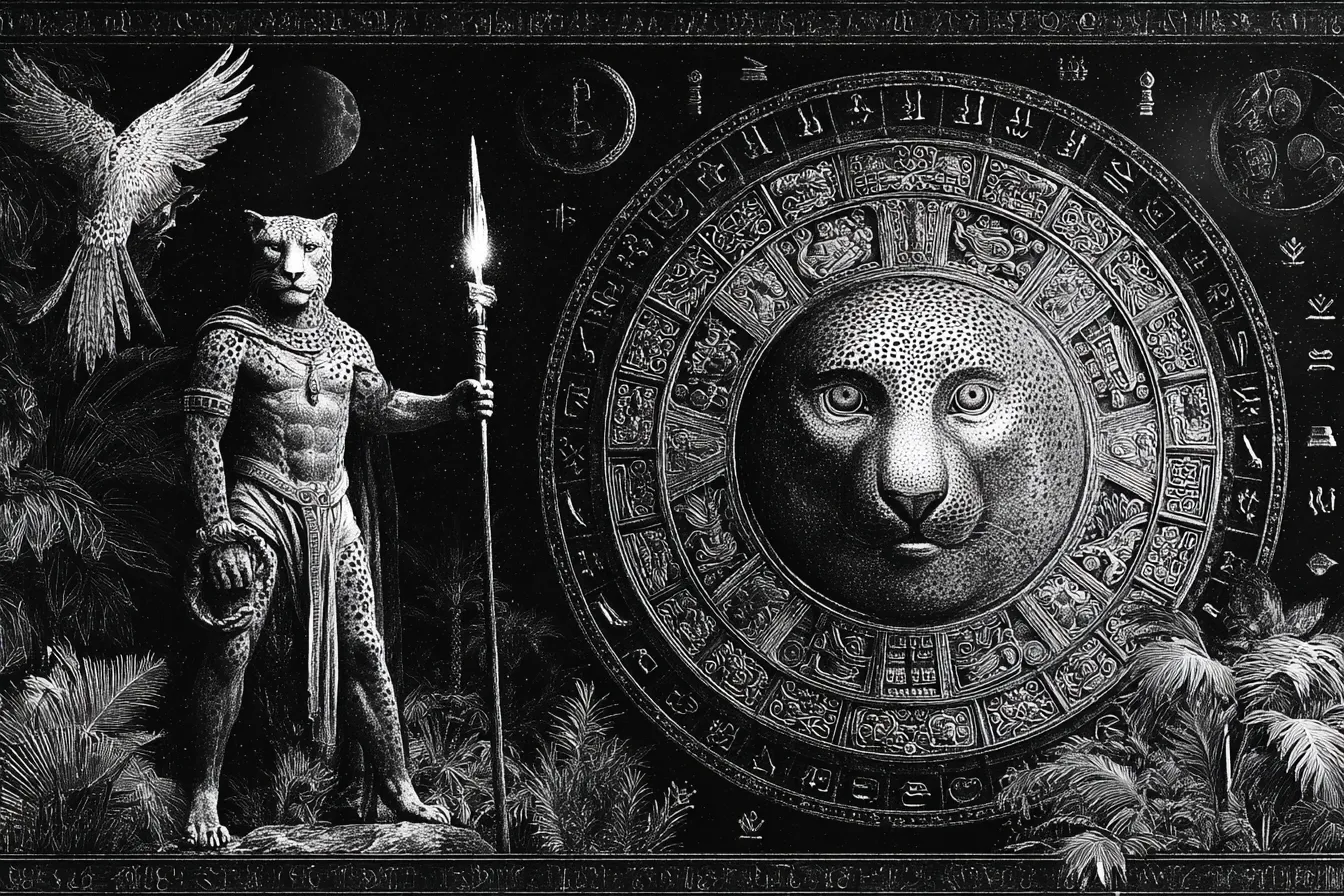
Both Akbal and Ix carry interior, depth-oriented qualities, but the Tzolkin tradition distinguishes them meaningfully. Akbal is the generative darkness of the night house — the dreamfield, the interior space where knowing arises from below consciousness. The quality is receptive, gestational, associated with the depth that produces insight through quiet presence. Ix (the White Wizard, Solar Seal 14) carries the jaguar’s quality of active, alert receptivity — not the passive receiving of the dreamer but the total presence of the shaman who is fully awake to all dimensions simultaneously. Akbal is the night; Ix is the jaguar who moves through it with complete wakefulness. One is the intelligence of the deep pool; the other is the intelligence of the being who inhabits the pool’s environment with supreme awareness.