
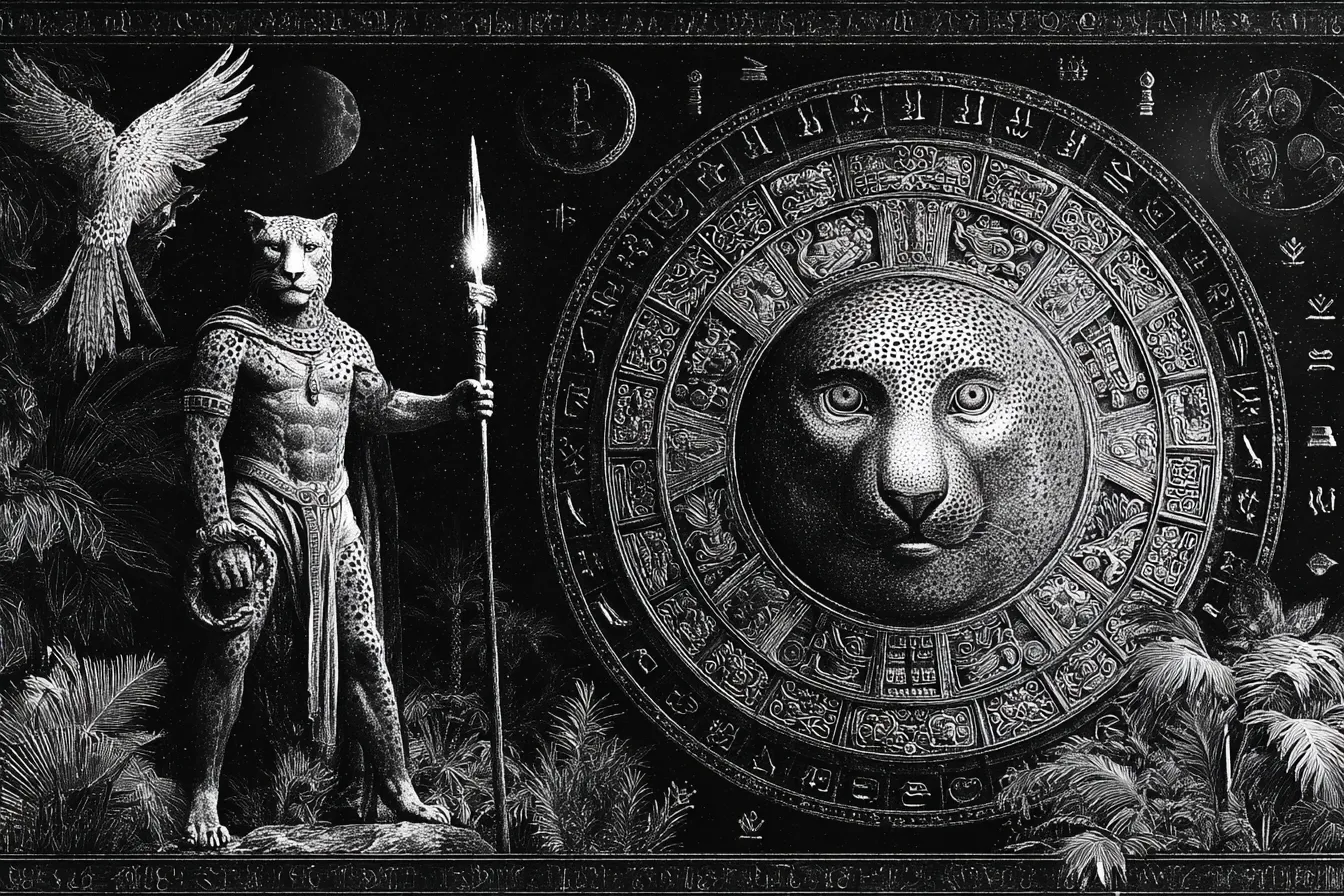
What is Etznab?
Etznab is the eighteenth of twenty Solar Seals in the Mayan Tzolkin — the 260-day sacred calendar built from twenty day signs cycling through thirteen numbered tones, producing 260 unique combinations called Kin. The Tzolkin has been in continuous use among Maya peoples for at least 2,500 years and remains a living tradition today. Ajq’ij — Maya day keepers and ceremonial priests — continue to guide communities through the Tzolkin cycle in Guatemala and southern Mexico, where the Chol Q’ij (the K’iche’ Maya name for the calendar) is woven into both ceremonial and everyday life. Engaging with Etznab means engaging with a tradition that has never been interrupted, one whose continuity passes through living communities rather than through archaeological reconstruction.
The Whisper integrates the Tzolkin alongside Western Astrology, Nine Star Ki, and BaZi into a single daily personal insight. Your birth seal is calculated by locating your birth date within the Tzolkin cycle using the GMT correlation constant (584283) — the most widely accepted scholarly alignment between the Maya Long Count and the Gregorian calendar. This differs meaningfully from the Dreamspell system developed by José Argüelles in 1987, which applies a different correlation and sometimes different seal names, and which can produce a different result for the same birth date. Many English-language tools for finding a “Mayan day sign” use the Dreamspell framework; The Whisper uses the traditional GMT correlation throughout. In addition to your birth seal, the daily seal marks the current day’s shared position in the Tzolkin cycle — the same for everyone worldwide — and The Whisper synthesizes both with the other active systems to generate each day’s insight.
Etznab arrives at position eighteen — two seals from the close of the Tzolkin’s full twenty-seal arc, the point where the accumulated wisdom of the entire cycle is brought into the sharpest possible focus. The preceding seventeen seals moved through every dimension of creative, emotional, intellectual, and spiritual development: from primal ocean to breath, depth, potential, life force, transformation, skilled making, harmony, flow, love, artistry, free will, sky-walking, receptivity, vision, fearless inquiry, and earth-navigation. Etznab is the moment when all of this is placed before a mirror — not to be judged, but to be seen with absolute, undistorted accuracy. The White Mirror does not comment; it simply shows what is actually there.
The symbol and its traditional roots
The glyph associated with Etznab in Maya iconography carries the dual symbolism of the polished obsidian mirror and the obsidian knife — two objects that in Mesoamerican culture were made from the same extraordinary volcanic glass and shared the same essential quality: the capacity for absolute, unyielding precision. Obsidian in the ancient world was among the sharpest materials available to human hands; obsidian blades retained their edge at a molecular level, cutting with a fineness that metal tools of the period could not match. The mirror and the blade are two expressions of the same quality — the surface that reflects without distortion and the edge that cuts without deviation.
The obsidian mirror of Tezcatlipoca is one of the most powerful and most feared objects in Aztec cosmological symbolism. Tezcatlipoca — whose name means “Smoking Mirror” — was the deity whose obsidian mirror reflected the truth of what was hidden, revealing the intentions, the failures, and the genuine nature of those who looked into it. The mirror showed not what people wished to see but what was actually there. This is the precise quality that Etznab carries: the reflection that does not flatter, that does not distort in the direction of comfort, and that does not omit the aspects of what is present that the observer would prefer not to see. The mirror’s service is accuracy, and its accuracy is its gift regardless of whether what it shows is welcome.
The obsidian blade’s quality of precise discernment adds the complementary dimension to Etznab. If the mirror shows what is, the blade separates what is essential from what is not — cutting away with extraordinary precision the material that has accumulated around the genuine core of a thing, revealing what is truly there by removing what is not. This is not destruction but clarification: the blade that separates the genuine from the non-genuine performs the same service as the mirror that shows what is actually present. Both the mirror and the blade are instruments of truth in the Etznab tradition, and both serve the same fundamental purpose — the accurate perception of what is genuinely real.
In the Aztec Tonalpohualli, the corresponding day sign is Tecpatl — Flint or the Obsidian Knife, carrying the same imagery and the same associations with precise, unyielding, truth-revealing sharpness across both Mesoamerican traditions. Tecpatl in Aztec cosmology was specifically the day sign of sacrifice — not in the gruesome popular-culture sense, but in the more precise ceremonial sense of the precise cutting that separates what is genuinely sacred from what has accumulated around it and obscured it. The Aztec flint knife was the ritual instrument of this separation; Tecpatl as a day sign carries the quality of the sacred precision that enables genuine revelation.
The color associated with Etznab is White, and the direction is North — the direction the Tzolkin associates with the mind’s clarifying and refining quality. White seals carry qualities of clarity, discernment, and the refinement that separates what is essential from what is not. Etznab as a White/North seal embodies this clarifying, refining quality in its most concentrated and most precise expression: the White Mirror is the completion of the North’s clarifying project — the sudden, complete, absolute clarity of the perfectly polished mirror surface that shows everything at once, without process or preparation.
The energy of Etznab
The traditional meaning of Etznab centers on the accurate reflection of what is actually present — the quality of awareness and perception that sees what is genuinely there rather than what is expected, feared, hoped for, or constructed from the available evidence by a mind that needs a particular answer. This is a more demanding quality than it initially appears: the capacity to see accurately requires the suspension of all the filters that ordinarily stand between perception and reality — the filters of desire, fear, habit, social conditioning, and the accumulated distortions of a particular personal history. The mirror reflects everything; the mind selects. Etznab’s quality is the mirror’s: the suspension of selection in favor of genuine, complete, undistorted reflection.
The Tzolkin tradition is careful to distinguish Etznab’s truth-reflection from criticism, judgment, or the enjoyment of others’ difficulty in the face of what is revealed. The obsidian mirror does not take pleasure in showing what is uncomfortable; it simply shows. Accurate reflection in the Etznab tradition is in service of genuine development — the understanding that the accurate perception of what is actually present, however uncomfortable that perception may be, is the necessary foundation for any genuine change, any genuine improvement, any genuine movement toward what is genuinely good.
The precise discernment that cuts away what is not genuine is the blade dimension of Etznab energy. Discernment in the Etznab tradition is not the broad-strokes judgment that evaluates whole people or whole situations as good or bad; it is the extraordinarily precise quality of the obsidian blade that can separate genuine from non-genuine at a level of refinement that cruder instruments cannot achieve. This is the discernment that can identify exactly which element of a complex situation is the source of the difficulty, which aspect of a creative work is not yet fully realized, which thread in a relationship has become genuinely unaligned with what both people value.
Truth-telling that arises from genuine clarity rather than judgment is another central Etznab quality. There is a meaningful distinction between the truth-telling that comes from genuine clarity about what is present and the truth-telling that comes from judgment, resentment, or the satisfaction of exposing what is uncomfortable. Etznab’s truth-telling is of the first kind: it arises not from any emotional agenda but from the simple, complete quality of the mirror’s reflection. The person who carries genuine Etznab energy tells the truth not because they enjoy the discomfort it produces but because accurate reflection is the quality they carry, and anything less than accurate reflection feels like the distortion it is.
There is a further quality in Etznab associated with the endlessness of genuine reflection — the mirror that reflects a mirror that reflects a mirror, the infinite regress of genuine clarity that reveals that every apparently final truth reflects another layer of what is present. Etznab in the tradition is associated not with the single revealing reflection that settles everything but with the quality of ongoing, inexhaustible clarity that continues to reflect accurately at every level to which the inquiry descends.
Etznab as a birth seal and daily seal
As a birth seal, Etznab in the Tzolkin tradition is associated with the person who carries the mirror’s quality of accurate, precise, undistorted reflection as their primary orientation — someone whose most characteristic quality is the depth of their clarity about what is actually present in situations, relationships, and themselves, and whose truth-telling tends to have the specific quality of the obsidian mirror: complete, precise, and genuinely in service of clarity rather than of judgment. The birth tone modifies how this expresses in practice: a person born on Etznab with Tone 5 carries the mirror quality with a more commanding, radiant, centrally revealing dimension; someone born on Etznab with Tone 9 may carry it with a more accomplished, completing quality that has fully integrated what the mirror shows.
People born under Etznab are traditionally associated with a particular capacity for seeing through to what is actually present — the ability to perceive what is genuinely there in a situation, a relationship, or a creative work, with a degree of clarity and precision that others who are more invested in particular outcomes or more susceptible to the usual perceptual filters do not consistently achieve. This quality tends to express as an unusual accuracy of perception about what is real versus what is performed, what is genuine versus what is constructed for effect.
There is also a traditional association between Etznab and a particular quality of natural integrity — the difficulty of being or doing anything other than what is genuinely true when the mirror quality is functioning. Etznab people in the tradition are sometimes described as finding inauthenticity genuinely uncomfortable — not merely distasteful but actively difficult to inhabit, in the same way that a clear, flat surface cannot easily produce a distorted reflection without ceasing to be what it is.
As a daily seal, when Etznab appears as the current day’s position in the Tzolkin cycle, the tradition suggests a quality of precise clarity and accurate reflection — a day when the capacity to see what is actually present tends to be more available than usual, when the precise discernment that separates genuine from non-genuine tends to be more accessible, and when truth-telling that arises from genuine clarity rather than from judgment or agenda tends to be particularly productive and particularly valued. The Whisper synthesizes this with the other active systems to generate the specific texture of that day’s reading.
Strengths and growth edges
The strengths traditionally associated with Etznab are rooted in its relationship to precise, accurate, undistorted reflection and discernment. The capacity to see and show what is genuinely there is the most fundamental — the ability to perceive what is actually present in situations, relationships, and creative work with a degree of accuracy and completeness that most forms of perception, filtered as they are by desire, fear, habit, and social conditioning, do not consistently achieve. This is a genuine and rare gift: the world needs accurate mirrors, and the person who can provide accurate reflection — who can show what is genuinely there with clarity and without distortion — offers something of genuine value.
The precise discernment of the obsidian blade is the second major strength — the capacity to separate what is genuine from what is not with an accuracy and precision that cruder instruments cannot achieve. This expresses in practice as an unusual effectiveness at identifying exactly what needs to change in a complex situation, exactly what is not yet fully realized in a creative work, exactly where the misalignment in a relationship or a project lies — without the imprecision that either over-identifies the problem or under-identifies it.
The truth-telling that comes from genuine clarity rather than judgment is the third recognized Etznab strength — the quality of honest, direct communication that is in service of genuine understanding rather than of any emotional agenda. When Etznab’s truth-telling is functioning at its best, it produces the experience in its recipient of being genuinely seen — of having what is actually present accurately reflected in a way that, while it may not be comfortable, is recognizable as true and therefore useful.
The growth edges associated with Etznab follow the shadow dimensions of these gifts with the characteristic precision one might expect of the mirror seal. The mirror that shows only surfaces without depth is the primary growth edge — the accurate reflection that has not developed the capacity to reflect the deeper layers of what is present, that shows the surface truth with great precision but misses the more complex, more vulnerable, more essentially human qualities that lie beneath it. Accuracy without depth produces a reflection that is technically correct but not fully true.
The knife-precision that cuts when healing is what is needed is a closely related growth edge — the discerning, precise quality of Etznab that has become so identified with the function of separating genuine from non-genuine that it applies the blade in situations where a different quality of engagement would serve more genuinely. Not every situation of genuine confusion or inauthenticity is best served by the obsidian blade’s clarity; some are better served by the patient, receptive quality that allows the genuine to surface in its own time.
Finally, the truth-reflection that has become coldness is a recognized Etznab growth edge — the clarity that has become so completely identified with accuracy that it has lost the warmth, the care, and the genuine regard for the person before the mirror that distinguishes the gift of accurate reflection from the injury of mere exposure. The obsidian mirror in Tezcatlipoca’s hand was feared precisely because it showed truth without care for the person it revealed. Etznab’s development involves the cultivation of the care and genuine regard that allows the mirror’s accuracy to be received as a gift rather than as an assault.
What Etznab means in The Whisper
In The Whisper’s multi-system synthesis, Etznab resonates across several traditions in ways that illuminate its essential qualities from complementary perspectives.
The resonance with Western Astrology is strongest with Mercury in Virgo and Saturn — the precise, discerning, truth-reflecting qualities of the planet of perception and communication in its most exacting sign, combined with the long-horizon, tested, high-standard quality of the planet most associated with the genuine development of discernment through sustained encounter with the actual conditions of reality. Mercury in Virgo carries the quality of perception and communication that is most attuned to the precise, the specific, and the accurate — the mind that notices the detail that matters, that communicates with the precision of the well-chosen word rather than the approximation of the adequate one, and that genuinely discomforts in the face of imprecision. Saturn carries the quality of the high standard that does not yield — the demanding intelligence that holds to what is genuinely excellent not out of perfectionism but out of genuine understanding that what is less than genuinely real is not genuinely serving. When The Whisper synthesizes an Etznab influence with a strong Mercury in Virgo or Saturn quality from the Western layer, the precise, discerning, truth-reflecting dimension of that day’s reading may be particularly amplified.
In Nine Star Ki, the resonance is with the Six White Metal Star (六白金星) — the precise, high-standard, truth-reflecting quality of the star most associated with heaven’s organizing principles and the specific form of clarity that arises from genuine alignment with what is genuinely excellent. The Six White Star in Nine Star Ki carries the quality of the blade at its most refined — not the crude force of raw metal but the honed, polished, precisely calibrated quality of the instrument that has been brought to its highest expression. This is the quality of discernment that knows exactly where the line falls between what is genuine and what is not, and that holds to that line not from rigidity but from genuine understanding of why it matters. When Etznab appears alongside a Six White Metal Star influence in The Whisper’s Nine Star Ki layer, the precise, high-standard, truth-reflecting quality of the mirror-and-blade intelligence may be especially present.
From a BaZi perspective, the resonance is with Xin Metal (辛金) — the polished, reflective, aesthetically precise quality of yin metal; the mirror surface, the jewel, the refined instrument that shines precisely because it has been brought to its highest degree of polish. Xin Metal in BaZi is the most refined of the ten heavenly stems — the metal that has been worked until it reflects with perfect clarity, that carries the quality of genuine aesthetic discernment and genuine perceptive precision as its essential nature. In its Etznab expression, Xin Metal carries the quality of the obsidian mirror’s surface: the reflection that arises not from effort but from the quality of the surface itself, which has been refined to the point where genuine reflection is its natural state. When Etznab appears alongside a Xin Metal influence in The Whisper’s BaZi layer, the polished, precisely reflective, genuinely discerning quality of the mirror intelligence may be particularly prominent.
The Aztec Tonalpohualli equivalent, Tecpatl (Flint/Obsidian Knife), adds the dimension of the sacred ceremonial blade — the instrument whose precision is specifically in service of revelation, of cutting through what has accumulated around what is genuinely sacred in order to make the sacred available. The flint knife in Aztec ceremony was not an instrument of harm but of the precise, reverent separation that genuine ceremony requires — which is exactly the quality of Etznab’s discernment at its best.
In The Whisper’s daily synthesis, Etznab days carry the quality of precise clarity and accurate reflection — days when the capacity to see what is genuinely present tends to be more available, when the obsidian blade’s precise discernment tends to be more accessible, and when truth-telling that arises from genuine clarity rather than from judgment or agenda tends to be particularly productive and particularly valued.
Frequently asked questions
Q: Is Etznab considered a difficult or uncomfortable seal to be around, given its association with unvarnished truth?
The Tzolkin tradition does not characterize any seal as inherently difficult or uncomfortable, but it does acknowledge that the mirror quality of Etznab can be experienced differently depending on the relationship between the person carrying it and the person being reflected. When Etznab’s accuracy is combined with genuine care and genuine regard for the person before the mirror — when the truth is offered in service of the other’s genuine development rather than as an end in itself — the experience of being accurately reflected tends to be received as a gift, even when what is shown is not entirely comfortable. The difficulty that sometimes arises around Etznab energy is usually the growth-edge dimension: the mirror that shows surfaces without depth, or the blade that cuts when something softer was needed. Etznab at its best is not uncomfortable but clarifying — the experience of being genuinely seen, which is one of the deepest forms of genuine acknowledgment available.
Q: How might The Whisper calculate a different birth seal for me than a Dreamspell-based Mayan astrology tool?
The Whisper uses the GMT correlation constant (584283), the traditional scholarly alignment between the Maya Long Count and the Gregorian calendar used by Maya communities today. The Dreamspell system, developed by José Argüelles in 1987, uses a different correlation and also handles leap years differently: the traditional Tzolkin counts every day including February 29 in leap years, while Dreamspell skips leap days entirely. This means that anyone born on or after March 1 in a leap year, or born on dates that fall in a different position in the two systems’ respective counts, may receive a different seal from each system. Both systems are internally consistent within their own frameworks, but they are genuinely different frameworks rather than different expressions of the same underlying information.
Q: Does Etznab’s association with mirrors and reflection have any connection to divination or seeing the future?
The Aztec obsidian mirror of Tezcatlipoca was used in some ceremonial contexts as a scrying instrument — a surface through which the skilled practitioner could perceive what was not immediately visible. The Etznab tradition does carry this association, but it is worth understanding precisely what it means in the Tzolkin context. The mirror’s capacity to reveal what is hidden is not understood in the tradition as a window into a predetermined future but as the quality of perception that can see what is actually present in the current situation at levels that ordinary, less refined perception cannot access. The “future” that the Etznab mirror reveals is more accurately the quality of what is genuinely present in the immediate situation — the conditions, tendencies, and genuine dynamics that are already there and that will, if nothing changes, produce particular outcomes. This is a form of genuinely deep perceptive clarity rather than prophecy in the conventional sense, and the distinction is worth maintaining.