
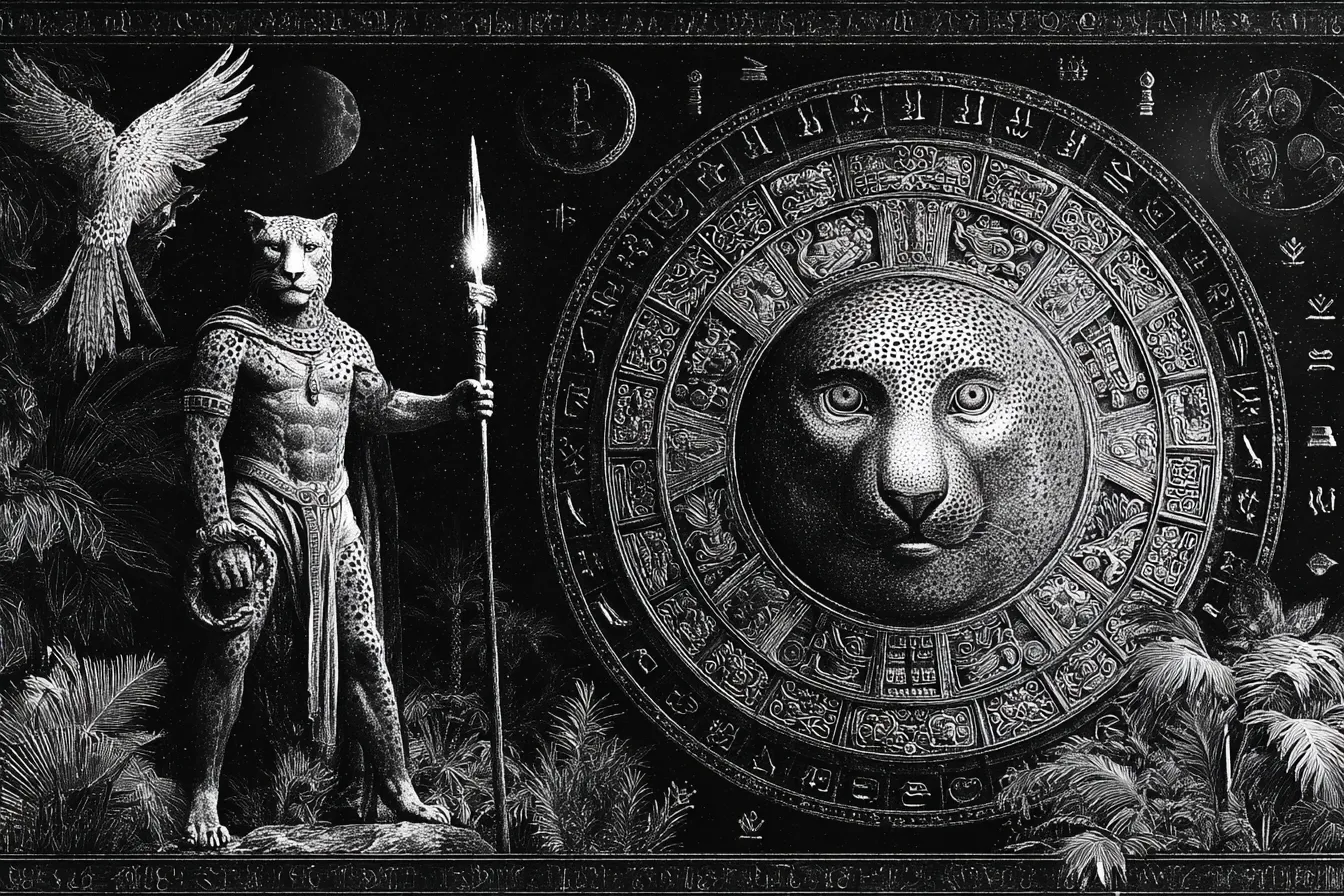
What is Cauac?
Cauac is the nineteenth of twenty Solar Seals in the Mayan Tzolkin — the 260-day sacred calendar built from twenty day signs cycling through thirteen numbered tones, producing 260 unique combinations called Kin. The Tzolkin has been in continuous use among Maya peoples for at least 2,500 years and remains a living tradition today. Ajq’ij — Maya day keepers and ceremonial priests — continue to guide communities through the Tzolkin cycle in Guatemala and southern Mexico, where the Chol Q’ij (the K’iche’ Maya name for the calendar) is woven into both ceremonial and everyday life. To engage with Cauac is to engage with a tradition that has never been interrupted, whose continuity passes through living communities rather than through reconstruction or revival.
The Whisper integrates the Tzolkin alongside Western Astrology, Nine Star Ki, and BaZi into a single daily personal insight. Your birth seal is calculated by locating your birth date within the Tzolkin cycle using the GMT correlation constant (584283) — the most widely accepted scholarly alignment between the Maya Long Count and the Gregorian calendar. This differs meaningfully from the Dreamspell system developed by José Argüelles in 1987, which applies a different correlation and sometimes different seal names, and which can produce a different result for the same birth date. Many English-language tools for finding a “Mayan day sign” use the Dreamspell framework; The Whisper uses the traditional GMT correlation throughout. In addition to your birth seal, the daily seal marks the current day’s shared position in the Tzolkin cycle — the same for everyone worldwide — and The Whisper synthesizes both with the other active systems to generate each day’s insight.
Cauac arrives at position nineteen — the penultimate seal of the entire twenty-seal cycle, one step from the completion that Ahau represents. The preceding eighteen seals have moved through the full arc of the Tzolkin’s development: primal ocean, breath, depth, potential, life force, transformation, skilled making, harmony, flow, love, artistry, free will, sky-walking, receptivity, vision, fearless inquiry, earth-navigation, and the precise mirror of accurate reflection. Everything the cycle has developed now stands before the storm. Cauac is not an ending but a clearing — the thunderstorm that sweeps through what has accumulated across the entire arc and makes the final emergence of Ahau’s solar light genuinely possible. The storm precedes the sun; it always has.
The symbol and its traditional roots
The glyph associated with Cauac in Maya iconography depicts the storm — specifically the tropical thunderstorm that in the Maya world was the most dramatic and most vital expression of the rain deity’s power, bringing both the destruction of lightning and the life-giving gift of rain in a single, inseparable event. In Maya agricultural society, the thunderstorm was not merely weather but the most immediately consequential divine force in daily life: the rain that the storm carried determined whether the maize would grow, whether the community would eat, whether the season would be one of abundance or one of hardship. The storm was feared and also prayed for; it was the force most immediately responsible for both the danger and the abundance of life in the tropical lowland Maya world.
The catalytic dimension of Cauac is embedded in the storm’s specific action: the thunderstorm does not merely bring rain. It first breaks the heat, the stillness, the accumulated pressure of the atmosphere that has been building through the dry period — and this breaking is itself transformative, not merely preliminary. The lightning that precedes the rain is not incidental to the storm’s gift but essential to it: the electrical discharge of the storm changes the chemical composition of the atmosphere, contributes nitrogen to the soil, and clears the accumulated stagnation in a way that makes the subsequent rain more genuinely nourishing. Cauac carries this quality: the transformation that is not a gentle, gradual process but the sudden, dramatic clearing that breaks what has been stuck and makes genuine renewal possible.
Self-generation is another quality the Tzolkin tradition associates with Cauac — the storm’s capacity to generate its own energy through its internal dynamics, to sustain and even intensify itself through the processes it sets in motion. The thunderstorm is not merely moved by the wind; it generates its own circulation, creates its own weather within the larger weather, and carries within itself the energy that sustains its transformative work. This self-generating quality of the catalyst is central to Cauac’s meaning: the transformation agent who does not merely respond to external conditions but generates from within the energy that the transformation requires.
In the Aztec Tonalpohualli, the corresponding day sign is Quiahuitl — Rain, carrying closely related associations with the divine gift of water falling from the sky and the transformative force of the storm that brings it. In Aztec cosmology, Quiahuitl was specifically governed by Tlaloc — the rain deity whose domain included both the life-giving rain and the destructive flood, both the gentle moisture that nurtures growth and the violent storm that reshapes the landscape. The paradox of Tlaloc’s domain — both nourishing and potentially devastating, both gift and threat — reflects the essential Cauac quality with unusual precision: the catalytic force that generates genuine transformation is the same force that can, when its balance is lost, produce more disruption than the situation can productively absorb.
The color associated with Cauac is Blue, and the direction is West — the direction the Tzolkin associates with transformation, deepening, and the willingness to engage with what lies beneath and beyond surfaces. Blue seals carry qualities of transformation and the depth that comes from genuine engagement with what is genuinely unknown. Cauac as a Blue/West seal embodies the transforming, deepening quality in its most dramatic and most immediate expression: the storm that moves through the accumulated stagnation of what the entire preceding arc of the cycle has developed and clears it in a single, concentrated, irreversible act of transformation.
The energy of Cauac
The traditional meaning of Cauac centers on catalytic transformation — the specific quality of transformative force that does not work gradually or gently but breaks through accumulated stagnation with the sudden, concentrated energy of the storm, clearing what has built up and making genuine renewal possible in a way that more gradual processes cannot. This is a meaningful distinction from Cimi’s transformation, which works through the threshold of genuine ending, or from the ongoing purification of Muluc’s flowing water. Cauac’s transformation is neither the clean crossing of a threshold nor the continuous movement of flow; it is the concentrated, sudden, self-generating force of the storm that reshapes everything within its range in a relatively brief, intense period of dramatic change.
The Tzolkin tradition is careful to distinguish Cauac’s catalytic force from mere disruption or destruction. Genuine catalytic transformation in the Cauac tradition is specifically transformation that serves renewal — the storm that clears the way for what was not possible before, that brings the rain that enables genuine new growth, that breaks the accumulated stagnation that was preventing genuine development. The storm is not the enemy of the crops; it is, in the right season and the right measure, their most powerful ally.
The rain that follows the lightning is another central Cauac quality that the tradition addresses with care. The storm does not consist only of its most dramatic moments — the thunder, the lightning, the sudden violent wind. It also carries the rain that follows, the moisture that soaks into the parched earth, the renewal that the clearing has made possible. Cauac energy tends to express not only as the dramatic, catalytic moment of clearing but also as the sustained, nourishing quality of what follows — the capacity to remain present through the aftermath of transformation and to provide the equivalent of the storm’s rain: the genuine support, the new information, the fresh perspective, the renewed energy that the cleared landscape can now receive in a way it could not before the storm came through.
The self-generating quality of the transformation catalyst is the third major dimension of Cauac energy. The storm generates from within the energy that sustains its transformative work; it is not dependent on external conditions to maintain its momentum once it has reached a sufficient intensity. Cauac people and Cauac days carry this quality: a self-sustaining transformative energy that, once activated, has its own internal logic and its own internal momentum. This is a significant strength — the capacity to maintain the energy of transformation through the difficult middle phases where the clearing is most intense and the renewal is not yet visible.
There is a further quality in Cauac associated with the storm’s relationship to what it moves through. The storm does not select what it clears; it moves through everything in its range with the same concentrated, transformative force. This quality of thoroughness — of not exempting anything from the clearing that genuine transformation requires — is both one of Cauac’s most essential gifts and the source of its most characteristic difficulty. The storm that is genuinely thorough does not leave pockets of stagnation intact because they were too important or too comfortable to disturb; it clears completely.
Cauac as a birth seal and daily seal
As a birth seal, Cauac in the Tzolkin tradition is associated with the person who carries the quality of catalytic, self-generating, thoroughgoing transformation as their primary orientation — someone whose most characteristic quality is the depth of their transformative energy and the capacity to move through what has accumulated and stagnated with the concentrated, self-sustaining force of the storm. The birth tone modifies how this expresses in practice: a person born on Cauac with Tone 3 carries the catalytic quality with a more rhythmically activating, break-through dimension; someone born on Cauac with Tone 12 may carry it with a more complex, cooperatively synthesizing quality that has integrated the storm’s force with the collaborative intelligence of genuine collective transformation.
People born under Cauac are traditionally associated with a particular capacity for generating transformation in the situations they inhabit — the quality of being a genuine catalytic presence whose arrival in a situation that has become stagnant or stuck tends to initiate the kind of concentrated, thoroughgoing clearing that more gentle or gradual approaches could not produce. This is not always comfortable for the people around the Cauac person, and the tradition does not pretend that it is; the storm does not ask permission before it transforms the landscape. What it produces, when it is genuinely catalytic rather than merely disruptive, is the clearing that makes genuine renewal possible.
There is also a traditional association between Cauac and a particular quality of renewal through the full cycle of the storm — not merely the dramatic clearing but the rain that follows, the nourishing quality of the aftermath, the sustained engagement with what the transformation has made possible. Cauac people in the tradition are sometimes described as carrying both the storm’s breaking force and the rain’s nourishing quality.
As a daily seal, when Cauac appears as the current day’s position in the Tzolkin cycle, the tradition suggests a quality of catalytic opening and transformative clearing — a day when the concentrated energy of genuine breakthrough tends to be more available than usual, when what has accumulated and stagnated may be particularly ready to be moved, and when the capacity to sustain transformative energy through the difficult middle of genuine clearing tends to be more accessible. The Whisper synthesizes this with the other active systems to generate the specific texture of that day’s reading. Cauac days in the tradition are also associated with the quality of genuine renewal — the acknowledgment that what the storm clears makes something genuinely new possible.
Strengths and growth edges
The strengths traditionally associated with Cauac are rooted in its relationship to catalytic, self-generating, genuinely thoroughgoing transformation. The capacity to catalyze genuine transformation is the most fundamental — the ability to move through what has accumulated and stagnated with the concentrated force of the storm, breaking through the inertia that more gradual approaches cannot overcome and making the kind of fundamental clearing that genuine renewal requires. This is a rare and genuinely valuable quality: the world regularly produces situations in which what is needed is not incremental improvement but the concentrated, thoroughgoing transformation that only the storm’s force can deliver.
The storm’s quality of clearing accumulated stagnation is the second major strength — the specific capacity to move through what has built up across time in a situation, a relationship, a creative project, or a community and to clear it with the thoroughness that the storm’s non-selective force enables. Cauac’s clearing is more thorough and less precise than Etznab’s blade; it sweeps through the accumulated material with a force that does not distinguish between what was worth keeping and what was not. This thoroughness is both a genuine strength and the source of the primary growth edge.
The rain’s quality of enabling new growth after clearing is the third recognized Cauac strength — the capacity to remain present through the aftermath of transformation with the sustained, nourishing energy that genuine renewal requires. This dimension of Cauac is most easily overlooked in descriptions of the seal that focus primarily on the storm’s dramatic clearing force; the rain that follows the lightning is as essential to the storm’s full gift as the lightning itself.
The growth edges associated with Cauac follow the shadow dimensions of these gifts with characteristic force. The storm that destroys what should have been reformed is the primary growth edge — the catalytic force that has not developed the wisdom to distinguish between what genuinely needs to be cleared and what genuinely needs to be developed, and that therefore sweeps through both with the same thoroughgoing force. Cauac’s development involves the cultivation of this discernment — the wisdom that can aim the storm’s force at what genuinely needs clearing while protecting what genuinely needs time.
The constant catalytic energy that cannot sustain what it has helped to create is a closely related growth edge — the Cauac quality that is so fully oriented toward the work of clearing and transformation that it cannot remain present through the long, patient, unglamorous work of sustaining and developing what the transformation has made possible. The storm passes; the rain is brief; the aftermath is long.
Finally, the transformation driver who cannot rest in what has been transformed is a recognized Cauac growth edge — the being who has become so identified with the role of catalytic transformation that they cannot inhabit the cleared landscape with genuine presence, cannot appreciate the renewal that the clearing has made possible, and are already generating the energy of the next storm before the rain from the last one has fully nourished what it cleared.
What Cauac means in The Whisper
In The Whisper’s multi-system synthesis, Cauac resonates across several traditions in ways that illuminate its essential qualities from complementary perspectives.
The resonance with Western Astrology is strongest with Uranus, Pluto, and Scorpio — the transformative, catalytic, storm-clearing qualities of the planets and sign most associated with the concentrated force of genuine, thoroughgoing change. Uranus in Western astrology governs the sudden, awakening, breakthrough quality of transformation that arrives without warning and reshapes the landscape irreversibly — the lightning of genuine insight and genuine change that cannot be planned for or predicted but that, when it arrives, makes a particular kind of return to what was before genuinely impossible. Pluto governs the deep, inexorable, thoroughgoing force of transformation that operates at the level of fundamental structure rather than surface arrangement — the volcanic force that reshapes the geological landscape of a situation by expressing what has been building below the surface. Scorpio governs the intensity of genuine, concentrated engagement with what is most real and most transformative in human experience. When The Whisper synthesizes a Cauac influence with a strong Uranus, Pluto, or Scorpio quality from the Western layer, the catalytic, thoroughgoing, storm-clearing dimension of that day’s reading may be particularly amplified.
In Nine Star Ki, the resonance is with the Three Jade Wood Star (三碧木星) — the awakening, initiating, breaking-through quality of the spring thunder energy that announces the end of winter with sudden, concentrated vitality. In Nine Star Ki, the Three Jade Star carries the quality of the thunder that breaks through the frozen ground — the sudden, concentrated, awakening force that initiates the season of growth by breaking the inertia that the cold has produced. This is precisely the Cauac quality: the force that initiates not through gradual warming but through the sudden, concentrated, self-generating burst of energy that breaks what has been frozen and makes the movement of genuine spring possible. When Cauac appears alongside a Three Jade Wood Star influence in The Whisper’s Nine Star Ki layer, the awakening, breaking-through, catalytically initiating quality of the transformative energy may be especially present.
From a BaZi perspective, the resonance is with Ren Water (壬水) — the powerful, breaking-through quality of yang water that clears its own path and that purifies through the force of its movement rather than through the gentle, pervasive flow of yin water. Ren Water in BaZi is the most powerful of the water elements: the ocean current, the flooding river, the water that, when it reaches sufficient force, shapes the landscape rather than being shaped by it. In its Cauac expression, Ren Water carries the quality of the storm’s rain — not the gentle, purifying flow of a clear stream but the concentrated, landscape-reshaping force of the downpour that follows the lightning, that saturates the earth, that fills the dry channels and moves what has been immobile with the sheer weight and force of its concentrated presence. When Cauac appears alongside a Ren Water influence in The Whisper’s BaZi layer, the powerful, clearing, landscape-reshaping quality of the catalytic transformation may be particularly prominent.
The Aztec Tonalpohualli equivalent, Quiahuitl (Rain), adds the dimension of Tlaloc’s paradoxical domain — the deity of both nourishing rain and devastating flood, both gentle moisture and violent storm. This frames Cauac’s transformative force not as simply destructive or simply nourishing but as genuinely paradoxical in the way that all genuinely powerful natural forces are: the same force that destroys is the same force that renews, and the distinction between the two depends entirely on the quality of the relationship between the force and the landscape it moves through.
In The Whisper’s daily synthesis, Cauac days carry the quality of catalytic opening and transformative clearing — days when the concentrated energy of genuine breakthrough tends to be more available, when what has accumulated and stagnated may be particularly ready to be moved, and when the capacity to sustain transformative energy through genuine clearing tends to be more accessible than usual.
Frequently asked questions
Q: Should I be concerned when Cauac appears as my daily seal in The Whisper — does it signal disruption or difficulty?
Cauac as a daily seal in The Whisper is not a warning of disruption or difficulty in the predictive sense; the Tzolkin tradition does not use Solar Seals as omens of specific events. Rather, a Cauac day suggests a quality of concentrated transformative energy in the day’s field — a day when the capacity for genuine clearing and catalytic breakthrough tends to be more available than usual, and when what has been accumulating and stagnating may be particularly ready to move. The Whisper synthesizes this with the other active systems to produce a specific insight rather than a general alert. Cauac days in the tradition are considered particularly favorable for the kind of deliberate, conscious engagement with what needs to change that transforms the storm’s force from mere disruption into genuine, productive clearing — the difference between the storm that destroys and the storm that clears is largely determined by the quality of the awareness that moves with it.
Q: How does The Whisper’s traditional GMT correlation produce a different result from Dreamspell-based Mayan astrology tools?
The GMT correlation constant (584283) is the most widely accepted scholarly alignment between the Maya Long Count and the Gregorian calendar, derived from decades of archaeological, astronomical, and ethnographic research, and is the correlation used by traditional Maya practitioners and communities today. The Dreamspell system, created by José Argüelles in 1987, applies a different correlation constant and handles leap years differently — Dreamspell skips February 29 in leap years, while the traditional Tzolkin counts every day. For people born on or after March 1 in a leap year, and for certain birth dates in non-leap years that fall differently in the two systems’ counts, the resulting seal assignment can differ. The Whisper uses the traditional GMT correlation throughout, for alignment with the living Maya tradition. If your result in The Whisper differs from a day sign you have received elsewhere, both are internally consistent within their respective systems, but they are genuinely different frameworks rather than different expressions of the same underlying information.
Q: If Cauac is my birth seal, does that mean my life tends to be characterized by constant upheaval and disruption?
The Tzolkin tradition does not suggest that Cauac birth-seal people live lives of constant dramatic disruption — it suggests that catalytic, thoroughgoing transformation is their primary quality and their natural contribution. The expression of Cauac energy across a lifetime looks very different depending on the degree of development: the undeveloped Cauac quality may indeed produce a pattern of constant disruption that serves more the force of the storm than the renewal that the storm makes possible; the developed Cauac quality expresses as a deeply productive, genuinely valued catalytic capacity that moves through what is genuinely stagnant with concentrated, self-sustaining transformative force and then remains present through the aftermath with the nourishing quality of the rain. What the tradition suggests for Cauac development is not the suppression of the catalytic force but the cultivation of the wisdom — and the care and the patience — that channels it in genuine service of renewal rather than in the mere expression of the storm.