
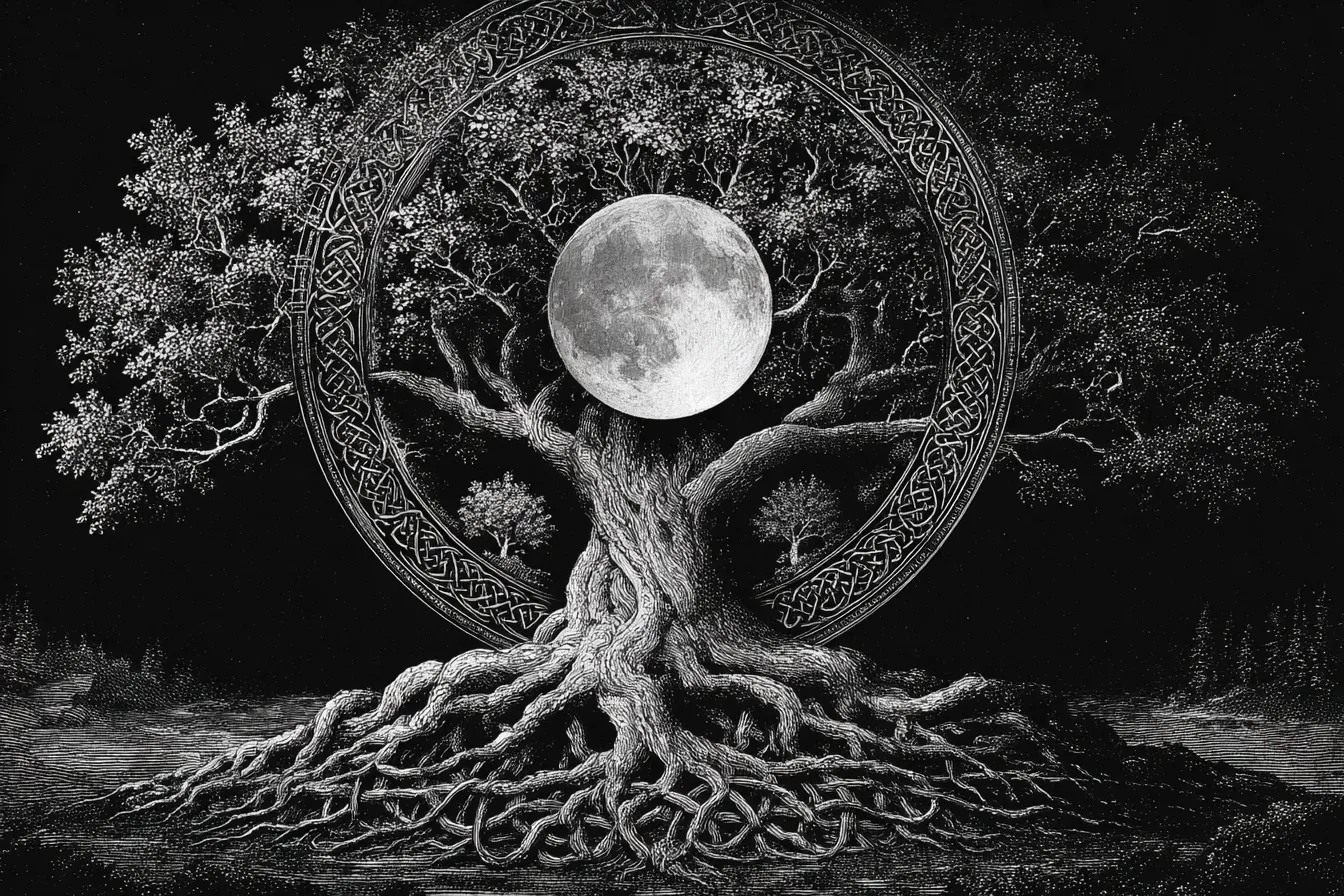
What is the Reed sign in Celtic astrology?
If your birthday falls between October 28 and November 24, the Celtic Tree Calendar places you under the Reed — the twelfth tree, the threshold instrument, the one whose hollow allows something larger than itself to speak. Its Ogham letter is Ngetal (ᚌ), the twelfth character in the ancient alphabet inscribed on standing stones across Ireland and western Britain. The Reed month contains Samhain — the first of November, the most significant of the Celtic fire festivals, the moment when the veil between the living and the dead is at its thinnest, when the threshold between this world and what lies beyond it is most openly passable in both directions. To be born under the Reed is to be born at the heart of the year’s most profound threshold crossing.
The Celtic Tree Calendar links each of its thirteen lunar months to a tree whose ecology, mythology, and material life in Ireland and Britain becomes a framework for understanding those born within it. As in every article in this series: the calendar in its modern form draws primarily from Robert Graves’s The White Goddess (1948), synthesising genuine medieval Irish and Welsh sources through Graves’s interpretive lens. It is not a transcript of pre-Christian Celtic practice. The Ogham alphabet is genuinely ancient — stone inscriptions from the 4th through 8th centuries CE — and the symbolic associations draw on real medieval sources. Contemporary Druidry and Celtic spiritual practice engage with this as a living tradition. The Whisper does the same.
The Reed is the only sign in the Celtic Tree Calendar that is not a tree. It is a plant — or more precisely, a hollow grass — and the specific quality of its hollowness is the central fact of everything the Reed sign means. The reed does not produce music. The music is produced because the reed is hollow — because the breath of something other than the reed passes through its emptiness and becomes sound. This distinction is the heart of the Reed.
The tree and its historical roots
The common reed (Phragmites australis) grows at the threshold between water and land — in the transitional zone of river margins, lakeshores, fens, and brackish coastal waters. It grows in dense communities called reed beds, colonies of individual stems rising from a shared underground rhizome, each reed physically separate but all connected beneath the surface of the water. The individual reed is always part of the reed bed — cut from it, it is isolated; in it, it is one of many.
The reed’s stem is physically hollow — a natural tube, a ready-made pipe. This is not a refinement or modification; it is the reed’s actual structure. The hollowness is structural, not accidental, and it is exactly the property that made reeds among the first materials used for musical instruments in human history. Reed instruments appear in the archaeological record across the ancient world — Egypt, Mesopotamia, the Indus Valley, pre-Columbian America — not because every culture independently arrived at the same design choice, but because the hollow reed presents itself as an instrument already made, requiring only cutting and shaping rather than the complex manufacture that other instrument types require.
Ngetal is associated in the medieval Ogham sources with the reed, and some versions also connect it with broom or fern — the same ambiguity of plant attribution that appears in several letters. The reed interpretation is consistent with the seasonal context: reeds are harvested in late autumn and winter for thatching, one of the primary traditional roofing materials of Ireland and Britain. The reed harvest happens precisely in the Ngetal month and the months that follow — October through February, when the sap is down, the stems are at their most durable, and the harvested material will last longest. The cutting of the reeds at Samhain is not merely symbolic: it is the actual practice of gathering the winter’s building material at exactly this threshold moment.
The reed bed is one of the most significant wildlife habitats in the British Isles. In winter — from November through February, deep in and past the Reed month — the dense stems of the reed bed provide shelter for extraordinary numbers of roosting birds. The reed bunting, bearded tit, and most significantly the bittern — one of Britain’s rarest and most cryptic birds — depend on intact reed beds for survival. The reed bed provides through the darkest and coldest period of the year by being what it is: dense, sheltering, holding the warmth that the birds need through the winter threshold.
The reed’s annual cycle is worth noting: the above-ground stems die in winter, releasing the cut harvest, and regrow from the same rhizome in spring. This is a genuine annual death and return — the above-ground reed disappears through the winter threshold and re-emerges in spring. The reed bed as a whole persists; the individual stems pass through their own small Samhain and return.
The reed as instrument: hollowness as gift
The most significant thing about the reed — the fact that shapes every aspect of the Reed sign — is what happens when the reed is hollow. The reed does not make music by itself. The music is made by the breath that passes through. This distinction is not semantic. It points at a specific quality that is the Reed’s most profound characteristic: the capacity to be the medium through which something larger than oneself speaks.
This quality is so fundamental that it appears independently in multiple unrelated traditions, each pointing at the same recognition. The most famous literary expression is the opening of Rumi’s Masnavi (13th century, Persian), which begins with the voice of the reed flute lamenting its separation from the reed bed: “Listen to the reed, how it tells a tale of separation — from the time of my cutting from the reed bed, men and women have lamented my lament.” The music that the reed produces is, in Rumi’s image, the voice of the longing created by the cutting — the separation from the source is both the wound and the gift that makes music possible. The hollow that aches is the same hollow through which the music passes. This is not a Celtic text; it is a 13th-century Persian Sufi poem. But it points at the same quality that the Celtic Ngetal sign carries, arriving at it from an entirely different direction.
The Greek myth of Pan and Syrinx arrives at the same point from yet another angle. Syrinx was a nymph who, fleeing from Pan, was transformed into reeds at the river’s edge by the water nymphs. Pan, in his grief and longing, cut the reeds and made them into the pan flute — the syrinx. The music of the instrument is, in the myth’s logic, the voice of the transformed nymph: what crossed the threshold between life and reed, between the natural world and the musical world, became the means by which what cannot be said in ordinary language is expressed. The reed instrument, in Greek mythological understanding, is the voice of transformation and of longing for what has crossed the threshold.
These two traditions — Persian Sufi, Greek myth — are not Celtic sources, and this should be said clearly. The Whisper is drawing attention to them as cross-cultural resonances that point at a quality the Celtic tradition expresses through the Samhain threshold and through the Reed’s specific position in the calendar. What all three traditions share is the same recognition: the reed’s hollowness is not absence but capacity; the cutting from the source is both loss and the condition of music; and what the reed carries is something that does not originate in the reed itself.
Samhain and the Reed’s threshold
Samhain — November 1, the first day of the Reed month’s second week — is the most significant threshold in the Celtic calendar. Unlike Imbolc (the stirring of spring), Beltane (the flowering of summer), and Lughnasadh (the first harvest), Samhain is specifically and primarily a threshold festival: the moment when the boundary between this world and what lies beyond it is at its most permeable. The dead are close. The sídhe move freely. The year’s accounting is taken. The fire is extinguished and relit from a central sacred flame. The cattle are brought in from the summer pastures.
The Reed month carries Samhain at its beginning and continues for three weeks past it, into mid-November — the period when the threshold has opened and the world is living in the immediate aftermath of the crossing. If the Ivy month is the approach to Samhain, the Reed month is Samhain itself and its immediate aftermath: the open threshold, the thin veil, the presence of what is normally beyond ordinary perception.
The Reed is the precisely correct sign for this month because the Reed’s quality — the hollow that carries what comes through the threshold — is exactly the quality required at Samhain. The Reed does not control or generate what passes through it; it provides the means for the passage. The Samhain awareness, the thinning of the veil, the presence of what is beyond ordinary life — these require the same quality: the capacity to be hollow enough that something other than ordinary life can move through and be heard.
The cutting of the reeds for thatching at this time of year carries its own Samhain resonance: the reed bed is harvested at the threshold, the stems cut from the rhizome that will regrow them in spring, the individual reeds separated from the collective bed that grew them. The cut reed is isolated from its source — as Rumi’s reed is isolated from the reed bed — and becomes, in that separation, capable of being made into an instrument.
Reed as a birth sign
As a birth sign, Reed describes a person whose particular gift is the capacity to be the means through which something larger than themselves speaks. Not the source of the music — the channel of it. Not the generator of the vision — the medium through which it becomes perceptible. This is not a passive quality. The reed is shaped by the reed-cutter, dried and cured, placed in the instrument, maintained and adjusted to the exact pitch required. The reed participates in the music without being its origin.
People with strong Reed energy often carry a quality that others experience as uncanny perceptiveness — a capacity to give voice to things that others are feeling but have not been able to say, to bring into expression what has been hovering at the threshold of the sayable. The Reed person is often not entirely certain where what they say comes from. It arrives through them. The process is more like transmission than like composition.
The Samhain threshold orientation gives Reed people a specific relationship with what lies beyond the ordinary surface of life. This is not necessarily supernatural in expression — it can manifest as a consistent awareness of what is not being said in a room, of what the official account is missing, of the grief or the fear or the longing that is present beneath the stated surface. The Reed’s channel quality opens toward what is usually kept below the threshold of ordinary expression.
The hollowness quality is the most challenging and most important aspect of the Reed sign to understand. To be the hollow through which something passes, the Reed must have a quality of genuine receptivity — a capacity to be genuinely empty enough that what needs to pass through can do so. This is not the absence of self. The reed has a specific shape, a specific length and diameter and wall thickness — these determine what it can carry and how. The hollowness is not formlessness; it is a specific form that has been made receptive. The Reed person’s capacity to channel what is not theirs to originate depends on this specific shaped receptivity: not the vacancy of someone with no character of their own, but the precise hollowness of someone whose character creates exactly the space through which what needs to be heard can pass.
The separation from the reed bed is present in Reed people as a specific quality of aloneness that is not quite loneliness. The reed that has been cut from the bed is isolated from the collective it grew from — and it is this isolation, this separation, that makes it capable of being an instrument. Reed people often carry a quality of being slightly outside the collective, not entirely belonging to the group they are in, experiencing a separation that is both genuinely felt and also the condition of their specific gift. The music of the cut reed is the voice of its longing for the bed it was part of. This is not a problem to be solved; it is the specific tension that produces the music.
The Reed month as a seasonal energy
In The Whisper, the seasonal dimension of the Reed applies to the calendar period of October 28 through November 24 as an energy active for everyone. The Reed season is defined by Samhain and its aftermath — the open threshold, the thin veil, the world in the immediate presence of what is normally beyond ordinary perception.
The Reed season carries a specific invitation: the invitation to listen at the threshold. Not to speak over what is present — the Reed is not the speaking sign; it is the carrying sign. The invitation is to develop the quality of the hollow: to be receptive enough that what is present at the Samhain threshold can be heard and given voice, rather than being missed in the noise of ordinary life’s insistence on itself.
Seasonal position within the Reed month adds nuance. Those born in the first days (October 28–31) arrive at the exact approach to Samhain — born at the thinnest part of the veil before it opens on November 1. The threshold awareness is most immediate here. Those born on or around Samhain itself (November 1–7) carry the most direct threshold quality — born at the open gate. Those born in mid-Reed (November 8–16) live in Samhain’s immediate aftermath — the threshold has been crossed and the world is in the period of living with what the crossing revealed. Those born in late Reed (November 17–24) are approaching the Elder threshold — the end of the month begins the movement toward the year’s final wisdom.
Strengths and growth edges
The strengths of the Reed are the strengths of genuine channel capacity. The ability to give voice to what is at the threshold of the sayable — to bring into expression what others are feeling but cannot articulate, to be the means by which what is not ordinarily heard becomes audible — is a specific and genuinely rare quality. The Reed’s music is not its own; it is something that passes through the Reed’s specific hollowness. This is not a lesser gift than origination. Some of the most significant music in human experience has come through instruments that did not originate it.
The threshold comfort is a related strength: the capacity to be genuinely present at Samhain, at the open gate, in the presence of what is beyond ordinary life, without the need to close the threshold or retreat to a safer distance. The Reed’s quality of holding the threshold space — being genuinely open to what passes through while maintaining the specific shape that makes the transmission coherent — is the capacity required at the most significant moments in collective life.
The growth edges are the shadows of the same qualities. The channel quality can become the loss of the channel’s own voice — the Reed person who has so thoroughly given themselves to carrying what passes through that they are no longer certain what is theirs and what is being transmitted. The reed that has been played continuously without rest, maintenance, or the attention of the musician who holds it can crack or warp — the instrument requires care as well as use.
The hollowness that enables transmission can become the hollowness of insufficient rootedness in one’s own life. The reed cut from its bed is isolated from the collective that grew it — and this isolation enables the instrument. But the isolation can also become a mode of existence: a consistent slight outside-ness, a consistent quality of not-quite-belonging, that has moved from the condition of the gift to the fundamental experience of the life. The cut reed becomes an instrument; the reed that was never part of a bed is just a stalk.
The Samhain orientation can become the preference for the threshold over the ordinary life on either side of it. The Reed that is most alive at the open gate can find the periods when the veil is thick — the ordinary seasons of growth and harvest — less available as territory for full engagement. The threshold is real; so is the life that is not at the threshold.
What people get wrong about the Reed sign
The most common misreading of the Reed sign is as passive mediumship — the one who simply receives and transmits without agency or character, the pure channel whose own nature is irrelevant to what passes through. This misses what is most important about how the reed actually works. The specific pitch, timbre, and quality of a reed instrument’s sound is entirely determined by the specific dimensions and qualities of the reed itself — its length, diameter, wall thickness, the material it is made from, how it has been cured and shaped. A different reed produces different music from the same breath. The channel is not neutral; it is constitutive. The Reed person’s specific character — their specific hollowness, their specific shape — determines what can pass through them and how it arrives in the world. This is not passive mediumship; it is active, specific, constitutive participation in what passes through.
The second common error is treating the Reed’s Samhain orientation as morbidity or preoccupation with death. Samhain in the Celtic tradition is a threshold festival, not a death festival — the dead are present, yes, and the veil is thin, but the quality of the festival is the permeability of the threshold rather than the fact of death. The Reed’s comfort at the threshold is the comfort of the instrument that is made for exactly this music — not a fascination with ending, but a specific attunement to what is at the boundary between ordinary and extraordinary, between the audible and the not-yet-spoken, between the living and what lies beyond ordinary life.
The third misreading treats the Reed’s channel quality as the absence of originality — as if carrying what passes through were categorically less than originating it. This is a category error. The reed instrument does not originate the music; it makes the music possible in a form that can be heard. Without the reed, the breath is just breath — present, alive, but without the form that makes it music. The Reed’s gift is the specific shaping of the passage — the hallowing of the hollow that makes transmission into expression.
What Reed means in The Whisper
In The Whisper, when Celtic is active in your oracle stack and your birth sign is Reed, the system reads your day through the Ngetal lens: the hollow instrument at the Samhain threshold, the channel through which what is beyond ordinary life becomes audible, the separation from the reed bed that is both the wound and the condition of music.
The Reed’s calendar month falls almost entirely within Scorpio in Western Astrology — Scorpio runs from approximately October 23 through November 21, and the Reed month (October 28–November 24) sits within it with unusual precision. The Scorpio resonance is among the most direct cross-system correspondences in the Celtic Tree Calendar. Both Scorpio and the Reed describe the qualities of the deepest autumn threshold: the willingness to be present in what lies beyond the ordinary surface of life, the comfort with the depth that most other orientations find inaccessible, the specific capacity for what Scorpio calls transformation and the Reed calls channeling — being the means by which what is not ordinarily accessible becomes present in the world. When The Whisper synthesis draws on both a Scorpio placement and a Reed birth sign, the reading is often one of the most profound coherences in the entire Celtic-Western synthesis: two systems, arrived at independently, describing the same quality of threshold presence, depth receptivity, and the transmission of what lies beyond ordinary perception.
Runes offer a precise parallel in Perthro (ᛈ) — the mystery rune, the lot-cup, the rune associated with fate, with the hidden, with what emerges from the unknown depth when the conditions are right. Perthro is one of the most ambiguous and least-certainty-bearing runes in the Elder Futhark — its name and visual form suggest the cup or container from which lots are drawn, the void from which what will be emerges. The runes are a Norse and Germanic tradition, distinct from the Celtic Ogham, but the Perthro resonance with the Reed is precise: both describe the quality of the container that is specifically prepared to receive and transmit what it did not originate, the hollow from which fate speaks, the threshold between the known and the genuinely unknown that remains genuinely unknown even as it is crossed. When The Whisper synthesis draws on Perthro-resonant runic energy alongside a Reed birth sign, the reading tends toward the specific threshold that is present: not what the known produces, but what is attempting to come through from the other side of the veil.
In BaZi, the Reed quality resonates most closely with Xin Metal (辛金) — the yin metal of the precise, hollow, channel-quality instrument. Xin Metal in BaZi is not the sword of Geng Metal, the direct cutting force of yang metal. It is the needle, the finely tuned instrument, the bell that has been cast to exactly the right dimensions so that when it is struck, exactly the right tone sounds. Xin Metal’s quality is precision in the service of transmission — the instrument that has been made exactly right so that what passes through it arrives in exactly the right form. The Reed’s quality of specific hollowness — the shaped receptivity that determines what can be transmitted and how — is the Xin Metal quality exactly. When The Whisper synthesis draws on a Xin Metal day alongside a Reed birth sign, the reading tends toward the invitation of precise, carefully maintained channel capacity: the attention to the instrument itself — its tuning, its care, its specific shape — as the condition of the quality of what it carries.
In Numerology, Ngetal is the twelfth Ogham letter, and the number 12 carries the quality of the final completion before the return to the beginning — the last station of the full cycle before the 13th tree closes it and the 1 begins again. The 12 is the number of the full year’s months, of the full circle before the year turns, of the completed cycle that is about to generate its own new beginning. In numerological traditions, 12 is associated with sacrifice, with the threshold between ordinary life and what lies beyond it, with the cycle’s completion that is simultaneously the preparation for the new beginning. This is the Reed’s position exactly: the twelfth tree, the Samhain threshold, the hollow instrument that carries what crosses the boundary between endings and beginnings. When The Whisper synthesis draws on a 12-resonant numerological day alongside a Reed birth sign, the reading tends toward the relationship between what is complete and what is about to begin — the threshold at which the reed sounds, the moment between the last breath of one cycle and the first breath of the next.
When multiple systems converge on the Reed quality — the hollow that carries what is not its own, the Samhain threshold held open, the specific shaped receptivity that makes transmission possible — The Whisper reads it as a signal about the relationship between the channel and what it carries. The reed is not passive; it is specific, shaped, maintained, held. What it carries is not its own; it is real, it is significant, and it requires the reed’s specific hollowness to become audible. The question the synthesis raises is whether the current threshold — whatever is trying to come through, whatever is present at the veil’s thinnest point — is being met with the quality of genuine receptivity the Reed sign describes: not the noise of the life insisting on itself, but the hollow that allows the music.
Frequently asked questions
Q: Is Samhain a death festival? Samhain is more accurately described as a threshold festival than a death festival. In the Celtic tradition, Samhain (November 1) marks the point in the year when the boundary between this world and the Otherworld — the realm of the dead, the sídhe, and what lies beyond ordinary life — is at its most permeable. The dead are present, yes, and the festival involves acknowledgment of and communication with ancestors. But the quality of Samhain is permeability and threshold, not morbidity. The fire is extinguished and relit from a sacred source; the cattle are brought in from the summer pastures; the year’s accounting is taken. The festival is fundamentally about the transition between the year’s two halves — the light half and the dark half — and the specific qualities that the threshold between them makes possible. The Reed sign’s Samhain orientation is an orientation toward this threshold quality, not toward death as a subject.
Q: Why is the Reed described as not being a tree? The Celtic Tree Calendar is named for trees, but the Ogham alphabet associates several of its letters with plants that are not technically trees — the ivy, the reed, the vine. The system’s logic is seasonal, ecological, and symbolic rather than strictly botanical. The reed is assigned to the Ngetal position because of its specific qualities — the hollow that carries what passes through, the Samhain threshold timing, the liminal growth at the water’s edge — not because it is a tree. The Whisper works with the broader category of plant-signs that the Ogham tradition has always included, rather than treating the “tree calendar” designation as a strict botanical requirement.
Q: Is the Rumi reference genuinely relevant to a Celtic astrology system? The Rumi passage about the reed flute is not a Celtic source — it is a 13th-century Persian Sufi poem, from a completely different cultural and geographical tradition. The Whisper includes it because it describes, from an independent direction, the same quality that the Celtic Ngetal sign is pointing at: the hollowness of the cut reed as both the wound of separation from the source and the condition of the music. This is presented as a cross-cultural resonance rather than as a Celtic source. When multiple independent traditions arrive at the same recognition about a specific symbol, that convergence is worth noting — it suggests the recognition is pointing at something genuinely real about the reed itself, rather than being a culturally specific interpretation.
Q: How does the Reed sign relate to creative or artistic work? The Reed’s channel quality — the capacity to give voice to what is at the threshold of the sayable, to be the means through which what is not ordinarily expressed becomes expressed — is directly relevant to creative work in several domains. Writers, musicians, and artists with strong Reed energy often describe their most significant work as arriving through them rather than being composed by them — the sense of being the instrument rather than the composer, the hollow that allows the music rather than its origin. This is a specific and genuine creative mode, and it requires the specific development the article describes: the shaped receptivity, the maintained hollowness, the care of the instrument itself as the condition of what it can carry.
Q: The Reed is the twelfth sign — what is the relationship between the Reed and the Elder that follows? The Reed (twelfth) and the Elder (thirteenth) sit at the end of the Celtic Tree Calendar’s cycle, and their relationship is the relationship of the threshold to the wisdom that the threshold has produced. The Reed is the Samhain crossing — the open gate, the thin veil, the transmission of what comes through. The Elder is what the crossing has produced in terms of genuine, accumulated, crone-wisdom — the knowing that comes from having genuinely passed through the deepest threshold of the year. Reed people often find resonance with Elder qualities as their development deepens; Elder people often have a Reed-like quality in the specific precision of their wisdom — the knowing of what has genuinely been heard at the threshold, as distinct from what has merely been thought about.