
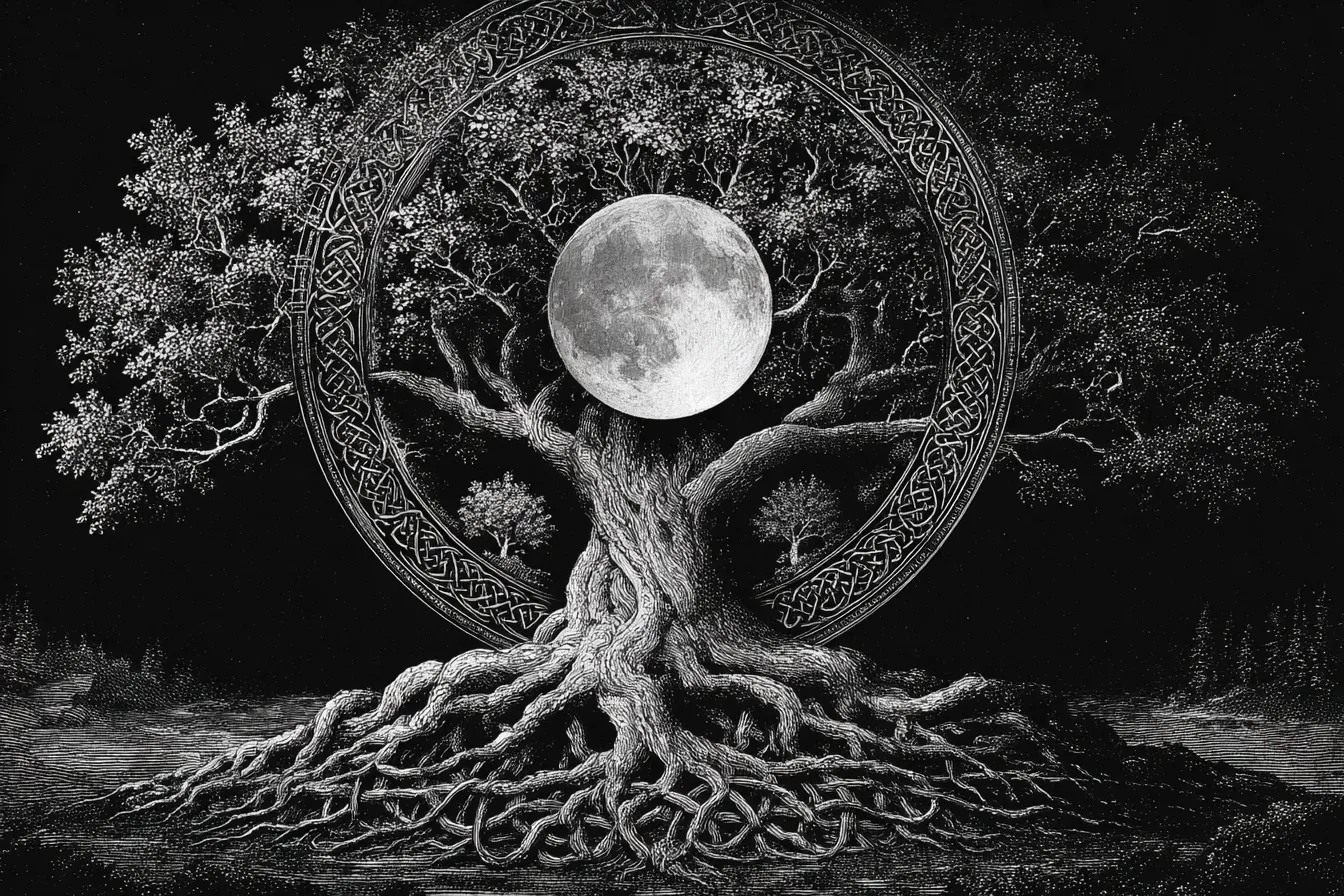
What is the Alder sign in Celtic astrology?
If your birthday falls between March 18 and April 14, the Celtic Tree Calendar places you under the Alder — the fourth tree, the builder of foundations in impossible terrain, the one who provides stable ground where none should exist. Its Ogham letter is Fearn (ᚄ), the fourth character in the ancient alphabet found carved on standing stones across Ireland and western Britain. The Alder arrives as the year tips past the equinox into genuine spring — but it is not the light, flowering energy of Beltane or the warmth of high summer. It is the energy of the first real establishment: not the Birch’s clearing and initiating, not the Rowan’s watching, not the Ash’s spanning reach — but the building of something that will hold, in ground that by rights should not support it.
The Celtic Tree Calendar links each of its thirteen lunar months to a specific tree, whose ecology, mythology, and role in the material life of Ireland and Britain becomes a framework for understanding those born within it. As in every article in this series: the calendar as widely practised today draws primarily from Robert Graves’s The White Goddess (1948), which synthesised genuine medieval Irish and Welsh material through Graves’s own interpretive lens. The Ogham alphabet itself is genuinely ancient, with inscriptions from the 4th through 8th centuries CE, and the symbolic associations have roots in real medieval textual sources. Modern Druidry and Celtic spiritual practice engage with this system as a living tradition, and The Whisper does the same — as a meaningful, historically grounded framework rather than a fixed revelation.
The Alder’s month begins three days after the spring equinox and runs through mid-April. The equinox has passed — the balance has tipped — and the year is now committed to its movement toward warmth and growth. The Alder’s task is not the tipping but the first real building in the new season’s ground.
The tree and its historical roots
The common alder (Alnus glutinosa) grows where other trees cannot: in waterlogged soil, along river margins, in the wet ground beside streams and floodplains that would drown an oak or rot a birch. The alder’s capacity to survive — and thrive — in saturated soil comes from a specific adaptation: its root system has evolved to function without the oxygen that other trees’ roots require. More remarkably still, the alder is one of very few trees that actively improves the ground it grows in. Its root nodules contain nitrogen-fixing bacteria, which convert atmospheric nitrogen into a form that plants can use. An alder does not merely survive difficult ground — it gradually transforms it into ground where other trees can eventually follow. This is the ecological reality behind the symbolic associations the tree carries.
The other remarkable property of alder is what happens to its wood underwater. Most timber, submerged for any length of time, will eventually rot. Alder does the opposite: submerged alder wood hardens. The foundations of Venice were driven into the Venetian lagoon on alder piles — some of them have stood for over a thousand years and are, if anything, harder now than when they were first placed. The old London Bridge, the medieval Amsterdam canal houses, the foundations of ancient Celtic lake dwellings — all of them relied on alder’s counterintuitive quality of becoming more durable in the conditions that would destroy ordinary timber. The Alder does not merely tolerate difficult conditions. It is made stronger by them.
Fearn means “alder” directly in Old Irish, and the tree holds a specific and significant place in Welsh mythology through the figure of Bran the Blessed (Bendigeidfran). In the Mabinogion’s tale of Branwen, the Welsh word for alder is gwern, and Gwern is also the name of Bran’s nephew — the child whose burning is the catastrophic act that breaks the peace and starts the war. Bran himself, the great king whose severed head remains oracular for decades, is associated with the alder’s protective and sacrificial qualities. When Bran’s army needed to cross the River Shannon to reach Ireland and there was no bridge, Bran waded into the water and became the bridge himself. The traditional saying associated with this act — a fo ben, bid bont, “he who would be chief, let him be a bridge” — goes to the heart of the Alder sign’s character: the willingness, and the structural capacity, to be the thing that makes crossing possible, at genuine cost to oneself.
The alder’s association with protection also appears in the Celtic literary record. Alder shields are mentioned in early Irish and Welsh poetry — the wood was considered to have protective properties, and its reddish-orange colour when freshly cut (the wood oxidises rapidly and appears to “bleed” on exposure to air) gave it associations with battle and the threshold between life and death. The alder’s catkins appear very early in spring, among the first of any native tree, releasing pollen before most other trees have leafed. The Alder arrives at the threshold and acts before the easier conditions that would make acting obvious.
The energy of Alder
The dominant quality of Fearn is the building of foundation in ground that does not look like it can support one. Not the Birch’s clearing of what is finished, not the Ash’s perception of what connects — the Alder’s quality is structural and sacrificial: the willingness to go into the difficult, waterlogged terrain and become the pilings that allow something else to stand.
This is not a glamorous quality. The foundation is invisible once the building is on top of it. The alder pilings under Venice are not celebrated by the people walking above them; the Venice canal houses are celebrated. The bridge that Bran became did not endure as a monument — it endured as a crossing. The Alder energy often operates in this hidden-infrastructure mode: the work is essential, the recognition is limited, and the foundation holds things up precisely by being beneath them.
The threshold quality of the alder is equally important: it grows at the exact boundary between water and land, between the element that drowns most things and the element that supports most things. The alder’s particular genius is not in avoiding the difficult boundary but in making it productive. Where water and land meet there is usually instability — the ground is neither firm earth nor open water, but a difficult in-between. The Alder does not resolve this instability by choosing a side. It puts its roots in the wet ground and its canopy in the air and becomes the living expression of the boundary itself.
There is something in the Alder energy that is specifically about early action in the new season. The alder is among the first trees to flower in spring — its catkins release pollen in late winter, before most trees have leafed, in conditions that are still cold and uncertain. This early action is not reckless; the alder is structurally suited to what it does. But it does not wait for spring to feel like spring before it begins. It acts in the early signs of warmth, in the threshold between what was and what is coming, before the establishment of conditions that would make action obvious. The Birch acts in the deepest cold; the Alder acts at the first turning, in the muddy, uncertain ground between winter and genuine spring.
Alder as a birth sign
As a birth sign, Alder describes a person whose particular gift is building something real in ground that others cannot use. Not the idealist who envisions what could be built in ideal conditions, not the pioneer who clears the ground and moves on — the Alder is specifically the one who looks at the waterlogged, difficult terrain and sees not its inhospitability but its potential, and begins to build.
People with strong Alder energy often find themselves in the structural roles that no one else wanted or could sustain: taking on the situation that was too difficult, the relationship that needed holding when others stepped back, the project that required building from unstable foundations. This is not martyrdom — the alder does not suffer in the wet ground, it thrives in it. But the Alder person’s natural orientation toward difficult, foundational work can mean that they spend significant portions of their energy in places and situations that do not reflect their contribution back to them. The pilings are under the building.
The hardening under pressure quality — what happens to alder wood when submerged — is one of the most significant aspects of the Alder sign and one of the least visible from the outside. The Alder person, in sustained difficulty, often does not deteriorate but actually becomes more capable, more dense, more structurally sound. They are not immune to difficulty; they feel it as fully as anyone. But the specific quality of sustained pressure over time tends to produce a hardening that is not brittleness — it is the increased density of wood that has been in water long enough to integrate the conditions rather than merely surviving them.
The bridge quality described in the Bran story is present in Alder people in a particular way. They often find themselves in the position of providing the crossing for others — the structural support that allows someone else’s movement, the holding of the difficult ground that makes it possible for something above to exist. The wisdom of Fearn involves recognising this function without being consumed by it: the bridge that allows the army to cross is valuable, but the bridge needs maintenance and cannot be indefinitely weight-bearing without cost.
The Alder month as a seasonal energy
In The Whisper, the seasonal dimension of the Alder applies to the calendar period of March 18 through April 14 as an energy active for everyone. The Alder season is the period of first establishment after the equinox’s balance: the year has tipped, the commitment to spring is made, and what now needs to happen is the building of actual, durable structure in the new season’s ground.
This is the season that distinguishes genuine spring from the mere promise of it. The Birch’s solstice energy was the turning of the light. The Rowan’s Imbolc was the first stirring. The Ash’s equinox held the balance. The Alder’s season is the first full expression of the year’s movement toward growth — and the specific quality it brings is foundational rather than flowering. The building before the beauty.
Seasonal position within the Alder month adds nuance to the birth sign. Those born in early Alder (March 18–25) carry the freshest equinox energy — they arrive at the very first moment of establishment, when the ground is still wet from the balance point. There is a quality of immediacy to early Alder: the action happens before the conditions feel hospitable, because the Alder does not wait for hospitable conditions. Those born in the heart of the Alder month (March 26–April 4) carry the foundation-building quality most fully expressed — this is the period of deepest Alder energy. Those born in late Alder (April 5–14) begin to approach the Willow threshold, and may find their foundational quality has a more flowing dimension — the foundation that also moves with what changes around it.
Strengths and growth edges
The strengths of the Alder are the strengths of genuine structural capacity. The ability to build something that holds — in conditions that look like they cannot support anything — is not a quality that can be performed or faked. It requires the specific combination of the alder’s properties: the tolerance for difficult ground, the nitrogen-fixing quality that actively improves the conditions over time, and the counterintuitive hardening under pressure that makes the Alder more capable in difficulty rather than less.
The Alder also carries the strength of early action under uncertainty. The catkins that release in late winter, before spring has established, are not naive about the cold — they are the expression of a structural readiness that does not require certainty before beginning. In practice, this manifests as the capacity to act in the early signs of a new situation, when others are still waiting for more confirmation, and to be structurally prepared for the conditions that will follow.
The growth edges are the shadow of the same qualities. The Alder’s orientation toward the difficult and the foundational can produce a pattern in which the Alder person consistently takes on the hardest ground while others build on it, without the explicit recognition that this arrangement is happening or an honest assessment of its costs. The nitrogen-fixing root system that enriches the soil is wonderful; the question is whether the Alder is also receiving what sustains it, or whether the improving is all flowing outward.
The bridge cost is real and specific. Bran became the bridge and the bridge did not survive the crossing undiminished. An Alder person in the bridge function — holding the connection, providing the structural support, being the thing that others cross — needs to be honest about the weight they are carrying. Not to refuse the function, but to understand it clearly enough to know when maintenance is required and when a particular crossing has extracted more than the structure can sustain without repair.
There is also the growth edge of remaining in the foundational role after it is no longer needed. The alder’s ecological role as an improver of waterlogged ground is essential in the early stages of a habitat — but once the soil has been enriched and other trees have established, the alder is eventually shaded out by what it made possible. An Alder person who is too identified with the foundational function can continue providing it past the point where it is needed, missing the moment when the new season has actually arrived and the hard ground has become something that can support a different kind of growth.
What people get wrong about the Alder sign
The most common misreading of the Alder sign is as a purely supportive or self-sacrificing quality — the one who holds everything up for others, the selfless bridge, the person whose needs come last. This reading reduces a complex structural quality to a social role and, in doing so, misses the most important thing about the Alder: it does not hold things up despite its needs. It thrives in the difficult ground. The waterlogged terrain is not a sacrifice for the alder — it is the alder’s home, the specific set of conditions in which the alder’s particular capacities are most fully expressed.
The distinction matters because the misreading often leads Alder people to understand their own capacity for difficult foundational work as a burden rather than as a genuine expression of their nature. The alder is not suffering under the buildings of Venice. The alder is doing what the alder does best. The question is not whether the foundational work is a burden but whether the Alder is in relationship with conditions — relationships, communities, practices — that reciprocate what is given.
The second common error is treating the Alder as a passive or reactive sign — the stable base that holds everything else, never moving itself. This misses the early-action quality entirely. The alder’s catkins are among the first to appear in spring. The Alder acts before the conditions are established, not after them. The Alder person is not waiting for others to initiate so that they can provide support — they are often the first mover into difficult ground, the one who acts in uncertainty because they can see the foundation that needs to be built before anyone else has perceived the need for it.
The third misreading is of the Alder as a straightforwardly protective or martial sign — partly because of the alder shield associations in early Celtic poetry and partly because the Bran story is a war story. The Alder’s protective quality is real, but its primary expression is structural rather than combative. The protection the Alder offers is the protection of the foundation: things built on Alder ground hold, because the ground has been transformed by the Alder’s presence. This is a longer, slower, more invisible protection than the warrior’s shield — and it is, in the end, more durable.
What Alder means in The Whisper
In The Whisper, when Celtic is active in your oracle stack and your birth sign is Alder, the system reads your day through the Fearn lens: the builder of foundations in difficult ground, the bridge that bears genuine weight, the threshold-dweller who transforms the conditions they inhabit rather than merely surviving them.
The Alder finds its closest resonance in Western Astrology with Aries, the sign that governs almost exactly the same calendar period. The overlap is genuine, and the resonance at first appears paradoxical: Aries is associated with fire, with the initiating spark, with the drive to be first and to move — qualities that seem at odds with the Alder’s patient, structural, foundation-building nature. But look more closely and the resonance becomes clearer. Aries is not merely impulsive; it is the sign of the first fire after the equinox, the earliest action in the new season, the movement into ground that is not yet warm or established. The Alder’s early action — the catkins before spring is confirmed, the piling driven into waterlogged ground before the building begins — is an Aries quality in its deepest form: not the impatience of someone who cannot wait, but the structural readiness of the one who acts first because they are made for early action. When the Whisper synthesis draws on both an Aries placement and an Alder birth sign, the reading often concerns the difference between initiating from excitement and initiating from genuine preparedness — the Aries fire burning through the wet ground the Alder has made habitable.
Runes offer a parallel in Ehwaz (ᛖ) — the horse rune, associated with partnership, with the carrying of one person by another, with the relationship between a rider and the horse that bears them forward. The runes are Norse and Germanic in origin, distinct from the Celtic Ogham tradition, but the parallel here is precise enough to be worth noting. Ehwaz describes the specific relationship of willing co-participation: not domination, not servitude, but the genuine partnership in which one being carries another because both benefit from the movement. This is the Alder’s bridge quality translated into a different symbolic vocabulary: the thing that provides the crossing does so not as victim but as partner in a shared purpose. When the Whisper synthesis draws on Ehwaz-resonant runic energy alongside an Alder birth sign, the reading tends toward the nature of the partnerships that currently require the Alder’s structural capacity — and whether those partnerships are ones of genuine reciprocity.
In BaZi, the Alder quality resonates strongly with Wu Earth (戊土) — the mountain earth, the stable, enduring, immovable quality of the great mass of land. Wu Earth in BaZi is the foundation that other elements build on and against: it does not yield readily, it accumulates rather than disperses, and its stability is the condition that makes growth possible in the surrounding landscape. The parallel with the Alder is not exact — the alder thrives in wet ground, while Wu Earth is associated with the mountain’s dry heights — but the structural quality is the same: both describe the capacity to be the stable underlying condition that other things depend on. When the Whisper synthesis draws on a Wu Earth day alongside an Alder birth sign, the reading often concerns the relationship between stability and growth — what is being held up, and whether what is being built on the foundation is worth the holding.
In Numerology, Fearn is the fourth Ogham letter, and the number 4 is the number of foundation in most Western numerological traditions — the square, the four walls, the solid structure that holds. This is perhaps the most direct correspondence in the Celtic sequence: the fourth letter, the fourth tree, the tree of foundation, and the number whose quality is foundation exactly. The 4 is associated with practicality, with building for the long term, with the willingness to do the invisible work that makes visible results possible. When The Whisper synthesis draws on a 4-resonant numerological day alongside an Alder birth sign, the reading is unusually coherent: both systems pointing toward the same quality of careful, structural, essential work that does not announce itself.
When multiple systems converge on the Alder quality — the foundation in difficult ground, the bridge that bears weight, the hardening under sustained pressure — The Whisper reads it as a signal about the relationship between capacity and cost. The alder can do what it does because it has the specific properties that the terrain requires. The question the synthesis raises is whether those properties are being used in ground that genuinely needs them, or whether the Alder’s capacity is being directed toward ground that has already been improved — whether the difficult terrain is the current terrain, or whether it is a story about the past that the Alder is still standing in.
Frequently asked questions
Q: Why is the Alder associated with Bran the Blessed in Welsh mythology? The connection runs through language as well as story. The Welsh word for alder is gwern, and Gwern is also the name of Bran’s nephew in the Mabinogion — the child whose death is the catastrophic centre of the Branwen story. Bran himself carries qualities that mirror the alder’s: the protective function that comes at great personal cost, the willingness to become the bridge, the structural sacrifice that allows others to cross. The alder’s wood was also associated in early Welsh and Irish poetry with shields and battle, and Bran is pre-eminently a warrior king whose protection extends to the point of self-sacrifice. The resonance between the tree’s properties — foundation in difficult ground, hardening under pressure, the transformation of waterlogged terrain — and Bran’s mythological character is direct enough to suggest a genuine cultural association rather than a forced one.
Q: The Alder month is mostly Aries in Western astrology — how do the two systems relate? Aries (approximately March 20 – April 19) and the Alder month (March 18 – April 14) overlap almost exactly. The resonance between them is real but not obvious at first, since Aries is associated with fire and impulse and the Alder with patient, structural foundation-building. The connection becomes clearer when you look at Aries in its deepest quality rather than its stereotype: Aries is the first fire of the new season, the initiating movement into ground that is not yet established, the action that precedes the confirmation of conditions. The Alder’s early-action quality — catkins before spring is confirmed, foundations driven into wet ground before the building begins — is Aries energy expressed through the structural rather than the martial. Both describe genuine readiness for early action in the new season’s uncertain terrain.
Q: Is the Alder sign particularly associated with leadership? The association with Bran and the saying a fo ben, bid bont — “he who would be chief, let him be a bridge” — gives the Alder a specific quality of leadership that is worth examining carefully. It is not the leadership of the one who commands from above, but the leadership of the one who provides the structural condition that allows others to move. This is a form of leadership that tends to be undervalued in cultures that celebrate visible authority over invisible infrastructure. The Alder sign does not describe the charismatic leader whose name is on the building — it describes the one whose work is the reason the building stands.
Q: What does it mean that alder wood hardens underwater — is this literally true? Yes, this is genuinely true. Alder timber, when kept submerged and away from air, resists decay far better than most woods and can actually increase in density over time. The mechanisms involve the absence of oxygen (which limits the activity of wood-degrading fungi) and the presence of natural compounds in the wood itself. The practical applications were well known in pre-industrial Europe: alder piles were used for the foundations of buildings in waterlogged urban environments including Venice, Amsterdam, and many Celtic lake-dwelling sites. This physical property is the direct source of the symbolic association — a material that becomes more durable in the conditions that would destroy ordinary timber is a genuine expression of what the Alder sign represents.
Q: My birth sign is Alder but I don’t feel like a “foundation builder” — is that possible? Yes, entirely. The Celtic Tree Calendar describes resonances and tendencies rather than fixed destinies. The Alder’s foundational quality can manifest in many different ways — not all of them visible as literal building or structural support. It may appear as the capacity for emotional steadiness in difficult circumstances, or as the tendency to stay present in situations that others find too uncertain or uncomfortable, or as a persistent orientation toward what is real and durable over what is convenient or impressive. If the Alder sign does not resonate immediately, The Whisper’s synthesis approach may find the Alder quality showing up more clearly in combination with other systems in your oracle stack than as a standalone description.