
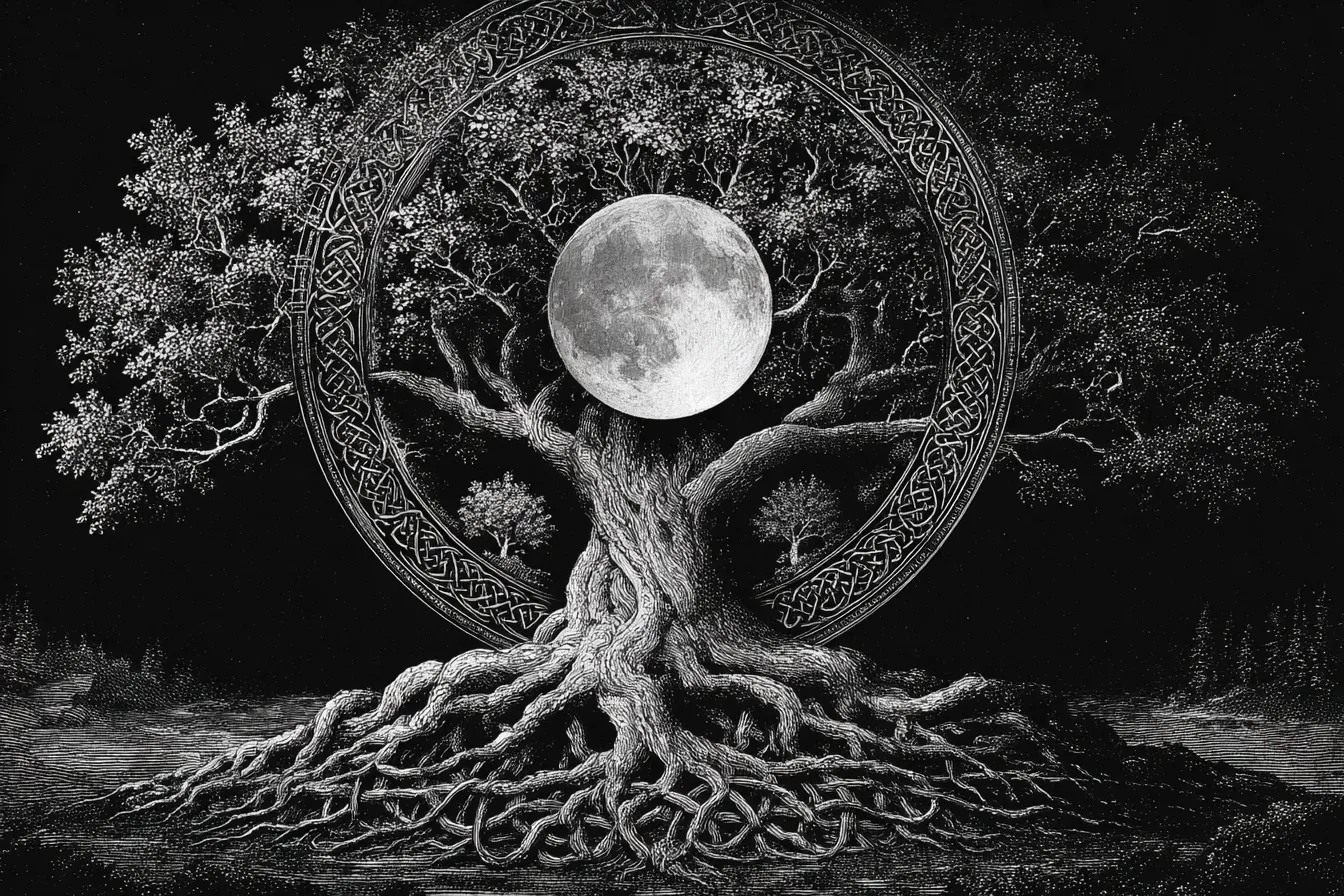
What is the Elder sign in Celtic astrology?
If your birthday falls between November 25 and December 23, the Celtic Tree Calendar places you under the Elder — the thirteenth and final tree, the cycle-closer, the one that holds the full knowledge of the year’s passage and does not flinch from any of it. Its Ogham letter is Ruis (ᚍ), the thirteenth and last character before the Celtic alphabet’s cycle returns to Beith and begins again. The Elder month contains the winter solstice — December 21 or 22, the longest night of the year, the darkest point before the light begins its long return — and it ends on December 23, the day before the Birch month begins and the new cycle opens. The Elder holds the darkness to its depth and then hands the year forward. This is its defining act.
The Celtic Tree Calendar links each of its thirteen lunar months to a tree whose ecology, mythology, and material life in Ireland and Britain becomes a framework for understanding those born within it. As in every article in this series: the calendar in its modern form draws primarily from Robert Graves’s The White Goddess (1948), synthesising genuine medieval Irish and Welsh sources through Graves’s interpretive lens. It is not a transcript of pre-Christian Celtic practice. The Ogham alphabet is genuinely ancient — stone inscriptions from the 4th through 8th centuries CE — and the symbolic associations draw on real medieval sources. Contemporary Druidry and Celtic spiritual practice engage with this as a living tradition. The Whisper does the same.
The Elder is the thirteenth. In most traditional counting systems, twelve is the number of the full cycle — twelve months, twelve hours, twelve zodiac signs, twelve members of a complete set. Thirteen is the number that exceeds the pattern, the extra moon that does not fit the calendar, the one that stands outside the neat completion and carries what the cycle cannot quite contain. The Elder sign carries this quality: not the culmination of the cycle in the sense of its highest point, but the wisdom that stands at its edge, that has seen the full passage, that holds what did not fit.
The tree and its historical roots
The common elder (Sambucus nigra) is one of the most ecologically significant and culturally complex native plants in Britain and Ireland. Some botanists classify it as a large shrub rather than a tree — its wood is pithy, hollow-stemmed, and too soft and brittle for structural timber, making it useless for the purposes that gave the oak, ash, and hawthorn their material cultural importance. The elder does not hold up buildings. It does not make bridges or wheel spokes or spear shafts. Its value lies elsewhere, in properties that are less immediately visible.
The elder’s ecological niche is revealing: it grows most readily in disturbed, nitrogen-rich ground — near old buildings, along field boundaries, in the disturbed soil of ruins and abandoned settlements. The elder is one of the characteristic plants of the places where human activity has been and moved on. Like the ivy, it finds its territory in what has been left behind. Unlike the ivy, it does not cover the ruin with living green — it stands alongside it, bare-branched and dark in December, carrying the accumulated history of the soil in its roots.
In June, the elder produces its distinctive flat-topped clusters of cream-white flowers — one of the most useful and widely used of any native British plant, genuinely medicinal with fever-reducing and antiviral properties documented in both traditional practice and modern pharmacology. In late summer, the flowers are replaced by the small, dark berries — elderberries — which are toxic when raw (containing sambunigrin, a cyanogenic glycoside, in the leaves, bark, and unripe fruit) but become genuinely medicinal when properly cooked. Elderberry preparations have been used in European folk medicine for centuries for their antiviral properties; modern research has found genuine pharmacological activity supporting traditional use. The elder is both dangerous raw and medicinal prepared — this specific duality is inseparable from its symbolic meaning.
The tradition in Britain and Ireland of not cutting or burning elder without permission is as deeply rooted as the hawthorn’s fairy tradition. Burning elder was said to bring the devil into the room, or to bring serious misfortune to the household. In some traditions, one must ask permission of the Elder Mother (or equivalent spirit) before cutting the tree, acknowledging its protective but also potentially wrathful presence. Like the hawthorn’s fairy associations, this tradition speaks to a genuine cultural recognition that the elder is not a neutral plant — it is one that has power, that requires acknowledgment, that cannot be treated as simple timber or fuel without consequence.
Ruis means “elder” in Old Irish, and the tree in Irish and Scottish tradition is associated most directly with the Cailleach — the divine winter hag, one of the oldest figures in the Gaelic mythological tradition. The Cailleach Bhéara (Irish), the Cailleach Bheur (Scottish), is the ancient goddess responsible for winter: she brings the cold, she creates the storms, she freezes the lochs with her staff, she holds the land in the grip of winter from Samhain through to Imbolc. She is not evil — she is the necessary force of the dark season, the cold that tests and in testing strengthens. She is ancient beyond reckoning: in some traditions she has lived through multiple cycles of the world’s creation and destruction, seen everything that has happened, and will persist into the next cycle as she persisted through all the previous ones. The Cailleach is the Elder’s divine form: the wisdom that has accumulated through so many turnings that ordinary calculation cannot contain it, the knowing that includes all the endings as well as all the beginnings.
The Elder and the solstice
The winter solstice — December 21 or 22 depending on the year — falls near the end of the Elder month, two days before the cycle closes and the Birch begins. This structural position is precise and important. The Elder does not arrive at the solstice as a beginning — it arrives as the culmination of the long descent into darkness that began at midsummer. Every tree from the Oak’s midsummer solstice peak has been part of the year’s arc toward this point. The Elder holds the darkest day not as a new beginning but as the full, complete expression of what the descent has been moving toward.
The solstice within the Elder month is structurally different from the solstice within the Oak month. The Oak’s midsummer solstice is the peak of the year’s light — the full expression before the turning. The Elder’s winter solstice is the full expression of the year’s darkness — the nadir before the turning. Both are turning points, but in opposite directions. The Oak knows that the light will turn toward darkness; the Elder knows that the darkness will turn toward light. The Elder holds the deepest point of the year’s night and, by holding it fully without flinching, enables the turning.
The night of the winter solstice is genuinely the longest night of the year — the hours of darkness exceed the hours of light by more than at any other point. There is something in the Elder’s quality that is specifically about holding the longest night. Not the Reed’s threshold opening, not the Ivy’s spiral approach — the Elder’s quality is the direct, fully present, unflinching holding of the maximum darkness. The Cailleach does not soften the winter. She brings it in its full force, because that is what winter is, and her wisdom is the wisdom of not pretending otherwise.
The Elder’s medicine: danger and healing
The specific pharmacology of the elder — toxic raw, medicinal prepared — carries one of the most precise symbolic correspondences in the entire Celtic tree series. The Cailleach’s wisdom is not comfortable wisdom. The Elder does not offer the Hazel’s accessible, warm, practical knowing, or the Willow’s flowing, lunar intuition. It offers the wisdom of having seen everything — including what is most difficult, most dangerous, most likely to be avoided. The elder berry must be cooked before it is safe; the elder’s medicine requires the transformation of fire before it becomes healing.
This is not a warning about the Elder sign’s people — it is a description of the specific quality of wisdom the Elder carries. The most genuinely useful knowledge the Elder holds is knowledge that has passed through fire: not theory about difficulty, not the comfortable recounting of hardship that has been thoroughly processed and made safe, but the direct, still-present knowing of what it means to have been in the longest night and to have held it. This knowledge heals. It is also not easy to be in proximity with, because it does not allow the pretense that the night is shorter than it is.
The transformative fire quality — the cooking that makes the toxic safe and the raw medicinal — is present in the Elder sign as the capacity to be the agent of transformation for what others bring to the threshold of what they cannot hold. The Elder person who has genuinely passed through their own longest nights carries a specific medicine that is not available to those who have not — and the medicine, when it is offered, requires the recipient’s own willingness to be in the heat of what the transformation requires. The Elder does not offer easy comfort. It offers genuine healing, which is different.
Elder as a birth sign
As a birth sign, Elder describes a person whose particular gift is the wisdom of having genuinely held the full cycle, including its darkest point. Not wisdom as a position to occupy or a credential to display — wisdom as the specific, functional knowing that comes from having been at the longest night and not flinched from it. The Elder’s wisdom is earned in a specific way: through passage, through the full circuit of the year’s arc, through the accumulation of what the cycle contains as it moves toward its nadir.
People with strong Elder energy often carry a quality that others experience as the weight of genuine knowing — something in their presence that is not immediately comfortable, that does not allow the maintenance of comfortable fictions about what the current situation is. The elder berry is toxic raw and medicinal cooked. The Elder person’s truth has the same property: it requires the willingness to be in its heat before it becomes the healing it actually is.
The Cailleach quality is present in Elder people as a specific relationship with winter — not the physical season only, but the winters of life: the periods of maximum darkness, loss, difficulty, and stripping-back that are the human equivalent of the solstice night. The Cailleach is not cruel; she is the force of what winter actually is. The Elder person who has developed this quality does not bring unnecessary difficulty — they hold what is genuinely difficult with the same directness the Cailleach holds winter: clearly, completely, without softening it into something it is not, and with the implicit knowledge that the turning is coming.
The cycle-completion quality of the Elder sign manifests in Elder people as a specific relationship with endings. They are often the ones in a group or a family who can hold the end of things — the deaths, the genuine closings, the acknowledgments that something has fully completed — with a presence that others find impossible. Not because they are invulnerable to loss, but because the Elder’s wisdom includes the knowledge of what endings actually are: not simply stoppings but the specific completion that generates the possibility of the Birch’s new beginning.
The number thirteen quality gives Elder people a specific relationship with the edge of the pattern. The thirteenth position is the one that does not fit the twelve-fold cycle — it is the extra, the one that stands outside the neat completion, the moon that upsets the calendar. Elder people often carry this quality: a consistent slight outside-ness, a difficulty fitting entirely within the existing pattern, a natural positioning at the edge of what the current cycle can contain. This is not a deficit. The elder grows in the nitrogen-rich soil of what has been left behind, in the disturbed ground of the threshold, in the places where the pattern has been broken. This is its territory.
The Elder month as a seasonal energy
In The Whisper, the seasonal dimension of the Elder applies to the calendar period of November 25 through December 23 as an energy active for everyone. The Elder season is defined by the approach to the solstice — the deepening into the year’s darkest period — and by the solstice itself, the longest night, the turning of the year.
The Elder season carries a specific invitation: the invitation to hold the longest night without either fleeing from it or pretending it is shorter than it is. December is the month in which many cultural traditions create maximum festivity and light as a response to the maximum darkness — the midwinter celebrations, the lights against the dark, the gathering of community in the coldest period. These responses are genuine and valuable. The Elder’s invitation is not to refuse them but to hold them in the context of the actual darkness they are responding to: to know what it is that the light is placed against, to understand the longest night fully, and then to bring the Birch’s new beginning from a place of genuine passage rather than of avoidance.
Seasonal position within the Elder month adds nuance. Those born in early Elder (November 25–December 4) arrive in the approach to the year’s deepest dark — the Samhain threshold has recently passed and the darkness is deepening. Those born in the heart of the month (December 5–15) carry the full Elder quality of the pre-solstice descent. Those born near the solstice (December 16–23) carry the Elder quality at its most precise: the knowing of the longest night, and the specific awareness that the turning is here. Born at the solstice itself is born at the exact moment the Elder’s work is complete and the Birch’s begins — the threshold between the end of the cycle and its new beginning.
Strengths and growth edges
The strengths of the Elder are the strengths of genuine cycle-wisdom — the knowing that comes not from having read about the full year’s arc but from having lived it, held it, and emerged from its darkest point still present. The capacity to be in the longest night without flinching — to hold what others cannot hold, to remain fully present in the difficulty that strips comfortable fictions away, to offer the medicine that requires fire to become medicine — these are rare and genuinely necessary qualities. Every community, every family, every organisation needs the Elder’s presence at the deepest threshold, the one who can hold the longest night.
The medicine quality is a related strength: the specific healing that is available from someone who has genuinely been in the darkness and returned. This is not the healing of comfort or reassurance — it is the healing of genuine witness, genuine company in what is hardest, genuine knowledge of what the passage actually requires. The elder berry properly prepared is genuinely antiviral; the Elder’s wisdom properly received is genuinely healing.
The growth edges follow directly. The Elder’s wisdom of the longest night can become the inability to allow the morning. The Cailleach holds winter, and the quality of holding winter is genuinely necessary — but the Cailleach also releases it at Imbolc, when Brigid’s flame begins its return. The Elder who is so identified with the darkness, so authoritative about the longest night, can find it difficult to make room for the Birch’s new beginning when the turning has genuinely come. The cycle completes; the Elder’s function is to enable the new beginning, not to prevent it.
The weight of genuine knowing can become the unwillingness to allow others their own passage through their own winters. The Elder who has held many longest nights and carries the accumulated wisdom of the full cycle can move too quickly to the knowledge of what the passage requires, bypassing the other person’s genuine need to be in their own darkness on their own terms. The Cailleach brings winter; she does not rush the traveller through it. The Elder’s wisdom is most healing when it accompanies rather than circumvents.
The thirteen quality — the outside-the-pattern positioning — can become the permanent exile from the pattern. The elder grows at the edge of human settlement, in the disturbed ground of what has been left; this is its territory and its gift. But the edge requires the centre to be meaningful. The Elder person who has made the outside-the-pattern position into a permanent identity — who has ceased to move between the edge and the centre — has lost the specific quality of the threshold that makes the Elder’s wisdom available to those who need it.
What people get wrong about the Elder sign
The most common misreading of the Elder sign is as straightforward darkness or morbidity — the sign of endings, the one associated with death and the solstice and the Cailleach’s cold, read as a sign whose primary quality is difficulty or suffering. This misses the most important aspect of the Elder: it holds the darkness in order to enable the turning. The Cailleach does not merely bring winter — she holds it until the precise moment of Imbolc’s release, when Brigid’s flame returns. The Elder’s quality is not darkness for its own sake; it is the willing, full, complete holding of the darkest point as the specific act that enables the new beginning. The Elder is the last tree before the Birch. Its function is to complete the cycle and hand it forward.
The second common error is treating the Elder’s wisdom as inaccessible or intimidating — the ancient, incomprehensible crone whose wisdom is real but whose form is too frightening to approach. This reflects a misunderstanding of what crone wisdom actually is. The Cailleach is frightening in the way that winter is frightening — genuinely powerful, genuinely capable of serious consequence, genuinely requiring respect. She is not cruel, not arbitrary, not withholding her wisdom from those who approach with genuine need. The Elder’s medicine, properly received, is genuinely healing. The intimidating quality is the rawness — the berry before cooking — and the cooking is the willingness to be in the heat of what the truth actually is.
The third misreading treats the Elder as the sign of the defeated or the worn out — the one who has been through too much, who carries too much, who is tired by the weight of the full cycle. This misreads what the Elder’s age means. The Cailleach’s antiquity is not exhaustion; it is the specific depth of knowing that comes from having been in every season of many cycles, from carrying the full weight of what each turning contains. The Elder is not tired by the longest night. It is specifically equipped for it. The wood is pithy and hollow, yes — but it is the hollow that makes the medicine, the pithy core that holds the berries, the structure that endures in the nitrogen-rich soil of the threshold.
What Elder means in The Whisper
In The Whisper, when Celtic is active in your oracle stack and your birth sign is Elder, the system reads your day through the Ruis lens: the crone wisdom at the cycle’s end, the full holding of the longest night before the turning, the medicine that requires fire to become healing, the thirteen that stands at the edge of the pattern and carries what the cycle cannot quite contain.
The Elder’s calendar month falls almost entirely within Sagittarius in Western Astrology — Sagittarius runs from approximately November 22 through December 21, and the Elder month (November 25–December 23) sits within it from beginning to the very final days, when Capricorn begins at the solstice. The Sagittarian quality of the philosophical wanderer who has ranged widely and returned carrying the understanding that only genuine ranging produces — this resonates with the Elder’s crone wisdom, but the resonance requires careful handling. The Sagittarian quality is characteristically adventurous — oriented toward the next horizon, the next expansion, the philosophical perspective gained from covering a wide territory. The Elder’s wisdom is characteristically accumulated — oriented not toward the next horizon but toward the full depth of what the complete circuit of all the horizons has produced. Where Sagittarius tends toward the generative expansion of inquiry, the Elder tends toward the distilled completion of inquiry. The convergence of a Sagittarius placement and an Elder birth sign in The Whisper’s synthesis tends toward the relationship between the ranging and the return — what the wide wandering has genuinely produced, and whether the full weight of that production is being drawn on.
The brief Capricorn overlap for those born in the final days of the Elder month (December 22–23) adds a different resonance: the Capricorn quality of serious, structural, winter-born initiation — which resonates so directly with the Birch that will follow — already beginning to appear in the Elder’s final days, the new cycle preparing beneath the surface of the old one’s completion.
Runes offer a direct and powerful parallel in Hagalaz (ᚺ) — the hailstone rune, associated with the necessary disruption that breaks what needs breaking before new growth can come, with the chaos of genuine winter that is not merely unpleasant but genuinely and specifically clearing. The runes are a Norse and Germanic tradition, distinct from the Celtic Ogham, but Hagalaz’s quality — the hailstone that falls with force, breaks what is brittle, and melts into the water that enables spring growth — is the Elder’s quality expressed through the northern European winter’s most striking meteorological event. Hagalaz is not gentle; it is the rune that arrives without warning and strikes what is exposed. But what it strikes was already unable to hold through winter; the hailstone reveals the brittleness rather than creating it, and its melting provides the water for what genuinely survives. When The Whisper synthesis draws on Hagalaz-resonant runic energy alongside an Elder birth sign, the reading is often one of concentrated clarity: two systems pointing at the same quality of the winter’s honest reckoning, the stripping back that is the condition of genuine new growth. The reading tends toward the question of what genuinely survives the honest winter, and what has been revealed by the cold to have already ended.
In BaZi, the Elder quality resonates with Ren Water (壬水) at the depth of its fullest winter expression — the maximum yin, the point at which yang water has reached the nadir of its containment before the inevitable return. In the BaZi understanding of the seasonal cycle, deep winter Ren Water carries an enormous reservoir of potential that has not yet found its expression — the yang seed within the maximum yin, the turning that is already prepared beneath the surface of the darkest point. This is the Elder’s quality exactly: the solstice night is the longest, and within it the year has already turned. The maximum darkness contains the seed of the returning light. When The Whisper synthesis draws on a deep-winter Ren Water day alongside an Elder birth sign, the reading tends toward the specific quality of what is already turning within the darkness — the seed of the Birch’s new beginning that is genuinely present in the Elder’s fullest holding of the longest night.
In Numerology, Ruis is the thirteenth Ogham letter, and the number 13 carries a specific quality that is different from its popular reputation. Thirteen is the number that exceeds the twelve-fold cycle — the thirteenth moon that does not fit the solar calendar, the extra that upsets the pattern. In many folk traditions, 13 is associated with transformation, with the breaking of the pattern that allows a new pattern to begin, with the threshold figure who stands at the edge of the cycle and holds what the cycle itself cannot contain. This is the Elder’s position exactly: the thirteenth tree, the one that does not fit the twelve-fold pattern, the sign that carries what the cycle cannot quite contain within its twelve orderly positions. When The Whisper synthesis draws on a 13-resonant numerological day alongside an Elder birth sign, the reading tends toward the relationship between the pattern and what it cannot contain — what stands outside the neat cycle, what holds the knowledge the cycle requires but cannot include, what must be acknowledged before the new beginning can be genuinely new.
The Elder is the last. After it, the Birch begins again. The cycle does not end at the Elder — it completes. The completion is not a stopping but a handing forward: the Elder holds the darkness to its depth, through the solstice’s turning, and on December 23 it releases the year to the Birch. What the Elder has held through the longest night — the full accumulated wisdom of the complete cycle, the medicine prepared by the fire of every season’s passage — is what the Birch carries into the ground of the new beginning. The Birch pioneers into the bare ground of January; the Elder is why the ground is bare, and why bare ground is exactly what is needed.
When multiple systems converge on the Elder quality — the crone wisdom, the longest night held without flinching, the medicine that requires transformation to become healing, the thirteen that stands at the cycle’s edge — The Whisper reads it as a signal about the relationship between the ending and the beginning it enables. The Elder does not merely close the cycle. It is the specific, irreplaceable act of closing that makes the opening possible. The question the synthesis raises is whether what has genuinely completed is being held in its completion — fully, directly, without the premature rush to the new beginning that skips the Elder’s work — and whether the medicine the longest night has produced is being offered at the moment and in the form that makes it genuinely healing.
Frequently asked questions
Q: Why is it considered bad luck to burn elder in British and Irish tradition? The tradition of not burning elder — or of asking the Elder Mother’s permission before cutting it — is documented across Britain and Ireland and appears in folk records from the medieval period onward. Like the hawthorn’s fairy associations, it reflects a genuine cultural recognition that the elder is a plant of particular power and consequence that cannot be treated as neutral material without acknowledgment of its nature. The specific explanations vary regionally — the devil entering the room, the household encountering serious misfortune — but the underlying recognition is consistent: the elder is a boundary plant, growing at the threshold between human settlement and what lies beyond it, associated with forces that require respect rather than casual use. The Whisper treats this tradition as a genuine cultural inheritance that speaks to the elder’s real qualities, rather than as superstition to be discarded.
Q: Is elderberry genuinely medicinal, or is this folk belief? Both the folk tradition and the modern pharmacological research agree that elderberry preparations have genuine medicinal properties, primarily antiviral. The berries contain high concentrations of anthocyanins and other compounds that have demonstrated activity against several respiratory viruses in laboratory and clinical studies. The important caveat is that the raw berries, leaves, and bark of the elder contain sambunigrin, a cyanogenic glycoside that is toxic when consumed in significant quantities. The traditional preparation — cooking the berries before consuming them — breaks down the toxic compound and preserves the medicinal ones. The folk wisdom of preparing rather than eating raw is pharmacologically correct, which is one of the reasons the elder’s dual quality (dangerous raw, medicinal prepared) is not merely symbolic but literally true.
Q: Is the Cailleach a specifically Irish or Scottish figure? The Cailleach is primarily an Irish and Scottish Gaelic figure, with her most extensive mythological development in those traditions. The Cailleach Bhéara of Irish tradition is associated with the Beara Peninsula in County Cork and with extreme longevity — she has lived through the reigns of seven successive husbands, each of whom she has outlasted. The Cailleach Bheur of Scottish Gaelic tradition is associated with the wild winter landscape of the Highlands and with the specific act of striking the ground with her staff to prevent spring’s arrival. Both figures share the core quality: the ancient, powerful, winter-holding force that is not evil but is genuinely formidable, that holds winter in its full force and will release it only at the proper time. The Elder’s association with the Cailleach is a resonance in the modern Celtic astrology tradition rather than a directly attested ancient text, but it is grounded in the elder’s genuine seasonal position and in the genuine qualities the Cailleach’s mythology describes.
Q: The Elder month contains the winter solstice — how does this relate to the Birch, which begins at Christmas? The structural precision of this is worth appreciating. The Elder month ends on December 23 — two days after the winter solstice (December 21 or 22) — and the Birch month begins on December 24. The Elder holds the solstice within its month rather than handing the year over at the solstice itself. This means the Elder does not merely witness the turning — it holds it, contains it, and continues for two full days after the year has turned before releasing the cycle to the Birch. The Birch begins not at the solstice but after the Elder has held the turning and ensured that what has genuinely completed is complete. December 24 — the Birch’s first day — is the day the light is genuinely, measurably longer than it was the day before the solstice. The Elder’s work is done; the Birch’s work can begin.
Q: What does it mean that the Elder is the thirteenth tree? The number thirteen has accumulated associations with misfortune in several Western traditions, but its deeper quality is the number that exceeds the twelve-fold cycle — the extra moon that does not fit the solar calendar, the one that upsets the pattern. In this older understanding, thirteen is not simply unlucky; it is the number of transformation, of the threshold-breaker, of what stands outside the neat completion of twelve and carries what the cycle cannot contain. The Elder as the thirteenth tree is the sign that holds what cannot fit within the twelve orderly positions — the wisdom that exceeds the pattern, the knowing that the cycle has produced but cannot itself contain. The Elder’s position at the end of the cycle is not an afterthought; it is the specific position required to hold the knowledge that the full circuit has accumulated and that the next Birch beginning will need.