
There’s a word that appears constantly in conversations about astrology, tarot, and divination — and almost every time it appears, it’s being used incorrectly.
That word is synchronicity.
People use it to mean roughly “a meaningful coincidence”: you were thinking about an old friend and they called; you pulled a tarot card that perfectly described your situation; your birth chart said “a period of transition” the week you actually changed careers. These moments feel significant. They feel like the universe winking at you. And we reach for Jung’s word — synchronicity — as the philosophical permission slip to take them seriously.
But Jung’s actual argument was more specific, more rigorous, and considerably stranger than that. Understanding what he really meant doesn’t reduce the power of these experiences — it deepens it. And it has direct consequences for what it means to use a divination system at all.
What Jung Actually Argued
Carl Jung introduced synchronicity as a formal concept in his 1952 essay Synchronizität als ein Prinzip akausaler Zusammenhänge — “Synchronicity: An Acausal Connecting Principle.” He had been developing the idea for decades before that, partly in dialogue with the physicist Wolfgang Pauli, whose collaboration gave the concept an unusual scientific seriousness.
The central claim is this: there exists a principle of connection between events that is acausal — meaning it operates outside the normal chain of cause and effect — but is nonetheless real and meaningful. Two events are synchronistic when they occur together in a way that carries meaning for the observer, without any causal relationship between them.
Jung was careful about what he was and wasn’t claiming. He was not saying that your thoughts caused the phone call, or that the cosmos arranged the tarot card. He was not arguing for magic in the sense of one thing reaching across space to influence another. He was arguing for something harder to categorize: a principle of meaningful connection that doesn’t work through causation at all.
He called this an acausal connecting principle — a phrase worth sitting with. Connection without causation. Two things belonging together not because one produced the other, but because they share a common meaning at a particular moment in time.
The I Ching Problem
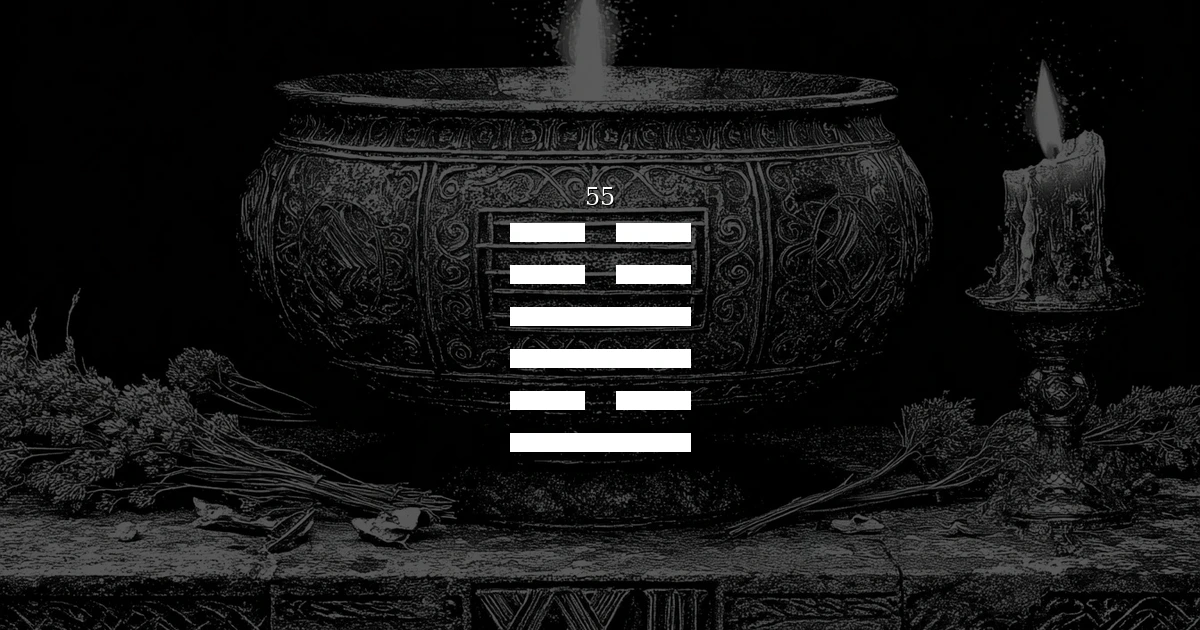
Jung’s engagement with the I Ching is central to understanding synchronicity, and it’s often the clearest illustration of what he meant. He spent decades consulting the I Ching, wrote a famous foreword to Richard Wilhelm’s translation, and took the hexagrams seriously as a thinking tool — not as prediction, but as something harder to name.
The I Ching works by introducing randomness: you throw coins or yarrow stalks, get a number, and look up the corresponding hexagram. The text you read is not related to your question by any causal mechanism whatsoever. And yet, Jung noted, the hexagram that appears has an uncanny tendency to be relevant — to speak to the actual situation in ways that feel specific rather than generic.
Jung’s explanation was not that the coins “know” anything. His explanation was that the moment of throwing — the precise configuration of coins at that instant — belongs to the same moment as the question being asked and the inner state of the person asking. The coins, the question, the psychological situation, and the resulting hexagram are all expressions of the same moment. They fit together not because one caused the other, but because they are all facets of the same instant in time.
This is the key to why The Whisper uses a seeded, deterministic method for I Ching and tarot readings — generating hexagrams and cards from your birth date and today’s date rather than random chance. The logic is Jungian: the meaning comes from the convergence of who you are (your natal data) and this specific moment (today). No randomness required; the fit is already there.
You can explore how this logic shapes The Whisper’s approach to the I Ching at /divination/i-ching/i-ching-daily-oracle/.
The Distinction That Gets Lost
The word synchronicity has drifted in popular usage to mean something like “the universe sending me a message.” This is not what Jung meant, and the difference matters.
When people say “that was synchronicity,” they usually mean: a coincidence occurred, and it felt meaningful, therefore it was arranged for me. There’s an implicit agent in that framing — something doing the arranging, something intending the message. It slides easily into magical thinking of the straightforward kind, where external events are being directed toward you by some intelligence.
Jung’s concept deliberately refuses that framing. There is no arranger. There is no agent. Synchronicity, in his model, is a property of reality itself — a tendency for meaning to cluster in time, regardless of whether any intelligence is orchestrating it. It’s closer to a physical principle, like gravity, than to a divine intervention.
This is a more difficult idea, and it’s easy to see why it gets flattened into something simpler. But the flattened version loses something important: it lets you be passive. If the universe is sending you messages, you receive them. Jung’s version requires more from you. If meaning clusters around moments in your life without being arranged for you, the act of reading that meaning becomes something you are actively doing — a cognitive and psychological act, not a reception.
The distinction between meaning-as-given and meaning-as-made is explored in more depth at /philosophy/meaning-vs-causation-divination/.
Pauli, Physics, and the Stranger Implications
Jung’s collaboration with Wolfgang Pauli — one of the founders of quantum mechanics — was not accidental. Jung was genuinely interested in whether synchronicity had any grounding in the physics of the mid-20th century, and Pauli was interested in the psychological dimensions of scientific observation.
Their joint publication, The Interpretation of Nature and the Psyche (1952), placed Jung’s synchronicity essay alongside Pauli’s work on the influence of archetypal ideas on the formation of scientific theories. The pairing is suggestive: both men were circling the same problem from different directions. How does the inner world of the observer — their expectations, their psychic states, their frameworks — relate to what they observe? Quantum mechanics had made this question inescapable in physics. Jung was arguing it was inescapable in psychology too.
This doesn’t mean Jung was claiming quantum physics explains synchronicity. He was more cautious than that. He thought the discovery of non-local correlations in physics (what Einstein dismissively called “spooky action at a distance”) was at least suggestive that the strict causal-materialist picture of reality was incomplete — that there might be room, at some level of description, for the kind of acausal connections he was pointing at.
It remains speculative. What it isn’t is naive.
Archetypes and the Collective Unconscious
Synchronicity cannot be fully understood without understanding what it’s operating on. For Jung, synchronistic events don’t arise between just any two random occurrences. They arise between outer events and inner psychological states — specifically, states of heightened emotional or archetypal activation.
An archetype, in Jung’s framework, is a universal pattern of experience that exists in the collective unconscious — the layer of psychic structure shared across all humans, beneath the personal unconscious. Archetypes are not images; they are structural tendencies that produce images. The archetype of the Threshold, the Trickster, the Great Mother, the Hero — these organize experience in characteristic ways.
Jung observed that synchronistic events cluster around moments of archetypal activation — when someone is at a significant turning point, under intense psychological pressure, or in a state where a deep archetypal pattern is constellating. The more charged the inner situation, the more likely meaningful outer coincidences become.
This is why divination tends to feel most accurate at life’s inflection points. It’s not (necessarily) that the system is more accurate then. It’s that the observer is more attuned — more psychically activated, more capable of recognizing patterns that were always there. The meaning finds you because you’ve become, temporarily, more permeable to it.
What This Means for Reading Systems
If Jung is right — or even interestingly half-right — it reframes what divination systems are doing. They are not mechanisms for extracting objective information about causal futures. They are instruments for inducing the right psychological state to engage with the synchronistic field.
This is a charitable but non-magical account. The I Ching doesn’t know your situation. But the act of asking it a question — formulating the question carefully, casting the coins with attention, sitting with the hexagram rather than skimming it — produces a psychological state in which meaningful pattern recognition becomes possible. The system creates the conditions; you provide the meaning.
This is also why the specificity of a reading matters more than its objective accuracy. A generic statement that fits everyone (“a period of change is approaching”) produces no synchronistic resonance because it requires no active meaning-making. A specific statement that could fit only your actual situation forces you to engage — to bring yourself to the text, to decide whether this is speaking to you or not. The friction is the feature.
Western astrology’s transit readings, BaZi’s daily pillar shifts, Nine Star Ki’s annual and monthly cycles — all of these function, on a Jungian reading, as frameworks for directed attention. They tell you what to look for. And what you look for, you notice. Whether that noticing is “really” synchronicity or just selective attention is, in the end, a question about what we think meaning is.
More on how different systems handle this question of attention and timing: /philosophy/i-ching-questions-not-orders/.
The Honest Assessment
Jung’s synchronicity is one of the most intellectually serious attempts to account for a class of experiences that most of modern thought simply dismisses. That seriousness is worth preserving against the casual way the word gets used.
It is not a scientific theory in the modern sense — it doesn’t generate testable predictions that could falsify it, and Jung never claimed it did. It’s closer to a phenomenological description: here is a class of experience, here is a structural account of what might be happening, here is why we can’t reduce it to coincidence without losing something real.
What it offers, practically, is permission of a specific kind. Not the permission to believe that the universe is arranging events for you — that’s the misuse. The permission to take your own meaning-making seriously. To notice that certain moments carry a particular weight. To engage actively with frameworks that organize attention rather than waiting for the universe to deliver messages addressed to you personally.
That is a harder practice and a more honest one. It puts the work where it belongs — inside the reader, not in the stars.
Jung’s engagement with the I Ching is covered in depth in /philosophy/synchronicity-jung-explained/. For a broader look at how meaning and causation relate in divination, see /philosophy/meaning-vs-causation-divination/.