
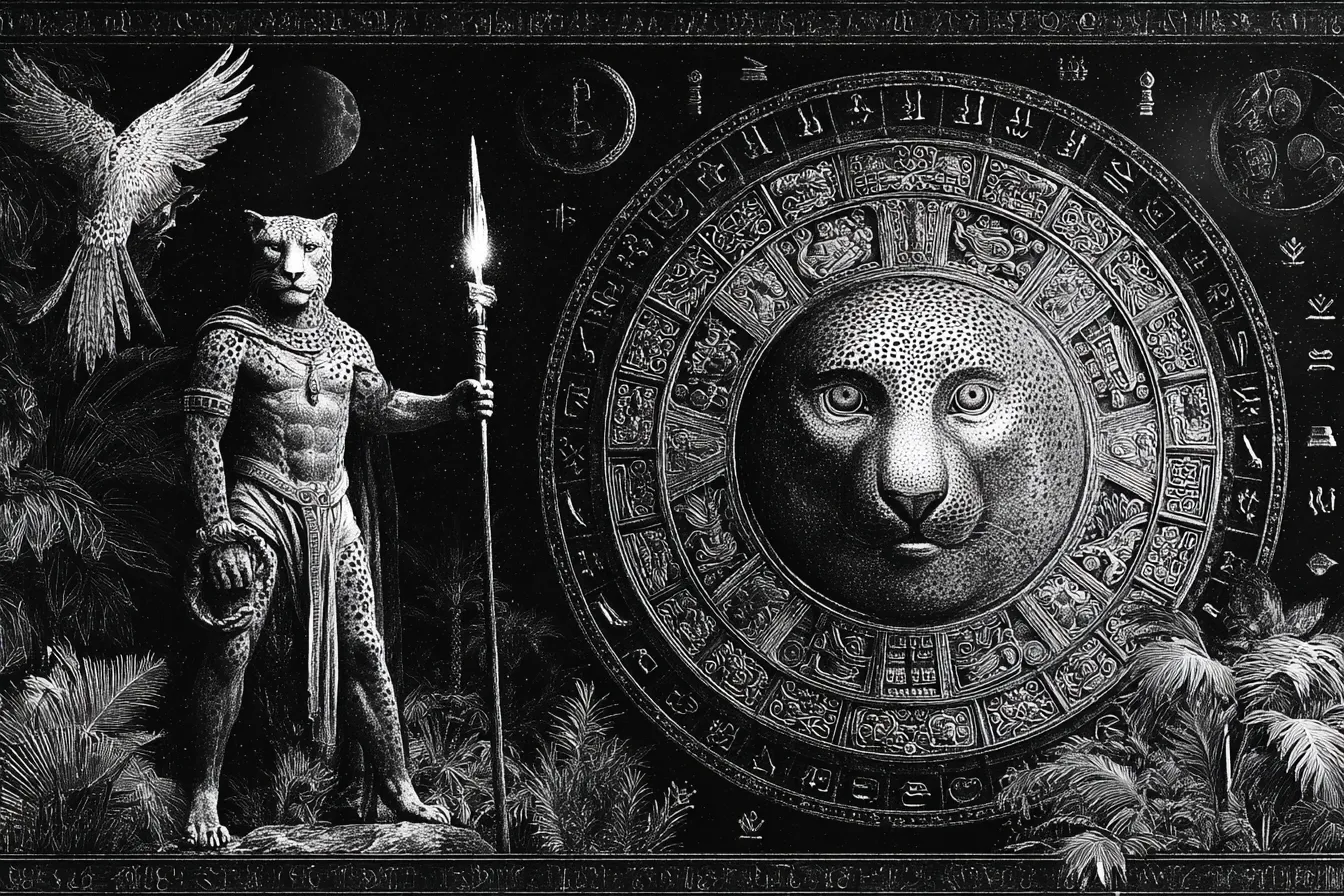
Most people who encounter Mayan astrology encounter the Tzolkin — the 260-day ceremonial calendar with its 20 Solar Seals and 13 Galactic Tones. What many don’t know is that the Maya ran a second calendar simultaneously, the Haab, and that the relationship between the two calendars is what produced one of the most sophisticated timekeeping systems in human history.
Understanding the Haab, and how it interacts with the Tzolkin, gives you a significantly more complete picture of how Mayan time worked — and how a civilization without writing systems for the first two thousand years of its calendar tradition managed to track astronomical cycles with extraordinary precision.
What the Haab Is
The Haab is the Maya’s 365-day solar calendar — a civil and agricultural calendar that tracks the solar year rather than the ceremonial cycle. Where the Tzolkin’s 260 days have no direct astronomical correspondence (or rather, correspond to several astronomical and biological cycles simultaneously), the Haab’s 365 days approximate the solar year closely enough to be useful for agricultural planning and seasonal ceremony.
The Haab is organized into 18 months of 20 days each, plus a 5-day period at the end called Wayeb (also written Uayeb). The math: 18 × 20 = 360, plus 5 = 365. The 18 named months are:
Pop — the beginning, the mat. Pop 0 (the first day of Pop) was the Haab new year. The beginning of each new Haab year was a major ceremonial occasion.
Wo — the black conjunction. Associated with frogs and rain, heralding the agricultural season.
Sip — the red conjunction. Associated with hunting and the red deer.
Sotz — the bat. Associated with underworld beings and the cave.
Sek — sky and earth combined. A transitional month.
Xul — the end. Associated with dogs and the transition of the agricultural cycle.
Yaxkin — new/first sun. Associated with the sun at its turning point.
Mol — water. Associated with rain-calling ceremonies.
Chen — black storm / well. Associated with the black sky and underground water.
Yax — green/new. Associated with Venus as morning star.
Sak — white/clear. Associated with the white/pale season.
Keh — red deer. Associated with the deer and the forest.
Mak — enclosed/covered. Associated with the end of the rainy season.
Kankin — yellow sun. The dry season.
Muwan — the owl/clouds. Associated with the owl and rain.
Pax — the planting time. The period associated with planting drums.
Kayab — turtle. Associated with the turtle constellation.
Kumku — granary. The final full month, associated with grain and thunder.
Wayeb — the five unnamed/unlucky days. The five-day period following Kumku before the new Haab year began.
The Wayeb was considered a liminal and inauspicious period in Maya tradition — the days when the normal order of the year was suspended. During Wayeb, Maya tradition held that the gates between the worlds were open and ordinary protective structures were weakened. Ceremonies during Wayeb focused on protection, on closing the old year safely, and on preparing for the new year’s beginning.
Your Haab Birthday Position
Your position in the Haab is expressed as a day number within a named month — for example, 4 Pop or 12 Yax. Every person born on the same Gregorian date shares the same Haab position. The Haab position describes which month’s energy you entered at birth and where within that month’s 20-day cycle your birthday falls.
Classical Maya date-reading used the Haab position to understand the agricultural and seasonal context of a birth — which month’s patron deity governed the period, what the seasonal quality was, and how the month’s energy interacted with the birth day’s Tzolkin Kin.
The Haab birthday position is less individualized than the Tzolkin Kin as a birth reading tool — with 365 positions over a solar year, more people share each Haab position than share each Tzolkin Kin. The Haab’s primary power is less in birth reading and more in its interaction with the Tzolkin through the Calendar Round.
The Calendar Round: 52 Years of Unique Days
The Calendar Round is what happens when the Tzolkin and Haab run simultaneously. Because 260 and 365 share no common factor greater than 5, the two calendars cycle together through 260 × 365 ÷ 5 = 18,980 unique day combinations before they return to the same combination. 18,980 days is approximately 52 solar years.
This 52-year cycle is the Calendar Round — and it was one of the most significant time units in Mesoamerican civilization. For the Maya and Aztec, 52 years was roughly equivalent to what we call a generation: the approximate span of an adult working life. The completion of a Calendar Round (a complete cycle of every possible combination of Tzolkin and Haab days) was a major ceremonial event, associated with the renewal of the world.
The Aztec New Fire Ceremony (Toxiuh Molpilli — the binding of years) was held at the end of every Calendar Round. All fires were extinguished; all hearths were emptied; people awaited the dawn in darkness. When the Pleiades star cluster reached zenith at midnight, signaling the continuation of the solar cycle, a new fire was kindled on the chest of a sacrificed individual on the Hill of the Star outside Tenochtitlan. From that new fire, runners carried flame to every temple and household throughout the empire. The world had been renewed for another 52 years.
The stakes were real for the people performing this ceremony. In their cosmological understanding, the failure of the New Fire would mean the end of the current world — the sun would not rise. The Calendar Round’s completion was an existential threshold, not merely an anniversary.
The Long Count: Extending Beyond the Calendar Round
The Calendar Round’s 52-year cycle solved most practical timekeeping needs — most events in a person’s life or within a generation’s memory could be located within a Calendar Round. But the Maya also needed to record events across multiple Calendar Rounds — to describe events that happened 200 or 1,000 years ago without ambiguity about which 52-year cycle was meant.
The Long Count was the Maya’s solution. Rather than cycling, the Long Count is a linear count of days from a fixed starting point — now correlated to around August 11, 3114 BCE in the Gregorian calendar (under the GMT correlation). Every day in history has a unique Long Count position, expressed as a series of units that roll over like an odometer.
The Long Count’s largest commonly used unit is the Bak’tun — approximately 394 solar years. Thirteen Bak’tuns complete what some interpretations read as a major world-age cycle. The completion of the 13th Bak’tun on December 21, 2012 generated the “Mayan apocalypse” narrative in popular culture — which actual Maya scholars and contemporary Maya communities largely regarded with a mixture of amusement and frustration. The end of the 13th Bak’tun was a completion, not a termination — like the completion of a Calendar Round, it was the end of one cycle and the beginning of the next.
The Haab and Tzolkin in Agricultural Context
The Haab’s 365-day solar structure made it the primary calendar for agricultural and seasonal planning. The Tzolkin’s 260-day cycle, while not directly keyed to the solar year, mapped to the interval between maize planting and harvest in the Mayan highlands (approximately 260 days in the right climate zones) and to several other agricultural rhythms.
Running both simultaneously meant that the Maya had two complementary lenses on the timing of agricultural activities. The Haab told you what month of the solar year it was — whether you were in the rainy season or the dry season, which agricultural activities were appropriate to the current period. The Tzolkin told you the ceremonial quality of the specific day — whether today’s energy was suited to the particular activity being planned.
This dual-calendar approach to timing was deeply pragmatic. No single calendar served all purposes. The Tzolkin alone would lose track of the seasons over time; the Haab alone would lack the ceremonial specificity for day-to-day decision-making. Together, they provided a complete temporal framework that was simultaneously astronomical, agricultural, and ceremonial.
What The Whisper Does with the Haab
The Whisper includes your Haab position as part of your Mayan calendar profile. Your Haab birthday month is one of the inputs that shapes the Mayan layer of your daily reading — specifically in the context of the current Haab date and how it relates to your birth position.
The Haab’s contribution to the daily synthesis is primarily seasonal and contextual: it describes the quality of the current period in the solar year’s cycle and its relationship to where you entered the world’s seasonal rhythm. The more individualized, ceremonial layer of the Mayan reading comes through the Tzolkin Kin — the 20 Solar Seals and 13 Tones in their specific combination. The Haab is the seasonal context; the Tzolkin is the ceremonial signature.
Together — as they were always meant to be used — they give you both the temporal location in the solar year and the qualitative signature of the day. The Calendar Round is the ancient technology that holds them both.
Frequently Asked Questions
What are the Wayeb days and should I be concerned about them? Wayeb is the five-day period at the end of the Haab year, traditionally considered inauspicious in Maya culture — a liminal time when the usual protections of the yearly cycle were suspended. In traditional Maya communities, Wayeb was a time for prayer, for avoiding new initiatives, and for protective ceremony. The modern equivalent is probably best understood as a period for reflection and closure rather than active beginning — not threatening, but better suited to ending than starting. If your Gregorian birthday falls in the Wayeb period of the Haab year, your Haab birthday position is one of the five Wayeb days, which carries its own specific liminal quality.
How does knowing my Haab position add to my Tzolkin reading? The Haab position contextualizes your Tzolkin Kin within the solar year’s rhythm. Two people born on different Gregorian dates might have the same Tzolkin Kin (if their birth dates fall on the same Kin in different years) but different Haab positions — meaning the same ceremonial signature entered the world in different seasonal contexts. The Haab provides the agricultural and seasonal layer that the Tzolkin’s ceremonial cycle doesn’t include.
Is the Haab still used today? Yes, among some Maya communities, particularly in Guatemala. The Haab’s traditional year beginning (0 Pop) is still celebrated in some communities, and the Calendar Round’s 52-year completion is still understood as a significant event. The Tzolkin is more widely used in contemporary Maya practice for day-keeping and ceremonial purposes; the Haab tends to function more as cultural heritage and agricultural reference. Both survive as living traditions, not merely archaeological artifacts.