
Mayan Astrology Has Almost Nothing to Do With What You Think
When most people hear “Mayan calendar,” they think of one thing: the end-of-the-world predictions that swirled around 2012. That calendar — the Long Count — was a linear record of vast historical cycles, something closer to a geological timescale than a personal horoscope. It had nothing to do with individual human beings.
The calendar that Mayan astrology actually uses is different. It’s called the Tzolkin (alternatively spelled Tzolk’in), and it’s 260 days long. It doesn’t predict apocalypses. It doesn’t track planetary positions. It’s a cycle of day-energies, and it’s been used continuously — not as a historical artifact but as a living practice — in parts of Guatemala and southern Mexico from before the Common Era to the present day.
The Tzolkin gives you two things: a Day Sign and a Tone. Together, they form your Mayan birth profile. This guide explains what both mean, how the system works, and why it describes human personality in ways that Western astrology doesn’t reach.
What the Tzolkin Actually Is
The Tzolkin is the product of two interlocking cycles running simultaneously.
The first cycle contains 20 named Day Signs (also called solar glyphs or nawales). The second contains 13 numbered Tones. These two cycles run concurrently: each day has both a Day Sign and a Tone. Since 20 and 13 share no common factors, they don’t repeat the same combination for 260 days — at which point the entire cycle begins again.
The result is 260 unique day-energies, each carrying a distinct quality. When you were born on a specific day, you were born into one of those 260 positions. That position gives you your Day Sign and your Tone.
The number 260 is not arbitrary. It corresponds closely to the human gestation period. The K’iche’ Maya — one of the primary contemporary keepers of the calendar — understand the Tzolkin as fundamentally a human calendar: the rhythm of human life rather than astronomical time. This is worth sitting with. Most astrological systems are geocentric or heliocentric. The Tzolkin is, in a meaningful sense, anthropocentric.
The 20 Day Signs
Each Day Sign carries a set of energies, a social function, and a set of characteristic traits. These are not sun signs in the Western sense — they don’t correspond to months or seasons. They cycle through continuously, every 20 days, throughout the year.
What follows is a working description of each, based on the interpretive traditions maintained by contemporary Maya daykeepers (aj q’ij) and comparative scholars. These are not fixed definitions; the tradition has regional variations and the understanding of each sign is considered to deepen over a lifetime of practice.
Imix (Crocodile / Caiman) — The first day sign. Primordial, creative, generative. Imix people have enormous creative energy that needs channeling or it becomes chaotic. Strong connection to the feminine, to water, to the origin of things. Often powerful but hard to live with.
Ik’ (Wind / Breath) — The energy of communication and spirit. Ik’ people are messengers — of ideas, of change, of what needs to be said. They can be inconsistent, like the wind. When they’re aligned, they’re visionary. When they’re not, they’re scattered.
Ak’bal (Night / Darkness / House) — The interior world. Ak’bal people are dreamers, intuitives, and people who do their best work in the quiet hours. They’re often misread as introverted or mysterious, but they’re actually processing at a depth that more outward types simply don’t access.
K’an (Seed / Net) — Abundance, potential, the moment before growth. K’an people are collectors and cultivators of possibility. They tend to accumulate — knowledge, relationships, resources — and the question their life poses is what they’re actually going to do with it all.
Chikchan (Serpent) — Primal life force, embodiment, sexuality, kundalini energy in some interpretations. Chikchan people have intensity. They’re often physically compelling, passionate, and capable of deep transformation. They can also be consuming — of others’ energy and their own.
Kimi (Death / Ancestor) — Transformation, endings, the ancestor connection. Despite the name, Kimi is not a dark or unlucky sign. It’s the energy of profound transition. Kimi people have a particular relationship to mortality — often calm about it, often drawn to work that involves endings, healing, or the unseen.
Manik’ (Deer / Hand) — Service, healing, travel. Manik’ people are often healers of one kind or another. They have a quality of gentle presence and are frequently drawn to work with animals, with the body, or with communities in movement. They are reliable in a way that’s easy to underestimate.
Lamat (Star / Rabbit / Venus) — Harmony, play, abundance. Lamat is associated with Venus and with the energy of celebration and fertility. Lamat people are often naturally joyful — sometimes so apparently light that their depth is missed. They have a real gift for bringing people together.
Muluk (Water / Moon) — Emotion, fluidity, the emotional body. Muluk people feel things at a scale that others don’t. This is their power and their challenge in equal measure. When their emotional intelligence is developed, they’re profoundly empathetic. When it isn’t, they’re reactive and easily overwhelmed.
Ok (Dog) — Loyalty, guidance, the heart’s compass. Ok people are fiercely devoted to whoever and whatever they’ve committed to. They are natural guides — often people turn to them for direction, for moral clarity, for the sense that someone knows the way.
Chuwen (Monkey / Howler Monkey) — Creativity, play, artistry, the trickster. Chuwen people are often genuinely gifted artists, storytellers, or comedians. They have the trickster quality: they can say the thing that’s true but unsayable, wrapped in humor. The shadow side is a difficulty with seriousness and sustained effort.
Eb (Road / Grass) — The long path, the pilgrimage, the journey of human life. Eb people have a quality of carrying — the weight of their lineage, their community, their own history. They are often quietly wise, and their wisdom is the earned kind. Not always easy to live with, because the road is not always easy.
Ben (Reed / Corn Stalk) — Authority, the sky road, the connection between earth and heaven. Ben people are often natural authorities — not because they seek power, but because they naturally occupy the role of the one who holds the center. Teachers, leaders, pillars of community. The challenge is the weight of what others project onto them.
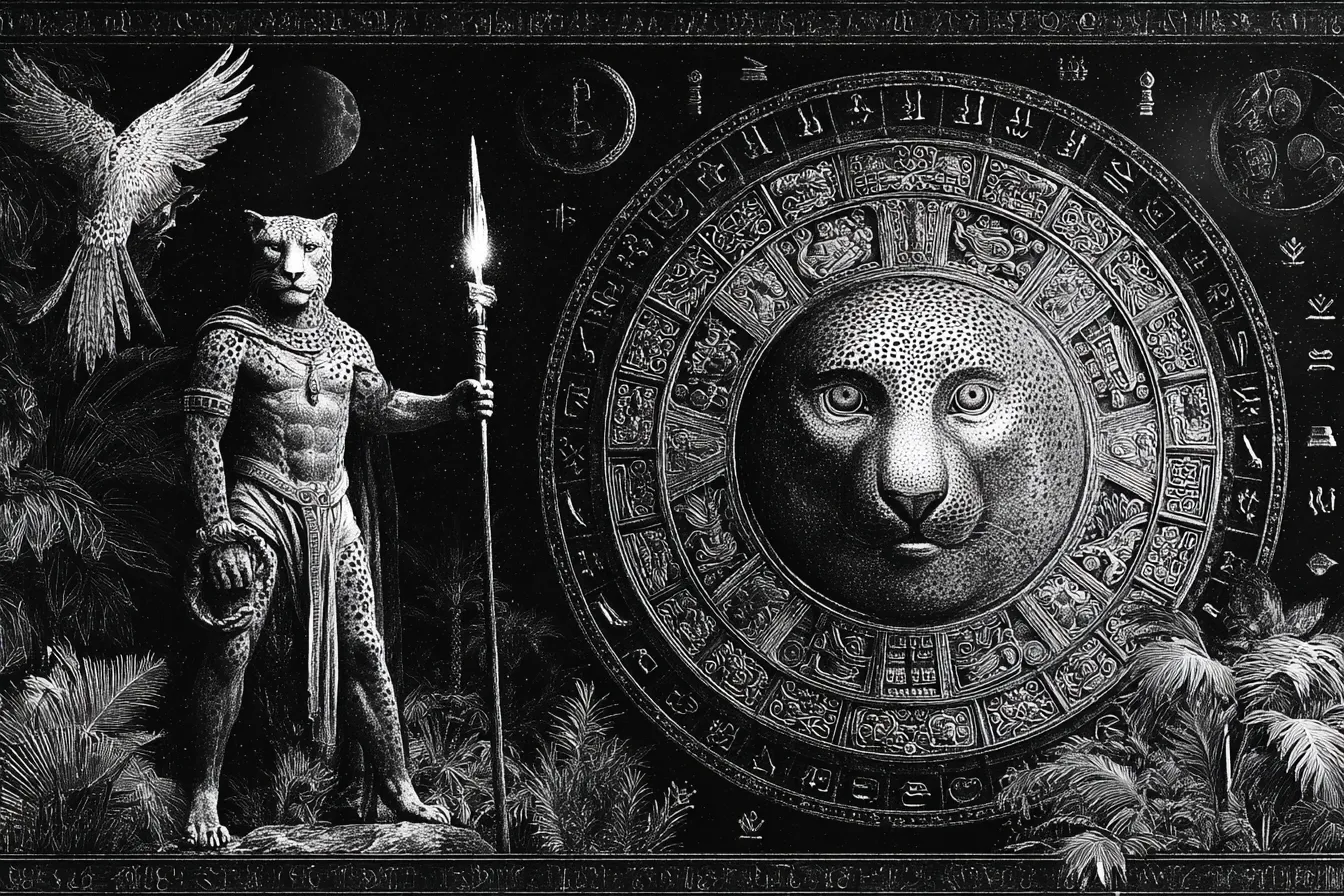
Ix (Jaguar / Wizard) — Feminine power, the earth, shamanic intelligence. Ix people have access to something that rational frameworks don’t easily describe. They’re perceptive in a way that goes beyond the ordinary. The jaguar sees in the dark. Ix people often have a gift for what’s hidden.
Men (Eagle) — Vision, altitude, the larger perspective. Men people see farther than most. They have genuine gifts of foresight and systemic thinking. The difficulty is that altitude requires distance, and distance can feel like coldness to the people who need them present.
Kib (Vulture / Owl / Wax) — Purification, ancient wisdom, the work of clearing what’s finished. Kib people have an affinity with what needs to be released — old patterns, dead weight, things that have outlived their purpose. They are often underestimated, and often the ones who do the work that makes everything else possible.
Kaban (Earth / Earthquake) — The living earth, intelligence, synchronicity. Kaban people have a quality of being in the right place at the right time that isn’t luck — it’s attunement. They think well, move well, and often have a gift for understanding how systems actually work.
Etznab (Flint / Mirror / Obsidian) — Clarity, truth, the cutting edge. Etznab people can see through things. They’re often uncomfortably direct, not from cruelty but from a genuine inability to pretend. This is their gift. The mirror shows what’s actually there.
Kawak (Storm / Thunder) — Purification through intensity, community, the feminine aspect of the cosmos. Kawak people are often catalysts. Things happen around them. They have a quality of drawing out what’s hidden — in situations, in people, in themselves.
Ajaw (Sun / Flower / Lord) — The last and the fullest. Completion, enlightenment, celebration. Ajaw people carry a quality of solar clarity. They’re often teachers of the most fundamental kind — not of techniques but of how to live. The shadow is the weight of that role when it’s not consciously inhabited.
The 13 Tones
If the Day Sign is what you are, the Tone is how you embody it.
The 13 Tones are numbered 1 through 13, and each carries a set of qualities that modulate the Day Sign. Two people born as Ik’ — but with different Tones — will express Wind energy very differently. One may broadcast it loudly; another may filter it through endurance; another through collaboration.
Here are the 13 Tones and their core qualities:
| Tone | Name | Core Quality |
|---|---|---|
| 1 | Unity | Beginning, purpose, raw potential |
| 2 | Duality | Polarity, relationship, challenge |
| 3 | Activation | Movement, electricity, communication |
| 4 | Stability | Form, foundation, definition |
| 5 | Empowerment | Core, radiance, command |
| 6 | Equality | Balance, flow, organic rhythm |
| 7 | Resonance | Attunement, the mystical center |
| 8 | Integrity | Harmonization, modeling, alignment |
| 9 | Intention | Pulse, realization, forward movement |
| 10 | Manifestation | Perfection of form, completion |
| 11 | Liberation | Dissolution, release, fluidity |
| 12 | Cooperation | Universalization, synthesis |
| 13 | Transcendence | Ascension, the leap beyond form |
Tone 7 — Resonance — sits at the center of the 13-tone cycle and is often considered the most mystically potent. Those born on a Tone 7 day are sometimes described in K’iche’ tradition as natural channels: people whose life function is to serve as a conduit for something larger than themselves.
Tone 1 and Tone 13 bookend the cycle: one is pure beginning, one is pure transcendence. Neither is better. They’re different relationships to the energy of the Day Sign they carry.
Reading Your Combined Sign
Your Mayan birth profile is always expressed as [Tone] [Day Sign] — for example, 4 Ak’bal or 11 Lamat or 7 Ben.
The Tone modifies the Day Sign in a specific way. A 1 Chikchan carries the raw, unmediated intensity of Serpent with nowhere to go yet — pure potential that needs direction. A 10 Chikchan carries that same intensity in its most fully manifested, structured expression — someone who has learned to work with and through their power rather than being consumed by it.
Learning to read your combined sign is not a five-minute project. Contemporary daykeepers in Guatemala spend years — sometimes decades — developing fluency with the Tzolkin. What you can do with a starting profile is begin to notice: does this resonate? Where does it describe something true? Where does it seem off, and is that because the description is wrong, or because it’s describing something you haven’t yet claimed?
The Tzolkin is, in the end, a diagnostic framework. It doesn’t tell you what will happen. It points at something about the quality of energy you carry and the particular work that energy wants to do.
The Tzolkin and The Whisper
The Whisper integrates the Tzolkin as one of the 15 divination frameworks in its daily synthesis. This means your Mayan Day Sign and Tone are active ingredients in the reading you receive each day — contributing alongside your BaZi Day Master, your I Ching hexagram, your Nine Star Ki number, and the other frameworks.
What makes this integration meaningful rather than merely additive is that the Tzolkin cycle moves independently of the Western calendar. Your daily reading draws on a different day-energy within the 260-day cycle than it did yesterday, and that shift genuinely changes what aspects of your birth profile become most relevant on any given day.
The Whisper doesn’t flatten these differences into a single “message.” The point is exactly that these systems were developed independently, in different parts of the world, by people with different questions. When they point at the same thing from different angles, that convergence is worth paying attention to. When they diverge, that tension is often where the most interesting insight lives.
Your Mayan profile is available in the app when you enter your full birth date. If you’re new to the system and want a broader orientation to how multi-system synthesis works, What Is BaZi? and the I Ching daily oracle guide are good companion reads — they cover systems that, like the Tzolkin, were developed entirely outside the Western astrological tradition and have a very different logic for how time and identity interact.
The 260-day calendar has been maintained continuously for at least two millennia. It survived the conquest, survived centuries of suppression, and is currently experiencing a genuine cultural renaissance among Maya communities. Something that survives that long, through that much disruption, is probably doing something worth understanding.