
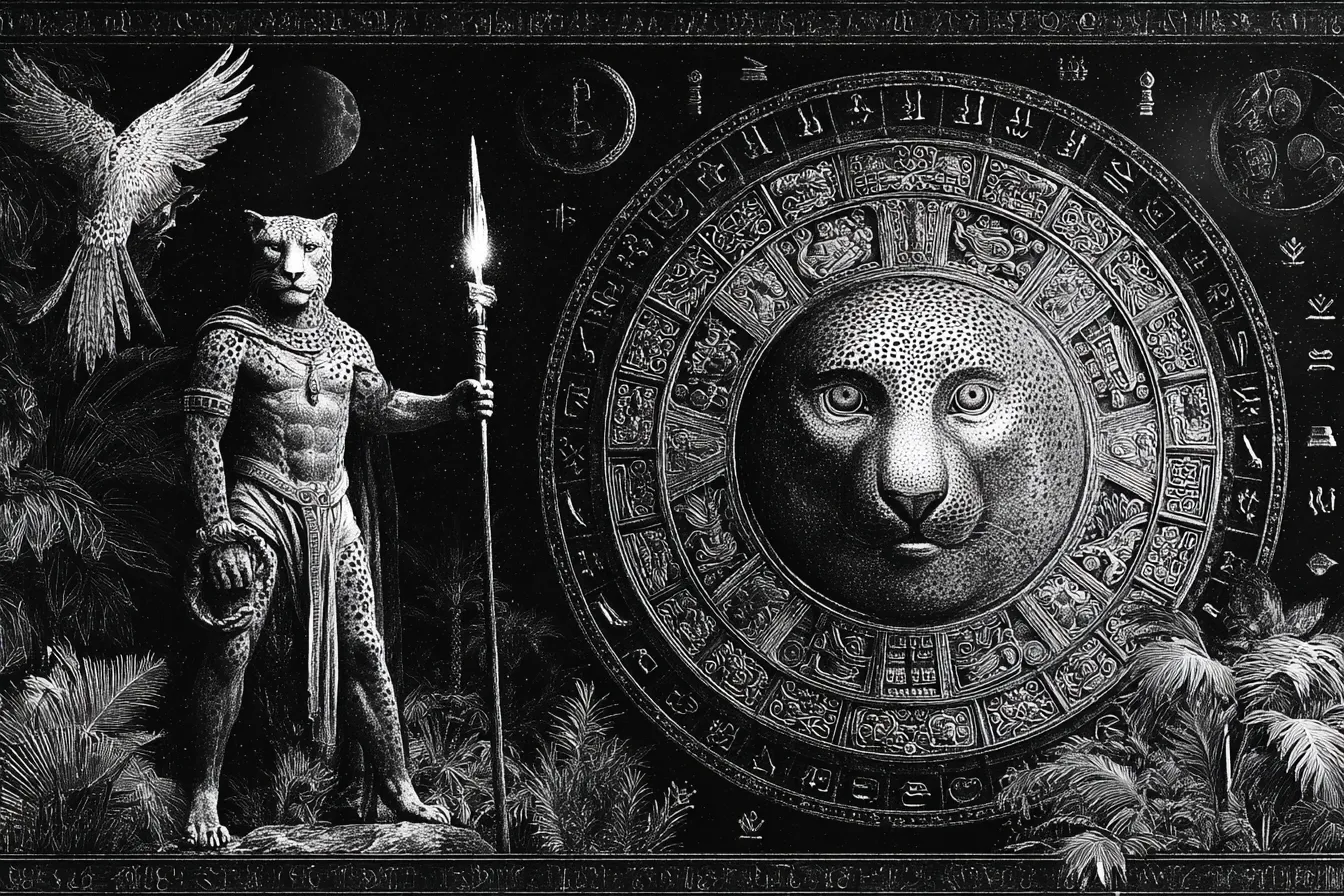
What is Cimi?
Cimi is the sixth of twenty Solar Seals in the Mayan Tzolkin — the 260-day sacred calendar built from twenty day signs cycling through thirteen numbered tones, producing 260 unique combinations called Kin. The Tzolkin has been in continuous use among Maya peoples for at least 2,500 years and remains a living tradition today. Ajq’ij — Maya day keepers and ceremonial priests — continue to guide communities through the Tzolkin cycle in Guatemala and southern Mexico, where the Chol Q’ij (the K’iche’ Maya name for the calendar) is woven into both ceremonial and everyday life. Engaging with Cimi means engaging with a tradition that has never been interrupted and continues to be carried by living communities.
The Whisper integrates the Tzolkin alongside Western Astrology, Nine Star Ki, and BaZi into a single daily personal insight. Your birth seal is calculated by placing your birth date within the Tzolkin cycle using the GMT correlation constant (584283) — the most widely accepted scholarly alignment between the Maya Long Count and the Gregorian calendar. Many English-language tools for discovering a “Mayan day sign” are based on the Dreamspell system developed by José Argüelles in 1987, which applies a different correlation and sometimes different seal names, and which can produce a different result for the same birth date. The Whisper uses the traditional GMT correlation throughout. In addition to your birth seal, the daily seal marks the current day’s shared position in the Tzolkin cycle, the same for everyone worldwide, and The Whisper synthesizes both with the other active systems each day.
Cimi arrives sixth in the cycle. The first five seals traced the movement from primal ocean (Imix) through animating breath (Ik), interior depth (Akbal), encoded potential (Kan), and embodied life force (Chicchan). Now, at the sixth position, the Tzolkin introduces the seal of death and transformation. This is not an interruption of the cycle’s logic but its necessary continuation: the life force that has been established must eventually encounter the threshold that teaches it what genuinely matters. Cimi is that threshold.
The symbol and its traditional roots
The glyph associated with Cimi in Maya iconography depicts the death’s head — the skull, which in Maya artistic and ceremonial tradition is not a symbol of horror or ending but of the passage between states and of the equalizing force that all living things share. In Maya culture, death was not conceived as the opposite of life but as its constant companion and necessary counterpart — the other face of the same reality, present throughout life and expressing most visibly at its completion.
The Worldbridger quality that gives Cimi its English name reflects this understanding directly. The bridge between worlds is not a one-way passage but a crossing point — a place where what has been released in one world becomes available in another. The Maya understanding of death as a transition rather than an ending is embedded in the Tzolkin’s entire cosmological structure, in which the soul’s journey through the underworld is not punishment but a necessary passage that enables rebirth. Cimi governs the quality of that passage: the capacity to stand at the threshold between what has been and what will be, and to cross it with awareness.
The equalizing quality of death is another traditional dimension of Cimi that the Maya tradition emphasizes. Death is the one experience that does not discriminate — the great lord and the humble farmer, the skilled warrior and the young child, all cross the same bridge. This equalizing force is not cruel in the Cimi tradition; it is clarifying. In the presence of genuine ending, the things that genuinely matter become unmistakably visible. Cimi carries this clarifying intelligence as one of its primary qualities — the capacity to see what is essential precisely because the non-essential has been or is being released.
In the Aztec Tonalpohualli, the corresponding day sign is Miquiztli — Death, carrying identical imagery and broadly similar associations. In Aztec cosmology, Miquiztli was associated with Tecuciztecatl, the moon god, whose monthly dying and rebirth modeled the cycle of transformation that Cimi represents. The lunar association adds a quality of rhythmic, cyclical transformation — death not as finality but as one phase in an ongoing cycle of release and renewal. The moon does not die once; it releases its fullness, passes through darkness, and returns renewed. This frames the Cimi quality not as a dramatic singular threshold but as a repeating, reliable capacity for transformation through release — a rhythm that can be lived with rather than feared.
The color associated with Cimi is White, and the direction is North — the direction the Tzolkin associates with the mind’s clarifying and refining quality. White seals carry qualities of clarity, discernment, and the refinement that separates what is essential from what is not. Cimi as a White/North seal brings this clarifying, refining quality to its transformative nature: the death that clarifies, the release that refines, the ending that reveals what was essential all along by removing everything that was not.
The energy of Cimi
The traditional meaning of Cimi centers on transformation through release — the quality of genuine ending that clears the way for something genuinely new. This is not transformation in the sense of gradual change or iterative improvement; it is the more radical transformation of the threshold, where what is released is genuinely gone and what comes next is genuinely different. The Worldbridger builds the bridge between these states, and the bridge can only be crossed in one direction at a time.
The Tzolkin tradition is careful to distinguish between Cimi’s transformative quality and mere change or loss. Not every ending carries Cimi’s quality — only the endings that involve genuine release, genuine surrender to something larger than the personal will, genuine crossing of a threshold from which return is not available. This distinction is important for understanding how Cimi energy tends to feel in practice: there is often a quality of irreversibility in genuine Cimi moments that distinguishes them from ordinary change. Something has genuinely ended; something genuinely new is now possible that was not possible before.
Surrender is a central Cimi quality that the Tzolkin tradition approaches with particular care. The surrender associated with Cimi is not passivity or defeat; it is the active, conscious release of what cannot be held — the willingness to let go of what is genuinely finished so that the passage to what is next can be made cleanly. This requires the kind of courage that is different from Chicchan’s vital, instinctive courage; it is the courage of the person who has genuinely assessed what is present and recognized that holding on is no longer serving life. The Worldbridger’s gift is precisely this capacity for conscious, clean release.
The equalizing intelligence of Cimi also expresses as a particular clarity about what genuinely matters — a quality that tends to be especially accessible in the presence of genuine endings. When something important has ended, or when the possibility of ending is genuinely present, the things that are truly important tend to surface with unusual clarity. Cimi energy in the Tzolkin tradition is associated with this clarifying presence — the capacity to see what is essential precisely because the non-essential has been or is being released.
There is a related quality of standing at thresholds that Cimi carries beyond its own personal experience of transformation. The Worldbridger is specifically the one who can stand at the crossing point and assist others in their passage — who is not destabilized by proximity to endings, who can be genuinely present to someone else’s process of release without needing to resolve or fix it. This threshold quality is one of Cimi’s recognized strengths and one of its most distinctive contributions.
Cimi as a birth seal and daily seal
As a birth seal, Cimi in the Tzolkin tradition is associated with the person who carries the equalizing, transformative, threshold-standing quality as their primary orientation — someone whose relationship to endings and transitions tends to be unusually clear and whose capacity to assist others through major life changes is often a distinctive strength. The birth tone modifies how this expresses: a person born on Cimi with Tone 3 carries the transformative quality with a more rhythmic, activated energy; someone born on Cimi with Tone 10 may carry it with a more manifesting, grounded quality.
People born under Cimi are traditionally associated with a particular freedom that comes from genuine release — the quality of someone who has learned, through the nature of their own seal energy, that holding on to what is finished costs more than releasing it. This tends to express as a certain lightness and practicality about endings that others, who carry more attachment-oriented seal energies, may find both admirable and difficult to understand. The Worldbridger has crossed enough bridges to know that what lies on the other side is real.
The Tzolkin tradition also notes an association between Cimi and genuine priority awareness — the capacity, sharpened by the equalizing intelligence of the death seal, to distinguish between what genuinely matters and what merely feels urgent or important in the moment. People with Cimi as a birth seal often carry a quality of long-term clarity about values and priorities that is not easily disrupted by short-term pressures.
As a daily seal, when Cimi appears as the current day’s position in the Tzolkin cycle, the tradition suggests a quality of transformative opening — a day when genuine release may be more accessible than usual, when the things that are ready to end may be more clearly visible, and when the courage required for conscious, clean crossing of thresholds may be more available. A Cimi day is not a day to fear but a day that tends to support the kind of honest reckoning with what is genuinely finished that enables real movement forward. The Whisper synthesizes this quality with the other active systems to produce the specific texture of that day’s reading.
Strengths and growth edges
The strengths traditionally associated with Cimi flow directly from its relationship to transformation and release. The capacity for genuine release is the most fundamental — the ability to let go of what is finished without the prolonged struggle that attachment introduces, and to make the crossing from one state to another with a cleanness that serves both the person releasing and those around them. This is a rarer quality than it might appear; genuine release, as distinct from apparent acceptance that masks continued holding, requires both clarity and courage.
The equalizing intelligence that sees what genuinely matters — sharpened by the proximity to endings that Cimi carries — is another recognized strength. This expresses practically as an unusual capacity for honest assessment of situations, relationships, and projects: the Worldbridger’s intelligence cuts through the accumulated layers of habit, attachment, and wishful thinking to see what is actually present. This quality is particularly valuable in situations that require clear-eyed evaluation rather than motivated reasoning.
The capacity to stand at thresholds and assist others across them is the third major Cimi strength — the quality of being genuinely present to others’ processes of transformation, change, and loss without being destabilized by proximity to difficulty.
The growth edges associated with Cimi are the shadow dimensions of these same strengths. The death-focus that becomes morbidity is the primary risk — the transformation-oriented awareness that has become preoccupied with endings to the point where it struggles to invest fully in what is present and alive. The Tzolkin tradition suggests that the Worldbridger’s gift is not a relationship with death for its own sake but a relationship with transformation — and transformation requires both the release of what is ending and the genuine engagement with what is beginning.
The surrender that is actually avoidance is a closely related growth edge — the use of Cimi’s releasing quality to move on from things prematurely, before the genuine completion that makes the release truly clean. Not every ending that feels complete is actually complete; genuine Cimi release is distinguished from premature abandonment by the quality of clarity and honoring that accompanies it.
Finally, the bridge-crossing quality can become a pattern of perpetual transition — the person who is always moving between worlds but never fully inhabits any of them. The Tzolkin tradition suggests that Cimi’s development involves learning when to build the bridge and when to stay where one is.
What Cimi means in The Whisper
In The Whisper’s multi-system synthesis, Cimi resonates across traditions in ways that illuminate its essential quality from complementary angles.
The resonance with Western Astrology is strongest with Pluto and Scorpio — the transformative, equalizing force of genuine death and rebirth in the Western astrological tradition. Pluto governs the deep, irreversible transformation that occurs when what has reached the end of its useful life is finally released — the power that is not destructive for its own sake but clears the way for genuine renewal. Scorpio governs the quality of genuine, deep engagement with what is real beneath surfaces, including the reality of endings and the transformation they make possible. When The Whisper synthesizes a Cimi influence with a strong Pluto or Scorpio quality from the Western layer, the transformative and releasing quality of the day’s reading may be notably amplified.
In Nine Star Ki, the resonance is with the One White Water Star (一白水星) — the depth quality of water that goes underground and emerges elsewhere, the hidden current that connects what appears to be separate. In Nine Star Ki, the One White Water Star is associated with the depth of midwinter, with the quiet that precedes genuine renewal, and with the kind of intelligence that operates through invisible underground channels rather than visible surface movement. The water that goes underground does not disappear; it emerges elsewhere, transformed by its passage through the earth. This mirrors the Cimi quality of the bridge between worlds: what is released in one form does not cease to exist but crosses into a different dimension of expression.
From a BaZi perspective, the resonance is with Xin Metal (辛金) — the refining quality of yin metal that separates what is essential from what can be released. Xin Metal in BaZi is the jewel, the refined metal, the blade that is precise rather than powerful — it cuts not through force but through sharpness, separating what belongs from what does not with a precision that cruder tools cannot achieve. In its Cimi expression, Xin Metal carries the quality of the discernment that knows what is genuinely finished and what is genuinely essential — the intelligence of the assayer who can tell gold from ore. When Cimi appears alongside a Xin Metal influence in The Whisper’s BaZi layer, the clarifying, discerning, refining quality of the transformation may be especially present.
The Aztec Tonalpohualli equivalent, Miquiztli (Death), adds the lunar dimension of rhythmic, cyclical transformation — the moon’s monthly passage through death and renewal as the model for understanding Cimi’s energy as not a singular event but a recurring quality of the cycle. This frames the Cimi quality not as a dramatic singular threshold but as a repeating, reliable capacity for transformation through release — a rhythm that can be lived with rather than feared.
In The Whisper’s daily synthesis, Cimi days carry the quality of transformative clarity — days when what is genuinely ready to end may be more visible than usual, and when the courage and capacity for genuine release tend to be more accessible.
Frequently asked questions
Q: Should I be concerned when Cimi appears as the daily seal in The Whisper?
Cimi as a daily seal is not an omen of literal death or loss — the Tzolkin tradition does not read Solar Seals as predictive in that sense. Rather, a Cimi day suggests a quality of transformative openness in the day’s field: a day when genuine release may be more accessible, when the things that are ready to end may be more clearly visible, and when honest reckoning with what is genuinely finished tends to be more productive than usual. The Whisper synthesizes this with the other active systems to produce a specific insight rather than a general warning. Cimi days in the Tzolkin tradition are considered auspicious for completing what needs completing, for honest conversations about what is no longer serving, and for the kind of conscious release that creates genuine space for what is next.
Q: How does The Whisper use the GMT correlation rather than the Dreamspell system, and why does this matter?
The GMT correlation constant (584283) is the most widely accepted scholarly alignment between the Maya Long Count and the Gregorian calendar, developed through decades of archaeological, astronomical, and ethnographic research. It is the correlation used by traditional Maya practitioners and communities today. The Dreamspell system, developed by José Argüelles in 1987, uses a different correlation and was created as a reinterpretation of the Tzolkin rather than a direct transmission of the traditional calendar. Both systems have their communities of practice, and both can be worked with meaningfully within their own frameworks. The Whisper uses the traditional GMT correlation because it aligns with the living tradition that the Tzolkin represents.
Q: Is Cimi a difficult or heavy seal to carry as a birth seal?
The Tzolkin tradition does not rank seals by difficulty. Cimi as a birth seal is associated with genuine strengths — the capacity for release, the equalizing clarity about what matters, the ability to stand at thresholds and assist others in transformation — alongside genuine growth edges around the risks of morbidity or perpetual transition. Every seal carries both. What is sometimes described as heaviness in Cimi is more accurately a particular kind of depth — an orientation toward what is real beneath appearances, including the reality of endings, that can feel weighty to others who are less comfortable with that territory. In the Tzolkin tradition, Cimi birth-seal people carry a quality that is genuinely needed in any community: the willingness to be present to what is ending, and the skill to help others cross difficult thresholds with clarity and dignity.