
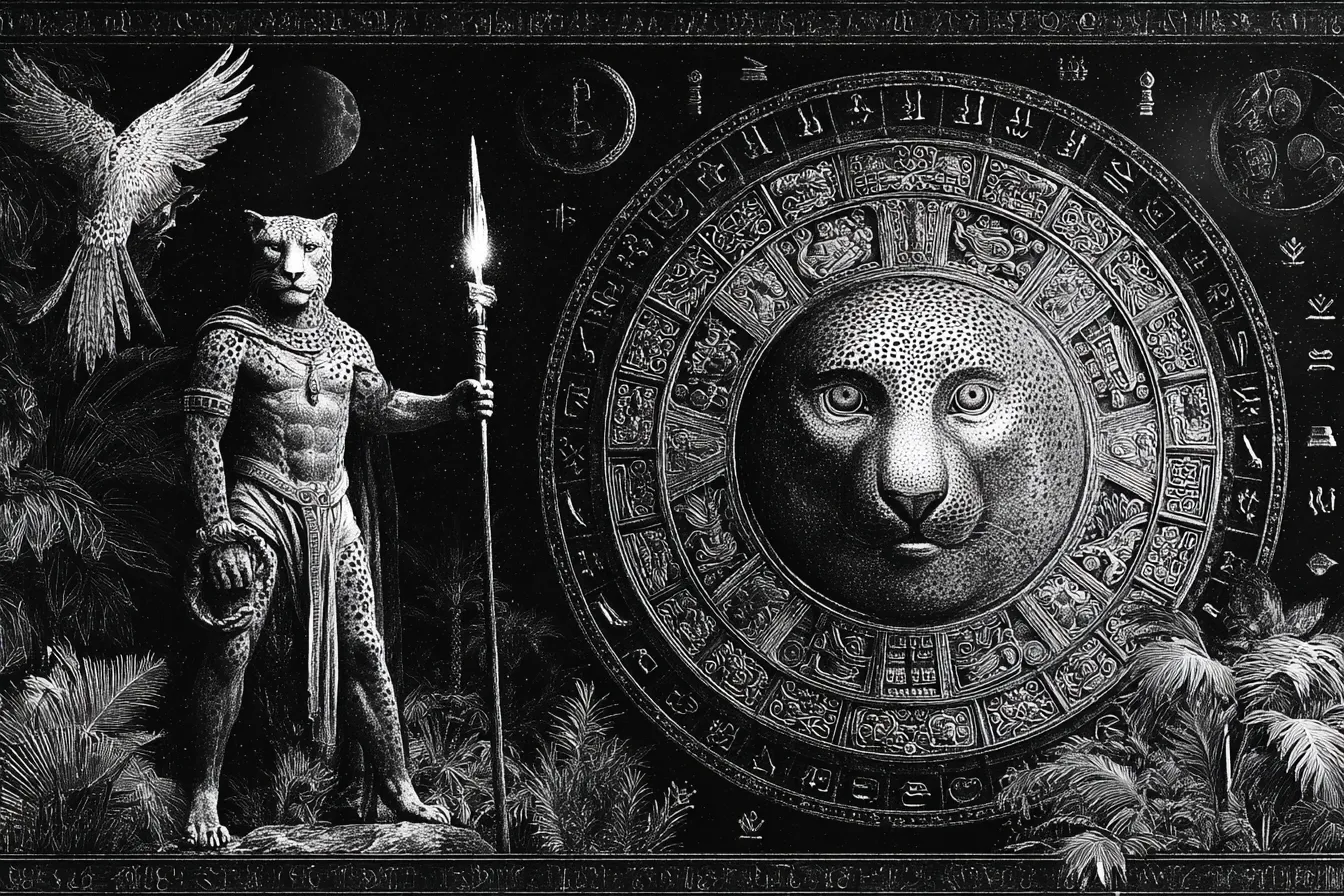
What is Cib?
Cib is the sixteenth of twenty Solar Seals in the Mayan Tzolkin — the 260-day sacred calendar built from twenty day signs cycling through thirteen numbered tones, producing 260 unique combinations called Kin. The Tzolkin has been in continuous use among Maya peoples for at least 2,500 years and remains a living tradition today. Ajq’ij — Maya day keepers and ceremonial priests — continue to guide communities through the Tzolkin cycle in Guatemala and southern Mexico, where the Chol Q’ij (the K’iche’ Maya name for the calendar) is woven into both ceremonial and everyday life. To engage with Cib is to engage with a tradition that has never been interrupted, carried by living communities for whom the Tzolkin remains a genuinely living guide.
The Whisper integrates the Tzolkin alongside Western Astrology, Nine Star Ki, and BaZi into a single daily personal insight. Your birth seal is calculated by locating your birth date within the Tzolkin cycle using the GMT correlation constant (584283) — the most widely accepted scholarly alignment between the Maya Long Count and the Gregorian calendar. This differs meaningfully from the Dreamspell system developed by José Argüelles in 1987, which applies a different correlation and sometimes different seal names, and which can produce a different result for the same birth date. Many English-language tools for finding a “Mayan day sign” use the Dreamspell framework; The Whisper uses the traditional GMT correlation throughout. In addition to your birth seal, the daily seal marks the current day’s shared position in the Tzolkin cycle and The Whisper synthesizes both with the other active systems to generate each day’s insight.
Cib arrives at position sixteen — the point in the Tzolkin’s second arc where the cycle, having moved through the jaguar’s interior receptivity (Ix) and the eagle’s expansive visionary perspective (Men), now encounters the question of what genuine wisdom requires in the face of what has been perceived. Where Men saw the whole pattern from altitude, Cib is the intelligence that descends from that altitude and engages directly with what has been seen — not with the smooth confidence of one who has not yet truly encountered resistance, but with the tested, earned, fearless quality of the being who has engaged with difficulty and has come through it with genuine understanding. Cib is the warrior whose weapon is the quality of their questioning.
The symbol and its traditional roots
The glyph associated with Cib in Maya iconography is connected to the owl and to the forces of the night that carry accumulated ancestral wisdom — the intelligence that arises not from youthful eagerness but from genuine, long encounter with difficulty, darkness, and the full range of what experience offers. The owl in Maya tradition is the messenger of Xibalba, the underworld — not a figure of fear but the bearer of the intelligence that only genuine encounter with the underworld produces. The owl sees in the dark not because it avoids the dark but because it has inhabited it with complete, attentive presence.
The warrior quality that gives Cib its English name requires careful understanding in the Maya tradition. The warrior here is not primarily a fighter in the conventional sense — not the aggressive, force-wielding warrior of conquest narratives — but the philosophical warrior whose primary weapon is fearless inquiry: the one whose courage expresses through the willingness to question without flinching, to pursue truth regardless of whether the answers are comfortable, and to engage directly with what is genuinely there rather than with a version of it that has been made more manageable by selective attention or wishful thinking. The warrior’s sword in the Cib tradition is the question that does not stop before it reaches genuine understanding.
Fearless intelligence is the quality the Tzolkin tradition most centrally associates with Cib — a specific combination of intellectual courage and genuine depth of engagement that is different from mere cleverness or combativeness. Fearless intelligence in the Cib tradition is the quality that does not deflect from what the inquiry is revealing, that can hold what is genuinely difficult and continue to work with it, and that has developed — through genuine encounter with difficulty — the specific kind of courage that comes not from never having been afraid but from having been afraid and having continued anyway.
In the Aztec Tonalpohualli, the corresponding day sign is Cozcacuauhtli — the Vulture, carrying associations of great age, patient wisdom, and the specific intelligence that arises from genuine encounter with what is difficult and what has ended. The vulture in Mesoamerican tradition is not a figure of death in the threatening sense but of the wisdom that comes from honest, unsqueamish engagement with the full reality of what is — including the aspects of reality that others prefer to look away from. This adds an essential dimension to Cib’s warrior quality: the fearlessness is not the fearlessness of the one who has never been threatened, but of the one who has looked directly at what is threatening and found, through that direct looking, that it is understandable.
The color associated with Cib is Yellow, and the direction is South — the direction the Tzolkin associates with ripening, completing, and the harvest. Yellow seals carry the warmth and fullness of the south’s completing quality. Cib as a Yellow/South seal represents fearless intelligence as a form of ripening — the warrior-wisdom that has been seasoned through genuine encounter with difficulty and that carries, in its full expression, the harvest quality of understanding that has been genuinely earned through direct engagement with what is.
The energy of Cib
The traditional meaning of Cib centers on fearless questioning as the primary expression of genuine wisdom — the specific quality of intelligence that does not stop at the first comfortable answer but continues until genuine understanding has been reached, regardless of whether the path toward that understanding is comfortable or whether the answers it reveals are easy to receive. This is not combativeness or the pleasure of argument; it is the specific courage of the being whose relationship to truth is strong enough that it can withstand the discomfort of following the inquiry wherever it genuinely leads.
The Tzolkin tradition is careful to distinguish Cib’s fearless intelligence from mere skepticism, cynicism, or the performance of intellectual toughness. Fearless questioning in the Cib tradition is specifically in service of genuine understanding — the warrior who questions does so not to defeat the position being questioned but to find what is genuinely true beneath the positions that have been adopted for comfort, habit, or social pressure. The Cib question is not a weapon used against others but a tool used in service of the shared project of genuine understanding. The warrior’s sword here cuts through illusion, not through people.
The wisdom that comes from genuine encounter with difficulty is another central Cib quality. The Tzolkin tradition positions Cib at the point in the cycle where the accumulated richness of the preceding fifteen seals now encounters the specific, testing quality of genuine difficulty honestly engaged with. Cib wisdom is not the wisdom of the one who has been sheltered from difficulty or has successfully avoided it; it is specifically the wisdom of the one who has engaged with difficulty directly, has allowed that engagement to teach what it genuinely teaches, and has arrived at understanding that is real in a way that more comfortable wisdom cannot be.
The directness of genuine engagement is the third major dimension of Cib energy that the tradition addresses. The warrior who engages directly is not necessarily aggressive; they are present. The quality of direct engagement means the willingness to be fully in contact with what is actually there — not mediated by the layers of interpretation, hedging, and comfortable distance that less courageous engagement introduces. Cib energy tends to express as a quality of genuine presence in difficult territory — the willingness to be actually there, in full contact with what is genuinely present.
There is a further quality in Cib associated with the warrior’s relationship to fear itself — not the absence of fear but the specific relationship to fear that genuine courage produces. The Cib tradition does not suggest that the warrior never experiences fear; it suggests that the warrior’s relationship to fear is different from the ordinary relationship to it. Where most beings experience fear as a signal to avoid, the Cib warrior experiences it as a signal to inquire more closely — the fear that arises in the face of a particular question or territory is, in the Cib tradition, precisely the indicator that this is where genuine inquiry needs to go.
Cib as a birth seal and daily seal
As a birth seal, Cib in the Tzolkin tradition is associated with the person who carries fearless inquiry and the warrior-wisdom of genuine direct engagement as their primary orientation — someone whose most characteristic quality is the depth of their willingness to pursue genuine understanding regardless of whether the answers are comfortable, and whose wisdom tends to have the specific quality of having been genuinely tested. The birth tone modifies how this expresses in practice: a person born on Cib with Tone 6 carries the warrior-wisdom quality with a more equalizing, rhythmically flowing dimension; someone born on Cib with Tone 13 may carry it with a more transcendent, completing quality that has moved through the full arc of what fearless inquiry reveals.
People born under Cib are traditionally associated with a particular capacity for genuine intellectual courage — the willingness to follow an inquiry into territory that is genuinely uncomfortable, to hold what is genuinely difficult without deflecting, and to arrive at understanding that has the quality of having been genuinely tested. This tends to express across many domains: the Cib person may be the one who asks the question in the meeting that everyone else has been avoiding, who pursues the thread of inquiry that others have dropped because the direction it leads is disquieting.
There is also a traditional association between Cib and a particular quality of earned authority — the kind of genuine standing that comes not from position or performance but from the visible quality of having actually engaged with difficulty and arrived at real understanding through it. The vulture in Mesoamerican tradition carries this quality: the authority of the elder who has genuinely seen a great deal, who has not looked away from what was difficult to look at, and whose understanding therefore carries a weight that younger, less tested intelligence cannot replicate.
As a daily seal, when Cib appears as the current day’s position in the Tzolkin cycle, the tradition suggests a quality of fearless inquiry and the direct engagement that genuine understanding requires — a day when the capacity for honest, direct, undeflected questioning tends to be more available than usual, when the courage to follow an inquiry wherever it genuinely leads tends to be more accessible, and when the wisdom that arises from direct engagement with what is genuinely there tends to be particularly productive. The Whisper synthesizes this with the other active systems to generate the specific texture of that day’s reading.
Strengths and growth edges
The strengths traditionally associated with Cib are rooted in its relationship to fearless inquiry and the wisdom earned through genuine direct engagement with difficulty. The capacity for fearless, direct engagement with truth is the most fundamental — the willingness to follow an inquiry wherever it genuinely leads, to hold what is genuinely difficult without deflecting, and to arrive at understanding that has the quality of genuine encounter rather than comfortable approximation. This is a form of intellectual and spiritual courage that the Tzolkin tradition treats as genuinely rare and genuinely valuable.
The questioning intelligence that does not stop before reaching genuine understanding is the second major strength — the specific quality of intellectual persistence that distinguishes the Cib warrior from the merely curious. Curiosity can be satisfied by an interesting answer; Cib’s fearless inquiry is not satisfied until it has reached what is genuinely true, which often requires continuing through a series of answers that are true only partially or true only in the terms of a particular framework.
The wisdom earned through genuine difficulty — the harvest-quality of Cib’s Yellow/South seal nature, the understanding that has been seasoned through full engagement with what is hard — is the third recognized Cib strength. This wisdom has a specific quality that more comfortable understanding does not: it is grounded in genuine encounter with reality, tested by the specific resistance that difficulty offers, and therefore reliable in a way that untested understanding is not.
The growth edges associated with Cib follow the shadow dimensions of these gifts with characteristic directness. The fearless questioning that becomes combativeness is the primary growth edge — the warrior quality that has lost its orientation toward genuine understanding and has become oriented instead toward the defeat of the positions it questions. The sword that was a tool for cutting through illusion has become a weapon for winning arguments.
The directness that has forgotten care is a closely related growth edge — the quality of direct, unmediated engagement that, without the care and attentiveness that genuine wisdom requires, becomes bluntness that injures without illuminating. The warrior’s sword requires both sharpness and skill in its application; the skill includes knowing when to cut and when to hold, knowing what the cut is in service of, and maintaining genuine respect for what is being engaged with even in the act of cutting through it.
Finally, the warrior who has made a permanent occupation of the battlefield is a recognized Cib growth edge — the one who has become so identified with the warrior stance of fearless questioning and direct engagement that they cannot rest in what has been found, cannot dwell in what has been understood, cannot inhabit the terrain that the inquiry has opened without immediately moving to the next frontier of questioning.
What Cib means in The Whisper
In The Whisper’s multi-system synthesis, Cib resonates across several traditions in ways that illuminate its essential qualities from complementary perspectives.
The resonance with Western Astrology is strongest with Mars and Saturn in their wisdom aspects — the courageous, direct, truth-seeking quality of the planet of action combined with the disciplined, high-standard, principled quality of the planet most associated with genuine long-term development of understanding. Mars in its wisdom aspect carries the quality of the warrior whose courage is in service of something genuine — not the aggressive Mars of raw force, but the Mars that acts from genuine conviction and genuine clarity about what the situation requires. Saturn in its wisdom aspect carries the quality of the elder whose understanding has been formed through genuine encounter with the full range of difficulty that time offers. The combination of Mars’s courageous directness and Saturn’s tested, earned depth captures the Cib quality closely: the warrior-philosopher whose fearlessness is in service of genuine understanding and whose wisdom has been earned through genuine engagement with difficulty. When The Whisper synthesizes a Cib influence with a strong Mars or Saturn quality from the Western layer, the courageous, directly engaging, tested-wisdom dimension of that day’s reading may be particularly amplified.
In Nine Star Ki, the resonance is with the Six White Metal Star (六白金星) — the principled, high-standard, fearlessly direct quality of the star most associated with heaven’s organizing principles and the specific form of courage that comes from genuine alignment with what is genuinely excellent. The Six White Star in Nine Star Ki carries the quality of the being who holds to high principles not because of stubbornness or rigidity but because genuine understanding of what is excellent makes compromise with what is not genuinely good feel untenable. When Cib appears alongside a Six White Metal Star influence in The Whisper’s Nine Star Ki layer, the principled, fearlessly direct, high-standard quality of the warrior’s intelligence may be especially present.
From a BaZi perspective, the resonance is with Geng Metal (庚金) — the sword of clear, direct, fearless engagement; the yang metal that does not yield to what is false. Geng Metal in BaZi is the most direct and forceful of the ten heavenly stems: the great sword, the axe, the quality of metal that cuts cleanly and completely, that does not hesitate at the moment of genuine engagement, and that maintains its essential quality regardless of the pressure brought to bear against it. In its Cib expression, Geng Metal carries the quality of the warrior’s fearless directness — the intelligence that cuts through what is not genuine with the clean, complete precision of a well-forged blade. When Cib appears alongside a Geng Metal influence in The Whisper’s BaZi layer, the directly cutting, fearlessly precise, fundamentally undeflectable quality of the warrior-intelligence may be particularly prominent.
The Aztec Tonalpohualli equivalent, Cozcacuauhtli (the Vulture), adds the dimension of great-age wisdom — the understanding that arises from having genuinely seen a great deal, from having not looked away from what is difficult to see, and from the specific, honest, unsqueamish engagement with the full reality of what is that the vulture represents. This frames Cib’s fearlessness not as youthful boldness but as the mature courage of the being who has already encountered the worst and found, through genuine engagement with it, that it is understandable.
In The Whisper’s daily synthesis, Cib days carry the quality of fearless inquiry and the direct engagement that genuine understanding requires — days when the capacity for honest, undeflected questioning tends to be more available, and when the wisdom that arises from direct engagement with what is actually there tends to be particularly productive.
Frequently asked questions
Q: Does Cib’s association with the warrior mean this seal is more masculine or aggressive in its expression?
The Tzolkin tradition does not assign gendered qualities to Cib, and the warrior archetype that Cib carries is specifically the philosophical warrior — the one whose courage expresses through fearless inquiry and direct engagement with truth rather than through physical force or aggression. The sword of the Cib warrior is the question that does not stop before genuine understanding, not a weapon of conquest or domination. This quality of fearless, direct, truth-seeking engagement is as available to any person regardless of gender, and the tradition’s framing of the warrior in the context of Cib is specifically about the courage required for genuine inquiry rather than about force or aggression.
Q: How does The Whisper determine my birth seal, and why might the result differ from other Mayan astrology sources?
The Whisper uses the GMT correlation constant (584283), the most widely accepted scholarly alignment between the Maya Long Count and the Gregorian calendar, and the correlation used by traditional Maya practitioners and communities today. Many English-language Mayan astrology tools and apps use instead the Dreamspell system developed by José Argüelles in 1987, which applies a different correlation constant and sometimes different seal names, and which uses a leap-day convention that the traditional Tzolkin does not. The two systems are genuinely different frameworks that can produce different seal assignments for the same birth date.
Q: Is Cib’s fearless questioning always expressed outwardly, or can it also be an interior quality?
The Tzolkin tradition does not specify the direction of Cib’s fearless inquiry — it can express as outward questioning of received ideas, established positions, and the comfortable assumptions of others, but it can equally and perhaps primarily express as the inward quality of genuine self-inquiry: the willingness to ask of oneself the questions that are genuinely uncomfortable, to pursue genuine self-understanding rather than settling for the version of oneself that is most flattering or most manageable. In some expressions of Cib, the most fearless questioning the person does is the inquiry directed at their own positions, their own assumptions, and their own preferred answers. The warrior whose sword is turned inward — not in the sense of self-destruction but in the sense of genuine, unsparing self-inquiry — is expressing the Cib quality in what the tradition sometimes suggests is its most demanding and most genuinely productive direction.