
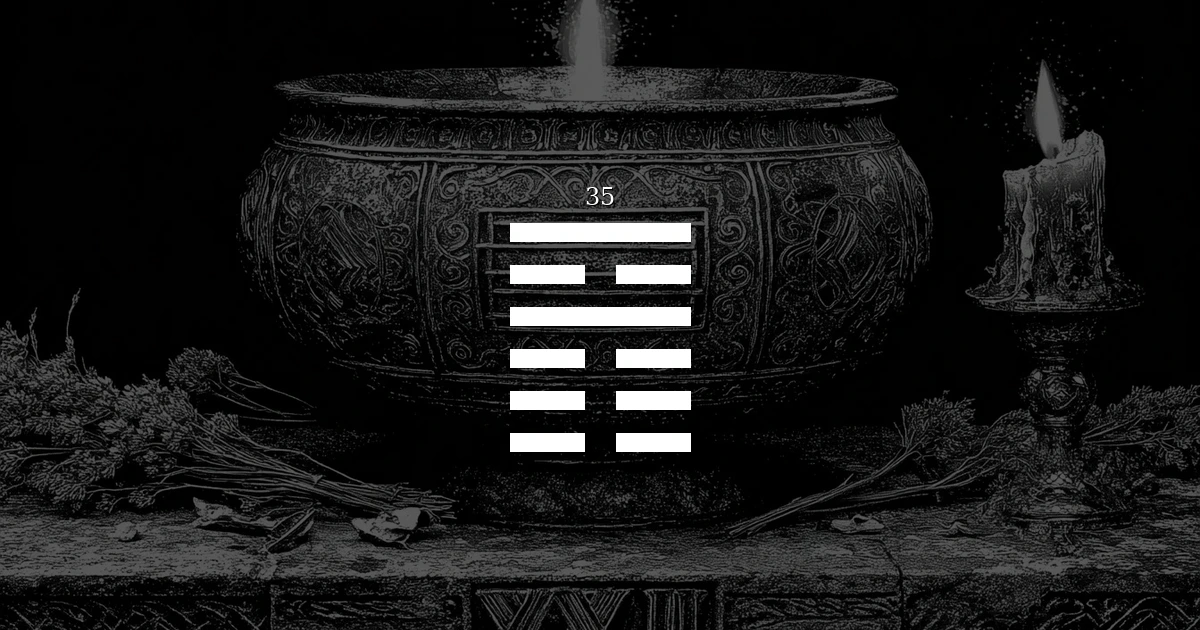
Every hexagram contains a hexagram within it. This isn’t a metaphor — it’s a structural feature of the I Ching’s architecture that most introductions to the system skip entirely, and that serious practitioners use as one of the most revealing layers in a reading.
The nuclear hexagram (互卦, hù guà — also called the inner hexagram or mutual hexagram) is formed by extracting four specific lines from a six-line hexagram and combining them to produce a new figure. It doesn’t change with your cast — it’s built into the structure of every hexagram and remains constant regardless of changing lines. What it offers is the hidden condition beneath the surface dynamics: the underlying pattern that persists through whatever transformation the primary hexagram is describing.
How the Nuclear Hexagram Is Constructed
Take any six-line hexagram. The four inner lines — lines 2, 3, and 4, plus lines 3, 4, and 5 — are used to form two new trigrams:
The lower nuclear trigram consists of lines 2, 3, and 4, read from bottom to top. The upper nuclear trigram consists of lines 3, 4, and 5, read from bottom to top.
Note that line 3 and line 4 appear in both trigrams — they are the shared core of the nuclear hexagram, which is part of why they carry interpretive weight.
These two trigrams combine (lower nuclear below, upper nuclear above) to form the nuclear hexagram.
Example: Hexagram 63, Ji Ji (After Completion)
Hexagram 63 is structured as follows (bottom to top): Line 1: yang (solid) Line 2: yin (broken) Line 3: yang (solid) Line 4: yin (broken) Line 5: yang (solid) Line 6: yin (broken)
Lower nuclear trigram (lines 2, 3, 4): yin, yang, yin = ☲ Li (Fire) Upper nuclear trigram (lines 3, 4, 5): yang, yin, yang = ☵ Kan (Water)
Li below Kan = Hexagram 64, Wei Ji (Before Completion).
This is not coincidental. Hexagram 63 (After Completion) contains within it Hexagram 64 (Before Completion) as its nuclear hexagram. The I Ching’s structure deliberately pairs these two hexagrams — they are the last two in the sequence, and their nuclear relationship encodes a deep cosmological principle: completion always contains the seed of the next incompleteness. The system is self-referential at this structural level.
What the Nuclear Hexagram Reveals
The nuclear hexagram is often described as the hidden condition, the underlying situation, or the unconscious foundation of the reading. Where the primary hexagram describes the surface dynamics of a situation — what’s visible, what’s actively moving, what the Judgment addresses — the nuclear hexagram describes what’s operating beneath that surface.
A few interpretive frames for how to read the nuclear hexagram:
The structural foundation. The nuclear hexagram doesn’t change with changing lines; it’s constant across all the possible relating hexagrams that a primary hexagram can generate. This constancy suggests it represents something more stable and fundamental than the surface dynamics — the ground condition within which the primary hexagram’s movement is occurring.
The hidden resource. Some practitioners read the nuclear hexagram as a description of the resources available within the situation — what’s present but not immediately visible, what can be drawn on. If the primary hexagram describes difficulty and the nuclear hexagram shows something like Hexagram 11 (Tai / Peace) or Hexagram 14 (Da You / Great Possession), there are genuine resources beneath the difficulty that aren’t immediately apparent.
The underlying dynamic. In some interpretive traditions, the nuclear hexagram describes the psychological or situational dynamics operating below the conscious level of the question. Where the primary hexagram addresses what you can see and work with directly, the nuclear hexagram addresses what’s driving the situation from beneath awareness.
The deeper process. For practitioners who use the I Ching philosophically as well as divinationally, the nuclear hexagram often describes the longer arc of a situation — the process that the primary hexagram’s shorter cycle is embedded within. If the primary hexagram is about a specific decision, the nuclear hexagram may describe the larger pattern of development within which that decision is taking place.
Nuclear Hexagrams of All 64 Hexagrams
The 64 hexagrams reduce to 20 distinct nuclear hexagrams — because many hexagrams share the same nuclear hexagram, and because the nuclear calculation by definition uses only the four inner lines. The following table gives the nuclear hexagram for every hexagram in the sequence:
Hexagram 1 → Nuclear: 1 (Qian / Heaven, all yang — lines 2-5 are all yang) Hexagram 2 → Nuclear: 2 (Kun / Earth, all yin) Hexagram 3 → Nuclear: 23 (Bo / Splitting Apart) Hexagram 4 → Nuclear: 23 (Bo) Hexagram 5 → Nuclear: 38 (Kui / Opposition) Hexagram 6 → Nuclear: 40 (Xie / Deliverance) Hexagram 7 → Nuclear: 24 (Fu / Return) Hexagram 8 → Nuclear: 23 (Bo) Hexagram 9 → Nuclear: 38 (Kui) Hexagram 10 → Nuclear: 37 (Jia Ren / The Family) Hexagram 11 → Nuclear: 54 (Gui Mei / The Marrying Maiden) Hexagram 12 → Nuclear: 53 (Jian / Gradual Progress) Hexagram 13 → Nuclear: 44 (Gou / Coming to Meet) Hexagram 14 → Nuclear: 43 (Guai / Breakthrough) Hexagram 15 → Nuclear: 40 (Xie) Hexagram 16 → Nuclear: 39 (Jian / Obstruction) Hexagram 17 → Nuclear: 53 (Jian) Hexagram 18 → Nuclear: 54 (Gui Mei) Hexagram 19 → Nuclear: 24 (Fu) Hexagram 20 → Nuclear: 23 (Bo) Hexagram 21 → Nuclear: 39 (Jian) Hexagram 22 → Nuclear: 40 (Xie) Hexagram 23 → Nuclear: 2 (Kun) Hexagram 24 → Nuclear: 2 (Kun) Hexagram 25 → Nuclear: 53 (Jian) Hexagram 26 → Nuclear: 54 (Gui Mei) Hexagram 27 → Nuclear: 2 (Kun) Hexagram 28 → Nuclear: 1 (Qian) Hexagram 29 → Nuclear: 27 (Yi / Nourishment) Hexagram 30 → Nuclear: 28 (Da Guo / Great Excess) Hexagram 31 → Nuclear: 44 (Gou) Hexagram 32 → Nuclear: 43 (Guai) Hexagram 33 → Nuclear: 44 (Gou) Hexagram 34 → Nuclear: 43 (Guai) Hexagram 35 → Nuclear: 39 (Jian) Hexagram 36 → Nuclear: 40 (Xie) Hexagram 37 → Nuclear: 64 (Wei Ji / Before Completion) Hexagram 38 → Nuclear: 63 (Ji Ji / After Completion) Hexagram 39 → Nuclear: 64 (Wei Ji) Hexagram 40 → Nuclear: 63 (Ji Ji) Hexagram 41 → Nuclear: 24 (Fu) Hexagram 42 → Nuclear: 23 (Bo) Hexagram 43 → Nuclear: 1 (Qian) Hexagram 44 → Nuclear: 1 (Qian) Hexagram 45 → Nuclear: 53 (Jian) Hexagram 46 → Nuclear: 54 (Gui Mei) Hexagram 47 → Nuclear: 37 (Jia Ren) Hexagram 48 → Nuclear: 38 (Kui) Hexagram 49 → Nuclear: 44 (Gou) Hexagram 50 → Nuclear: 43 (Guai) Hexagram 51 → Nuclear: 39 (Jian) Hexagram 52 → Nuclear: 40 (Xie) Hexagram 53 → Nuclear: 64 (Wei Ji) Hexagram 54 → Nuclear: 63 (Ji Ji) Hexagram 55 → Nuclear: 28 (Da Guo) Hexagram 56 → Nuclear: 28 (Da Guo) Hexagram 57 → Nuclear: 38 (Kui) Hexagram 58 → Nuclear: 37 (Jia Ren) Hexagram 59 → Nuclear: 27 (Yi) Hexagram 60 → Nuclear: 27 (Yi) Hexagram 61 → Nuclear: 27 (Yi) Hexagram 62 → Nuclear: 28 (Da Guo) Hexagram 63 → Nuclear: 64 (Wei Ji) Hexagram 64 → Nuclear: 63 (Ji Ji)
The repetition pattern is striking: only 20 distinct nuclear hexagrams appear across all 64 primary hexagrams, and several of these (Hexagram 23, 39, 40, 43, 44, 53, 54, 63, 64) appear repeatedly. This concentration means that certain underlying patterns operate beneath a wide range of surface conditions.
Notable Nuclear Relationships
Some nuclear hexagram relationships are particularly illuminating:
Hexagram 11 (Tai / Peace) → Nuclear: Hexagram 54 (Gui Mei / The Marrying Maiden). The condition of peace contains, as its hidden foundation, the dynamic of the unequal or transitional partnership — the situation where someone is operating from a position of less authority or stability than they might wish. Peace rests on relationships that require navigation and sensitivity; beneath the harmony is a more complex relational dynamic.
Hexagram 12 (Pi / Standstill/Stagnation) → Nuclear: Hexagram 53 (Jian / Gradual Progress). The surface condition of stagnation conceals, as its nuclear pattern, the slow but genuine process of development. Within standstill, something is actually advancing incrementally. This is one of the I Ching’s most characteristic structural paradoxes.
Hexagram 29 (Kan / The Abysmal) → Nuclear: Hexagram 27 (Yi / Nourishment). Within the condition of repeated danger and the abyss, the hidden pattern is nourishment — the question of what feeds and sustains. Navigating danger requires attention to what actually nourishes; beneath the drama of the water, the deeper question is one of sustenance.
Hexagrams 63 and 64 forming each other’s nuclear hexagrams (described above) is the most elegant example of the system’s self-referential architecture.
The Nuclear Hexagram in Practice
How much weight to give the nuclear hexagram in a reading is a matter of interpretive tradition and personal practice orientation. Some practitioners read it in every consultation; others use it selectively for readings where the primary hexagram feels incomplete or where the surface dynamics seem to not quite account for the full weight of the situation.
A practical approach for integrating the nuclear hexagram into readings: after reading the primary hexagram’s Judgment and Image, identify the nuclear hexagram and read its Judgment and Image as context for the underlying condition. Ask: what does the nuclear hexagram add to the picture? Does it confirm the primary hexagram’s direction? Does it describe something that was present but not visible in the surface reading? Does it account for something about the situation that the primary hexagram alone didn’t fully capture?
The changing lines interpretation focuses on what’s transforming in the surface dynamics; the nuclear hexagram describes what’s stable beneath that transformation. Together, they give you the movement (changing lines and relating hexagram) and the ground within which the movement is occurring (nuclear hexagram).
This layered reading — primary hexagram + changing lines + relating hexagram + nuclear hexagram — is the complete analytical structure of a sophisticated I Ching consultation. Not every reading requires all layers; the simpler the situation, the fewer layers are needed. But for major questions or complex situations, the nuclear hexagram often provides the perspective that makes everything else cohere.
Frequently Asked Questions
Does the nuclear hexagram change if there are changing lines? No. The nuclear hexagram is derived from the primary hexagram’s structure — from lines 2, 3, 4, and 5 as they appear in the primary hexagram, before any transformation. It does not use the relating hexagram’s lines. This is precisely why it represents a stable underlying condition rather than the movement that changing lines describe.
Should I always read the nuclear hexagram? Not necessarily. Many experienced practitioners read it regularly as part of their standard consultation process; others use it selectively for readings where the primary hexagram plus changing lines doesn’t feel complete. There’s no tradition-wide consensus on whether it’s mandatory. What most agree on is that it’s available and often revealing when the surface reading leaves questions unanswered.
The nuclear hexagram for my reading seems to contradict the primary hexagram. How should I read that? Apparent contradiction between the primary and nuclear hexagrams is common and usually the most interesting part of the reading. They’re describing different layers: the surface dynamics and the underlying condition. What looks like contradiction often describes a real tension in the situation — something that’s visible on the surface is being supported or undermined by something different operating beneath. The question is how the two relate: is the nuclear hexagram providing resources the primary hexagram’s difficulty can draw on? Is the primary hexagram’s apparent ease concealing complications indicated by the nuclear hexagram? Holding both together rather than resolving the tension in favor of one is typically the more accurate and more useful reading.