
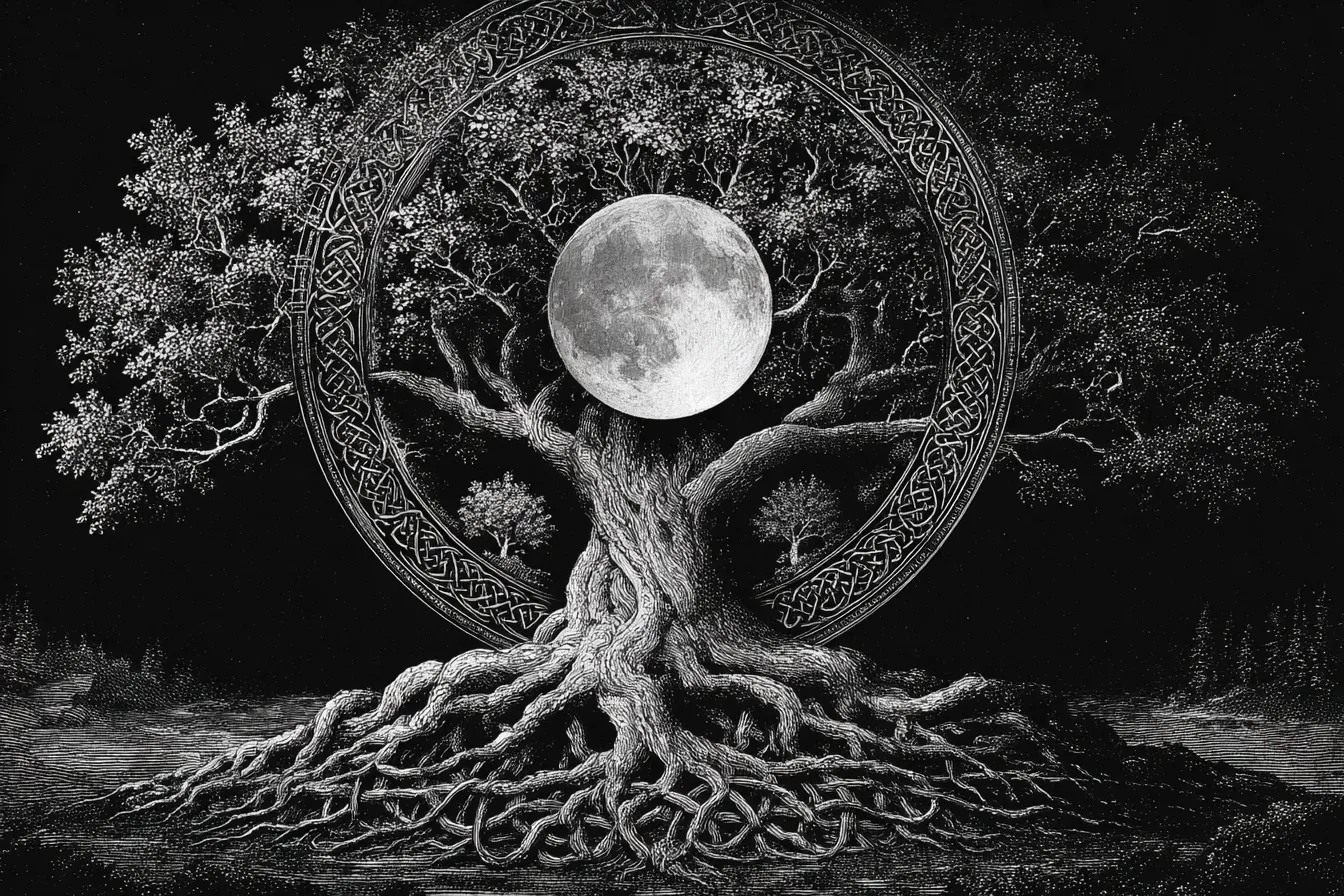
What is the Birch sign in Celtic astrology?
If your birthday falls between December 24 and January 20, the Celtic Tree Calendar places you under the Birch — the first tree, the pioneer, the one that moves into ground before anything else is ready to. Its Ogham letter is Beith (ᚁ), the opening character of the ancient alphabet inscribed on standing stones across Ireland, Wales, and the western coasts of Scotland and Britain. Beith is where the alphabet begins, and the Birch is where the year begins: not at the warmth of spring but in the coldest weeks of winter, when beginning is hardest and most necessary.
The Celtic Tree Calendar divides the year into thirteen lunar months, each linked to a tree whose character, ecological behaviour, and place in the mythology of the British Isles becomes a lens for understanding those born within it. It is not a system that predicts your character in the way a blueprint determines a building — it is closer to a framework of resonance, a set of qualities worth trying on against your own experience.
A word on origins that matters: the Celtic Tree Calendar as widely practised today owes its modern form primarily to Robert Graves’s The White Goddess (1948), a work of poetic and mythological synthesis that drew from medieval Irish literary sources, Welsh mythology, and Graves’s own scholarly imagination. It is not a direct transcription of pre-Christian Celtic religious practice, and it would be dishonest to claim otherwise. What is genuinely ancient is the Ogham alphabet itself: stone inscriptions in Ogham have survived from roughly the 4th through 8th centuries CE, the letters take their names from trees and plants, and the symbolic associations Graves drew on have roots in real medieval Irish textual sources such as the Ogam Tract and the Book of Ballymote. Contemporary Druidry and Celtic spiritual practice have developed this calendar as a living tradition, and The Whisper engages with it in that spirit — as a meaningful, historically grounded framework, not a set of claims to be accepted on faith.
With that context established: what does it mean to be born under the Birch?
The tree and its historical roots
The silver birch (Betula pendula) is one of the most important pioneer species in the ecology of northern Europe. “Pioneer species” is a technical term from ecology, and it describes something specific and remarkable: the birch colonises bare, disturbed, or recently cleared ground that other trees cannot yet survive in. After a fire, after clear-cutting, after glacial retreat, the birch arrives first. Its seeds are tiny and light enough to travel long distances on wind; it tolerates thin, poor, acidic soils that would kill an oak or an ash; it grows quickly, fixes nitrogen, provides shade, and gradually transforms the soil chemistry so that other species can follow. The birch does not persist forever in the landscape it pioneers — it is eventually shaded out by the slower, longer-lived trees that it made possible — but without the birch going first, those trees could not have come at all.
This is not metaphor. It is the tree’s actual behaviour, and it is worth sitting with before reaching for symbolic interpretation. The Birch is the first because of a genuine structural capacity: it tolerates conditions that exclude others, it is mobile where others are rooted in place, and what it leaves behind is a transformed environment for those who follow. Any symbolic meaning the Birch carries in Celtic astrology grows from this ecological reality.
The name Beith in Old Irish is traditionally translated as “the shining one,” and again, the etymology reflects something real. The bark of the silver birch is white and papery — it contains a compound called betulin that reflects ultraviolet and visible light — and it glows distinctly against the brown and grey of a January landscape. In the darkest weeks of winter, before the snowdrops and before any other tree shows growth, a stand of silver birch is unmistakably luminous. It does not glow with warmth. It glows with a cold, clear, white light. The distinction is important.
In Irish and Scottish folk tradition, the birch held strong associations with purification and threshold-crossing. The besom — the traditional broom, sometimes called a witches’ broom — was classically made from birch twigs, and its purpose was not merely domestic: sweeping with a birch besom was understood as clearing old energies before the new could enter. At Beltane, cattle were driven between birch fires before going to summer pasture, a purification practice with practical roots (the smoke deterred insects and disease) and symbolic ones. The 9th-century Irish text Cath Maige Tuired mentions birch as the material of a protective charm. The thread running through the textual and folk record is consistent: the birch is the tree that clears what has finished and makes space for what comes next.
The energy of Birch
The dominant quality of Beith is initiation in the absence of hospitable conditions. Not initiation when circumstances have aligned, not the beginning that waits for warmth and clear ground. The Birch begins in January, in the cold, in the weeks immediately after the solstice when the light has technically turned but nothing yet feels different. The light returning is real — you can measure it — but you cannot yet feel it. The Birch energy is the capacity to act on what you know is true before it has become perceptible.
This is different from impulsiveness. The birch tree is not reckless; it has evolved specifically for the conditions it encounters. It is not naive about the cold. It begins in the cold because that is precisely when beginning is needed, and it is structurally suited to do what other trees cannot yet do. The Birch energy, in a person, is not the leap before looking — it is the prepared readiness to move into ground that others find inhospitable, because something in you recognises that the conditions for waiting are not coming.
There is a particular paradox at the heart of the Birch season that the symbol holds without resolving. The weeks after the winter solstice are the time of year when two things are simultaneously true: the light is returning, and the cold is at its most intense. January is harder than December in the northern hemisphere for most people, despite the fact that December is when the darkness is at its peak. The light has turned, but the ground has not yet warmed. The Birch does not resolve this tension. It inhabits it. There is a quality of luminous endurance in the Birch — not warmth, not comfort, but a clear and real light in difficult conditions.
The other quality the Birch carries is the wisdom of clearing. Before new growth can establish itself, what is finished needs to go. The birch-besom exists for a reason. The Birch energy does not simply arrive and begin — it arrives, recognises what needs to be cleared, does the clearing, and then begins. This sequence is one that people often skip in their urgency to get to the new thing. The Birch understands it as inseparable: the beginning and the clearing are the same movement.
Birch as a birth sign
As a birth sign, Birch describes a person whose particular gift is beginning — especially from difficult ground. Not performing beginning, not beginning when the conditions are right, but the genuine capacity to initiate after genuine endings, in genuine cold, without requiring the environment to confirm that it is time.
People with strong Birch energy often find themselves as the first mover in situations — arriving before the infrastructure exists, before others have recognised that something needs to happen, before the ground is prepared. They may do significant amounts of clearing work — personal, professional, relational — that makes it possible for others to build. They are not always recognised for this work; the pioneer is often gone before what they made possible becomes visible.
There is also a clarity that tends to come with Birch: the pioneer who goes first into uncertain ground must see what is actually there, rather than what would be comfortable to see. The white bark that glows in winter light is not decorative — it is the quality of being genuinely visible in difficult conditions, of not obscuring what you are or where you are. This clarity can be bracing for those around a Birch person, who may be more comfortable with the softness of indirect light.
The quality that requires the most care in a Birch is consolidation. The birch tree lives fast. In ecological time, it is a short-lived pioneer — it does not root itself in one place and grow for three hundred years. For a person, this tendency can manifest as the perpetual new beginning that avoids the full depth of commitment: moving on to the next clearing project before the current one has fully established, before the roots have genuinely gone in. The clearing impulse is a gift. The wisdom is knowing when the clearing is done and the establishing can begin.
The Birch month as a seasonal energy
The Birch does not only speak to those born within its dates. In The Whisper, the seasonal dimension of each Celtic tree applies to the calendar period itself: when the date falls between December 24 and January 20, the Birch quality is active as the day’s energy for everyone, regardless of birth sign.
The Birch season carries a specific invitation. January is the month of new year intentions and resolutions — a cultural phenomenon that aligns interestingly with the Birch quality of beginning, but that often gets the sequence wrong. The cultural impulse is to declare the new before the old has genuinely been cleared. The Birch wisdom is the opposite: clear first, then begin. The besom before the building.
For those who do have Birch as their birth sign, the seasonal dimension adds a layer: the Birch month is the period in which your birth-tree energy and the current tree energy are aligned. The Whisper reads this as a period of intensified Birch quality — not necessarily easier, but more directly expressive of your particular grain.
Seasonal position within the Birch month also shapes the reading. Those born in the earliest days (December 24–31) carry the most solstice-threshold quality: born at the exact pivot of the year, when the turn has happened but nothing yet shows it. There is an uncanny quality to this position — the knowledge of what has changed without the evidence of it. Those born in the heart of the Birch month (January 1–10) carry the purest pioneer energy. Those born in the final days (January 11–20) begin to approach the Rowan threshold — the next tree, the bright protector — and may find their Birch energy has a somewhat more watchful, perceptive quality.
Strengths and growth edges
The strengths of the Birch are not soft ones. The capacity to begin again — not as a performance of resilience but as a genuine renewed capacity to move — is rare and genuinely useful. Many people, when circumstances have stripped things back, need to wait for conditions to improve before they can re-engage. The Birch moves in the other direction: the stripped-back condition is precisely the one that activates the Birch energy. There is no pretending required. What is done is done, what needs clearing can be cleared, and the ground ahead — however cold — is open.
The clarity that comes with this is a related strength. The pioneer cannot afford comfortable fictions about the terrain. The Birch person tends to see with a directness that can surprise those who expect the world to be narrated more gently. This is not harshness. It is the white bark in winter light: unmistakable, real, and genuinely bright.
The growth edges are the shadow of exactly the same qualities. The perpetual new beginning is the Birch’s most significant risk. If the pattern is: clear, initiate, begin to establish, then feel the clearing impulse fire again before genuine roots have gone in — then the Birch energy is working against itself. The birch tree does eventually give way to the oak and the ash, not because it fails, but because the ecosystem it helped create no longer requires pioneering. Knowing when the pioneering is done — when the clearing impulse should yield to the slower, rootier work of deepening — is Birch wisdom at its most mature.
There is also the edge of the cleanser who clears without discernment: the besom that sweeps out what should have been kept alongside what should have gone. Not everything that is old is finished. Not everything that does not yet flower is dead. The wisdom of Beith includes the ability to distinguish the two, which requires more presence than the pioneer’s forward motion naturally affords.
What people get wrong about the Birch sign
The most common misreading of the Birch is as a straightforwardly optimistic or high-energy sign — the one who is always ready to start something new, the natural entrepreneur, the person who thrives on change. This reading is not wrong, exactly, but it misses what is genuinely demanding about the Birch position.
Beginning in January, in the cold, on bare ground, is not an inherently comfortable or energising thing. The Birch does not begin because beginning is easy for them — they begin because not beginning, when beginning is what is needed, is more costly than the cold. The distinction matters enormously for self-understanding: Birch energy is not enthusiasm, it is readiness under difficult conditions. People with strong Birch qualities are often exhausted by the clearing work they do, often less recognised for it than they might be, and often find themselves having moved on to the next bare-ground situation before they have received much from the last one.
The second common misreading is of the Birch’s luminosity as warmth. The white bark glows, yes — but it glows cold. Birch clarity is not the same as emotional warmth or relational comfort. A Birch person’s directness and clarity can be experienced as cold by those who need softer light. Understanding this as a feature of the Birch rather than a personal failure — and finding the contexts where cold clarity is exactly what is needed — is part of working consciously with Beith.
What Birch means in The Whisper
In The Whisper, the Birch sign is one of fifteen systems contributing to the daily synthesis. When Celtic is active in your oracle stack and your birth sign is Birch, the system reads your day through the Beith lens: the pioneer quality, the clearing-before-beginning wisdom, the luminosity that is real without being warm.
The Birch finds its closest resonance in Western Astrology with Capricorn, the sign that governs the same calendar period. This overlap is not coincidental — both describe the same fundamental season — but the resonance goes deeper than timing. Capricorn and Birch both describe the quality of beginning in the hardest season, not because conditions are favourable but because it is time and the capacity exists. Where they differ is in emphasis: Capricorn tends toward the structural, the architectural, the long accumulation of what endures. The Birch is more immediate — it is the clearing and the first movement rather than the edifice. When a Whisper draws on both Birch and a strong Capricorn placement, the synthesis tends toward: the ground is bare, the conditions are cold, and you are exactly what this terrain requires.
Runes offer a parallel worth noting. The rune Berkano (ᛒ) is named for the birch and carries closely aligned symbolic associations: new beginnings, regeneration, the renewal of life force after a period of dormancy. Berkano is the rune of the birch grove, of the sheltered clearing where new growth is possible. It is important to be clear that runes are a Norse and Germanic tradition — distinct from the Celtic Ogham tradition, though both emerged from northern European cultures that knew the same trees. The fact that the birch carries essentially the same symbolic weight across both traditions says something about the tree itself: its ecological behaviour as a pioneer and cleanser is consistent enough across its range that independent traditions arrived at similar meanings. When The Whisper synthesises a Berkano-resonant runic day with a Birch birth sign, the signal is unusually coherent — two separate traditions pointing at the same quality.
In BaZi, the Birch energy resonates with Ren Water (壬水) — the powerful yang water of deep winter, which holds within it the maximum capacity without yet expressing it. Ren Water in BaZi carries the quality of the deep reservoir: still on the surface, enormous in depth, fully present in the darkest season. This is not the warmth of spring water or the nurturing quality of rain — it is the capacity that precedes expression, the fullness that has not yet found its outlet. Both Ren Water and Birch describe a readiness that does not yet look like what it will become. When the Whisper synthesis draws on both, the reading tends toward questions of genuine capacity: what are you actually carrying that has not yet had its ground?
Numerology adds a final layer. Beith is the first Ogham letter, and in numerological terms, the 1 is the initiating force — the self-sufficient origin point, the number that contains all other numbers as potential. The Birch sits at the beginning of the Celtic calendar precisely because its quality is the quality of the 1: not building on what came before, but establishing the ground on which building becomes possible.
When multiple systems in The Whisper converge on this quality — the initiation that does not wait for hospitable conditions — the synthesis is read as a signal about genuine readiness. Not the readiness of comfortable preparation, but the birch-readiness of the one who goes first because going first is what is needed, and the cold is simply the weather.
Frequently asked questions
Q: Is the Celtic Tree Calendar an ancient system with pre-Christian origins? The system as widely practised today — thirteen months, each linked to a tree and an Ogham letter — owes its modern form primarily to Robert Graves’s The White Goddess (1948). Graves was drawing on genuine medieval Irish literary sources, but his synthesis was his own interpretive work, not a transcription of pre-Christian practice. The Ogham alphabet itself is genuinely ancient, with stone inscriptions surviving from the 4th–8th centuries CE. The symbolic meanings attributed to the trees have roots in real medieval Irish texts including the Ogam Tract and the Book of Ballymote. Contemporary Druids and Celtic practitioners engage with this system as a living tradition. The Whisper treats it the same way: as a meaningful, historically grounded framework, not an ancient secret that predates all other knowledge.
Q: Is the Birch sign compatible with my Western astrology sign? If you were born between December 24 and January 20, your Western astrology sign is Capricorn (until January 19 or 20, depending on the year) or the very beginning of Aquarius (from January 20). The Birch resonates strongly with Capricorn — both describe the quality of serious, enduring initiation in difficult conditions. If your birthday falls on or near the Capricorn-Aquarius cusp (around January 19–21), you may find the Birch has a slightly more perceptive, watchful quality — beginning to approach the Rowan’s sharp awareness that characterises the following month.
Q: What does it mean that the Birch is the first tree — does that make it the most important sign? Being first in the sequence does not imply superiority — it implies a particular function. The birch’s ecological role as a pioneer is essential precisely because it is temporary: it prepares ground for the trees that follow. In the context of the Celtic Tree Calendar, the Birch’s position as the first reflects the quality of the winter solstice threshold rather than a hierarchy of signs. Every position in the thirteen-month cycle carries its own complete character.
Q: I’ve seen different date ranges for the Birch sign on different websites — which is correct? There is no single authoritative source for the Celtic Tree Calendar dates, and different books and websites use slightly different ranges. The most common variation places the Birch from December 24 to January 20, which is the range The Whisper uses. Some versions begin it on December 22 (the solstice itself) or December 23. The Whisper applies a consistent set of dates across its system so that your reading remains stable — if you were born on a date that appears in different ranges on different sites, The Whisper will consistently assign you the same sign.
Q: Can the Birch sign apply to me if I wasn’t born in this period? In The Whisper, the Celtic system works on two levels: the birth sign (determined by your birth date, fixed) and the seasonal energy (which applies to everyone during the Birch month of December 24–January 20, regardless of birth date). If you are reading this during the Birch season, its energy of clearing, initiation, and luminous persistence is active as a quality of the current period for all users, whatever their birth sign. The birth sign and the seasonal sign layer on top of each other in the daily Whisper synthesis.