
The Revolution That Changed What “Thinking” Means
For most of the twentieth century, the dominant model of cognition — the “computational” or “information-processing” view — treated the mind as essentially a software system running on neural hardware: inputs come in through the senses, the mind manipulates abstract symbolic representations according to various rules, and outputs go out to the body. On this view, the body is more or less incidental to thinking — a vehicle for getting information in and out, but not a participant in the actual cognitive work.
Beginning in the 1980s, and accelerating through the 1990s and 2000s, a substantial challenge to this view emerged from multiple directions simultaneously. Philosophers including Hubert Dreyfus and Mark Johnson, cognitive scientists including George Lakoff, Francisco Varela, and Evan Thompson, and later neuroscientists including Antonio Damasio converged on a different picture: cognition is not well-described as the manipulation of abstract symbols in a body-independent medium. It’s grounded in bodily experience — in the specific kind of body we have, the way it moves, the sensations it registers, the motor programs it runs — in ways that shape even the most apparently abstract forms of thought.
This is the “embodied cognition” research program, and its core claims have accumulated substantial empirical support across the past three decades. The claim isn’t that abstract thought doesn’t exist, or that the brain doesn’t matter — it’s that thinking and brain function are more tightly coupled to bodily and sensory experience than the computational model recognized, and that this coupling shows up in specific, testable ways.
Conceptual Metaphor and Grounded Meaning
One of the most extensively documented findings in embodied cognition research concerns conceptual metaphor — the finding, developed primarily by Lakoff and Johnson, that a large portion of abstract human thought is structured by metaphors whose source domains are bodily and physical experience.
Time, for instance, is widely conceptualized across languages as spatial — the future is “ahead,” the past is “behind,” events “approach” and “pass,” we “look back” on our history and “look forward” to what’s coming. Importance is conceptualized through verticality — important things “rise” to prominence, serious matters “weigh on us,” hierarchies are “high” and “low.” Emotion is conceptualized through temperature and physicality — arguments “heat up,” relationships “cool down,” people are “hard-headed” or “warm-hearted,” we “carry” burdens and “shoulder” responsibility. These aren’t just convenient metaphors that could equally well be replaced by any other convention — embodied cognition research has found that the bodily source domains actively participate in the processing of the abstract concepts they structure, producing measurable effects in behavior and judgment.
In one frequently cited experimental paradigm, subjects who physically held a warm object (a cup of coffee) rated strangers as having “warmer” personalities than subjects who held a cold object — a physical temperature influencing a social judgment, through the bodily grounding of the warmth metaphor in social cognition. The effect is small and, like many social priming findings, has faced replication challenges that the research community continues to work through. But the broader Lakoff-Johnson program — the claim that abstract thought is extensively metaphorically structured through bodily experience, documented across dozens of languages and conceptual domains — has proven considerably more robust than individual priming experiments, and represents a genuine shift in how cognitive scientists understand the relationship between body and mind.
What This Means for How Symbols Work
This framework changes what’s happening when a person engages with the rich symbolic vocabulary of a divination system — and it’s worth being specific about how, because “symbols carry meaning” is trivially true, while the embodied-cognition claim is more specific and more interesting.
The symbolic content of most divination traditions is extensively grounded in bodily and sensory experience, through exactly the metaphorical structuring Lakoff and Johnson describe. The Five Elements of BaZi and Chinese medicine — Water, Wood, Fire, Earth, Metal — aren’t abstract labels attached arbitrarily to categories; they’re organized around sensory and phenomenological properties of their source domains (fluidity, growth, warmth and upward movement, stability and weight, hardness and cutting) that structure the abstract meanings the system builds on them. A “Water day master” isn’t labeled with an arbitrary token; the label imports a whole set of bodily-grounded associations (yielding, finding paths around obstacles, depth, cold, the behavior of water in varied circumstances) that participants in the tradition bring to the interpretive process, grounded in a lifetime of physical experience with actual water.
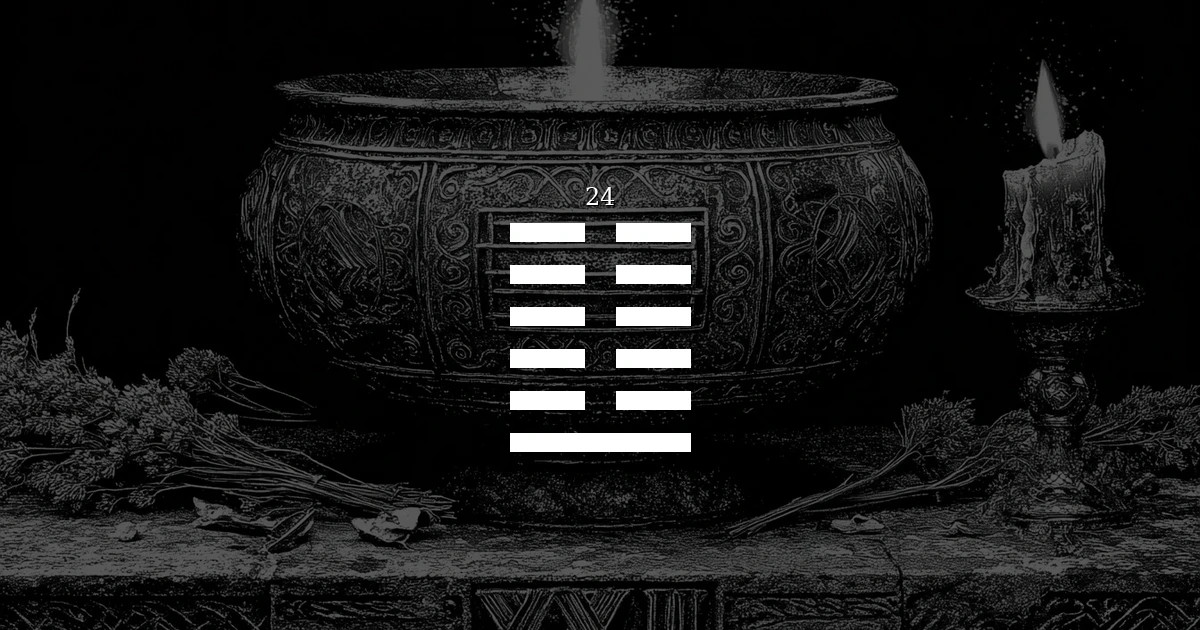
The same is true, in varying degrees, across most serious symbol systems: tarot’s imagery deploys visually and phenomenologically rich content whose associated meanings are anchored in bodily, emotional, and social experience; the I Ching’s natural imagery (thunder over water, mountain under heaven, fire atop fire) grounds abstract situation-descriptions in the sensory properties of natural phenomena; astrological symbolism deploys planetary associations (Mars’s heat and force, Venus’s softness and attraction, Saturn’s weight and restriction) whose experiential ground is partly astronomical-observational and partly extended metaphorically from bodily experience.
The Physical Ritual as Cognitive Participant
Embodied cognition also has specific implications for the role of the physical elements of divination practice — the shuffling of tarot cards, the casting of coins for I Ching, the rhythmic sorting of yarrow stalks, the act of writing a birth date and watching a calculation run — that pure-content accounts of these practices tend to underemphasize.
If cognition is grounded in bodily action and sensory experience rather than occurring in a disembodied abstract medium, then the physical actions surrounding a divination ritual aren’t merely delivery mechanisms for symbolic information that could equally well be conveyed in pure text. The physical engagement — the specific motor patterns, the tactile sensations, the slowing of pace and attention required by certain traditional practices — participates in the cognitive process in ways that likely shape what gets noticed, how the symbolic content gets interpreted, and what psychological states the practice induces.
This is consistent with research on what’s sometimes called the “ritual as cognitive scaffolding” thesis: the finding, across a range of traditions and experimental settings, that structured ritual actions — even ones whose causal connection to any intended outcome is implausible — can reliably induce specific cognitive and emotional states, influence subsequent performance and attention, and provide a form of behavioral structure that shapes perception and judgment in ways that aren’t fully explicable by the propositional content of the ritual alone. Connson Locke’s research on pre-performance rituals in sports and music settings found performance benefits even in practitioners who explicitly believed the rituals had no causal power — suggesting that the behavioral and embodied component of ritual can function somewhat independently of the belief framework surrounding it.
Gesture, Posture, and the Oracle
A further extension of the embodied-cognition framework concerns the role of posture and gesture in how symbolic content is processed. Research by Pablo Briñol, Richard Petty, and colleagues has found that posture influences self-evaluation (upright posture increases confidence in thoughts generated in that posture) and that bodily states that match the emotional or cognitive content of what’s being processed can facilitate certain kinds of thought, while incongruent bodily states can interfere.
For divination practice, this suggests that the context in which a reading is engaged with — whether one is upright and attentive, reclining passively, hurried or still — isn’t neutral with respect to what gets noticed, how the symbolic content gets processed, and what personal associations arise. This is not a claim that the “right” posture makes a reading more accurate in any predictive sense — it’s a claim that the embodied context shapes the cognitive process of engaging with the symbolic content in ways that the content alone doesn’t determine.
This is also part of why practices that have evolved around serious contemplative traditions — I Ching yarrow-stalk casting’s extended physical ritual, certain forms of tarot reading that include specific physical setup and grounding practices — may produce qualitatively different cognitive and psychological experiences than the same symbolic content delivered through a quick app notification, even when the underlying symbolic output is identical. The body’s participation in the process isn’t eliminated by making the process more efficient. It changes what the process does.
What Embodied Cognition Cannot Say
There’s a limit to this framework that’s important to state clearly: embodied cognition research establishes that symbol systems are not processed by a disembodied, purely abstract cognitive machinery — that the body participates in how meaning gets made from symbolic content. This is a genuine and important finding about cognition. It is not evidence that the symbolic systems themselves contain accurate information about anything external to the cognitive process.
A symbol system can be phenomenologically rich, bodily-grounded in its metaphorical structure, and cognitively engaging in the ways described above — all without its claims about the world (about personality, fate, celestial influence, or anything else) being predictively valid. The richness of the embodied engagement with a symbol system is partly independent of the truth-value of the system’s claims about external reality, in the same way that a beautifully constructed metaphor can be phenomenologically vivid and cognitively generative without necessarily being literally true.
What embodied cognition adds to the picture built up across this series is an account of why symbol systems feel different from purely propositional content when engaged with seriously — why consulting an oracle, even one the practitioner doesn’t believe in literally, can produce a kind of cognitive engagement that propositional reasoning alone doesn’t replicate. The body is part of how meaning gets made. The body doesn’t validate the claims about meaning that any particular system attaches to the symbols it uses.