
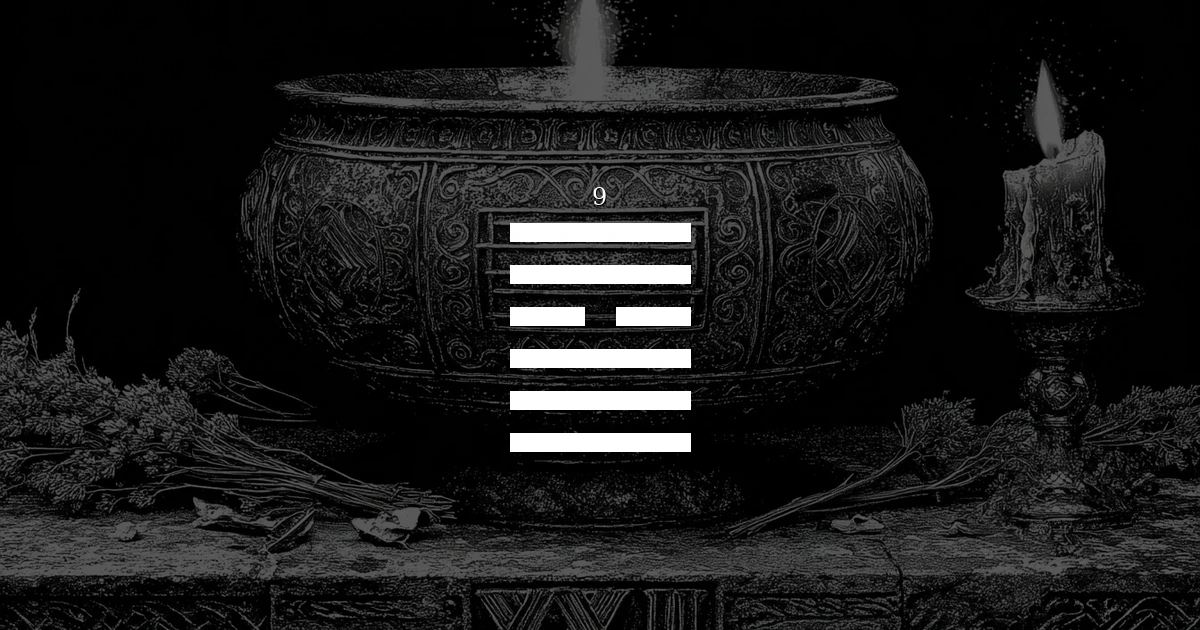
There is a particular frustration that follows a reading when it does not pan out. You consulted the I Ching on a career decision, received hexagram 29 — the Abysmal, water over water — and read it as a warning. You proceeded cautiously. Nothing bad happened. Was the reading wrong? Were you wrong to take it seriously? Or were you, without quite realizing it, asking the question incorrectly from the start?
The answer has less to do with the oracle and more to do with how probability works — specifically, with how most people, trained on yes/no thinking, encounter a tool that was never designed to produce yes/no outputs.
What Bayesian Reasoning Actually Is
Bayesian reasoning is named for the eighteenth-century English minister Thomas Bayes, who left behind an unpublished manuscript later developed by Pierre-Simon Laplace into what we now call Bayes’ theorem. The core idea is disarmingly simple: when you receive new information, you should update your beliefs in proportion to how much that information shifts the probability of what you already suspected.
Start with a prior — your best estimate of the likelihood of something before you have any new evidence. Encounter new evidence. Calculate a posterior — your revised estimate after incorporating that evidence. Repeat with every new piece of information you receive.
What makes this difficult in practice is that humans are not naturally Bayesian. We tend to update too dramatically on single pieces of vivid evidence (anecdotes, striking coincidences, memorable predictions) and not enough on statistical base rates (how often this kind of thing is actually true for people in similar circumstances). The cognitive science term for the first failure is availability bias; the second is base rate neglect. Both distort how people interpret divination.
Why the “Was It Right?” Question Is the Wrong Question
When someone evaluates an astrological reading or an I Ching hexagram, the implicit framework is usually binary: the reading either matched reality or it did not. This is prediction thinking — the assumption that an oracle is making a claim about what will happen, which can then be verified or falsified.
Bayesian thinking reframes the question entirely. Instead of asking “was the reading correct?”, it asks: “Did this reading shift the probability distribution of how I understand my situation?” These are not the same question, and they have very different answers.
A reading that draws your attention to the possibility of interpersonal conflict in the week ahead is not claiming conflict will occur. It is offering a lens — raising your prior probability that such dynamics deserve attention. If you go through the week more attentive to how your words land, and you navigate one conversation better than you otherwise might have, the reading has done something useful even if no dramatic conflict materialized. It shifted your priors, which changed your behavior, which changed the outcome. Evaluating it as “wrong because nothing bad happened” mistakes the mechanism entirely.
This is precisely what the self-fulfilling prophecy research shows from the other direction: beliefs alter behavior, which alters outcomes. The Bayesian frame simply makes this loop explicit rather than treating it as a flaw in the system.
Priors, Evidence, and the Oracle’s Role
In formal Bayesian reasoning, you enter every calculation with a prior. The prior encodes everything you already know: your history, your patterns, your circumstances. The new evidence — the reading, the hexagram, the day’s astrological configuration — gets weighted against that prior.
Here is what this means practically. If you draw a card warning of financial instability and you are, objectively, in a period of financial security with a stable job and no unusual expenses, the rational Bayesian response is to weight that reading lightly. Your prior is strong. The single data point of one tarot card should not — and in a genuinely thoughtful practice, does not — override everything else you know about your situation.
Conversely, if you have been tracking a pattern of difficulty in one area of your life, and a reading names exactly that area, you have just received a piece of evidence that is consistent with an already-elevated prior. A Bayesian would say: this raises my credence that this pattern deserves more deliberate attention right now. Not “the cards have confirmed my doom” — but “the signal is consistent, and consistency across multiple independent sources increases the probability that this deserves weight.”
This is not mystical. It is how you would interpret any structured prompt that draws your attention toward something you had already noticed but not fully examined.
Multiple Systems as Independent Evidence Channels
The Bayesian framing becomes especially interesting when you are working with more than one divination system at once. This is not the default mode for most apps or most practitioners, who tend to work within a single system. But when you bring multiple frameworks to bear on the same day or decision, something structurally different happens.
If your BaZi chart flags a particular month as demanding patience, and the I Ching cast for that same period returns a hexagram about restraint, and your Nine Star Ki position for the year is one traditionally associated with groundwork rather than action — you have three nominally independent systems pointing in the same direction. A Bayesian update on convergent evidence from independent sources is qualitatively stronger than any single piece of evidence alone.
This is true even if each system individually is unreliable. Imagine three instruments, each of which is right sixty percent of the time. If all three agree, the probability that their agreement reflects something real — rather than random convergence — is substantially higher than sixty percent. This is not a guarantee of accuracy. It is a meaningful update. The logic holds whether you are triangulating weather models or divination systems.
The limits of chaos theory in prediction make it clear that no system — astrological or otherwise — can generate certain forecasts about complex human lives. But certainty was never the goal of good oracular practice. Probability updates are.
The Calibration Problem: Why Vivid Readings Override Good Priors
One of the most consistent findings in behavioral economics is that people over-update on vivid, narrative evidence and under-update on statistical base rates. A reading that describes your personality with unusual precision — what the research on the Barnum effect and hit rate tracking examines in detail — feels more evidentially powerful than it actually is, because the vividness of the match triggers an emotional response that the rational calculator does not.
This is a real problem in divination practice. The reading that was “eerily accurate” in one memorable instance anchors your evaluation of the whole system more than the thirty readings that were generic or miss-adjacent. A Bayesian would say you are failing to update for the base rate — the frequency of accurate readings across all instances, not just the ones that stuck in memory.
The solution is not to stop using oracles. It is to keep some kind of record. Not to “test” the system in a way that forces binary outcomes onto inherently probabilistic guidance, but to develop a calibrated sense of when a given system — or a given type of reading — tends to surface information you find genuinely actionable, versus when it tends to produce ambient noise. Over time, this calibration is what separates a practitioner who is genuinely using divination as a thinking tool from someone who is being used by it.
What Good Updating Looks Like in Practice
A Bayesian who uses an oracle does not enter a reading hoping for validation of what they already believe. That is confirmation bias dressed in ritual clothing. Nor do they treat every reading as equally weighted evidence that should dramatically revise their plans.
What good updating looks like is something more like this: you begin a reading with an honest statement of your current priors. What do you actually believe about this situation, right now, before consulting anything external? Then you encounter the reading — the hexagram, the card spread, the day’s configuration across multiple systems. You ask: is this consistent with my prior? Does it raise or lower my confidence in what I already suspected? Does it draw attention to something I had discounted or ignored? And finally: given everything, including this new input, what is my best current estimate of the situation?
Notice that this process does not require believing the divination system has access to hidden truths about reality. It requires only that the system generate structured prompts that are unpredictable enough to surface information you would not have generated through ordinary directed thinking. The randomness in tarot, the yarrow-stalk probability distributions in I Ching, the fixed positional data in astrology — each provides a kind of external constraint that prevents you from simply generating the answer you were already leaning toward.
The Oracle as a Probability Interrupt
There is a useful concept in decision theory called the “red team” — a designated group whose job is to argue against the prevailing plan, specifically to counteract groupthink and challenge assumptions that have calcified into certainties. The oracle, understood Bayesianly, functions as a structural red team for your own mind.
Most of the time, your internal forecasting apparatus will generate predictions consistent with your existing priors. You will expect the things you have always expected, weight the evidence you find comfortable, and underestimate the possibilities that are outside your current frame. The reading interrupts this by pointing somewhere your attention was not already going. It does not tell you the truth. It tells you to update — to consider whether your confidence in your current model of the situation is as warranted as you assumed.
This is why the most sophisticated practitioners, across traditions, have always warned against over-literal reading. The I Ching’s great commentators were explicit that the text’s purpose was not to deliver verdicts but to generate questions. The same orientation applies to every system worth taking seriously: not “what does this predict?” but “what am I now obligated to consider that I was not considering before?”
Reading the Present, Not the Future
The Bayesian framing dissolves a false binary that traps most public conversation about divination: either oracles predict the future (which they cannot, reliably) or they are worthless superstition. Neither position is coherent once you understand what probability updating actually does.
Oracles do not need to be accurate predictors to be useful reasoning tools. They need to shift your priors in ways that improve your engagement with the actual decision or situation at hand. When they do that — when a reading genuinely surfaces something true about your present moment that you had been avoiding — they have done everything that a good thinking tool is supposed to do.
The question to ask after every reading is not “was this right?” The question is: “Did I come out of this with a more honest and complete picture of where I actually am?”
That is a question any Bayesian — religious, secular, skeptical, or enthusiastic — can ask. And it is the question The Whisper was built to help you answer.