
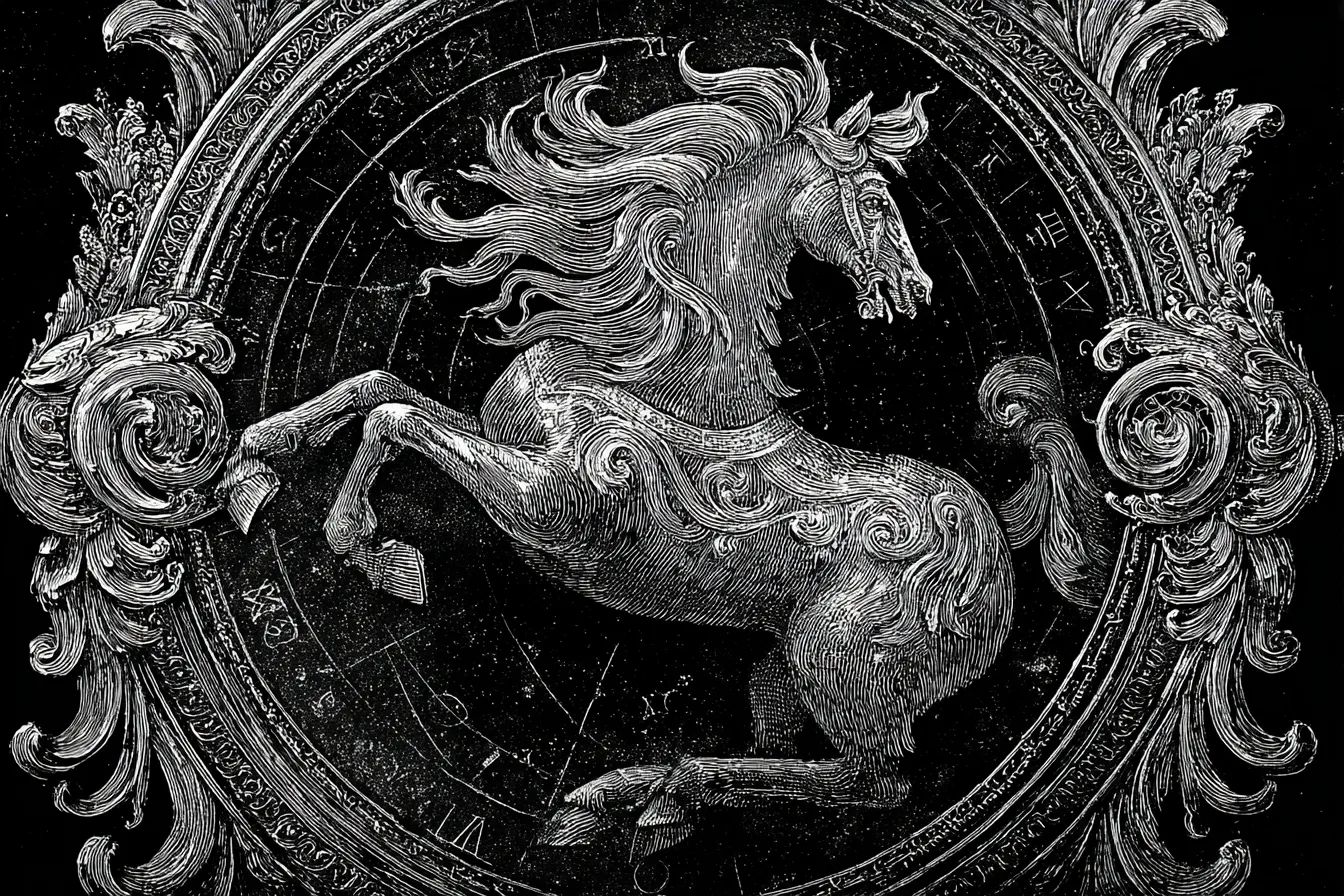
In the spring of 399 BCE, Chaerephon went to Delphi and asked the oracle whether any man was wiser than Socrates. The Pythia answered: no one. Socrates, hearing this, didn’t take it as flattery. He took it as a puzzle to be solved — and spent the rest of his life testing the oracle’s claim by talking to everyone reputed to be wise, finding them deficient, and concluding that if the oracle was right, it could only be because he alone knew that he knew nothing. The examined life had found its charter.
Three centuries later, the Stoics — Zeno, Chrysippus, Epictetus, Marcus Aurelius — were articulating a philosophy of radical rational self-governance. Know what is in your control and what is not. The external world, including the movements of planets and the pronouncements of oracles, lies outside. The internal world — your judgments, your will, your response to circumstance — is the only domain in which virtue, and therefore happiness, can be achieved. On the face of it, this looks like a repudiation of everything the oracle at Delphi represented.
It is not, quite. The apparent opposition dissolves when you look at what the Stoics actually believed about divination, and what the Delphic tradition was actually oriented toward. Beneath the surface disagreement about mechanism and authority, there is a convergence on something more fundamental — about the purpose of self-examination, the nature of what can and cannot be known, and the right relationship between knowledge and action.
What Delphi Was Actually Doing
The popular image of the Delphic oracle is of a smoke-inhaling priestess delivering cryptic prophecies that kings interpreted badly and thereby fulfilled. Perseus asks whether he should invade Persia; the oracle says a great empire will fall; he invades; his own empire falls. The oracle was right, technically. The lesson usually drawn is about hubris, or the futility of trying to outsmart fate.
But this reading misses what Delphi was actually doing in the majority of its consultations, which were not about military campaigns by great kings but about the small and medium-sized decisions of ordinary Greek life — should I move to this city, should I pursue this litigation, should I adopt this heir. And in those consultations, the oracle’s function was less oracular than we imagine. The process of consulting Delphi required extensive preparation: ritual purification, the formulation of a precise question, the interpretation of an often ambiguous response within a tradition of accumulated commentary. You did not leave Delphi with a clear answer. You left with a prompt, and the work of interpretation was yours.
The inscription carved into the pronaos of the temple at Delphi was not a prophecy. It was an instruction: γνῶθι σεαυτόν — know thyself. A second maxim, attributed to the temple with equal antiquity: mēden agan — nothing in excess. These are not the mottoes of a prediction machine. They are the mottoes of a reflective practice.
Delphi’s real function, across most of its seven centuries of active operation, was to create a structured occasion for self-examination. The journey itself — expensive, time-consuming, requiring you to articulate what you actually wanted to know — changed how you related to your question before you arrived. The ambiguous response sent you back to your own judgment, better prepared to use it. As an exploration of the oracle’s history examines, the institution endured not because it produced reliable predictions but because it reliably produced something else: a particular quality of attention to the questions that mattered.
What the Stoics Actually Believed About Divination
The Stoics are often cast as rationalist opponents of divination. This is partly true and mostly misleading.
The early Stoics — Zeno and Chrysippus in particular — were not opponents of divination. Chrysippus wrote treatises defending it. The Stoic position was that divination was possible in principle because the universe is a rational, interconnected whole governed by logos — a kind of immanent reason — and that a sufficiently skilled reader of signs could, in principle, read that whole through its parts. The flight of birds, the arrangement of entrails, the positions of planets — these were not magical causes of events but signs of a coherent cosmic order, legible to those trained to read them.
This is a sophisticated position, and it has a family resemblance to what serious practitioners of astrology and BaZi have always claimed: not that the stars cause your circumstances, but that the patterned whole expresses itself consistently across its parts, and that one set of patterns can be read through another. The relationship between stoicism and astrology runs deeper than the surface opposition suggests.
The Stoics did become skeptical of specific divinatory practices on empirical grounds — Cicero’s De Divinatione, which engages seriously with both sides, documents the skeptical case within the Roman Stoic tradition. But the objection was not that divination was in principle incompatible with reason. It was that particular methods — extispicy, augury, astrology as practiced — didn’t reliably deliver what they promised. This is an empirical objection about implementation, not a philosophical objection about the very idea of reading patterns.
What the Stoics consistently rejected was a particular use of divination: the use that made people passive, that caused them to abdicate their rational agency in favor of external authority. Epictetus, the freed slave who became one of the most rigorous Stoic teachers, addressed this directly: when you go to the oracle, don’t take the question “will this happen?” — take the question “how should I respond to what happens?” The oracle as an occasion for abdicating judgment is incompatible with Stoic ethics. The oracle as an occasion for clarifying what matters and sharpening the will — that is something else.
The Point of Agreement
Strip away the specific mechanisms — the Pythia’s vapor, the planetary positions, the hexagrams — and what remains is a shared orientation that both Delphi and the Stoics were organized around.
First: the examined life is the prerequisite for right action. The Delphic maxim know thyself is not decorative. It names the work without which good decisions are impossible. The Stoic practice of the evening examination — Marcus Aurelius’s nightly review, Meditations as a record of self-interrogation — is the same injunction in practice. You cannot act well from a self you have not examined. The tools for examination differ; the necessity does not.
Second: the goal is clarity about what is and isn’t in your control. The oracle, in its best consultations, was not in the business of removing uncertainty. It was in the business of locating where the uncertainty actually lived — distinguishing what could not be changed from what could, redirecting attention from the uncontrollable to the actionable. The Stoic dichotomy of control — eph’ hēmin and ouk eph’ hēmin, up to us and not up to us — is structurally the same move. What both traditions are trying to produce is not certainty about outcomes but clarity about agency.
Third: the consultation is not the answer — it is the beginning of the work. No Greek who consulted Delphi was supposed to simply implement the oracle’s verdict. The ambiguity of the response was not a defect but a design feature, forcing the consulter to engage their own judgment. The Stoics were explicit that reason — not authority, not tradition, not even the gods — was the final court of appeal for practical decisions. Both traditions converge on the position that external frameworks are useful for prompting thought, not for replacing it.
Why This Convergence Matters Now
There is a tendency in contemporary divination practice to choose between two inadequate frames. The first: the reading is authoritative, and the right posture is receptive trust. The second: the reading is entertainment, and the right posture is amused detachment. Neither frame is what Delphi or the Stoics were offering.
What they were offering was a third posture, harder to maintain: engaged critical receptiveness. You bring your real questions — not test questions, not questions you already know the answer to, but the ones that actually disturb your sleep. You receive the response, whatever form it takes, with enough openness to be genuinely surprised and enough judgment to evaluate what you’ve received. And then you do the work of integration: fitting the response against your knowledge of your actual situation, your values, your sense of what matters, and acting from the result.
This is demanding. It requires holding two things simultaneously that it’s easier to have in sequence: openness to what the framework offers, and confidence in your own capacity to evaluate it. It’s the posture of someone who reads a wise book not to be told what to think but to think better — someone who can take the I Ching’s hexagram or the BaZi chart seriously without taking it as final.
The oracle at Delphi lasted as an institution for roughly seven centuries. Stoicism, in one form or another, has been a continuous influence on Western ethics for two and a half millennia. Both survived as long as they did because they were organized around something that actually works: the insight that the most important navigation is internal, that the quality of your attention to your own situation is the primary variable in how well you act, and that structured occasions for that attention — however imperfect their mechanisms — have genuine and enduring value.
Know thyself. The oracle carved it in stone. The Stoics built a practice around it. The distance between them was always smaller than it looked.