
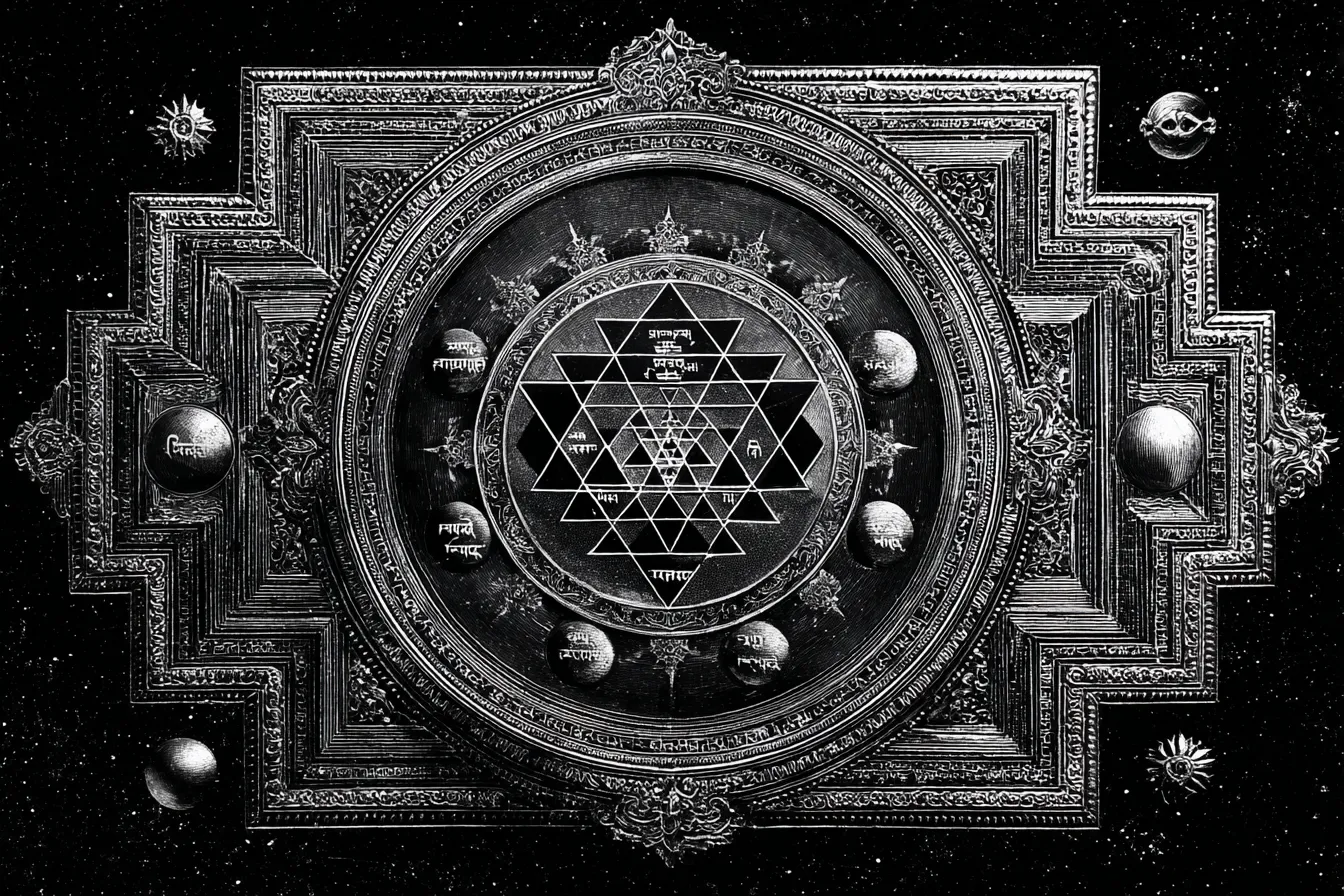
One of the most disorienting things that can happen in a life is a period when everything feels like it’s being reorganized around a single theme — when career, identity, relationships, and energy all seem to be responding to the same underlying current, pulling in the same direction or demanding resolution of the same recurring question. People often describe these periods as feeling “charged,” or like they’re finally operating closer to the surface of what actually matters.
In Vedic astrology, that’s not a metaphor. It’s the dasha system at work.
What the dasha system is
The Vimshottari dasha system is one of Jyotisha’s most distinctive contributions to astrological timing. Rather than tracking the current positions of transiting planets alone (as Western astrology primarily does), the dasha system assigns each person a sequence of planetary periods — called mahadashas — based on which nakshatra (lunar mansion) the Moon occupied at birth.
The total cycle runs 120 years, divided among nine planetary rulers: Sun (6 years), Moon (10 years), Mars (7 years), Rahu (18 years), Jupiter (16 years), Saturn (19 years), Mercury (17 years), Ketu (7 years), and Venus (20 years). The sequence is always the same; what varies is where you enter it, determined by your Moon’s nakshatra at birth. Within each mahadasha, there are smaller sub-periods — antardashas — ruled by each of the nine planets in turn, adding another layer of specificity.
The result is a planetary timeline unique to each individual, showing which planet’s energy and themes will be most active at which point in a life.
The Sun Mahadasha: core themes
The Sun Mahadasha lasts six years — the shortest of all the planetary periods, which itself says something. The Sun in Jyotisha is the planet of the soul’s expression in the world: authority, vitality, identity, government, the father and father figures, public recognition, and the capacity to illuminate rather than merely accumulate. Six years of solar emphasis tends to feel concentrated — significant events often happen relatively quickly, without the long gestation typical of slower periods like Rahu (18 years) or Saturn (19 years).
The quality of your Sun Mahadasha depends substantially on the condition of the natal Sun in your birth chart — its sign, house, strength, and the aspects it receives from other planets. A Sun that is well-placed (in Aries where it’s exalted, or in Leo where it rules) will produce a Sun Mahadasha that tends toward genuine recognition, career achievement, and a consolidation of identity. A Sun in a challenging position — in Libra where it’s debilitated, or heavily aspected by Saturn or Rahu — may produce a Sun Mahadasha that involves confronting obstacles around authority, recognition, or the relationship with the father.
Neither version is simply good or bad. Both are solar — both center the themes of who you are, what you stand for, and how you’re seen by the world.
What tends to happen during Sun Mahadasha
Career and public life typically become more prominent during a Sun Mahadasha, regardless of the Sun’s condition. The solar energy has a centripetal quality — it pulls life toward the question of what are you here to do? in the most concrete, worldly sense. This period often brings encounters with authority structures (employers, institutions, governments), either as a beneficiary or as someone navigating friction with them.
For people in leadership roles, the Sun Mahadasha can be a period of significant consolidation and recognition. For those still developing their professional identity, it often brings defining choices — moments when the question “what kind of work do I actually want to be doing?” becomes impossible to defer.
The relationship with the father or father figures tends to be activated. This can mean literally — events involving a father’s health, death, or changing circumstances — or more psychologically, in the form of recurring questions about paternal authority, approval, and the degree to which one has individuated from parental expectations.
Health and vitality often become more salient. The Sun rules the physical heart and general vitality in classical texts. During a Sun Mahadasha, the body’s energy levels become a more direct reflection of one’s alignment with one’s actual purpose. When the period is going well — when work is meaningful, identity is clear, and one’s sense of authority is grounded — physical vitality tends to be high. When there’s misalignment, the body tends to signal it more audibly than at other times.
The sub-periods within Sun Mahadasha
Within the six-year Sun Mahadasha, each of the nine planets rules a shorter sub-period (antardasha). These sub-periods color the mahadasha’s expression with additional planetary textures.
The Sun-Sun period, which opens the mahadasha, is often the most intensely solar phase — matters of identity, career, and recognition come to the foreground most directly. The Sun-Moon period often brings greater emotional complexity to the solar themes, with domestic life, relationships, and inner emotional experience intersecting with the outward directedness of the solar period. The Sun-Mars period is typically active and driven, sometimes combative — there may be more conflict with authority figures or a stronger impulse toward assertion and independence.
The Sun-Rahu and Sun-Ketu sub-periods are often the most complex. Rahu amplifies and complicates the Sun’s themes — ambition can become excessive, recognition can feel hollow, or situations involving public life may take unexpected turns. Ketu in the Sun’s mahadasha can bring a more inward or spiritually-tinged quality to an otherwise outward period — sometimes including events that pull a person away from conventional career paths toward something less definable.
Sun-Saturn is classically described as one of the more challenging sub-periods, since Saturn and the Sun are natural enemies in Jyotisha (representing subordinates and authority respectively, or, more philosophically, the democratic principle of time and equality meeting the aristocratic principle of hierarchy and distinction). During this sub-period, delays, obstacles, and lessons around humility and structural limitation often intensify.
How the natal Sun’s placement shapes the experience
If your natal Sun sits in the 1st house, the Sun Mahadasha tends to be a period of pronounced self-expression, increased visibility, and a strong orientation toward personal agency. Health and vitality are particularly featured.
A natal Sun in the 10th house (its natural house of exaltation in terms of worldly impact) typically makes the Sun Mahadasha a peak career period — one of the most professionally significant phases of the life, often involving public recognition, leadership responsibility, or a defining achievement.
A natal Sun in the 12th house will produce a more inward, complex Sun Mahadasha — one where the standard solar drive toward recognition may be redirected toward spiritual work, creative expression in private, or work done in institutional or retreat settings. The recognition, when it comes, may be less public than the person expected.
A natal Sun aspected by Saturn suggests a Sun Mahadasha involving confrontation with limitation, the father, or structures of authority — but also the possibility of earning recognition through sustained effort rather than sudden visibility.
Navigating a Sun Mahadasha
The most useful orientation during a Sun Mahadasha is toward clarity — clarity about what you actually stand for, what kind of work genuinely reflects your values, and whether the public role you’re occupying or seeking is authentically yours rather than something inherited, assumed, or adopted to satisfy others’ expectations.
The solar period has a particular intolerance for inauthenticity. People who spend it performing an identity that doesn’t quite fit often find that the period generates friction — not punishment, but the pressure of a system trying to correct toward alignment. People who spend it clarifying what actually matters and moving toward it tend to look back on those six years as defining.
This doesn’t mean the Sun Mahadasha is a period for dramatic reinvention. Sometimes it’s the period when what you’ve been building for years finally receives the recognition it deserves — a solar illumination of what was already true. The six years don’t have to feel like a crisis to be significant.
The Whisper’s Vedic layer reads your current dasha period — including where you are within the Sun Mahadasha if that’s your active period — as one input into your daily synthesis. The question the solar period asks, in one form or another, is always the same: what is the clearest, most authentic expression of what you’re actually capable of? The specific form that question takes on any given day depends on the sub-period, the current transits, and everything else the chart is doing. But the underlying current remains solar.
When the Sun Mahadasha ends
After six years, the Sun Mahadasha gives way to the Moon Mahadasha — a ten-year period with a very different quality. Where the solar period is outward, centripetal, and focused on identity and recognition, the lunar period turns attention inward, toward emotional life, domestic concerns, and the quality of one’s inner experience. Many people experience this transition as a kind of release — the pressure of the solar period lifting, replaced by a more receptive, fluid orientation.
Understanding where you are in the dasha cycle is one of the most practically useful things Jyotisha offers. It doesn’t tell you what will happen. What it tells you is what kind of attention the period calls for — and that alone can make the difference between moving through a phase unconsciously and engaging with it deliberately.