
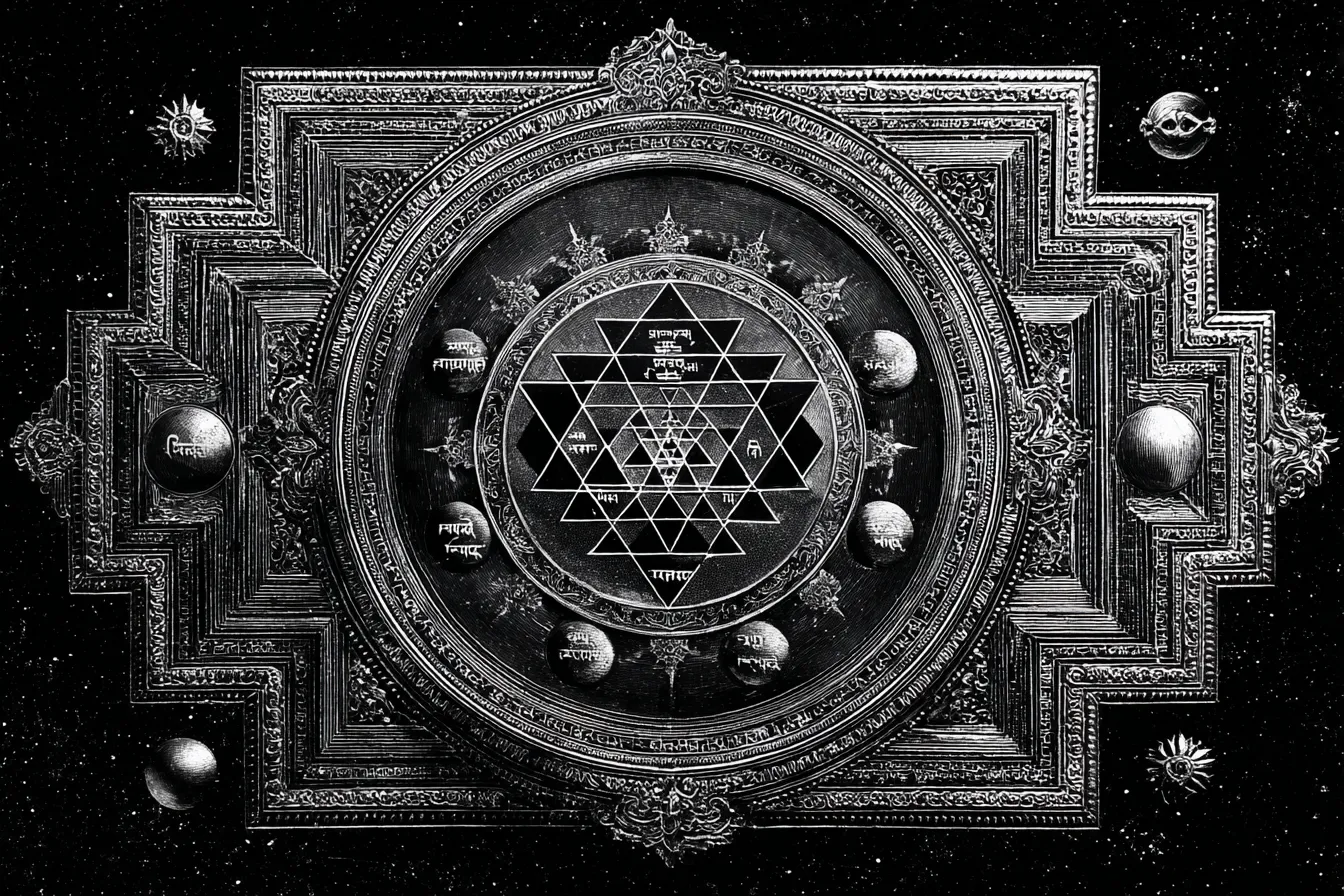
What is Siṃha in Vedic astrology?
Siṃha — the Lion — holds a singular position in the Jyotiṣa zodiac: it is the only sign ruled by a single luminary. The Sun (Sūrya) rules Siṃha alone, without sharing that rulership across two signs the way every other planet does. In classical Jyotiṣa — the Indian astrological tradition documented across the Vedāṅgas and in foundational texts such as the Bṛhat Parāśara Horā Śāstra and Varāhamihira’s Bṛhat Jātaka — this singular relationship between sign and planet carries real weight. Siṃha is where the Sun is not merely a planet passing through, but the ruler in its own domain, expressing its qualities without compromise or modification.
The same foundational clarification matters here as for every Vedic sign: Jyotiṣa uses the sidereal zodiac, anchored to fixed stars, rather than the tropical zodiac of Western astrology, anchored to the seasons. The current ayanāṃśa (the accumulated precession shift between the two systems) places the Vedic Siṃha solar period from approximately August 17 to September 16 — about one month after the Western Leo period. If you identify as a Western Leo, your Vedic sun sign most likely falls in Karkaṭa (Cancer). These are genuinely distinct systems, not the same system with different names.
In The Whisper, your birth rāśi is determined primarily by your Moon sign (Chandra Lagna) — the sign the Moon occupied at birth. Classical Jyotiṣa prioritises the Moon because it governs manas, the mind and emotional-processing faculty, making it the most direct indicator of how you experience daily life. If your birth time is known, your Lagna (Ascendant) is also incorporated. These natal placements are synthesised with the day’s current planetary transits and the active Nakshatra (lunar mansion) to produce your daily reading across all fifteen systems.
The classical roots of Siṃha
In the Jyotiṣa textual tradition, Siṃha is described as the svakṣetra (own sign) of the Sun — and because the Sun rules only this one sign, the relationship is total. Every other planet governs two signs, distributing its qualities across two modes of expression. The Sun governs one. What this means in practice is that the Siṃha quality is the solar quality in its purest, most concentrated form: the quality of light that does not arrive here as a visitor but as the resident.
The classical texts associate Siṃha with rāja (kingship) not in the political sense but in the dharmic sense — the one who holds authority because they genuinely know what the situation requires and are willing to act from that knowing without requiring consensus first. The Sanskrit root siṃha carries the associations of strength, but also of the generosity that arises from genuine power. The lion does not hoard; it presides. The distinction matters: Siṃha is not about accumulation but about the creation of a field in which others can operate.
The sthira (fixed) modality deepens this quality considerably. Sthira fire is not the initiating spark of Meṣa; it is the sustained flame — the fire that holds its warmth through all seasons, that does not require the excitement of new fuel to maintain its light. The Lion in its fixed-fire mode is the one who keeps showing up, who holds their position through seasons of difficulty and seasons of ease alike, whose quality of presence does not fluctuate with the approval of the room.
The energy of Siṃha
The core Siṃha quality is perhaps best captured by a single classical concept: ātmakāraka — the significator of the self. The Sun is the ātmakāraka in Jyotiṣa, the planet that represents the soul’s purpose and the quality of genuine self-expression. In Siṃha, this quality is at home. The sign is where the Sun is most completely itself, which means Siṃha energy tends to orient everything it encounters toward the question of genuine expression: what is this situation actually calling for, and am I willing to provide it fully?
This is not vanity, though it can look like it from the outside. The Siṃha quality has no particular interest in performing; it is interested in being — and being fully, without the self-diminishment that social life often requires. The Lion’s dignity is not arrogance. It is the quality of the one who has moved past the need to prove what they are, because what they are has become sufficiently clear — to themselves, at minimum. The classical texts consistently distinguish between the genuine solar authority that Siṃha represents and the compensatory displays of those who have not yet earned that authority from within.
The sthira-Agni (fixed-fire) element combination gives Siṃha its particular quality of warmth. Fire in its initiating mode (Meṣa) produces heat and motion. Fire in its fixed mode (Siṃha) produces sustained light and warmth — the quality that makes it possible for others to gather around, to work, to see clearly. This is one way to understand Siṃha’s natural orientation toward creative self-expression: the expression is generative for others, not merely satisfying for the self.
The sidereal Siṃha period falls in mid-August to mid-September — the Sun in its own sign at the height of summer’s sustained heat. The year has passed its peak of light, but the warmth remains full and unhurried. There is no urgency here; there is simply continued, reliable presence. This captures the Siṃha quality in its seasonal form.
Siṃha as a birth sign: Lagna, Moon, and Sun
Siṃha Lagna shapes the physical constitution and the fundamental worldly orientation. Those with Siṃha rising tend toward a natural presence of authority and dignity — not the authority that is claimed, but the authority that is simply there, that others orient around without being asked to. The Sun (Sūrya) becomes the chart ruler (lagnādhipati), and its placement in the chart — which sign, which house, what aspects it receives — becomes the most important single factor for understanding how the Siṃha Ascendant native operates. Classical texts associate this rising sign with a constitution that tends toward vitality and warmth, with a natural orientation toward leadership, and with a relationship to creative expression that is both genuine and sustained.
Siṃha Moon (Chandra in Siṃha) describes the emotional mind in its relationship to solar qualities. The Moon in Siṃha tends toward a quality of emotional generosity — feeling is expressed openly, given fully, and the warmth of the Siṃha Moon tends to be genuinely experienced by those who receive it. There is a natural quality of magnanimity here: the Siṃha Moon does not keep emotional accounts carefully; it gives, because giving is what it does. The challenge is that the fixed-fire Moon can have difficulty with the seasons of diminishment that are part of any sustained life — the periods where the warmth is less visible, where the light is turned inward rather than outward. The Siṃha Moon can experience these periods as a kind of failure of self, when they are in fact simply winter.
Siṃha Sun (Sūrya in Siṃha) is the Sun in its own sign — a genuinely powerful placement. The solar qualities of clarity, authority, vitality, and the drive toward genuine self-expression all operate here without the friction that arises in less congenial signs. Classical texts treat this as a dig bala (directional strength) context for the Sun’s qualities: the purposive drive is clear, sustained, and oriented toward dharmic expression rather than personal ambition alone.
Strengths and growth edges
The Siṃha strengths are those of genuine solar authority — and it is worth being precise about what that means, because the concept is easily caricatured. The natural authority that others trust is not the same as dominance or rank. The Siṃha quality that earns trust does so because it arises from a genuine centre that is not performing — and the difference between performed authority and genuine authority is perceptible to almost everyone at the level of direct experience. People follow genuine authority; they comply with performed authority while privately reserving judgment. Siṃha placements, at their best, attract the former.
The generosity that gives fully is equally significant and equally misunderstood. Classical texts consistently associate Siṃha with generous spirit — the willingness to give without calculating what the return will be. This quality arises from the sthira-fire’s fundamental orientation: the sustained flame does not diminish by sharing its warmth; it is simply what it does. Siṃha generosity is structural, not occasional.
The creative self-expression that does not require approval is perhaps the most practically valuable of Siṃha’s strengths, precisely because approval-independence is genuinely rare. Most creative expression is shaped, consciously or not, by the anticipated response of an audience. Siṃha placements, when functioning well, produce from a genuine internal necessity rather than from audience management.
The growth edges arise from the same solar-fixed-fire nature. The solar authority that becomes the need for acknowledgment is the most common challenge: the sustained flame that begins to require the reflection of others’ appreciation to know that it is still burning. This is the reversal of genuine solar authority — where genuine authority requires no confirmation, this version requires constant confirmation, which makes it fragile in exactly the way genuine authority is not. The signal is usually a sensitivity to being overlooked that is disproportionate to the actual situation.
The generosity that expects reciprocal recognition follows the same pattern. When the giving that was structural and unconditional begins to carry an unspoken account — when the lion begins to notice who has and has not shown adequate appreciation — the sthira-fire quality has turned toward fixity rather than warmth.
What Siṃha means in The Whisper
When The Whisper integrates a Siṃha placement into a daily reading, it draws on the natal solar quality, the day’s planetary transits affecting the sign and its ruler the Sun, and the active Nakshatra through which the Moon is moving.
Three Nakshatras fall within Siṃha, each bringing a distinct colouration to the sign’s solar-fixed-fire quality. Maghā (ruled by Ketu, associated with the Pitṛs — the ancestral beings — and with the royal throne) occupies the early degrees of Siṃha and gives the sign its quality of ancestral authority. Maghā is the Nakshatra of the throne room: the authority that has been inherited from those who came before, the dignity that carries the weight of lineage. For those with planets in the Maghā degrees of Siṃha, the question of what has been received from the ancestors — what strength, what obligation, what unfinished work — is often present in some form. Pūrvā Phālgunī (ruled by Venus, associated with Bhaga the deity of pleasure and good fortune) gives the central degrees of Siṃha their quality of the generous, pleasure-oriented, creative fullness that arises when the solar authority is secure and at ease. Pūrvā Phālgunī is the Nakshatra of rest, of the hammock between two fig trees, of the enjoyment that is only possible when one is not striving — and it gives Siṃha’s fixed-fire quality its capacity for genuine delight. Uttarā Phālgunī (first pada, ruled by the Sun, associated with Aryaman the deity of hospitality and social bonds) bridges Siṃha into Kanyā and gives the later Siṃha degrees their quality of generous, principled social responsibility — the solar authority expressed through the creation of bonds that genuinely nourish the community.
In cross-system terms, The Whisper resonates the Siṃha quality with Western Astrology’s tropical Leo — with the important note that the sidereal shift places the two signs approximately one month apart in the solar year, and the Vedic Siṃha’s emphasis on dharmic authority and rāja yoga potential gives it a more explicitly social-moral dimension than the Western Leo emphasis on creative self-expression and individual confidence. In BaZi terms, the Siṃha quality resonates with Bīng Fire (丙火) at its fullest — the Sun’s own fire; the midday light that illuminates the space simply by being present. In Nine Star Ki, the resonance falls with 9 Fire — the full visibility and radiance quality, the Ki that corresponds to presence that cannot be concealed.
As with all Vedic integrations in The Whisper, this works with Rāśi, Lagna, and Nakshatra. It does not calculate Dasha periods, Ashtakavarga scores, or divisional charts (Varga) — for that depth, a qualified Jyotiṣa practitioner is needed. What The Whisper offers is the daily integration of your Siṃha quality with the current planetary conditions: one clear lens among fifteen.
Frequently asked questions
Q: Why does the Sun only rule one sign in Vedic astrology, when every other planet rules two?
In classical Jyotiṣa, the seven traditional planets (Sun, Moon, Mars, Mercury, Jupiter, Venus, Saturn) each rule the zodiacal signs. Six of the seven — Mercury, Venus, Mars, Jupiter, Saturn, and the Moon — rule two signs each, expressing their qualities in two different modes. The Sun alone rules only one: Siṃha. The Moon rules Karkaṭa. The significance is that the Sun’s qualities — solar authority, vitality, self-expression, the clarity of genuine centre — have only one zodiacal home. Siṃha is that home, without division or compromise.
Q: What is a rāja yoga in Jyotiṣa, and why is Siṃha associated with it?
A rāja yoga (literally “royal combination”) in Jyotiṣa is a specific planetary combination in the natal chart that classical texts associate with significant social authority, success, and the capacity to rise to positions of genuine influence. Siṃha is associated with rāja yoga potential not because every Siṃha placement automatically produces one, but because the sign’s solar-fixed-fire quality is inherently oriented toward the kind of genuine authority that rāja yogas describe. Whether a specific rāja yoga is present in a chart depends on the precise placement of the chart ruler and the planets involved — this is one reason why a full Jyotiṣa consultation goes considerably beyond sign-level interpretation.
Q: How does The Whisper incorporate my Siṃha placement into a daily reading?
Your Siṃha Moon or Lagna provides the stable background quality — the sustained solar warmth and authority that characterises how you engage with experience day to day. The daily layer adds the current planetary transits affecting Siṃha and its ruler the Sun (the Sun moves through a sign roughly once a month), and the Nakshatra the Moon is transiting: Maghā, Pūrvā Phālgunī, or the first pada of Uttarā Phālgunī each bring a distinct quality to the reading. These Vedic inputs are then synthesised with your Western Astrology, BaZi, Nine Star Ki, and other active systems into a single daily insight — not a prediction of what will happen, but an informed set of perspectives on what is already present.