
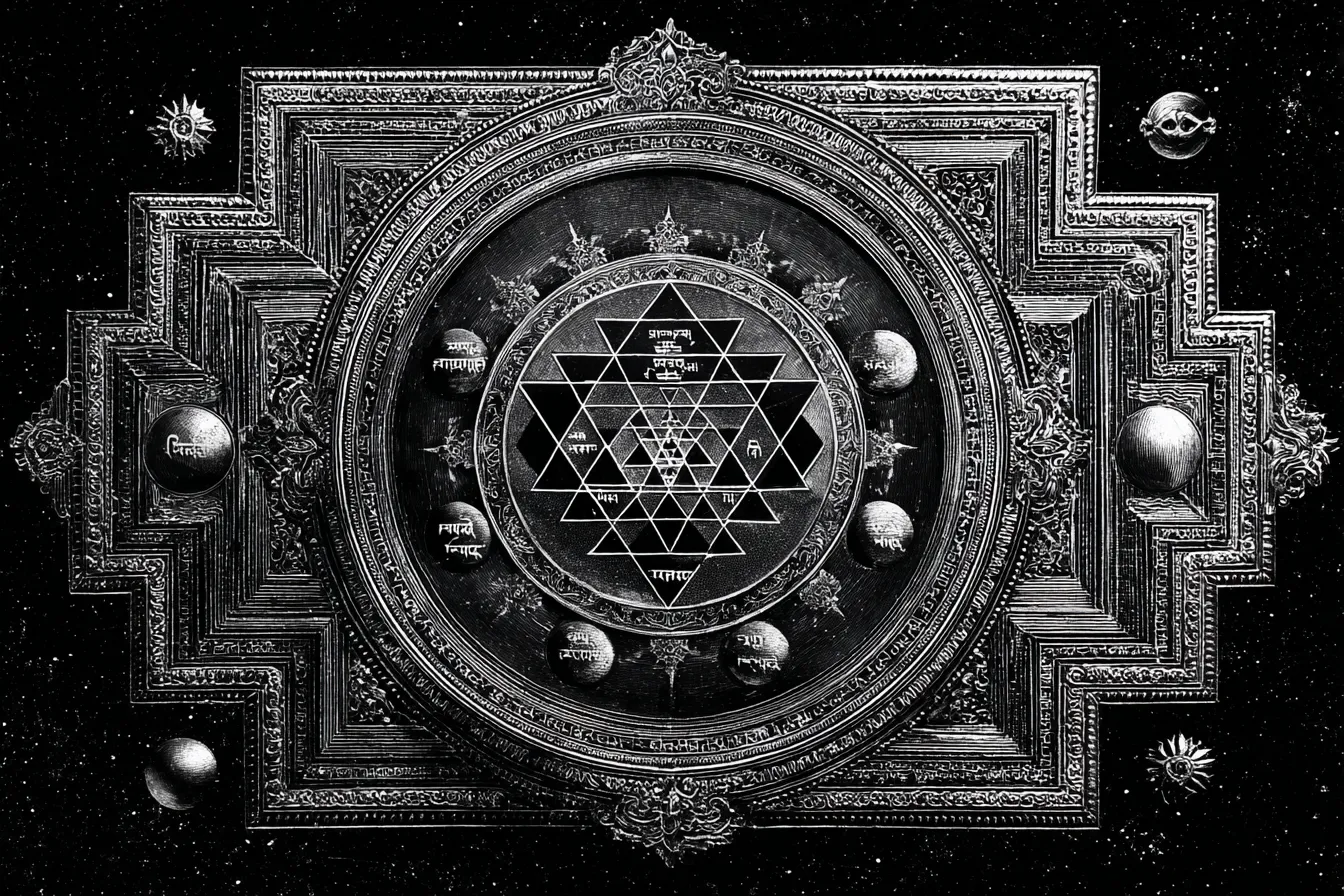
What is Dhanus in Vedic astrology?
Dhanus means “the bow” — and the image carries more than a passing resemblance to adventure. In the Vedic tradition, the archer’s bow is a precision instrument of purpose: it does nothing until the archer has found stillness, drawn fully, aimed exactly, and chosen the moment of release. The arrow, once released, cannot be recalled. Dhanus is the ninth sign in the classical rāśi sequence of Jyotiṣa, the Indian astrological tradition documented across more than three thousand years of continuous textual history and one of the six Vedāṅgas (auxiliary limbs of the Vedas). In that tradition, Dhanus is the sign of jñāna — not knowledge as information, but knowledge as the living inquiry that, pursued far enough, has the capacity to liberate.
The sidereal clarification matters here as for every Vedic sign: Jyotiṣa uses the sidereal zodiac, referenced to fixed stars, while Western astrology uses the tropical zodiac, referenced to the seasons. The ayanāṃśa (the accumulated precession shift) currently amounts to approximately 23 degrees, placing the Vedic Dhanus solar period from roughly December 16 to January 13 — about one month after the Western Sagittarius period. If you identify as a Western Sagittarius, your Vedic sun sign most likely falls in Vṛścika (Scorpio). The two systems are genuinely distinct in their calculation and in important aspects of their interpretive emphasis.
In The Whisper, your birth rāśi is determined primarily by your Moon sign (Chandra Lagna) — the sign the Moon occupied at birth. Classical Jyotiṣa gives primacy to the Moon because it governs manas, the mind and emotional-processing faculty — the most direct indicator of how daily experience is actually felt from the inside. If your birth time is known, your Lagna (Ascendant) is also incorporated. These natal placements are then integrated with the current day’s planetary transits and the active Nakshatra (lunar mansion) across all fifteen systems in your daily reading.
The classical roots of Dhanus
Jupiter (Guru, also called Bṛhaspati) rules two signs in Jyotiṣa: Dhanus and Mīna. They are not repetitions of the same quality; they are two genuinely distinct expressions of Jupiterian intelligence. Mīna (Pisces) is Jupiter in the water element — the expansive, oceanic, boundary-dissolving quality where accumulated wisdom dissolves into direct experience, where jñāna becomes bhakti and the seeker merges with what is sought. Dhanus is Jupiter in the fire element — the purposive, directional, teaching quality where wisdom is pursued through inquiry and then transmitted through the guru function. Where Mīna is Jupiter as ocean, Dhanus is Jupiter as the flame that illuminates the path.
In classical Jyotiṣa, the guru is not merely a teacher in the academic sense. Bṛhaspati, the planet’s deity, is the guru of the gods — the one who provides the philosophical framework within which right action becomes possible. The guru function is the transmission of understanding that genuinely changes how the receiver sees, rather than merely adding to what they already know. Dhanus is the sign most closely associated with this function: not the student (that role belongs more to Mithuna’s Mercury-curiosity), but the one who has accumulated genuine understanding and now serves as its conduit.
The dvisvabhāva (dual or mutable) modality gives Dhanus its particular relationship to form. Dvisvabhāva fire is not the fixed-fire of Siṃha, which holds its position through all seasons, nor the chara-fire of Meṣa, which initiates and moves on. Dvisvabhāva fire adapts its form to the question at hand — it can take the shape of direct teaching, of Socratic inquiry, of silent transmission, of the philosophical text, of the parable. The Dhanus quality does not insist on a single form of knowledge transmission; it uses whatever form the understanding requires.
The ninth position of Dhanus in the natural zodiac is significant. In classical Jyotiṣa, the ninth house is the dharma house — the house of higher knowledge, of the guru, of bhāgya (fortune that arises from right action), and of the philosophical framework within which one’s life is understood. The ninth sign carries a related quality: Dhanus is the sign that is most naturally oriented toward the big questions — not because it is especially spiritual in a devotional sense, but because it cannot be satisfied with answers that do not account for the whole.
The energy of Dhanus
Dhanus energy is recognisable by what it cannot be satisfied with. Where Vṛścika cannot be deflected from depth, Dhanus cannot be deflected from range. The question that appears to have been answered always reveals another question behind it; the understanding that seemed complete always opens onto a wider context that the previous understanding had not accounted for. This is not restlessness in the ordinary sense — it is a structural orientation toward the horizon, the recognition that the real truth is always a little further than the current position.
The fire element (Agni tattva) gives Dhanus its particular quality of illumination. Meṣa’s fire initiates; Siṃha’s fire warms and sustains; Dhanus’s fire shows the way. The torch held up to light the path for others is an apt image for the Dhanus quality at its most functional. The philosophical understanding that Dhanus seeks is not kept private; the guru function is fundamentally oriented toward transmission — toward the passing on of what has been genuinely understood.
The archer’s posture is worth dwelling on. To release the arrow correctly, the archer must first become still. The bow must be drawn to full tension — which requires both strength and patience. The aim must be true before the release. This is a precise description of how Dhanus operates at its best: the philosophical question is held fully drawn, in genuine tension, without premature release — until the moment of insight arrives and the arrow can be released with precision. The Dhanus growth edge is the archer who releases too early, before the stillness has been reached.
The sidereal Dhanus period falls in mid-December to mid-January — the approach to and passage through the winter solstice in the northern hemisphere. The year has reached its point of maximum darkness and is turning back toward light. The philosophical resonance is immediate: Dhanus is the sign that seeks the return of light, that holds the torch at the darkest point, that transmits the understanding that makes the turn possible. Makara Saṃkrānti, which follows in the next sign, is the festival of the return of solar light; Dhanus is the inquiry that prepares for it.
Dhanus as a birth sign: Lagna, Moon, and Sun
Dhanus Lagna shapes the physical constitution and fundamental worldly orientation. Those with Dhanus rising tend toward a quality of expansive engagement with the world — an orientation that reaches naturally toward what is larger, more comprehensive, more philosophically significant than the immediately available. Jupiter (Guru) becomes the chart ruler (lagnādhipati), and its sign, house, and aspects in the natal chart become especially significant for understanding how the Dhanus Ascendant native engages with the world. Classical texts associate this Ascendant with a constitution that tends toward expansiveness — in body, in spirit, in appetite for experience — and with a natural orientation toward teaching, learning, and the pursuit of understanding as a way of life.
Dhanus Moon (Chandra in Dhanus) describes the emotional mind in its relationship to the Jupiter-fire-dvisvabhāva quality. The Moon in Dhanus tends to process experience through the search for meaning — feelings are most fully integrated when they can be understood within a larger context, when the specific event can be connected to a pattern or principle that illuminates why it matters. This is a fundamentally optimistic emotional quality: the Dhanus Moon tends to find possibility where others find limitation, because it is constitutionally oriented toward the next vista rather than the current obstacle. The challenge is that the meaning-seeking can become a way of bypassing the direct experience of feeling — understanding used as an alternative to staying with what is actually present.
Dhanus Sun (Sūrya in Dhanus) describes the purposive quality expressed through philosophical range and the transmission of understanding. The Sun in Dhanus tends toward a drive that is most fully satisfied in the domains of teaching, philosophical inquiry, and the pursuit of the kind of understanding that changes how one sees rather than merely adding to what one knows. The solar authority here is the authority of the guru — genuine, earned, and oriented toward the liberation of the receiver rather than the elevation of the teacher.
Strengths and growth edges
The Dhanus strengths are those of genuine philosophical range — and these are worth naming clearly, because the capacity to hold the big questions without forcing premature answers is a genuinely rare quality that produces real value in every domain it enters. The philosophical range that can hold the big questions open is perhaps the most significant: the Dhanus quality can sustain inquiry through the long season of genuine uncertainty without collapsing it prematurely toward a comfortable conclusion. This is not indecision; it is the recognition that real understanding takes the time it takes, and that the premature answer is worse than none.
The teaching quality that transmits from genuine understanding — the actual guru function — is equally significant. The difference between teaching from genuine experience and teaching from accumulated information is perceptible to anyone who has encountered both. The Dhanus capacity for the former, when it has been earned through genuine inquiry, is one of the most valuable things a person can offer others.
The optimistic expansion that finds possibility where others find limitation is the practical expression of the Jupiter-fire quality. This is not naive positivity; it is the genuine perceptiveness of the sign that is oriented toward what is possible rather than what is merely present. The archer can see the target that others, standing in the same place, cannot yet make out.
The growth edges are instructive precisely because they arise from the same expansive-fire-dvisvabhāva nature. The philosophical breadth that disperses before depth is reached is the most significant: the Dhanus quality that reaches past every available answer can prevent the sustained engagement with a single domain that genuine mastery requires. Breadth and depth are not opposites, but they exist in genuine tension, and Dhanus often has to choose — or rather, to learn when to choose and when to range.
The guru quality that mistakes enthusiasm for earned wisdom is the related challenge. The Dhanus love of understanding and transmission can produce the premature assumption that enthusiasm for an idea constitutes sufficient ground for transmitting it as if it were genuinely known. The Mūla Nakshatra work — the root-pulling that Dhanus must do before new understanding can be built on genuine foundation — is precisely the discipline that prevents this.
What Dhanus means in The Whisper
When The Whisper integrates a Dhanus placement into a daily reading, it draws on the stable natal quality of the sign, the day’s planetary transits affecting Dhanus and its ruler Jupiter, and the active Nakshatra through which the Moon is moving.
Three Nakshatras fall within Dhanus, and their sequence tells a story that illuminates the sign’s full arc. Mūla (ruled by Ketu, associated with Nirṛti the goddess of dissolution and the roots of things) occupies the early degrees of Dhanus and sits at the galactic centre — the point in the sky closest to the centre of the Milky Way. Mūla means “the root” — and this Nakshatra gives Dhanus its most demanding quality: the necessity of going all the way to the root of a belief or understanding before new knowledge can be genuinely built. Nirṛti is the deity of dissolution, of the unravelling of what has accumulated past its usefulness. Mūla’s gift to Dhanus is the capacity for genuine intellectual renewal — but only after the root-pulling work has been done, which is to say, only after what was previously believed but no longer serves has been genuinely released rather than merely updated. This is not a comfortable Nakshatra; it is an honest one. Pūrvā Āṣāḍhā (ruled by Venus, associated with Āpas, the deity of water and purification) means “the earlier invincible one” and gives the central degrees of Dhanus a quality of philosophical invincibility that has been earned through the purifying passage of Mūla. The Venusian rulership here adds aesthetic intelligence and the capacity for beauty — this is the Dhanus quality that finds and transmits understanding in forms that are not merely correct but genuinely beautiful, that illuminate rather than merely explain. Uttarā Āṣāḍhā (first pada, ruled by the Sun, associated with the Viśvedevas — the universal gods) means “the later invincible one” and bridges Dhanus into Makara. The solar quality of this Nakshatra’s first pada gives the final degrees of Dhanus their quality of principled, universally oriented authority — the understanding that has been tested through the Mūla dissolution and the Pūrvā Āṣāḍhā purification is now held with the quiet certainty of something genuinely known.
In cross-system terms, The Whisper resonates the Dhanus quality with Western Astrology’s tropical Sagittarius — with the important note that the sidereal shift places the two signs approximately one month apart, and the Vedic Dhanus has a more explicit emphasis on jñāna (knowledge as liberation) and the guru function than the Western Sagittarius emphasis on adventure, freedom, and philosophical belief. In BaZi terms, the Dhanus quality resonates with Jiǎ Wood (甲木) — the upward-reaching yang wood, the great tree growing toward the light — held in relationship with Bīng Fire (丙火), the solar yang fire that the wood catches and transmits. In Nine Star Ki, the resonance falls with 3 Wood — the initiating, expansive, outward-reaching quality, the Ki that moves toward what is not yet known with the confidence of spring’s first growth.
The Whisper works with Rāśi, Lagna, and Nakshatra as its Vedic inputs. It does not calculate Dasha timing cycles, Ashtakavarga scores, or divisional charts (Varga) — these require a qualified Jyotiṣa practitioner for their full interpretive depth. What The Whisper provides is the daily synthesis of your Dhanus quality with the current planetary conditions: one clear lens among fifteen.
Frequently asked questions
Q: How does Vedic Dhanus differ from Western Sagittarius?
The most meaningful difference lies in emphasis. Both signs share Jupiter rulership and the expansive, philosophical quality — but the Vedic Dhanus is more explicitly oriented toward jñāna (knowledge as a path to liberation) and the guru function than Western Sagittarius’s emphasis on adventure, belief, and the freedom of physical and intellectual movement. The guru in the Vedic tradition is not merely a teacher but the one who transmits living understanding — understanding that changes how the receiver sees, not merely what they know. The sidereal shift also places the two signs approximately one month apart: Vedic Dhanus runs December 16–January 13, about one month after Western Sagittarius’s November–December period. If you are a Western Sagittarius, your Vedic sun sign most likely falls in Vṛścika.
Q: What is the significance of Mūla Nakshatra being in Dhanus, and what does “root-pulling” actually mean?
Mūla Nakshatra (ruled by Ketu, positioned at the galactic centre, associated with Nirṛti the goddess of dissolution) occupies the first eight degrees of Dhanus. Mūla means “root,” and its presence at the beginning of the philosophical fire sign carries a specific message: genuine understanding cannot be built on roots that have not been examined. “Root-pulling” in the Mūla sense means the genuine investigation and release of beliefs, frameworks, and understandings that were accumulated in a previous phase and have since become foundations for further construction — even when that foundation is no longer sound. This is not intellectual housecleaning; it is the often uncomfortable work of finding out what you actually believe, rather than what you have assumed you believe. Dhanus’s philosophical range is most genuine and most useful after this work has been done.
Q: How does The Whisper use a Dhanus placement day to day?
Your Dhanus Moon or Lagna provides the stable background quality — the philosophical range, the orientation toward meaning, and the guru-function capacity that characterises how you engage with experience. The daily layer adds the current planetary transits affecting Dhanus and its ruler Jupiter (Jupiter moves through a sign roughly once a year, making its current position a significant contextual factor), and the Nakshatra the Moon is transiting: Mūla, Pūrvā Āṣāḍhā, or the first pada of Uttarā Āṣāḍhā each bring a distinctly different quality to the reading. These Vedic inputs are synthesised with your Western Astrology, BaZi, Nine Star Ki, and other active systems into a single daily insight — an informed set of perspectives on what is already present, rather than a prediction of what will arrive.