
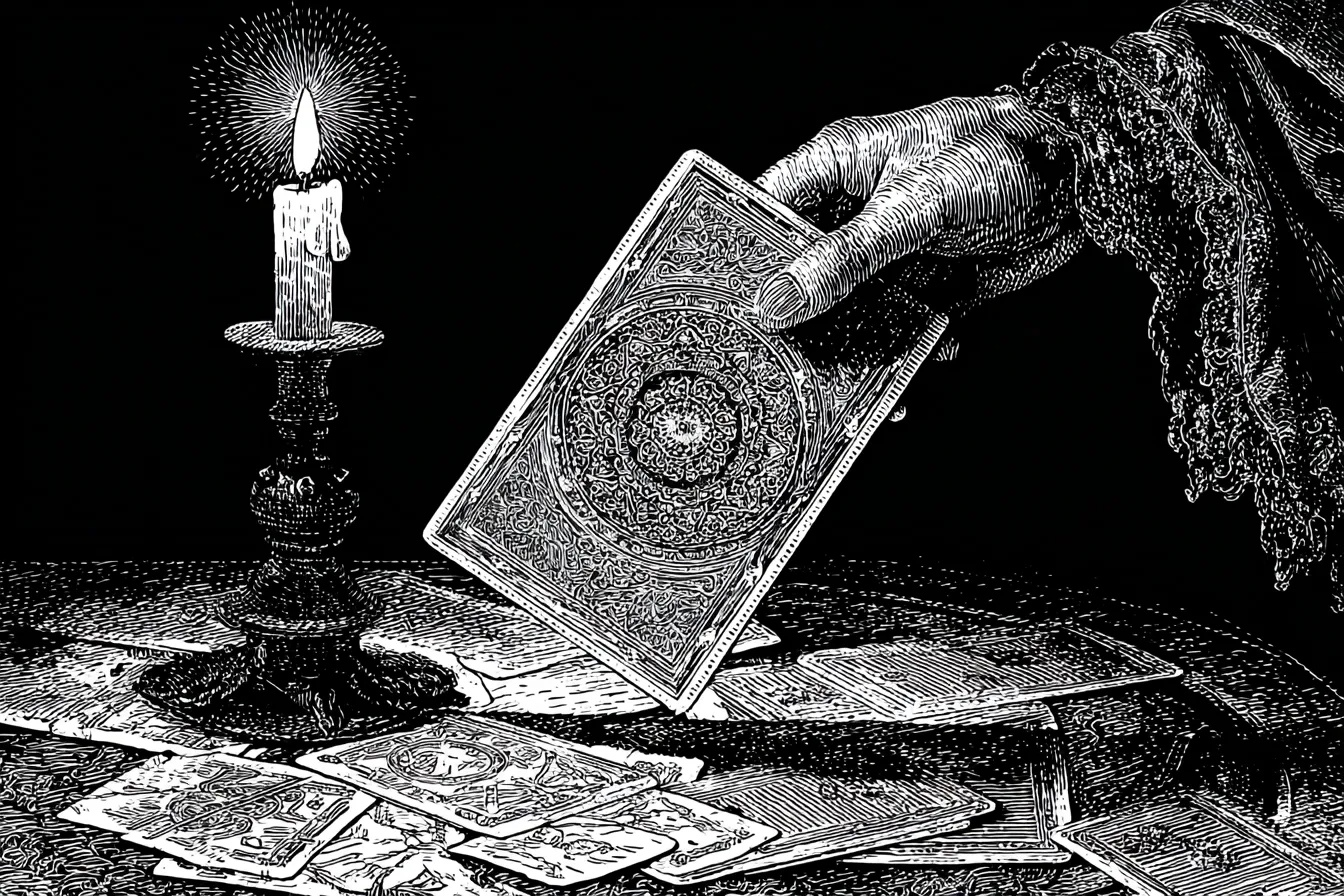
The most common misunderstanding about Tarot is also the most limiting one: the belief that the cards are supposed to tell you what will happen.
When Tarot is understood as a fortune-telling system — one that predicts specific events from a fixed future — it invites two equally problematic responses. The first is credulity: taking the reading as a literal prediction and treating the cards as an authority on what your future holds. The second is dismissal: once you’ve concluded (correctly) that the cards can’t reliably predict specific future events, you discard the practice entirely as superstition.
Both responses miss what Tarot is actually good at. And what it’s actually good at — when used well — is considerably more useful than prediction.
What the Cards Are Actually Doing
A Tarot deck contains 78 cards, each bearing an image rich enough in symbolic content to support multiple interpretations. The Major Arcana’s 22 cards — The Fool, The Tower, The Moon, The World — depict archetypal situations and characters that have been recognized across many cultures as fundamental to human experience. The 56 Minor Arcana cards describe the textures of everyday life: the energy of beginnings (Ace cards), the complexity of relationships (court cards), the dynamics of conflict and resolution (sword suits), the nature of abundance and its complications (pentacle suits).
When you draw a card in response to a question or situation, you’re selecting a symbol from this vocabulary — a precisely named picture of a human experience — and asking: does this name something real about my current situation?
This is not prediction. It is naming. And naming is valuable.
The Tower doesn’t predict a literal catastrophe. It names a recognizable situation: the sudden revelation that something you believed was solid was built on faulty foundations. The Moon doesn’t predict confusion. It names the specific quality of the experience of navigating something you can’t see clearly — where intuition and anxiety are difficult to distinguish, where what’s there isn’t what it appears to be.
When a card lands and the name fits — when you recognize in the Tower the relationship you’ve been maintaining on false assumptions, or in the Moon the decision you’ve been trying to make without adequate information — the recognition is not the product of supernatural prediction. It’s the product of a precise vocabulary for human experience aligning with your actual experience.
The Non-Deterministic Foundation
Using Tarot as guidance rather than prediction rests on a specific philosophical premise: the future is not fixed in a way that makes it readable from the present.
This is not a rejection of pattern. Some things are genuinely predictable — not because the future is fixed, but because patterns in human character and circumstance have consistent tendencies. A person who hasn’t resolved a recurring relational dynamic is likely to encounter it again. A project built on a weak foundation is likely to face structural difficulties. These aren’t mystical predictions; they’re observations about how things tend to unfold.
What Tarot as guidance does is help you see those patterns — in yourself, in your situation, in the character of what you’re navigating — more clearly than unaided reflection often allows. The card’s image and symbolism interrupt your habitual narrative about your situation and offer a different frame. That different frame sometimes reveals something you already knew but couldn’t articulate. It sometimes names a pattern you were participating in without fully seeing it. It sometimes clarifies what the situation actually calls for rather than what you were planning to do regardless.
None of this requires the cards to know your future. It requires only that the symbolic vocabulary be rich enough to name real situations with genuine precision — which, when you work closely with the 78 cards over time, they demonstrably are.
How to Use a Reading as Guidance
The shift from prediction-seeking to guidance-seeking changes how you approach every aspect of a reading.
The question changes. Prediction-seeking questions are binary and event-focused: “Will this relationship work out?” “Should I take this job?” These questions treat the future as fixed and the cards as possessing knowledge of what it holds. Guidance-seeking questions are open and process-focused: “What is this relationship showing me about what I need?” “What am I not seeing clearly about this decision?” These questions treat the cards as a tool for illuminating your current situation rather than as an oracle about future events.
The interpretation changes. When you’re seeking prediction, an uncomfortable card is bad news — The Tower is frightening, Death is ominous. When you’re seeking guidance, an uncomfortable card is information — The Tower is naming something about the structure of your current situation that deserves honest examination; Death is identifying something that has run its course and needs to be released. The card’s value is not in what it promises or threatens but in what it names.
The response changes. Prediction-seeking ends with information received: you now know what will happen, or you believe you do. Guidance-seeking continues into reflection and action: the card has named something, and the naming opens questions about what to do differently, what to pay attention to, what deserves more honest examination. The reading is the beginning of a process, not the end of it.
The relationship to accuracy changes. When you’re seeking prediction, accuracy is binary — either the event happened as predicted or it didn’t. When you’re seeking guidance, accuracy is a matter of whether the reading named something genuinely present in your situation. A guidance reading is “accurate” when it surface something real — a pattern, a dynamic, a quality of your situation — that you can verify against your own honest self-examination. This is a different standard than event prediction, and it’s one that the rich symbolic vocabulary of the Tarot can actually meet.
The Daily Practice
The most valuable context for Tarot as guidance is daily practice — drawing a single card each morning and working with it as an orientation for the day.
The single daily draw is not about predicting what will happen. It’s about setting a reflective frame: which aspect of my experience, which quality of the situation I’m navigating, does today’s card invite me to notice?
The High Priestess drawn on a day when you’re facing a decision invites you to sit with what you intuitively know before acting on what you analytically conclude. The Five of Cups drawn on a day when you’re disappointed invites you to notice whether your attention is fixed on what’s lost rather than what remains. The Ace of Swords drawn before a difficult conversation invites clarity and honest direct speech rather than the indirect approach you might have defaulted to.
These are not predictions. They are framings — specific lenses through which the day’s experiences pass — that can genuinely change how you navigate those experiences if you hold them consciously rather than just glancing at the card and moving on.
The retrospective component of the daily practice is equally important: at the end of the day, returning to the card and asking whether it named something real about what actually unfolded. This retrospective assessment, done honestly over weeks and months, builds genuine skill with the cards — a relationship to the symbolic vocabulary that allows it to be more specifically accurate and less generically applicable.
What This Means for The Whisper
The Whisper uses Tarot in exactly this non-predictive frame. Your Tarot Birth Card — the Major Arcana card calculated from your birth date — is a permanent element of your profile: a fixed description of your life’s characteristic curriculum, the recurring themes and challenges that the tradition associates with your card’s archetype. This is not a prediction about what will happen. It’s a named pattern in who you are.
The daily Tarot layer in your composite reading contributes the specific quality the card names — not as a forecast of the day’s events, but as a framing lens that sits alongside your BaZi day, your Nine Star Ki star, and your I Ching hexagram. When these multiple framings converge, the convergence is worth taking seriously. When they diverge, the divergence reveals complexity.
The cards are guidance. They are not fortune. That distinction is the beginning of using them well.
Explore your Tarot Birth Card and daily Tarot reading in The Whisper — alongside BaZi, I Ching, and more, at whisper.day.