
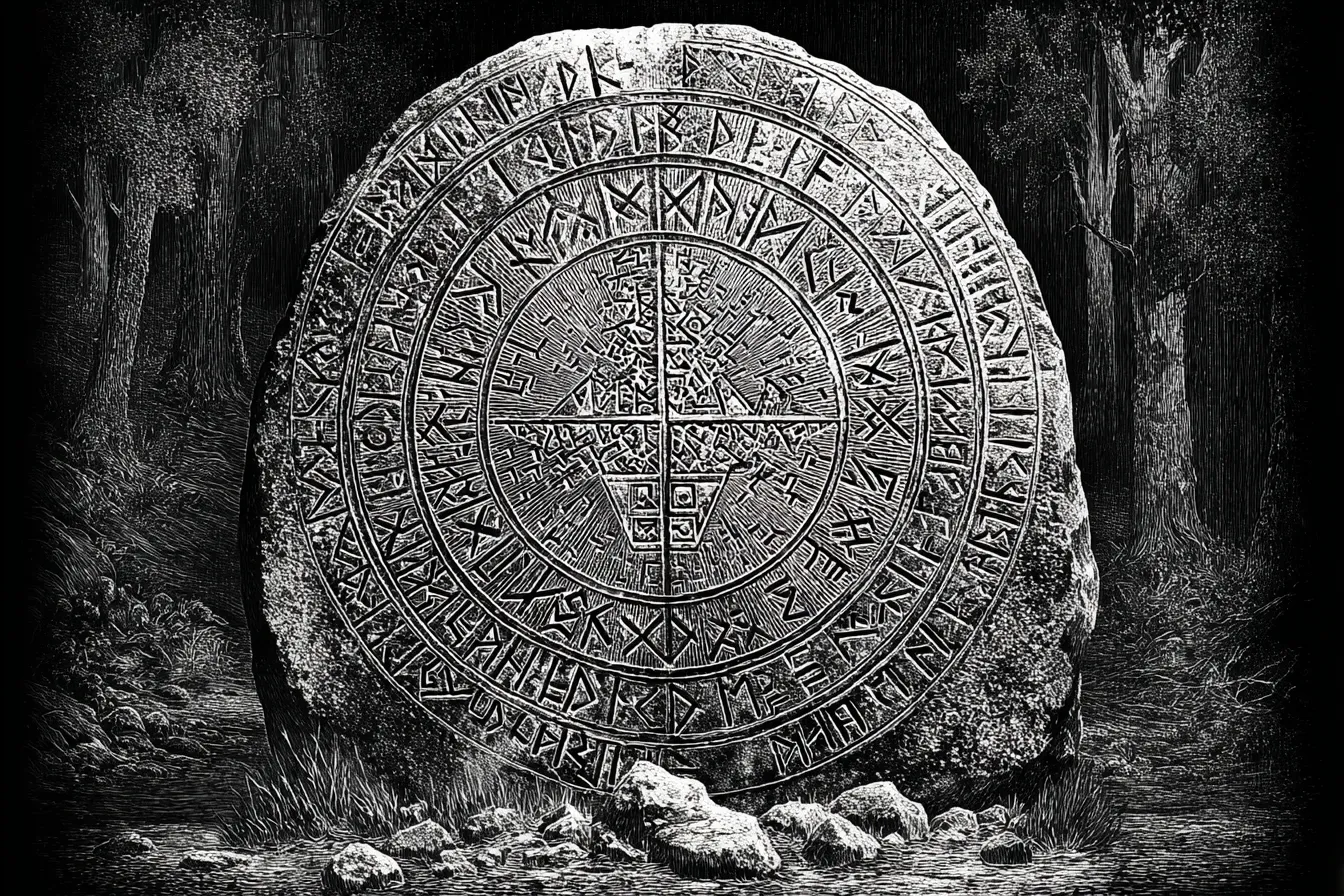
What is Fehu?
Fehu is the first rune of the Elder Futhark, the oldest runic alphabet used by Germanic and Norse peoples across Northern Europe from roughly the 2nd to 8th centuries CE. As the opening rune of a system of 24, it carries a particular significance: the futhark begins not with gods or cosmic forces, but with the most immediate concern of earthly life — wealth, and the work required to generate it.
The Elder Futhark is organised into three groups of eight runes called aettir (singular: aett). Fehu opens Freyr’s Aett, the first group, which is broadly associated with the generative forces of life: fertility, creation, and the basic material conditions of existence. Each aett takes its name from a Norse deity, and Freyr — the god of fertility, prosperity, and the harvest — sets an appropriate tone for the group that Fehu leads.
In The Whisper, the Elder Futhark functions alongside Western Astrology, Nine Star Ki, and BaZi as one of the active divination systems synthesised into a single daily personal reflection. Two rune calculations are at work. Your birth rune is determined by a deterministic calculation applied to your birth date — all digits are summed, reduced, and mapped to one of the 24 runes. This produces a single rune that The Whisper treats as a personal lens, analogous to a birth card in Tarot or a birth star in Nine Star Ki. Your daily rune is drawn from a deterministic hash of your birth date combined with today’s date. Like The Whisper’s Tarot and I Ching implementations, this draw is framed as fated rather than random: the same person will always receive the same rune on the same calendar date, making the result feel personal rather than arbitrary.
One note on sources: the rune meanings The Whisper uses are informed by the historical rune poems and scholarly literature, but filtered through a lens of self-reflection. They are not claimed to be identical to any single ancient document. Much of what circulates today as “traditional” rune meaning is partly a reconstruction shaped by 19th-century Romantic revival and 20th-century esoteric practice. If the historical scholarship interests you, the works of R.I. Page and Klaus Düwel offer grounded academic perspectives on runic inscriptions and their meanings.
Name, sound, and symbol
The name Fehu derives from the Proto-Germanic word for cattle — the same root that gives modern English the word “fee.” The connection is not incidental. In the Norse and Germanic world, cattle were the primary form of movable wealth: they could reproduce, they could be lost to disease or raiding, and they required constant tending. Unlike land, which was fixed and inherited, cattle represented wealth that moved, multiplied, and demanded active management.
The phonetic value of Fehu is F, and the rune’s shape — two diagonal strokes rising from a vertical stave, like horns or outstretched arms reaching upward — visually suggests growth and outward expansion. It is wealth not sitting still but reaching, producing, offering.
The three surviving medieval rune poems each gloss Fehu in instructive ways. The Old Norwegian Rune Poem describes it as a source of strife among kinsmen — abundance that, if not circulated with care, produces conflict rather than harmony. The Old English Rune Poem emphasises comfort and the responsibilities that come with it. Taken together, the tradition suggests that Fehu is never purely a symbol of good fortune: it is wealth with obligations attached.
The traditional meaning of Fehu
At its core, Fehu is the rune of earned wealth — not inherited, not discovered by chance, but produced through sustained effort and skill. This is an important distinction. The Norse and Germanic traditions were well aware of the difference between what was given and what was made; Fehu occupies the second category.
But Fehu’s meaning extends beyond simple prosperity. The rune is traditionally associated with the stewardship of abundance — the principle that wealth which is hoarded rather than circulated loses its vital quality. Cattle left without tending sicken; wealth held without generosity stagnates. This is central to the rune’s character: the productive force is not a destination but a flow, and the person who understands Fehu understands that maintaining abundance requires both the effort to generate it and the wisdom to keep it moving.
The Norwegian Rune Poem’s warning about strife among kinsmen points directly to Fehu’s shadow. Abundance that is neither shared nor well-managed becomes a source of conflict — within families, communities, and within the individual who becomes more concerned with protecting what they have than with engaging generously with the world. The rune asks a persistent question: is your wealth in service of genuine generosity, or has it become a measure of security that you are afraid to disturb?
It is worth noting honestly that the specific interpretations applied in modern runic practice — including the emphasis on stewardship and circulating wealth — are reconstructions informed by the rune poems but not reducible to them. The Norse and Germanic sources provide a genuine historical foundation; the interpretive layer belongs partly to later tradition.
Fehu as a birth rune and daily rune
When Fehu appears as your birth rune in The Whisper, it suggests that the energy of earned abundance and the dynamics of stewardship are a persistent theme in how you engage with the world. This does not mean you are guaranteed financial success, nor that material wealth is your defining value. It means that questions of how you generate, manage, and circulate what you have — whether that is money, creative capacity, energy, or relational goodwill — tend to be active areas of your life.
People with Fehu as a birth rune often have a natural orientation toward productivity and practical results. The rune’s quality of sustained effort toward tangible outcomes can show up as a genuine gift for building things over time. The shadow aspect worth attending to is the Fehu tendency toward anxiety about loss — the productive force that tips into hoarding, either of material resources or of the time, energy, and attention that could be shared more freely.
When Fehu appears as your daily rune, The Whisper is pointing toward a day whose quality is inflected by themes of abundance, effort, and stewardship. It may be a useful day to attend to how you are generating and circulating what you have — not necessarily in financial terms, but in the broader sense of whether your efforts are producing genuine results, and whether you are engaging with appropriate generosity in the areas where you have genuine surplus.
Strengths and growth edges
Fehu’s strengths centre on the capacity to generate and manage abundance through sustained effort. This is the rune of the person who understands that results require work and who applies that understanding with consistency. The productive energy associated with Fehu tends to express as practical competence — the ability to identify what needs doing and do it, to build over time, and to take genuine satisfaction in the outcomes of well-directed effort.
A second strength is the quality of generosity that comes from genuine surplus. Fehu’s generosity is not the generosity of self-depletion; it is the giving that flows naturally when abundance is genuinely present and the giver understands that circulation maintains rather than diminishes the whole.
The primary growth edge is what the rune poems flag directly: the attachment to material security that prevents genuine generosity. This can manifest as an anxiety about loss that is disproportionate to actual circumstances — the experience of abundance as fragile, requiring constant vigilance, which makes it difficult to share freely or to take the creative risks that genuine productivity sometimes requires. Wealth hoarded, in all its forms, loses its vital quality; this is Fehu’s clearest teaching about where its energy goes wrong.
A subtler growth edge is the tendency to equate worth with productivity. Fehu is the rune of earned abundance, and the person whose birth rune or daily rune it is may carry an implicit belief that rest, receptivity, or periods of lower output represent failure rather than a necessary part of the full cycle.
What Fehu means in The Whisper
In The Whisper’s synthesis, Fehu is read alongside the other active systems to produce a coherent daily reflection. Each system offers a different lens on the same underlying quality; Fehu’s resonances across systems make the synthesis particularly rich.
In Western Astrology, Fehu carries a strong resonance with Venus in Taurus — the earthy, sustained, productive abundance of the fixed earth sign at its most generative. This is the astrology of the farmer rather than the speculator: wealth built patiently through consistent attention to what is genuinely productive. When The Whisper reads a Fehu day alongside a Taurus or Venus transit, the reinforcement is direct.
In Nine Star Ki, Fehu’s closest resonance is with the Eight White Earth Star (八白土星) — the star associated with the accumulation of genuine value through sustained, patient work. Eight White carries the mountain’s quality of permanence and the threshold’s quality of transition; at its best, it represents the abundance that has been genuinely earned and is being genuinely consolidated. A Fehu day in a period of Eight White influence suggests the potential for real progress on things that have been built steadily over time.
In BaZi, Fehu resonates with Ji Earth (己土) — the yin earth of the fertile garden or farm field. Ji Earth is the earth that produces abundance when properly tended: responsive to what it receives, genuinely fertile, and capable of sustaining what grows within it. Like Fehu, Ji Earth’s quality is not passive; the fertility is latent until it is activated by the right kind of attention and effort.
When The Whisper synthesises these systems on a Fehu day, the resulting reflection tends to emphasise the relationship between effort and result, the current conditions for generating genuine abundance, and the question of whether what has been built is being shared or held.
Frequently asked questions
Q: Is Fehu only about money and financial wealth? Fehu’s traditional root in cattle — the movable wealth of the Norse world — means material prosperity is genuinely part of its domain. In The Whisper’s usage, however, abundance is understood more broadly: creative capacity, relational generosity, time, energy, and attention can all be read through Fehu’s lens. The underlying question the rune raises — how do you generate, manage, and circulate what you have? — applies to all of these.
Q: Is Fehu considered a “positive” rune? The rune poems treat Fehu with ambivalence: it is both the comfort of genuine prosperity and the source of strife among kinsmen who handle it poorly. In The Whisper’s framework, runes are not divided into positive and negative; they are lenses that illuminate different qualities. Fehu points toward themes of earned abundance and stewardship, which carry genuine strengths and genuine growth edges. Whether the rune reads as supportive or challenging depends on the full synthesis and the individual’s current circumstances.
Q: How does The Whisper calculate which rune is my birth rune? The birth rune calculation is deterministic: the digits of your full birth date are summed and reduced until the result maps to a number between 1 and 24, corresponding to one of the Elder Futhark runes. The same calculation will always produce the same result for the same birth date — it is not random. This approach is analogous to how birth cards are calculated in Tarot systems and is intended to produce a stable personal reference point rather than a reading subject to daily variation.