
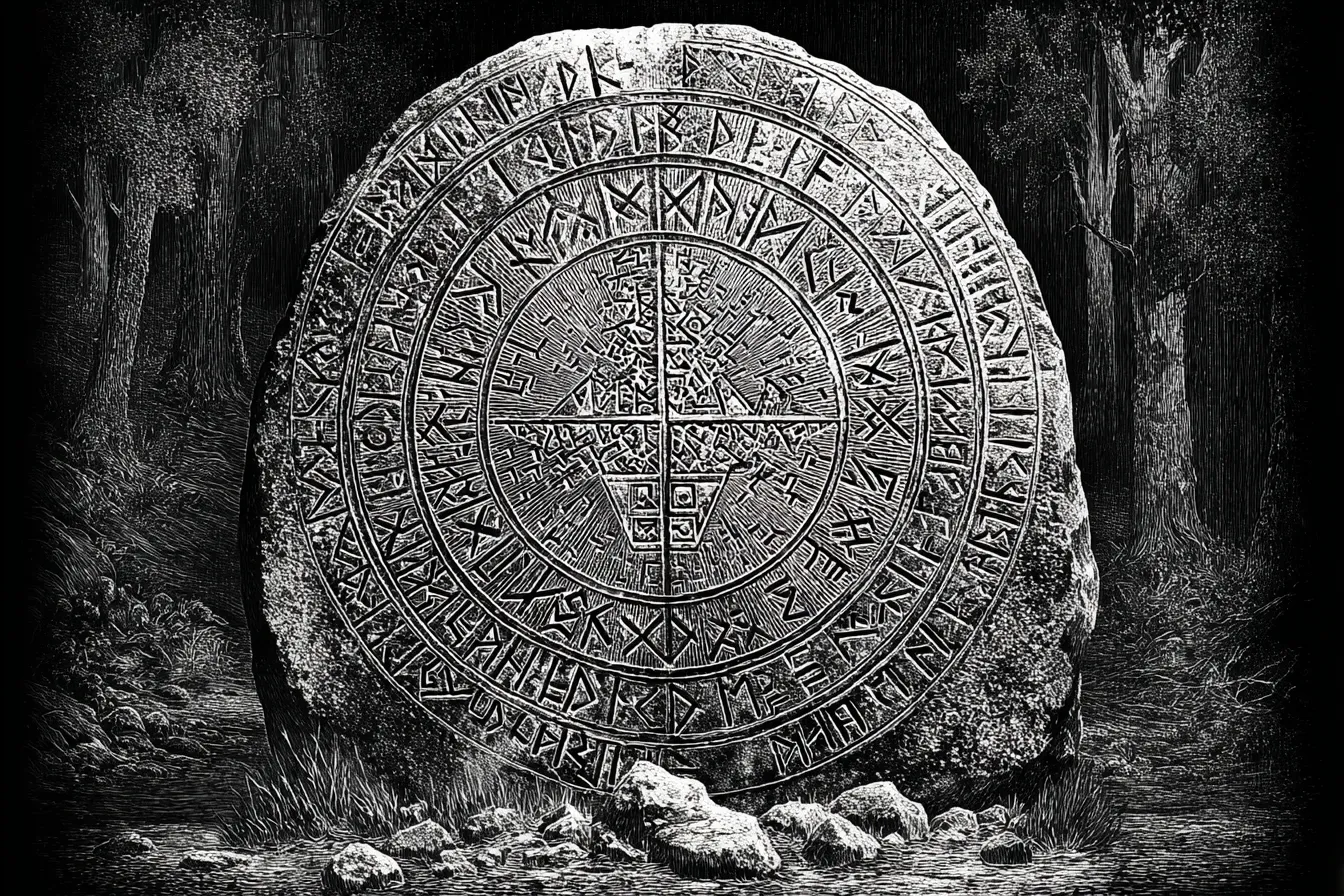
What is Eihwaz?
Eihwaz is the thirteenth rune of the Elder Futhark and the fifth rune of Heimdall’s Aett. It sits near the centre of the entire futhark and this position reflects something essential about its character. Eihwaz is the axis. It is the rune of the thing that stands between worlds, that connects what is above to what is below, that endures through transformation rather than being consumed by it.
The sequence within Heimdall’s Aett that arrives at Eihwaz has been one of increasingly profound challenge: the external shock of Hagalaz, the productive constraint of Naudhiz, the crystalline suspension of Isa, and the patient completion of Jera. Eihwaz now introduces a quality different in kind from all of these: the deep, living endurance of the yew tree — the thing that survives what others cannot, that remains standing when the easier and more pliant trees have long since fallen.
In The Whisper, your birth rune is determined by a deterministic calculation applied to your birth date; your daily rune is drawn from a deterministic hash of your birth date combined with today’s date.
A note on historical context: the rune meanings The Whisper uses are informed by the medieval rune poems and scholarly sources, filtered through a self-reflection lens. R.I. Page and Klaus Düwel offer grounded academic perspectives.
Name, sound, and symbol
The name Eihwaz derives from the Proto-Germanic word for yew — the Taxus baccata, the ancient evergreen tree that is simultaneously one of the longest-lived organisms in the Northern European world and one of the most toxic. The Old English name is eoh or īw, meaning yew; the Old Norse is yr, which some poems gloss as yew bow. The phonetic value is Ei or a long I — an elongated, sustained vowel sound that itself captures something of the rune’s quality of endurance.
The rune’s shape is striking: a vertical stave with diagonal branches extending in opposite directions from different points — one reaching upward to the right from the upper portion, one reaching downward to the left from the lower — creating a form that suggests simultaneous reach in two directions, above and below.
The traditional meaning of Eihwaz
At its core, Eihwaz is the rune of endurance through transformation — not endurance by refusing to engage with transformation, but endurance through a structural depth that makes genuine endurance possible. The yew does not endure by refusing to engage with time and its changes. It endures because its roots go deeper than the changes that affect the surface.
The living axis that connects above and below is Eihwaz’s second central quality. The world-axis — whether understood as Yggdrasil or as the more general concept of the cosmic tree — is a living structure through which the energies and qualities of the different worlds circulate and interact. The bow’s quality of directed, concentrated force adds a third dimension — the precision and power of the yew-wood longbow that stores potential energy in its drawn form and releases it with controlled, directed power.
Eihwaz as a birth rune and daily rune
When Eihwaz appears as your birth rune, it suggests that themes of deep endurance, the axis between worlds, and the relationship between transformation and what genuinely survives it are persistent qualities in how you engage with the world. People with Eihwaz as a birth rune often carry a quality of depth and groundedness that others find genuinely stabilising in times of genuine difficulty. The shadow worth attending to is the endurance that has become stubbornness — the refusal to yield even when genuine yielding is what the situation requires.
When Eihwaz appears as your daily rune, The Whisper is pointing toward a day inflected by themes of deep endurance and the relationship between what is genuinely lasting and what is genuinely transient.
Strengths and growth edges
Eihwaz’s primary strength is the capacity for genuine endurance through genuinely difficult conditions. A second is the quality of the yew that lives through what destroys lesser trees — the specific resilience that comes from genuine depth. A third is the bow’s focused, directed force — the force developed through genuine depth and released with genuine precision.
The primary growth edge is the endurance that becomes stubbornness. A second is the refusal to yield even when yielding is right. A third concerns the cost of holding the axis — the person who habitually occupies the holding position carries something genuinely heavy and must recognise when genuine rest is what Eihwaz’s depth actually requires.
What Eihwaz means in The Whisper
In Western Astrology, Eihwaz carries a strong resonance with Pluto and Scorpio — the transformation through genuine depth, the endurance that comes from contact with what is genuinely unchanging beneath the surface of change.
In Nine Star Ki, Eihwaz resonates with the Eight White Earth Star (八白土星) — the mountain quality of genuine, deep endurance; the threshold that holds between worlds.
In BaZi, Eihwaz resonates with Geng Metal (庚金) — the unyielding strength of the sword, the quality of genuine endurance through genuine hardness.
Frequently asked questions
Q: Is Eihwaz specifically about death and mortality? The yew tree’s deep association with death and the boundary between the living and the dead is genuinely part of Eihwaz’s character. In The Whisper’s framework, the death association points toward genuine engagement with the full cycle of life rather than toward literal mortality specifically. The person who has genuinely faced the yew tree’s reality tends to carry a quality of depth and freedom.
Q: How does Eihwaz’s endurance differ from the endurance that Isa or Naudhiz describe? Isa’s endurance is the patience of the frozen river — the stillness that simply holds its form through the winter without movement. Naudhiz’s endurance is the productive friction of necessity — the sustained creative engagement with genuine constraint. Eihwaz’s endurance is structural depth — the quality of the thing whose roots go all the way down, that survives what the more superficially rooted things cannot.
Q: What does it mean in practice to occupy the axis position that Eihwaz describes? The axis quality tends to express in the person who holds the thread of genuine continuity in a family or community through periods of significant change — not by preventing change but by remaining genuinely present through it and providing the stable reference point by which others can orient themselves.