
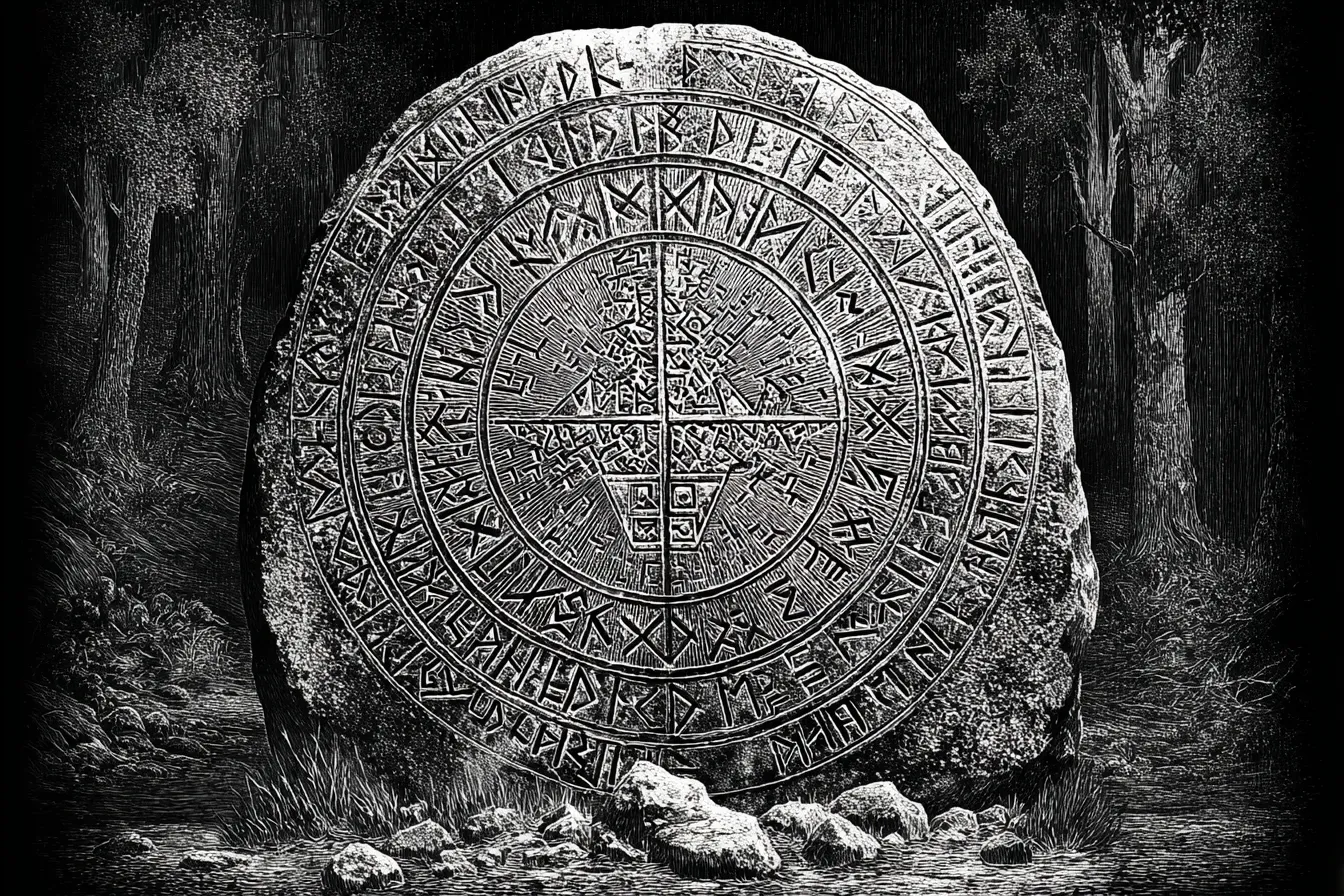
What is Dagaz?
Dagaz is the twenty-third rune of the Elder Futhark and the seventh rune of Tyr’s Aett — the penultimate rune of the final group of eight. One rune before the Elder Futhark’s conclusion, Dagaz arrives as the moment of dawn, the threshold instant when darkness becomes light, when what was hidden is suddenly revealed, when the night that contained everything in undifferentiated darkness resolves into the day that makes individual forms genuinely visible.
In The Whisper, your birth rune is determined by a deterministic calculation applied to your birth date; your daily rune is drawn from a deterministic hash of your birth date combined with today’s date.
Name, sound, and symbol
The name Dagaz derives from the Proto-Germanic word for day. The Old English name is dæg, the Old Norse is dagr, and all three rune poems treat the rune with a quality of genuine warmth and affirmation. The Old English Rune Poem describes the day as the Lord’s messenger, dear to all people, the great light of God. The Old Norwegian Rune Poem calls it the light of the world. Across all three traditions, Dagaz is treated as a quality of genuine divine generosity: the gift of the light that makes genuine seeing and genuine living possible.
The phonetic value is D, the dental stop — the sound of a threshold being crossed, of an obstruction removed, of the flow recommencing. The rune’s shape is one of the most visually distinctive and most philosophically suggestive in the Elder Futhark: two triangles placed point to point at the centre, creating a form that is simultaneously an hourglass and an infinity symbol — two spaces fully enclosed on either side of a central point through which both are connected.
The hourglass or infinity quality encodes the rune’s most fundamental teaching: the threshold is not a place that can be inhabited; it is the point through which one passes from one state to another. Dawn does not last; the sun rises and the threshold moment is immediately superseded by the full day that follows.
The traditional meaning of Dagaz
At its core, Dagaz is the rune of the breakthrough of light — the specific, transformative instant when what was obscured by darkness becomes suddenly and fully visible, when the threshold is crossed and everything is changed by the crossing. Dagaz is not the sustained illumination of the full day; it is the specific instant of the dawn’s arrival.
The quality of genuine breakthrough — as distinct from gradual progress, forced resolution, or the dramatic performance of change — is Dagaz’s most practically important teaching. Genuine breakthrough has the character of the dawn: it arrives at the moment of its genuine readiness, not before; its arrival changes the entire quality of what was present; and it cannot be forced to arrive before it is genuinely ready any more than the dawn can be forced to arrive before the night has run its full course.
The paradox of the threshold that Dagaz embodies — simultaneously ending and beginning — is one of the most philosophically rich teachings in the Elder Futhark. The threshold moment belongs fully to neither side; it is the crossing point itself.
Dagaz as a birth rune and daily rune
When Dagaz appears as your birth rune, it suggests that themes of genuine breakthrough, transformative threshold crossing, and the relationship between darkness and clarity are persistent qualities in how you engage with the world. People with Dagaz as a birth rune often carry a quality of natural orientation toward genuine transformation — a genuine preference for the breakthrough moment of genuine qualitative change over the patient incremental progress that precedes it. The shadow worth attending to is the perpetual dawn that never becomes full day — the breakthrough energy that burns brightly and briefly but does not consolidate into the sustained changed condition that genuine transformation requires.
When Dagaz appears as your daily rune, The Whisper is pointing toward a day inflected by themes of breakthrough, threshold crossing, and the transformation from one quality of seeing to another.
Strengths and growth edges
Dagaz’s primary strength is the capacity for genuine breakthrough — the ability to reach and cross the genuine threshold of qualitative change. A second is the quality of the dawn moment that changes the entire situation. A third is the clarity that comes when the light breaks — the specific quality of the dawn’s illumination, which shows things in their genuine form for the first time.
The primary growth edge is the perpetual dawn that never becomes full day — the breakthrough energy that does not consolidate into the sustained changed condition. A second is the breakthrough energy that burns brightly and briefly without consolidating. A third concerns the transformation that does not consolidate into the changed condition — experiencing genuine breakthrough but returning to the previous condition rather than genuinely inhabiting the change.
What Dagaz means in The Whisper
In Western Astrology, Dagaz carries resonances with both Uranus and the Sun — two planets that approach the quality of breakthrough and illumination from complementary angles. Uranus is the archetype of the sudden qualitative shift; the Sun adds the dimension of the illumination itself.
In Nine Star Ki, Dagaz resonates with the Three Jade Wood Star (三碧木星) — the thunderous awakening quality, the moment of beginning that breaks through what was dark with the specific character of the thunder that announces the spring’s arrival.
In BaZi, Dagaz resonates with Bing Fire (丙火) at sunrise — the quality of the sun’s first light, the illumination that is simultaneously the ending of the night and the beginning of the day.
Frequently asked questions
Q: Does Dagaz always indicate something dramatically positive? Dagaz is consistently treated with warmth in the rune poems, and the quality of dawn and breakthrough it describes tends to be experienced as positive. In The Whisper’s framework, however, the rune points toward genuine qualitative transformation rather than toward guaranteed positive outcome. The dawn reveals things as they genuinely are; what is revealed is not always what was hoped for.
Q: How does Dagaz relate to Isa, since both runes seem to involve significant moments of change in clarity? Isa is the quality of arrested movement — the crystalline clarity of the frozen surface, the world held in complete stillness so that what is there can be seen precisely. Dagaz is the quality of threshold movement — the specific instant of the crossing itself. Where Isa’s clarity comes from stillness, Dagaz’s clarity comes from the threshold crossing.
Q: What is the difference between Dagaz’s breakthrough and the breakthrough that other runes describe? Dagaz’s breakthrough is distinguished by its specific threshold character: not the force that breaks through, not the external disruption that shatters, not the ongoing illumination that reveals, but the specific instant of the threshold crossing itself — the moment when night becomes day, when one quality becomes another simultaneously and completely.