
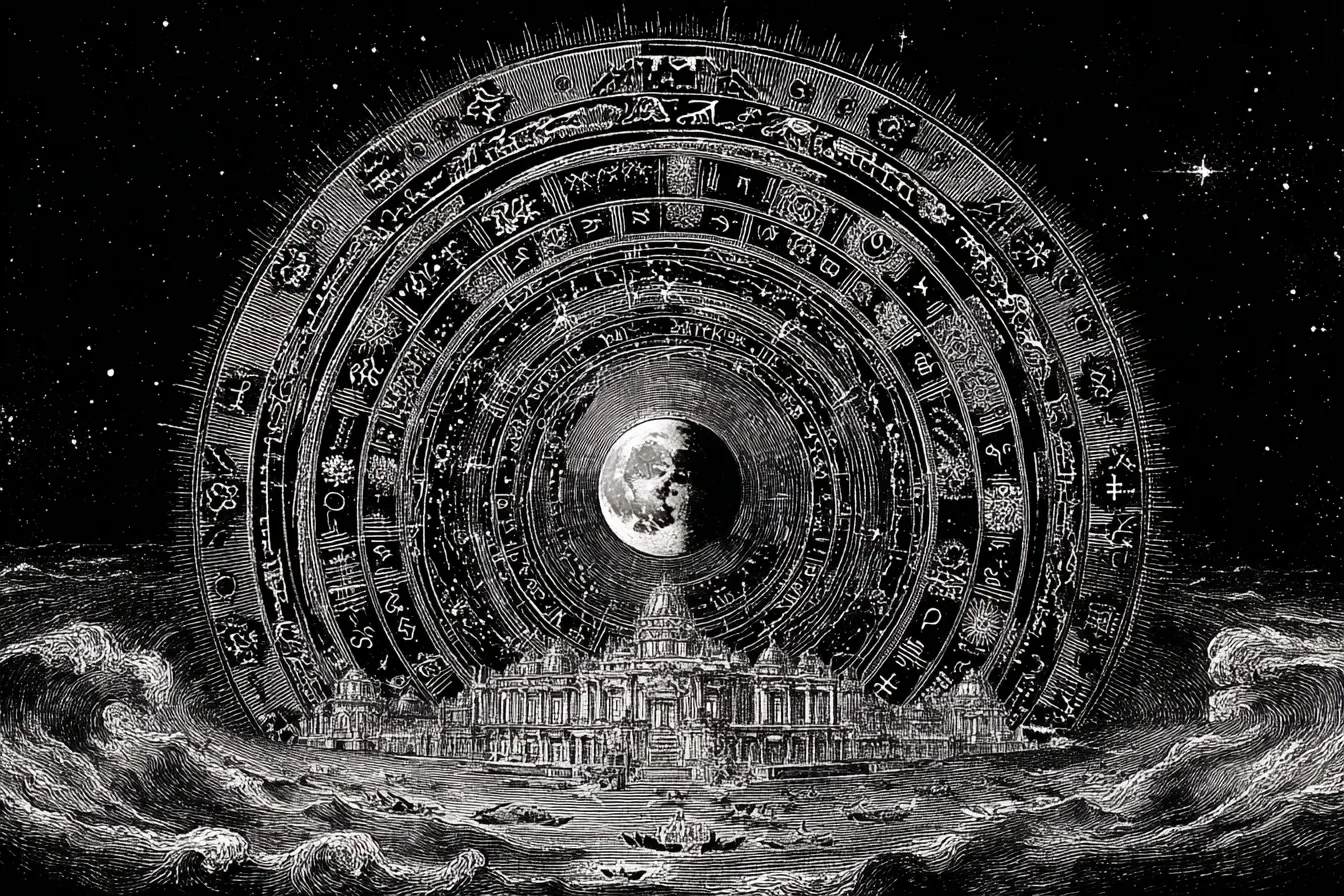
What is Shatabhisha Nakshatra?
Shatabhisha is the twenty-fourth nakshatra in Jyotish, occupying from 6°40’ to 20°00’ of Aquarius — sitting within Saturn’s innovative, collective sign and carrying the particular quality of Varuna’s cosmic ocean combined with Rahu’s amplifying, boundary-crossing depth. The name Shatabhisha means “a hundred physicians” or “a hundred healers” — and the plurality is precise. This is not the healer as an individual but the healing intelligence that is vast, that knows a hundred approaches, that works with the full depth of what has accumulated over immense time.
Shatabhisha sits in Aquarius’s territory between Dhanishtha (the rhythmic abundance before it) and Purva Bhadrapada (the passionate transformative fire after it). This position gives it a specific quality: the depth that has accumulated from everything that came before in the zodiac, operating through Aquarius’s unconventional, collectively oriented intelligence.
In The Whisper, your birth nakshatra is determined by the Moon’s position at birth. If the Moon was in Shatabhisha, the Jyotish tradition associates your emotional nature with a particular quality of depth perception — the capacity to work with what is not visible on the surface, to understand mechanisms beneath apparent conditions, to heal in the way that Varuna’s ocean does: pervasively, without being seen doing it.
A note on accuracy: The Whisper approximates birth nakshatra from birth date when birth time is unavailable. For births near the Dhanishtha–Shatabhisha or Shatabhisha–Purva Bhadrapada transitions, birth time will improve the calculation.
Symbol and ruling deity
Shatabhisha’s primary symbol is the empty circle — one of the more philosophically resonant symbols in the nakshatra system. The empty circle is complete in itself and empty at the same time; it is the potential before action, the healing capacity that has not yet been applied. It is also the symbol of the cosmic ocean in some traditions: the boundless, the container that is defined by its emptiness rather than its contents.
The name’s meaning — a hundred physicians — adds another dimension: the circle may contain all hundred healers within it, invisible, present as potential. The healer who is a hundred healers is the healer who holds the full range of healing approaches, who does not arrive with a single method but with the vast intelligence of deep waters.
The ruling deity is Varuna — one of the oldest and most philosophically significant deities in the Vedic tradition. Varuna is the god of the cosmic ocean, of the laws that sustain the cosmos, of the knowledge of what is hidden — specifically, the knowledge of what is done in secret. Varuna is the deity who sees everything, who knows what is not confessed, who presides over the cosmic order that holds regardless of whether it is acknowledged. His quality of knowing the hidden things — the mechanisms beneath apparent conditions — is the central quality of Shatabhisha.
The ruling planet is Rahu — the north lunar node, amplifier, boundary-crosser, and the quality of never being fully satisfied with what is known. Rahu in Aquarius, combined with Varuna’s cosmic ocean depth, produces the healer whose knowledge keeps reaching further, whose perception keeps going deeper, for whom the surface of any situation is always a starting point rather than an endpoint.
The nature and qualities of Shatabhisha
Jyotish classifies Shatabhisha as Chara (movable, variable) in quality and its gana as Rakshasa (fierce, independent). The Chara quality describes the movement of Varuna’s ocean: it does not stay still, it reaches everywhere. The Rakshasa quality describes the independence of someone who operates at a depth that conventional social structures do not always accommodate.
What the tradition most consistently describes as Shatabhisha’s central quality is the perceptive intelligence that works with what is not visible — the mechanisms beneath apparent conditions, the hidden dimensions of situations that simpler analysis does not reach. This is not psychic in any conventional sense; it is the quality of genuine depth intelligence, the capacity to understand how things actually work rather than how they are presented as working.
This quality tends to produce a specific pattern: Shatabhisha people often appear reserved or private on the surface — the empty circle does not announce what it contains — while internally carrying a depth of perception and accumulated understanding that can be surprising when it is expressed. The secrecy that the tradition sometimes notes is not deceptive; it is the natural privacy of someone who understands that most of what they perceive does not belong in the public register.
Shatabhisha is also specifically associated with healing — and the tradition’s understanding of this is broader than medicine, though medicine is included. The healing that Shatabhisha describes is the healing that addresses what is actually causing the condition rather than only the symptom: the kind that requires depth perception to identify, and depth intelligence to address.
Strengths and growth edges
The qualities the tradition associates with Shatabhisha include deep perceptive capacity, genuine healing intelligence that works with what is not visible, Rahu’s capacity to cross the boundaries that ordinary perception cannot, Varuna’s vast, accumulated cosmic wisdom, the Aquarian quality of unconventional perception, and the quality of the empty circle: the potential that has not yet been applied, the vast readiness.
The growth edges are specific and worth attending to. Rahu’s restlessness combined with Varuna’s ocean depth can produce the person lost in their own depths — the perception that has gone so deep it cannot find its way back to the surface of ordinary exchange and practical action. The secrecy that protects genuine depth can become the isolation that prevents genuine meeting — the person who perceives deeply but cannot be genuinely known because the depth is never shared.
The empty circle that represents the healing potential can remain empty: the potential that does not become actual, the healing capacity that is never deployed because the conditions for deploying it are never quite right. This is the specific growth edge that the tradition most consistently notes for Shatabhisha: the vast depth that serves only when it finds its way into genuine expression.
What Shatabhisha means in The Whisper
The Whisper draws on Shatabhisha’s cross-system resonances when synthesizing the daily message.
Western Astrology: Shatabhisha occupies Aquarius in the sidereal zodiac. The Western tradition’s Aquarius is Saturn/Uranus-ruled — associated with innovation, unconventional intelligence, and the collective reach beyond conventional structures. Rahu’s amplifying quality within Aquarius and Varuna’s cosmic ocean depth give this Aquarius territory unusual depth: the unconventional perception that goes further than Aquarius’s characteristic innovation usually reaches. On days when Saturn, Aquarius, or Rahu-associated dynamics feature in the Western transits, Shatabhisha’s quality of deep hidden perception may be particularly active.
Nine Star Ki: The resonance here is with the One White Water Star (一白水星) — the hidden depth quality, the underground current that sustains what is above from below. One White Water and Shatabhisha share the characteristic of depth that does not announce itself: the perception that works quietly, the intelligence that sustains through its presence rather than its visible activity.
BaZi: The resonance is with Ren Water (壬水) — the deep yang water of the ocean, the vast and pervasive quality that knows what is in its depths. Ren Water carries Shatabhisha’s quality of the healer who works with the deep water’s knowledge: pervasive, encompassing, understanding the mechanisms of the ocean from within rather than observing them from shore.
Frequently asked questions
Q: What does it mean for the deity to be Varuna, one of the oldest in the Vedic tradition?
Varuna’s antiquity in the tradition is significant. He is among the oldest of the Vedic deities — the cosmic sovereign who presides over the law that sustains the universe, who knows what is done in secret, who governs through awareness rather than through force. As Varuna gradually gave way to Indra in the tradition’s development, he retained his association with the cosmic ocean and the hidden knowledge. Shatabhisha’s connection to Varuna therefore carries this quality of ancient, pre-conventional depth: the wisdom that precedes the organized world and continues beneath it.
Q: Is Shatabhisha connected to medical or healing work specifically?
The name “a hundred physicians” is specific, and the tradition does associate Shatabhisha with healing — particularly the healing that works with what is not immediately visible, including chronic and complex conditions whose mechanisms are not surface-level. Varuna’s knowledge of hidden things applies here: the healer who can identify what is actually driving a condition, not only its surface expression. This does not mean all Shatabhisha people become healers, but the quality of deep perception that makes genuine healing possible tends to be present in whatever domain they inhabit.
Q: How does The Whisper use Shatabhisha in a daily reading?
When the Moon transits Shatabhisha — approximately once every 27 days — The Whisper draws on the quality of hidden depth, healing perception, and the question of what is visible and what is not as one contribution to the synthesis. The day may carry an invitation to look beneath the surface of a situation — to ask what mechanism is actually driving what appears on the surface — or may invite a reflection on where the depth perception that is available has not yet found its expression.