
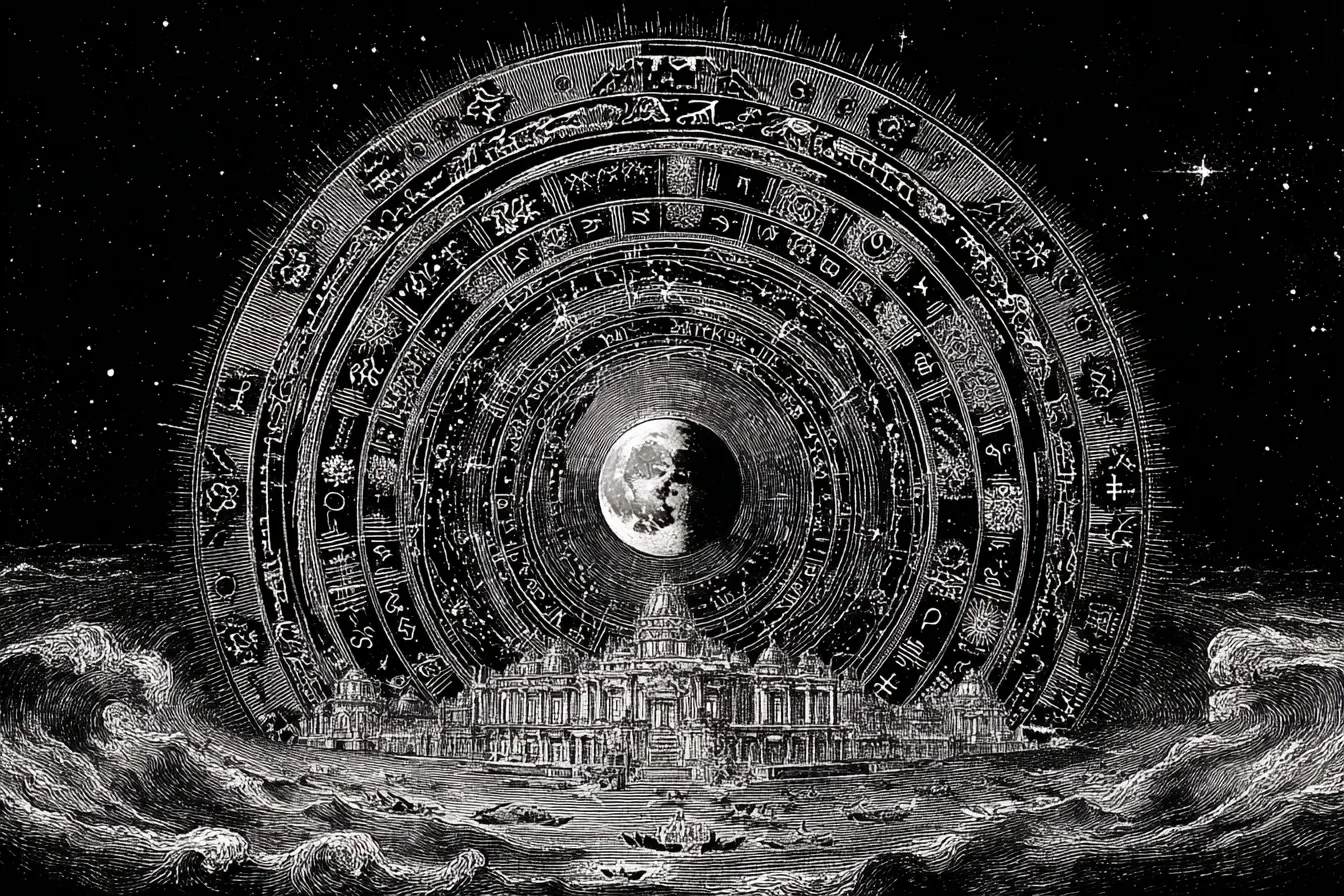
What is Mula Nakshatra?
Mula is the nineteenth nakshatra in Jyotish, and its position is as significant as any in the system: it occupies from 0°00’ to 13°20’ of Sagittarius, opening the final arc of the zodiac at the very beginning of Jupiter’s expansive sign. Just as Magha opened Leo at its first degree with the weight of ancestral lineage, and Ashwini opened Aries with the first impulse of the zodiac, Mula opens Sagittarius — but it opens it in contact with dissolution rather than with simple beginnings.
The name Mula means “root” or “foundation” — and the nakshatra’s central quality is the investigation of what genuinely holds when the non-foundational has been stripped away. This is not an abstract philosophical inquiry for Mula; it is a lived experience. The nakshatra is associated with Nirrti, the goddess of what dissolves, and the combination produces a quality that is paradoxical and precise: the person who finds the root by going through dissolution rather than around it.
In The Whisper, your birth nakshatra is determined by the Moon’s position at birth. If the Moon was in Mula, the Jyotish tradition associates your emotional nature with a quality of searching beneath surfaces — the instinct to find what is genuinely foundational, and the willingness (not always chosen, but characteristic) to discover this through processes that involve the dissolution of what had been assumed to be foundational.
A practical note: The Whisper approximates birth nakshatra from birth date when birth time is unavailable. For births near the Jyeshtha–Mula boundary (the Scorpio–Sagittarius transition), birth time will meaningfully improve the calculation.
Symbol and ruling deity
Mula’s symbols are the bunch of roots tied together — sometimes described as a cluster of roots pulled from the earth, held up for examination — and the tail of a lion. The bundle of roots describes the investigation: gathering what lies beneath the surface and holding it up to the light. The lion’s tail describes something different: the appendage that is not the main body of the lion but is unmistakably part of it, the extension of what gives the whole creature its quality.
Both images describe the same underlying theme from different angles: getting to what is genuinely part of the thing rather than what is presented on the surface, finding the root rather than the flower, reaching the tail rather than observing only the mane.
The ruling deity is Nirrti — the goddess of dissolution, of what lies beyond the boundary of order, of what is sometimes translated as “the formless” or “the goddess of calamity.” Nirrti is not a comfortable deity. She presides over the dissolution of form — the thing that makes structures fall apart, the force that removes what is no longer genuinely alive. Her presence at the opening of Sagittarius is philosophically significant: the most expansive, philosophically ambitious sign of the zodiac begins in contact with the dissolution of what it had previously taken for granted.
The ruling planet is Ketu — the south lunar node, associated with release, past karma, and the quality of detachment that comes from having been around before. Ketu in Sagittarius brings a quality of philosophical detachment that is not indifference but the capacity to pursue what is genuinely foundational without being attached to what is found.
The nature and qualities of Mula
Jyotish classifies Mula as Tikshna (sharp) and also Ugra (fierce) in quality — two of the nakshatra’s more intense classifications, both suggesting an energy that is not gentle in its operation. Its gana is Rakshasa (fierce, independent), consistent with a nakshatra that operates at the edge of what conventional structures can accommodate.
These classifications describe something genuine: Mula’s investigation of foundations is not comfortable. The roots are underground; getting to them requires digging. And what is found is not always what was expected to be there. The tradition takes seriously the possibility that Mula’s root-seeking can unearth what would have been better left covered — not because ignorance is preferable to knowledge, but because not all discoveries are stabilizing.
What the tradition most consistently associates with Mula is an investigative quality — a genuine need to understand what actually underlies apparent structures, whether in ideas, relationships, institutions, or the individual life. This investigation is not academic; it is driven by Nirrti’s quality of dissolution, which means Mula often discovers what is genuinely foundational through the experience of having what was assumed to be foundational dissolve.
This produces a specific pattern in the life: Mula is associated with transformative upheavals — not as external misfortune (though they may appear that way), but as the dissolution of what was never genuinely foundational. The tradition’s understanding is that what dissolves in Mula’s life was never the actual root; the actual root remains. The growth is in discovering the difference.
Sagittarius’s philosophical quality gives this process a particular expression: Mula tends to be philosophical in a searching rather than systematic way — the philosophy that emerges from genuine question rather than from the organization of received answers.
Strengths and growth edges
The qualities the tradition associates with Mula include the capacity to survive and work through dissolution, genuine philosophical depth that has been tested rather than merely theorized, the ability to reach beneath what appears foundational to what actually is, the courage to face what dissolution reveals rather than reconstructing comfortable surfaces, and the specific quality of not being intimidated by dissolution that makes Mula useful in situations where others cannot remain present.
The growth edges are equally specific. Ketu’s detachment combined with Nirrti’s contact with dissolution can produce the person who pulls out foundations without knowing what will collapse — the root-seeking that is destructive rather than exploratory, the investigation that dismantles structures before understanding what they were holding. The philosophical intelligence that drives toward foundations can, without the grounding of Sagittarius’s broader perspective, become nihilistic rather than liberating — finding nothing foundational and concluding that nothing is.
Traditional Jyotish also notes a tendency for Mula’s dissolution experiences to extend to relationships and external circumstances — a pattern sometimes framed as “loss” but better understood as the natural consequence of the root’s quality of stripping away what does not belong to the actual foundation.
What Mula means in The Whisper
The Whisper draws on Mula’s cross-system resonances when synthesizing the daily message.
Western Astrology: Mula opens Sagittarius in the sidereal zodiac. The Western tradition’s Sagittarius is Jupiter-ruled — expansive, philosophical, oriented toward meaning and the broad horizon. Ketu’s influence in Mula gives this opening of Sagittarius a more searching, sometimes unsettling quality: the philosophical expansion that begins in contact with dissolution rather than with the easy optimism that Sagittarius can also describe. On days when Jupiter or Sagittarius features in the Western transits, Mula’s quality of searching philosophical depth may be particularly active.
Nine Star Ki: The resonance here is with the One White Water Star (一白水星) — the quality of going deep, below the surface, to find what genuinely holds. One White Water’s underground current quality — the hidden source that sustains what is above — resonates with Mula’s root symbol: the thing that is not visible but is what everything else depends on.
BaZi: The resonance is with Yi Wood (乙木) — the root quality, the plant that survives by holding underground while what is above is stripped away. Yi Wood’s resilience comes from the root that does not release; this captures Mula’s quality of the thing that genuinely holds through dissolution.
Frequently asked questions
Q: Is Mula considered particularly challenging in Jyotish?
The tradition does describe Mula as one of the more intense nakshatras — and the intensity is real. The quality of dissolution and root-seeking that Mula describes means that those with prominent Mula placements often experience significant upheavals, particularly in the first part of life, as what was assumed to be foundational turns out not to be. The Whisper frames this honestly: the challenge is genuine, and so is the depth of understanding that typically follows it. Mula is not simply difficult; it is the nakshatra that produces genuine philosophical depth through genuine contact with dissolution.
Q: What is the significance of Mula opening Sagittarius rather than being in the middle or end?
The tradition’s placement of Mula at the very start of Sagittarius is philosophically deliberate. The most expansive, philosophically ambitious sign begins in contact with Nirrti’s dissolution — the implication is that genuine philosophical expansion requires having gone through what seemed foundational and found it insufficient. The Sagittarian horizon is not accessible from comfortable ground; it requires having found the actual root through the dissolution of what was merely assumed to be.
Q: How does The Whisper use Mula in a daily reading?
When the Moon transits Mula — approximately once every 27 days — The Whisper draws on the quality of root-seeking, philosophical depth, and the question of what genuinely holds versus what has been assumed to hold. The day may carry an invitation to examine something more carefully than its surface presentation invites, or to remain present with a dissolution rather than immediately reconstructing what was comfortable. The synthesis with the other active systems will shape how this quality expresses: a day when other systems also suggest depth and investigation will read differently than a day when most systems suggest lightness and movement.