
What is Magha Nakshatra?
Magha is the tenth nakshatra in the Jyotish system, occupying from 0°00’ to 13°20’ of Leo. Its position is as significant as Ashwini’s: just as Ashwini opens the entire zodiac at the beginning of Aries, Magha opens the second arc of the nakshatra cycle at the beginning of Leo. This placement gives Magha a quality of genuine beginnings — specifically, the kind of beginning that carries the full weight of what preceded it.
The moment the zodiac enters Leo marks an important transition. The lunar nakshatras of Cancer — the Moon’s sign, with its emotional depth, its nourishing quality, and its orientation toward the past and the inner life — give way to Leo, the Sun’s sign, with its quality of authority, self-expression, and the radiance that projects outward. Magha sits at this threshold, and it carries the transition in its nature: the authority of Leo combined with Ketu’s orientation toward the past and the ancestral.
In The Whisper, your birth nakshatra is calculated from the Moon’s position at your birth. If your Moon was in Magha when you were born, you carry a quality that the Jyotish tradition associates with something it takes seriously: the weight of lineage, the authority that comes from genuine connection to what has come before, and the paradox of a nakshatra that is both deeply connected to the ancestral past and — through Ketu’s quality of release — oriented toward moving beyond it.
A practical note: The Whisper approximates birth nakshatra from birth date when birth time is unavailable, which is reliable for most births. Adding birth time will confirm the placement, particularly if you were born near the Ashlesha–Magha or Magha–Purva Phalguni boundary.
Symbol and ruling deity
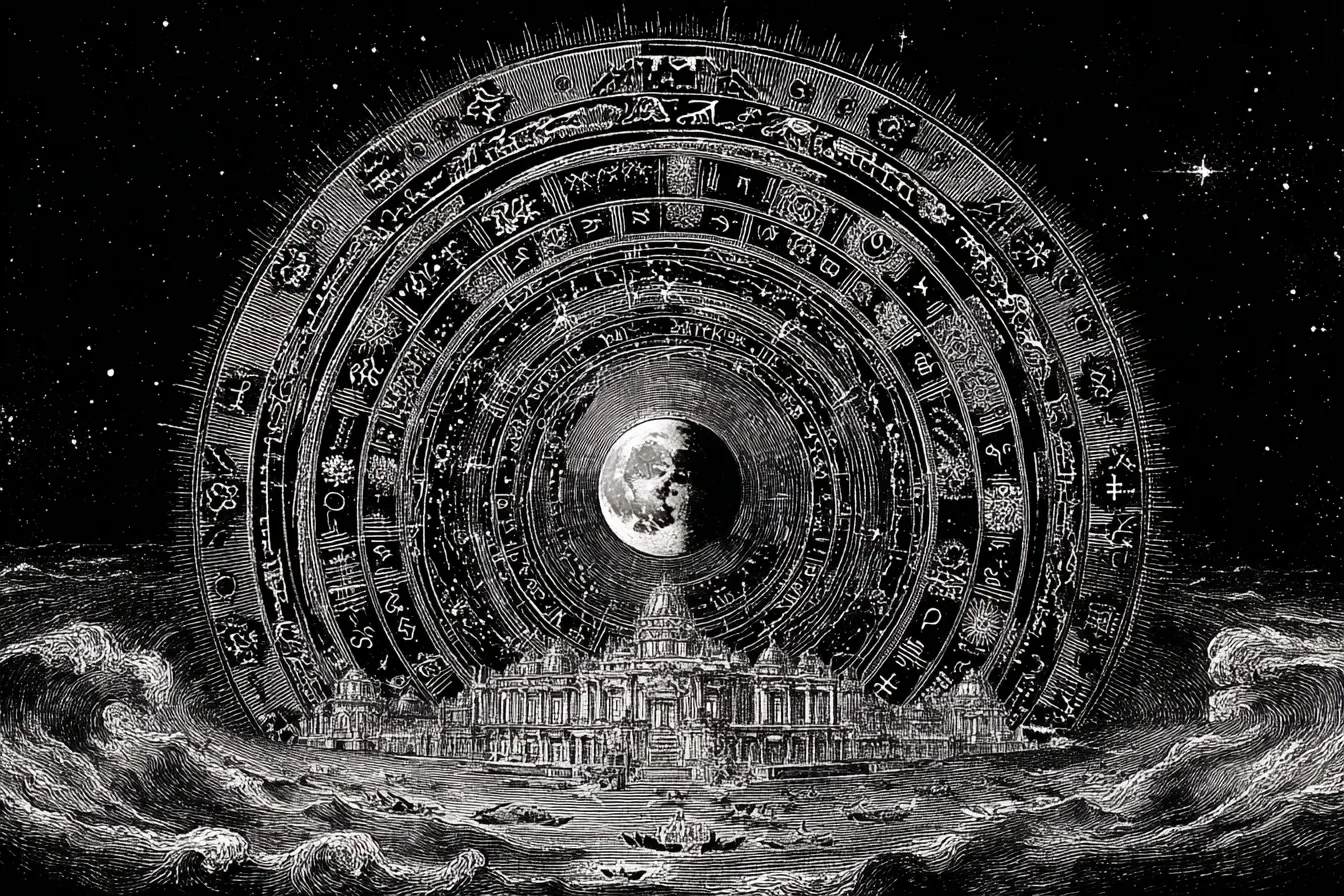
Magha’s primary symbol is the royal chamber or throne room — sometimes also a palanquin, the ceremonial carriage borne by attendants for royalty. The throne room is not simply where authority is exercised; it is where authority is inherited, where the continuity between past rulers and present ones is made visible and formal. The throne does not belong to the person sitting in it; it belongs to the lineage, and the person sits in it as a holder of that lineage.
The ruling deities are the Pitrs — the ancestors, the honored dead of the Vedic tradition. The Pitrs are not abstract or merely symbolic; in the Vedic understanding, the ancestors are genuinely present in the world, connected to their descendants through lines of karma and relationship that are real and active. Honoring the Pitrs is one of the three great duties (along with honoring the gods and honoring teachers) in the tradition. Magha is specifically associated with this ancestral connection — the quality of carrying what has been handed down and being responsible for what is handed forward.
The ruling planet is Ketu — and the combination of Leo, the Pitrs, and Ketu is philosophically interesting. Leo is the sign of the individual self in its full expression; Ketu is associated with the dissolution of individual boundaries and the connection to what is beyond the individual. The ancestors are both personal (my lineage) and beyond-personal (the collective lineage of humanity). Magha holds this paradox: the most personal authority (the individual on the throne) carrying the most impersonal inheritance (the weight of all who sat there before).
The nature and qualities of Magha
Jyotish classifies Magha as Ugra (fierce, sharp) in quality and its gana as Rakshasa — the intense, independent category. Both suggest that Magha’s authority is genuine and does not bend easily to social pressure or to the expectations of those who would prefer something less demanding. The tradition takes Magha’s royal quality seriously.
What the tradition most consistently associates with Magha is natural authority — not the authority that comes from position or title, but the authority that people recognize without being told to. This is the quality of the person who walks into a room and others orient toward them without fully understanding why. The Pitrs’ ancestral connection suggests that this quality is not ego-driven; it comes from something that runs deeper than the individual’s own preferences or ambitions.
Magha is also associated with magnanimity — the quality of the genuinely large-spirited person who can afford to be generous because their sense of their own position is secure. This is related to the throne room image: the person who is genuinely established does not need to diminish others to maintain their place. The generosity that comes from security rather than from scarcity is one of Magha’s most attractive qualities.
The Ketu influence adds a dimension that complicates the royal picture in a productive way. Ketu’s association with release and detachment from the ordinary means that Magha carries its authority with a certain quality of not being entirely attached to it — the king who knows that the throne belongs to the lineage, not to the individual, and who can therefore exercise authority without mistaking it for identity.
Strengths and growth edges
The qualities the tradition associates with Magha include natural, unforced authority, genuine magnanimity that comes from security rather than performance, the capacity to honor what has come before while exercising genuine leadership in the present, pride in the best sense — the quality of holding oneself well because one knows one’s own worth — and the leadership that carries others rather than merely directing them.
The growth edges follow directly. The pride that grounds Magha can shade into arrogance — the genuine quality of authority hardening into the assumption that one’s position is unquestionable and one’s judgment infallible. The weight of lineage that gives Magha its depth can become the weight that prevents innovation — the inheritance that is carried rather than transformed, the patterns of what was done before replacing genuine engagement with what is actually required now.
Ketu’s influence adds its own complexity: the detachment from the ordinary can produce the person who has authority but cannot fully engage with it — who sits in the throne room but is already mentally in the realm beyond form. This is an unusual growth edge that requires a particular kind of attention: the fully present engagement with the role and its responsibilities, without pretending that the role is the whole person.
Traditional Jyotish also notes Magha’s connection to ancestral patterns that need to be both honored and released — the distinction between carrying what is genuinely valuable from the lineage and being determined by patterns that the lineage has not yet worked through.
What Magha means in The Whisper
The Whisper draws on Magha’s cross-system resonances when synthesizing the daily message.
Western Astrology: Magha occupies the opening degrees of Leo in the sidereal zodiac. The Western tradition’s Leo is the Sun’s sign — the place of full, generous, self-expressive authority, the sign most associated with the creative principle operating in the world through individual expression. Ketu’s influence on Magha gives this Leo beginning an unusual depth of connection to the past and the ancestral that the sign alone does not always carry. On days when the Sun or Leo features strongly in the Western transits, Magha’s quality of established, lineage-connected authority may be particularly active.
Nine Star Ki: The resonance here is with the Six White Metal Star (六白金星) — the star of the father archetype, high principle, and the authority of heaven. Six White Metal carries authority that comes from genuine alignment with what is right rather than from force or performance — this resonates with Magha’s quality of the inherited, legitimate authority that is recognized rather than asserted.
BaZi: The resonance is with Geng Metal (庚金) — the strong, proud, authoritative yang metal that holds its position and does not yield what it holds without reason. Geng Metal carries the quality of natural authority in the BaZi system: the metal that is both hard and bright, whose strength is visible and whose position is not easily shifted.
Frequently asked questions
Q: What is the significance of the ancestors (Pitrs) as ruling deities?
The Pitrs are a genuinely unusual choice for a ruling deity in the nakshatra system, and their selection for Magha is philosophically deliberate. In the Vedic tradition, the ancestors are not simply the dead; they are the living inheritance — the patterns, qualities, and karma that pass through generations rather than ending with the individual. Magha’s association with the Pitrs means it specifically describes the person who carries something forward from what has come before — not as burden, but as continuity. The tradition invites honoring this connection through the Pitri Paksha, a period each year specifically dedicated to acknowledging ancestral inheritance.
Q: Does Magha Nakshatra always produce leaders?
Not in the conventional sense. The authority and leadership quality associated with Magha expresses differently in different lives: sometimes as formal leadership, sometimes as the quiet authority of the person who is simply recognized as the one to listen to in a given domain, sometimes as the artist or craftsperson whose work carries a quality of genuine mastery. The thread is the quality of authority that comes from genuine connection — to lineage, to depth, to what has been genuinely earned — rather than from title or position.
Q: How does The Whisper use Magha in a daily reading?
When the Moon transits Magha — approximately once every 27 days — The Whisper draws on the quality of established authority, ancestral connection, and the question of what is being honored and carried forward versus what is ready to be released. The day may carry a quality of genuine presence and authority, or may surface a reflection on inheritance — what has been handed down, what needs to be transformed before it is passed on, and what in the present moment calls for the magnanimity that comes from genuine security.