
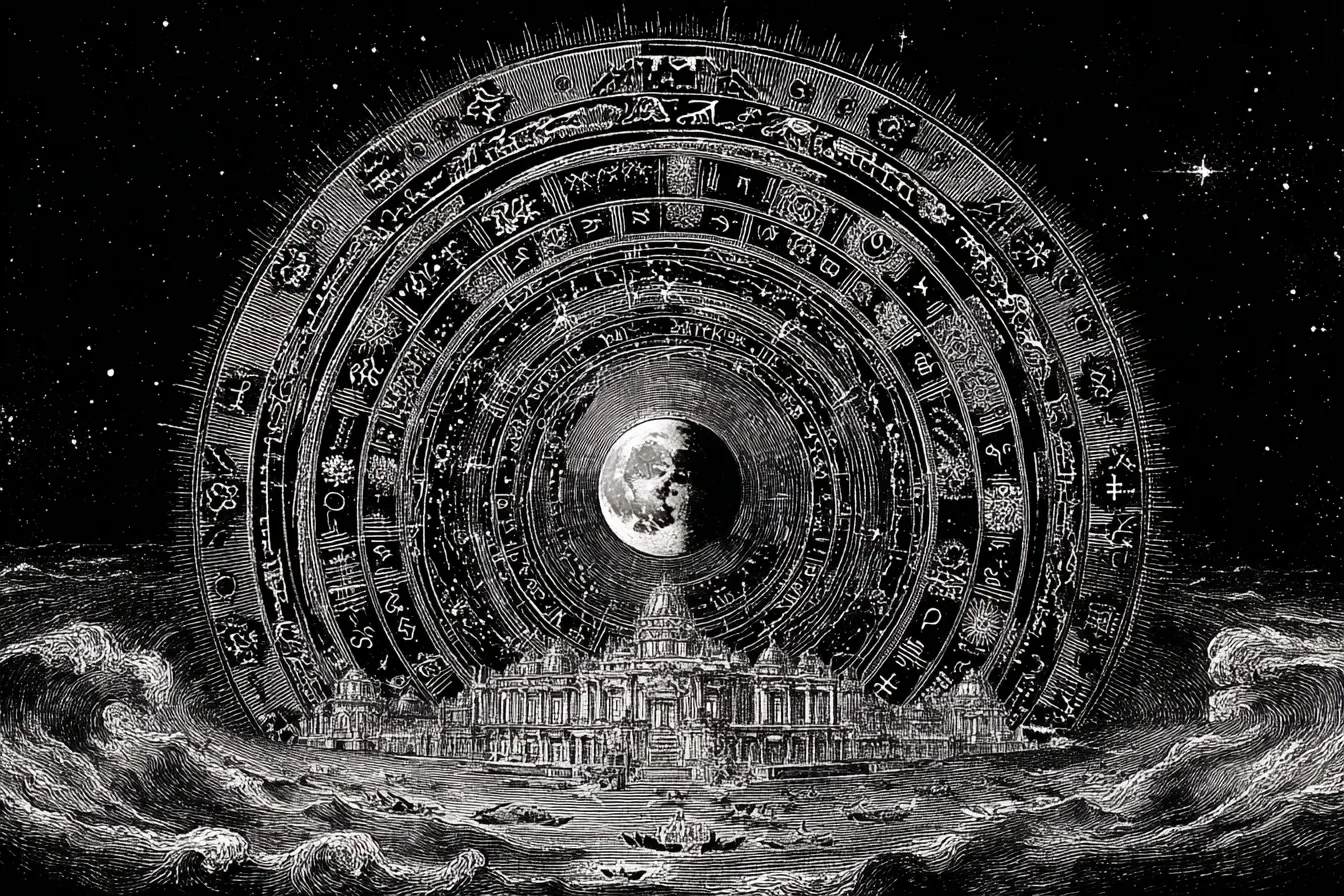
What is Ashlesha Nakshatra?
Ashlesha is the ninth and final nakshatra of the first arc of the zodiac — spanning from 16°40’ to 30°00’ of Cancer, it closes out the Cancer portion before the zodiac moves into Leo. This positioning is meaningful. Ashlesha sits at the end of the Moon’s own sign, and there is something of “the end of one world before the next begins” in its quality. It carries Cancer’s emotional depth but with an intensity and a penetrating quality that is quite different from the more openly nourishing nakshatras that precede it in Cancer.
The name Ashlesha means “clinging” or “entwining” — and this name is taken seriously by the tradition. The image of the coiled serpent says something precise: the coiling can be protection, the way a snake curls around what it wishes to keep safe. It can also be constriction. The same motion, the same quality, different outcomes depending on what is being held and with what intention.
In The Whisper, your birth nakshatra is determined by the Moon’s position at birth. If the Moon was in Ashlesha when you were born, you carry a quality of emotional intelligence and instinctive response that is characteristically deep, perceptive, and not always visible on the surface — the serpent who moves quietly rather than announcing itself.
A note on accuracy: The Whisper approximates birth nakshatra from date alone when birth time is unavailable. For births near the Pushya–Ashlesha or the Ashlesha–Magha boundary, birth time will meaningfully improve the calculation.
The daily nakshatra — the Moon’s current position — shifts approximately each day and contributes its quality to The Whisper’s daily synthesis alongside the other active systems.
Symbol and ruling deity
Ashlesha’s symbol is the coiled serpent — the snake at rest, curled into its characteristic circle. The coiled serpent is one of the most symbolically dense images across world mythologies: it appears in the caduceus of Hermes (the staff of the messenger and healer), in the kundalini of yogic tradition, in the ouroboros of alchemical imagery. Coiled, the serpent is potential energy — not yet moving, but fully capable of movement in any direction.
The ruling deities are the Nagas — the serpent deities of the Vedic tradition, associated with ancient, instinctive wisdom, with the depths of the earth and the waters, with healing and with venom. The Nagas are not simple figures; they are genuinely ambivalent in the mythological tradition — deeply respected, sometimes feared, capable of both great gifts and great harm. This complexity is part of Ashlesha’s quality: the ancient wisdom that has not been domesticated into something safe and predictable.
The ruling planet is Mercury — and Mercury here is not the light, quick, socially charming Mercury of some other placements. Mercury in this context is the Mercury of the analyst, the Mercury that takes the intelligence of the Nagas’ instinctive depth and gives it language, categorization, and perceptive precision. The combination produces what the tradition describes as a peculiarly sharp psychological perception — the capacity to see through structures and agendas, to understand what is motivating behavior from the inside rather than only observing it from the outside.
The nature and qualities of Ashlesha
Jyotish classifies Ashlesha as Tikshna (sharp, dreadful) in quality and its gana as Rakshasa (fierce in quality rather than malevolent). Both classifications point toward the same thing: Ashlesha is not gentle in its perception. It is the nakshatra of the intelligence that sees what is actually present rather than what is presented, and this quality is irreducibly sharp.
What the tradition most consistently associates with Ashlesha is a particular combination: psychological depth and perceptive acuity that operates below the surface. This is the intelligence that understands what is motivating people — including motivations that the people themselves may not have explicitly articulated. Ashlesha perceives the subtext. Mercury’s analytical mind operating through the Nagas’ ancient instinctive depth produces something that is both intellectually precise and intuitively grounded.
This combination tends to appear in several characteristic ways. Ashlesha people often have an unusual capacity to read people and situations accurately — not through cold analysis but through a kind of instinctive knowing that can feel like being seen from the inside. They often have a quality of working in the depths rather than on the surface of whatever domain they inhabit: the therapist who hears what is not said, the writer who captures the subterranean currents of a situation, the strategist who understands what is actually driving the apparent conflict.
The Cancer context adds the emotional dimension: this depth of perception is not cold. It is emotionally engaged with what it perceives, which is both a strength and a source of the nakshatra’s more difficult qualities.
Strengths and growth edges
The qualities the Jyotish tradition associates with Ashlesha include profound perceptive intelligence, the capacity to see through surfaces and agendas, genuine psychological depth that makes for real — if sometimes difficult — wisdom, intensity of purpose when engaged with what genuinely matters, and the ancient wisdom that the Naga association describes: not the wisdom of textbooks, but of instinctive depth that has been tested.
The growth edges are closely shadowed versions of the same qualities. The perception that sees through surfaces can become a watchfulness that prevents genuine trust — the serpent who is always coiled, always ready, never fully at rest. Mercury’s analytical quality combined with the Nagas’ instinct can produce a tendency toward knowing others’ motivations while keeping one’s own carefully private — a kind of asymmetry that serves self-protection but can prevent genuine mutuality.
The coiling that protects can become the constricting hold — the attachment to people, situations, or perceptions that has moved from protective into something that prevents the other from moving freely. Ashlesha’s growth edge is often precisely this: learning to release what the serpent quality would hold.
Traditional Jyotish also notes that the sharp perceptive quality can, when not carefully held, become manipulation — not necessarily conscious or malicious, but the application of the knowledge of what moves people to produce desired outcomes rather than to serve genuine understanding.
What Ashlesha means in The Whisper
The Whisper draws on Ashlesha’s cross-system resonances when synthesizing the daily message.
Western Astrology: Ashlesha occupies the final degrees of Cancer in the sidereal zodiac. The Western tradition’s Cancer is the Moon’s sign — emotional, receptive, instinctively oriented toward home and belonging. Ashlesha adds Mercury’s analytical intelligence and the Nagas’ depth to this emotional base, producing a quality that is emotionally engaged but analytically sharp rather than purely receptive. On days when Mercury or Cancer features prominently in the Western transits, or when the transit is in late Cancer degrees, Ashlesha’s perceptive quality may be particularly active in the synthesis.
Nine Star Ki: The resonance here is with the One White Water Star (一白水星) — the hidden current quality, the depth that is not visible on the surface but sustains what is above from below. One White Water and Ashlesha share the characteristic of depth that does not announce itself: the underground current that is known only by its effects, the perception that works quietly rather than visibly.
BaZi: The resonance is with Gui Water (癸水) with Metal influence — the fine, pervasive water that finds the cracks, flowing into the smallest openings silently and working its effect from within. Gui Water with Metal has a particular quality of precision and persistence: it finds where the structure is not fully closed and enters there. This captures something about Ashlesha’s Mercury-Naga combination: the analytical intelligence that does not force its way but finds the opening that was already there.
Frequently asked questions
Q: Is Ashlesha considered inauspicious in Jyotish?
Ashlesha has a complex reputation in the tradition. Some classical texts are cautious about it for certain kinds of undertakings — specifically those requiring simple, open goodwill. But the nakshatra’s reputation is often overstated in popular presentations. What Ashlesha actually describes is a depth of intelligence and perception that is powerful but requires care. The Whisper uses this quality as information about how the day’s energy is textured, not as a warning against action.
Q: What is the connection between Ashlesha and healing?
The Naga deities are associated in the Vedic tradition not only with depth and instinctive power but with healing — specifically the kind of healing that works with venom (the snake’s own nature) as medicine. This is homeopathic reasoning in its ancient form: what can harm in excess can heal in careful application. Ashlesha’s association with deep perception makes its potential healing quality specific: the capacity to see what is actually causing the pattern, not just the surface symptom.
Q: How does The Whisper use Ashlesha in a daily reading?
When the Moon transits Ashlesha — approximately once each 27-day cycle — The Whisper draws on the quality of depth perception, the intelligence that operates beneath the surface, and the question of what is being held and with what quality of grasp. The day may carry an invitation to perceive something that has not been clearly seen, or may surface a question about what is being held too tightly. As always, The Whisper synthesizes this with the other active systems rather than using the nakshatra in isolation.