
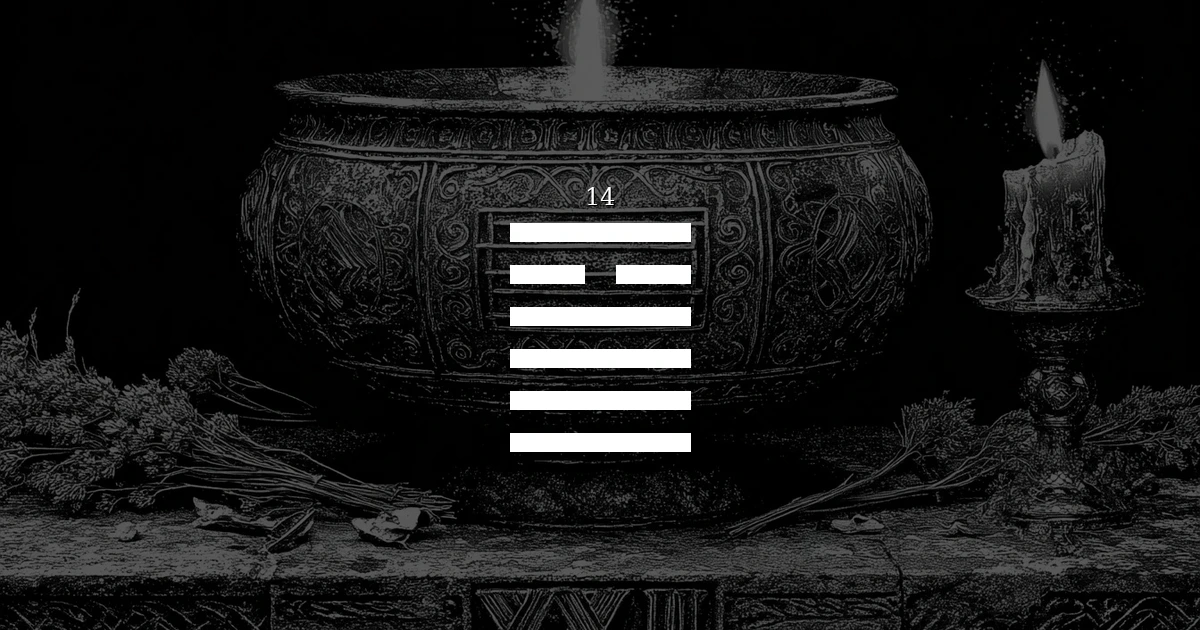
What is Hexagram 9, Small Taming?
Hexagram 9 of the I Ching is 小畜 (Xiǎo Xù), translated as Small Taming or The Taming Power of the Small. Its structure places Wind (☴) above Heaven (☰): the gentle, penetrating quality of wind working on the immense creative force of heaven. The taming is small not because it is weak but because it works through accumulation of small correct acts rather than through the application of equal and opposing force. Wind does not stop heaven; it redirects it gradually.
The I Ching is one of the oldest continuously consulted texts in human history, with origins in Zhou dynasty China approximately three thousand years ago. The Wilhelm/Baynes translation (1923/1950) is the primary Western reference, though original meanings continue to be debated by scholars. The Whisper engages with this tradition as a lens for self-reflection rather than a predictive system.
In The Whisper, your daily hexagram is determined by a hash of your birth date and today’s date — a deterministic draw framed as fated rather than random. When Hexagram 9 appears, the system is pointing toward the quality of patient accumulation and gentle restraint in your current situation.
The two trigrams: Wind above Heaven
The trigram Xun (Wind) above the trigram Qian (Heaven) creates an image that requires some reflection: wind above heaven. In terms of natural force, heaven is incomparably more powerful. The wind cannot simply stop or overpower heaven’s creative strength. What it can do is work consistently, in the same direction, accumulating small deflections into a gradual overall change.
Qian, in its lower position here, carries the quality of great creative power — the impulse toward strong, continuous, forward movement. Xun above carries the quality of gentle persistence and penetration. The hexagram’s dynamic is not one of equal opposition but of different registers: a small, consistent taming influence working on a much larger energy, gradually shaping its expression without confronting it directly.
The traditional image associated with this hexagram is dense clouds but no rain yet. The conditions are forming; the gathering is real; but the result is not yet visible in the outer world. This image points toward one of the hexagram’s most practically useful teachings: there are periods when the work is genuinely proceeding, the accumulation is genuinely happening, but the outward result is not yet present. These periods require patience and trust in the process rather than escalation of effort.
The core teaching of Small Taming
The central teaching of Hexagram 9 is that gentle, consistent accumulation of small correct acts can redirect and shape even very large forces — but that this work requires patience, because the results appear as clouds before they appear as rain. The taming is small; the force being tamed is not. The disproportion is the point: the way that wind shapes heaven is fundamentally different from the way that any force comparable to heaven would.
This has practical implications for situations in which someone is attempting to work with or redirect a force much larger than themselves: an institution, a cultural pattern, a powerful individual, a deeply ingrained habit. Direct opposition tends to fail or to exhaust the opponent while activating the large force’s defensive responses. The small taming approach — the consistent, gentle, penetrating action that accumulates without confrontation — often achieves what direct opposition cannot.
The hexagram also addresses the interior dimension of taming: the work of bringing one’s own large, powerful impulses — strong desires, habitual reactions, the force of long-established patterns — under the gentler guidance of considered judgment. This is not suppression; it is the wind working on heaven from the inside. The small correct actions that gradually redirect what would otherwise be undirected creative force. The formation of genuine discipline, not through heroic self-overcoming, but through the patient accumulation of small consistent choices.
The shadow of Hexagram 9 is the impatience that forces — that cannot trust the process of accumulation and tries to get the rain before the clouds are ready. Dense clouds but no rain yet is an accurate description of many genuine processes of accumulation, and the frustration of that state can produce the attempt to escalate into direct confrontation or forced result, which is precisely what the hexagram’s structural teaching says will not work with this particular type of situation.
How Small Taming appears in daily life
The pattern of Hexagram 9 in daily life is recognizable in the experience of working consistently on something whose results are not yet visible — the practice that is building capacity before the capacity expresses itself in performance; the relationship that is developing trust before that trust is relied upon; the project in its preparation phase, where all the work is creating conditions that will only become visible later.
The hexagram consistently points toward trust in the genuineness of the accumulation. The dense clouds are real; they are not nothing. The fact that rain has not yet fallen does not mean the work has not been proceeding. This is the specific consolation the hexagram offers to people in periods of genuine invisible progress: the accumulation is real even when the result is not yet visible.
Practically, the counsel that often emerges from Hexagram 9 is to continue the small correct acts — not to escalate, not to force, not to substitute dramatic gesture for consistent small action. The small taming that works is the one that does not abandon its patience when the clouds are dense but the rain is not yet coming. The wind that has found its direction continues in that direction; that is how it eventually shapes even the most powerful creative force.
What Small Taming means in The Whisper
In The Whisper’s synthesis, Hexagram 9 resonates most directly with the Four Green Wood Star (四緑木星) in Nine Star Ki — the yin wood star of wind, gentle penetration, and the communication that reaches distant places through consistent patient presence. When both systems point toward this quality, The Whisper may draw attention to where the current situation calls for patient accumulation rather than escalation.
In BaZi, the resonance appears in configurations where Yi Wood (乙木) is the Day Master — the vine element that bends and wraps and accumulates its way upward rather than growing straight through what blocks it. The quality of patient, flexible persistence that achieves what rigid direct force cannot.
From Western Astrology, Hexagram 9 carries qualities associated with Gemini’s Mercury — the gathering of information and perspective before the decisive communication; the accumulation of connections that become a network; the preparatory phase of Mercury transits before the aspect becomes exact and the result becomes visible.
Frequently asked questions
Q: Does “small taming” mean I should not act boldly or take strong action? The hexagram is not a general counsel against bold action — it is specific to situations in which the force being worked with or redirected is much larger than what direct confrontation could address. In those specific situations, the small consistent approach works where direct force does not. The hexagram identifies a particular type of situation and points toward the appropriate approach for that type; other situations call for other hexagrams.
Q: What are the “small correct acts” the hexagram refers to? The specific content of what constitutes correct action depends on the situation, but the hexagram points toward the quality of the acts rather than their size. Small and correct means genuinely appropriate to the situation — not the dramatic gesture, not the escalated response, but the action that is genuinely fitting, consistently applied. Over time, the accumulation of fitting small actions produces the directional change that drama cannot.
Q: How long does the cloud-without-rain phase typically last? The hexagram does not provide a timeline, and different processes of accumulation have different natural durations. What the hexagram offers is the recognition that dense clouds without rain is a real and meaningful phase rather than a sign that nothing is happening. The practical test is whether the small correct acts are genuinely continuing: if they are, the process is proceeding even when the result is not yet visible. The clouds are accumulating; the rain will come when the clouds are ready.